Review: AI-Driven Cancer Nanotherapy Using Intelligent Nanoplatforms
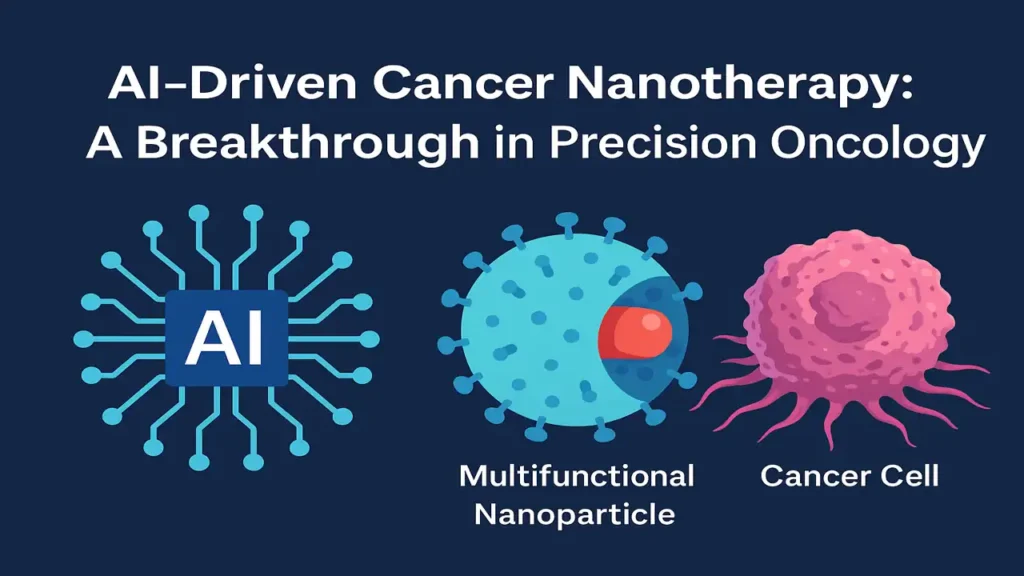
AI-Driven Cancer Nanotherapy
Review of Deng et al. (2025): Discover how AI-driven nanoplatforms are revolutionizing precision cancer therapy through adaptive, intelligent nanomedicine.
Introduction: The Rise of Intelligent Nanomedicine
In the ever-evolving battle against cancer, the fusion of artificial intelligence (AI) and nanotechnology is reshaping how we perceive diagnosis and treatment. A recent landmark paper by Deng, Liu, and Zhao (2025) titled “Multifunctional nanoplatforms for tumor microenvironment remodeling”, published in Materials Today Bio, presents a compelling vision of AI-guided nanoplatforms as precision tools for tumor microenvironment (TME) remodeling.
This innovation marks a new era of smart therapeutic ecosystems, where AI algorithms tailor cancer treatments in real-time, increasing efficiency and minimizing toxicity.
What Is AI-Driven Cancer Nanotherapy?
AI-driven cancer nanotherapy refers to the use of artificial intelligence models to design, optimize, and control nanomaterials for targeted drug delivery, diagnostics, and therapy at the cellular or molecular level. Deng et al. push this further by proposing “self-adaptive nanoplatforms” that respond dynamically to the tumor environment.
The AI Boom: Innovation or Just Another Bubble?
Key Innovations:
- Multifunctional nanocarriers that adapt based on real-time TME signals.
- AI-optimized delivery systems for drug targeting.
- Intelligent biosensing for feedback control.
- Remodeling of TME to enhance immune response and reduce resistance.
What Makes This Research Unique?
Deng and colleagues do more than apply AI to oncology they engineer a closed-loop therapeutic ecosystem that learns and adapts. Unlike traditional nanocarriers that passively deliver drugs, their system:
Actively senses TME biomarkers
Uses AI to predict tumor behavior
Adjusts therapy dosage and type in real time
Targets both tumor cells and stromal components
This adaptive architecture could solve persistent problems in cancer treatment like heterogeneity, metastasis, and drug resistance.
Top AI Research Breakthroughs in 2025 You Need to Know About
Applications & Future Implications
This paper paves the way for:
- Personalized cancer treatments based on patient-specific data.
- AI-powered nanodevices capable of decision-making inside the body.
- Remote-controlled precision therapy through cloud-connected medical AI.
- Enhanced synergy with immunotherapies and gene editing tools (e.g., CRISPR).
As this field matures, we may soon see:
- Clinical trials for AI-guided nanodrugs
- Smart injectable “theranostic” agents
- Cross-platform integration with wearables and biosensors
Final Thoughts: Why It Matters
The fusion of AI with nanomedicine isn’t just an upgrade it’s a paradigm shift in how we fight cancer. This paper by Deng et al. is a must-read for researchers, clinicians, and biotech innovators. It highlights a bold direction where cancer therapy becomes personalized, adaptive, and intelligent making “treatment as dynamic as the disease itself.”