Defining Climate and the Climate System: Understanding Earth’s Balance
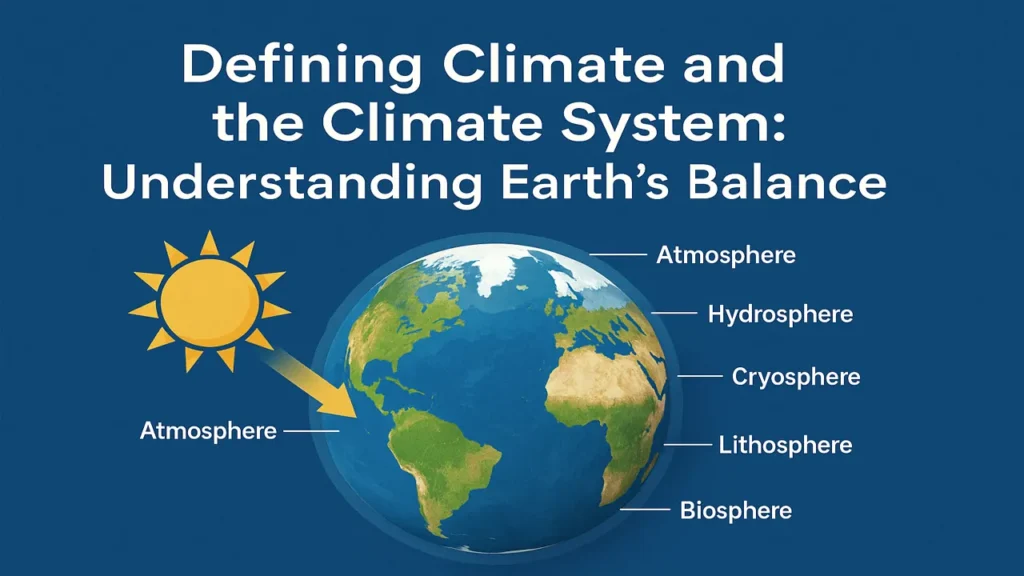
Climate System
Learn how Earth’s climate is defined, discover its five major components, and understand how energy, matter, and life interact to maintain our planet’s delicate balance.
What Is Climate?
Climate is not just the weather you see each day it is the average condition of the atmosphere measured over long periods, typically 30 years or more.
It describes patterns in temperature, humidity, rainfall, and wind that define the environmental character of a region.
For example, Karachi and London both experience rain, but their climates differ because one has tropical heat while the other has temperate chill. These long-term patterns shape everything from agriculture to architecture to lifestyle.
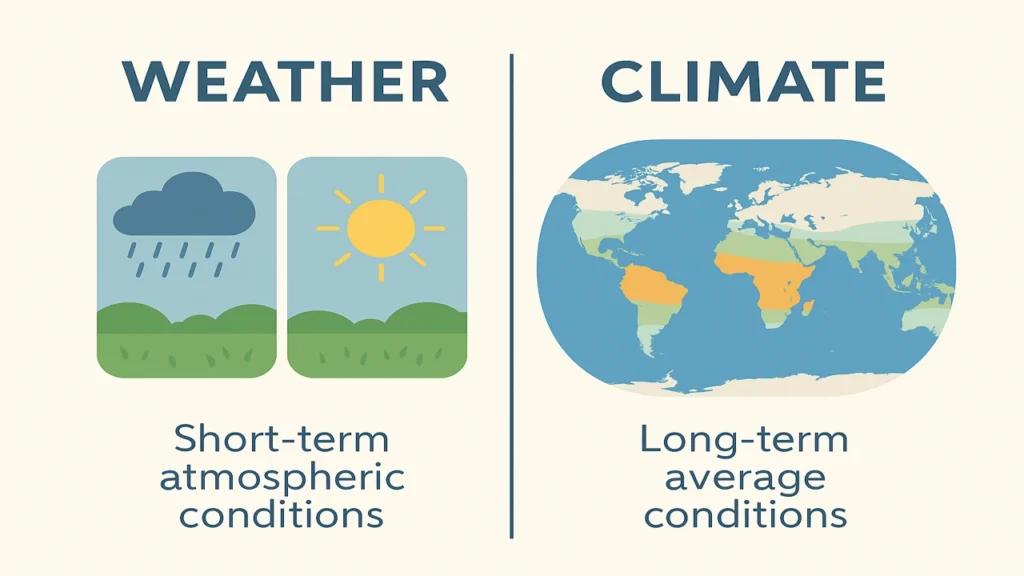
Difference between Weather and Climate
Weather = short-term atmospheric changes (hours → days).
Climate = long-term patterns (decades → centuries).
For More. Review: AI-Driven Cancer Nanotherapy Using Intelligent Nanoplatforms
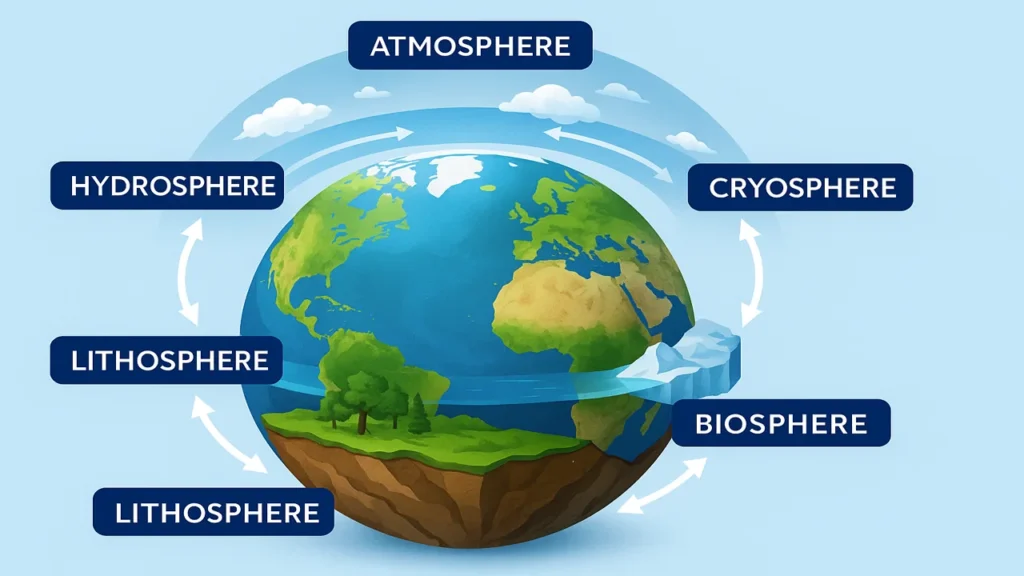
The Climate System Earth’s Five Interconnected Spheres
Earth’s climate doesn’t work in isolation. It is a complex, self-regulating system made up of five interdependent parts:
Atmosphere
The gaseous envelope surrounding Earth. It acts as a shield and blanket, absorbing solar radiation, trapping heat, and circulating air currents.
- Contains greenhouse gases like CO₂ and methane.
- Distributes heat globally via jet streams and trade winds.
Hydrosphere
Covers all liquid water: oceans, lakes, rivers, groundwater.
- Oceans absorb 90% of excess heat from global warming.
- Evaporation drives cloud formation and rainfall patterns.
Cryosphere
Includes frozen regions – ice sheets, glaciers, snow cover, and permafrost.
- Reflects sunlight (high albedo).
- Its melting raises sea levels and disrupts ocean currents.
Lithosphere
Earth’s crust and upper mantle.
- Volcanoes release gases influencing atmospheric chemistry.
- Landforms affect wind flow and precipitation patterns.
Biosphere
All living organisms – plants, animals, and humans.
- Forests absorb CO₂ and release oxygen.
- Human activities (deforestation, farming, industry) alter carbon and nitrogen cycles.
These spheres are interlinked. A change in one (e.g., warming oceans) can trigger a chain reaction across others.
For More. Punjab Launches EcoBot: AI Chatbot for Real-Time Air Quality in Punjab
Interactions within the Climate System
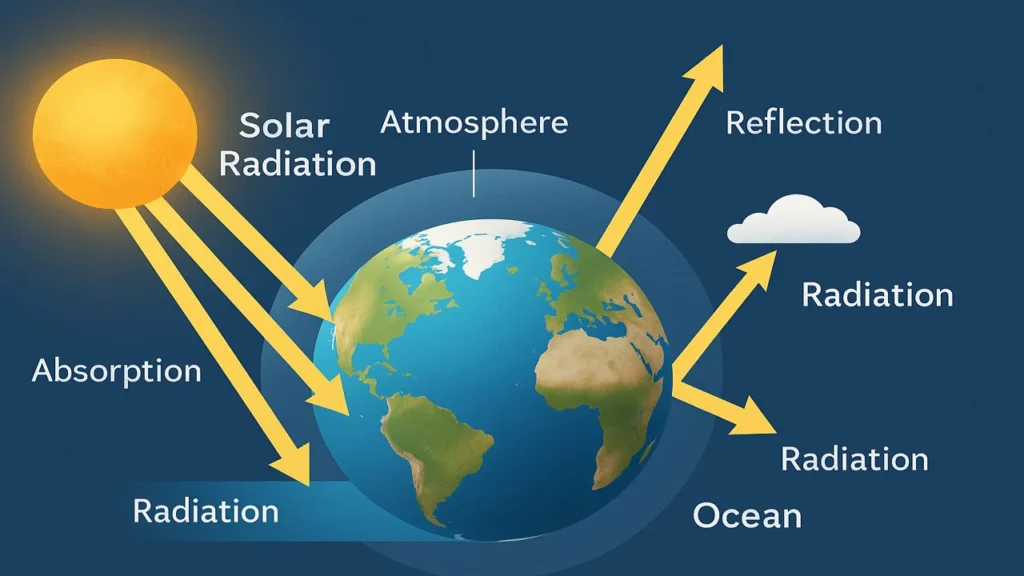
The climate system functions through energy and matter exchange among its spheres.
- Solar Energy Input: Sunlight warms land and oceans, driving atmospheric motion.
- Ocean-Atmosphere Exchange: Oceans store and release heat, influencing monsoons and El Niño events.
- Carbon Cycle: Plants absorb CO₂ during photosynthesis, while oceans act as carbon sinks.
- Feedback Loops: Melting ice reduces reflectivity → more heat absorbed → more melting.
Understanding these interactions helps scientists build climate models to predict future scenarios and assess the effects of greenhouse gases.
Climate Zones and Global Patterns
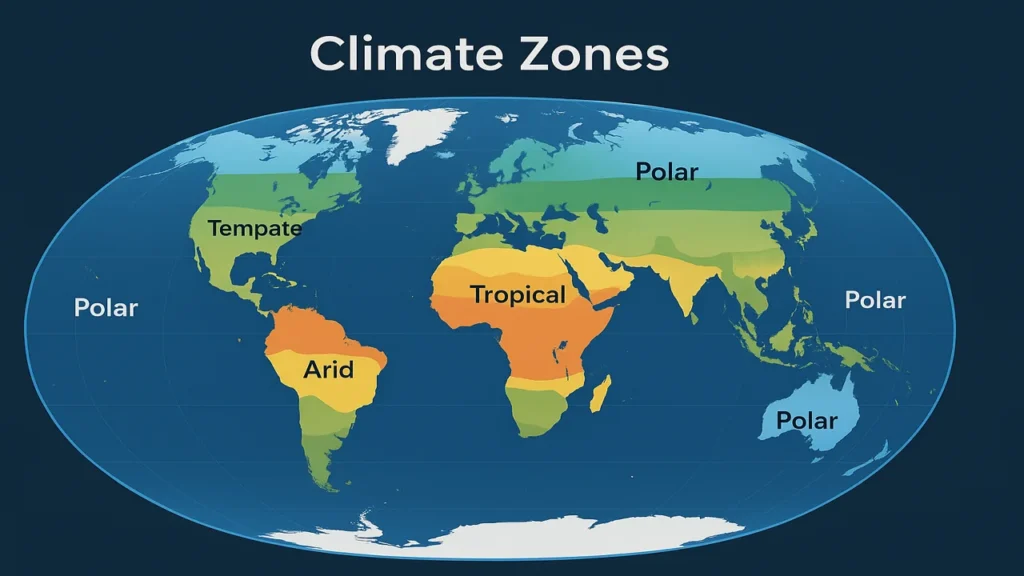
The Sun’s uneven heating creates climate zones:
- Tropical: Hot and humid (near equator).
- Dry (Arid): Low rainfall, high temperature (deserts).
- Temperate: Moderate weather (middle latitudes).
- Polar: Extremely cold (high latitudes).
These zones influence vegetation, wildlife, and human settlement. Mountains, ocean currents, and wind belts further diversify local climates such as coastal vs inland differences.
Why Understanding the Climate System Matters
Climate shapes economies, agriculture, and health. Knowing its mechanisms helps us:
- Predict and adapt to climate change.
- Develop renewable energy strategies.
- Create disaster preparedness plans.
- Protect ecosystems and water resources.
Education is the first step toward climate action, and Week 1 forms the foundation for advanced learninglike radiation, energy budget, and policy impacts in the coming weeks.