What is composition in object-oriented programming?
Lecture 12 – Composition and Aggregation
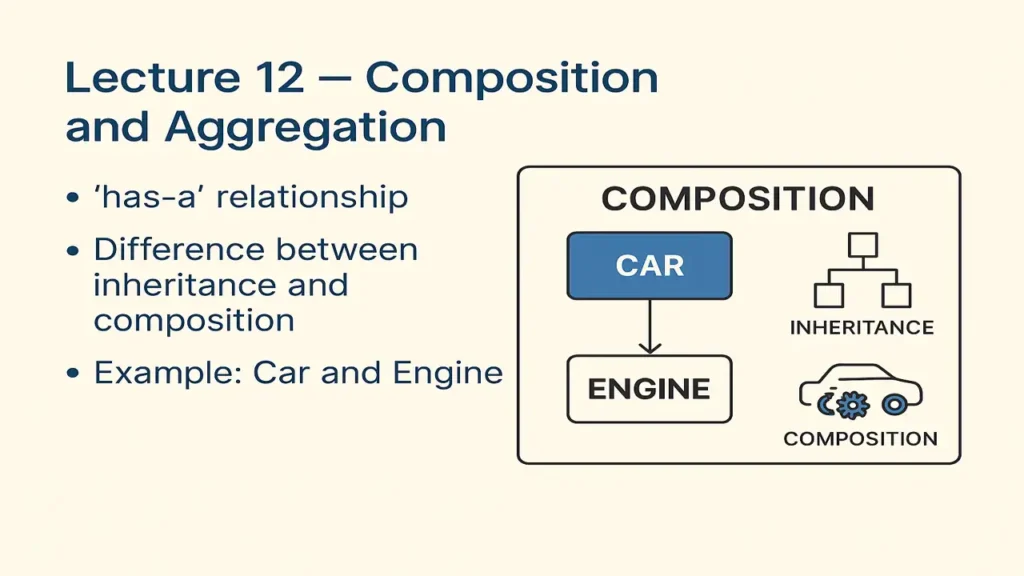
Understand Composition and Aggregation in Object-Oriented Programming. Learn the “has-a” relationship, difference between inheritance and composition, and explore real-world examples like Car and Engine in C++ and Java.
Introduction
So far, we’ve learned about Inheritance (the is-a relationship) where a class derives properties from another.
But sometimes, an object doesn’t inherit another; it simply uses another.
That’s where Composition and Aggregation come in.
Definition:
Composition and Aggregation represent a “has-a” relationship between two classes one class contains or owns another class’s object.
The “has-a” Relationship
In Object-Oriented Programming, a “has-a” relationship means one class contains another as a member object.
Examples in real life:
- A Car has an Engine
- A Library has many Books
- A Department has Employees*
Here is our recent lecture, you can revise it and do focus if you skipped it:
Lecture# 11: Abstract Class and Interface.
Composition (Strong Relationship)
In Composition, one class cannot exist without the other.
If the container object is destroyed, the contained object also dies.
Example:
If a Car is destroyed, its Engine is also destroyed.
Example (C++ – Composition):
#include <iostream>
using namespace std;

class Engine {
public:
    void start() {
        cout << "Engine started." << endl;
    }
};

class Car {
private:
    Engine engine;  // Composition (Car owns Engine)
public:
    void startCar() {
        engine.start();
        cout << "Car is running." << endl;
    }
};

int main() {
    Car myCar;
    myCar.startCar();
}
Explanation:
Carhas anEngine.- The
Engineobject is created automatically insideCar. - If
Caris destroyed,Engineis also destroyed.
Example (Java – Composition):
class Engine {
    void start() {
        System.out.println("Engine started.");
    }
}

class Car {
    private Engine engine = new Engine(); // Composition

    void startCar() {
        engine.start();
        System.out.println("Car is running.");
    }
}

public class Main {
    public static void main(String[] args) {
        Car c = new Car();
        c.startCar();
    }
}
The Engine belongs entirely to the Car this is Composition.
Aggregation (Weak Relationship)
In Aggregation, one class uses another class, but both can exist independently.
Example:
A Department has Teachers, but if the department closes, the teachers still exist.
Example (C++ – Aggregation):
#include <iostream>
using namespace std;

class Teacher {
public:
    string name;
    Teacher(string n) : name(n) {}
};

class Department {
private:
    Teacher* teacher; // Aggregation (Pointer reference)
public:
    Department(Teacher* t) : teacher(t) {}
    void showTeacher() {
        cout << "Teacher: " << teacher->name << endl;
    }
};

int main() {
    Teacher t1("Mr. Ali");
    Department d(&t1);
    d.showTeacher();
}
Explanation:
- The
Teacherexists outside ofDepartment. - If
Departmentis destroyed,Teacherstill exists weak relationship.
Example (Java – Aggregation):
class Teacher {
    String name;
    Teacher(String name) {
        this.name = name;
    }
}

class Department {
    Teacher teacher; // Aggregation
    Department(Teacher teacher) {
        this.teacher = teacher;
    }

    void showTeacher() {
        System.out.println("Teacher: " + teacher.name);
    }
}

public class Main {
    public static void main(String[] args) {
        Teacher t = new Teacher("Mr. Ali");
        Department d = new Department(t);
        d.showTeacher();
    }
}
The Teacher is passed as a reference Department doesn’t own it fully.
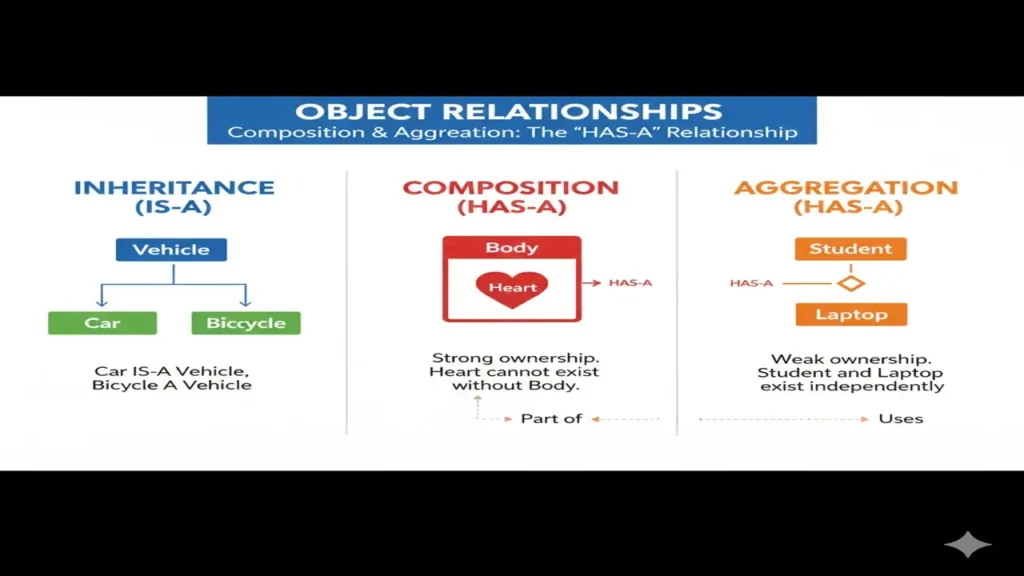
Difference Between Inheritance and Composition
| Feature | Inheritance | Composition |
|---|---|---|
| Relationship | “is-a” | “has-a” |
| Reuse | Inherits properties | Uses existing classes |
| Lifetime | Child depends on parent | Composed object dies with main object |
| Example | Car extends Vehicle | Car has Engine |
| Code Change | Affects subclass | Only affects owning class |
Difference Between Composition and Aggregation
| Feature | Composition | Aggregation |
|---|---|---|
| Ownership | Strong – owned completely | Weak – shared or referenced |
| Lifetime | Dependent | Independent |
| Example | Car and Engine | Department and Teacher |
| Object Creation | Inside the class | Passed from outside |
Your upcoming lecture:
Lecture 13 – Exception Handling
Real-World Analogy
- Composition: A human has a heart. Without the human, the heart cannot function alone.
- Aggregation: A student has a teacher, but both can exist separately.
Summary of Lecture 12
| Concept | Relationship | Example |
|---|---|---|
| Composition | Strong “has-a” | Car → Engine |
| Aggregation | Weak “has-a” | Department → Teacher |
| Inheritance | “is-a” | Dog → Animal |
Positive Thought for Students
“Composition teaches teamwork strong when together, independent when needed. Build your code like relationships: meaningful and balanced.”
People also ask:
Composition is a strong relationship where one class owns another, and the contained object cannot exist without the owner.
Aggregation is a weaker relationship where one class references another, but the referenced object can exist independently of the owner.
Use composition when one object’s lifecycle depends on another, and aggregation when objects can exist separately but still need to interact.