How is Environmental Biology different from Ecology?
Week 1- Environmental Biology Introduction, Scope, Biosphere, Biomes, Ecosystems & Biodiversity
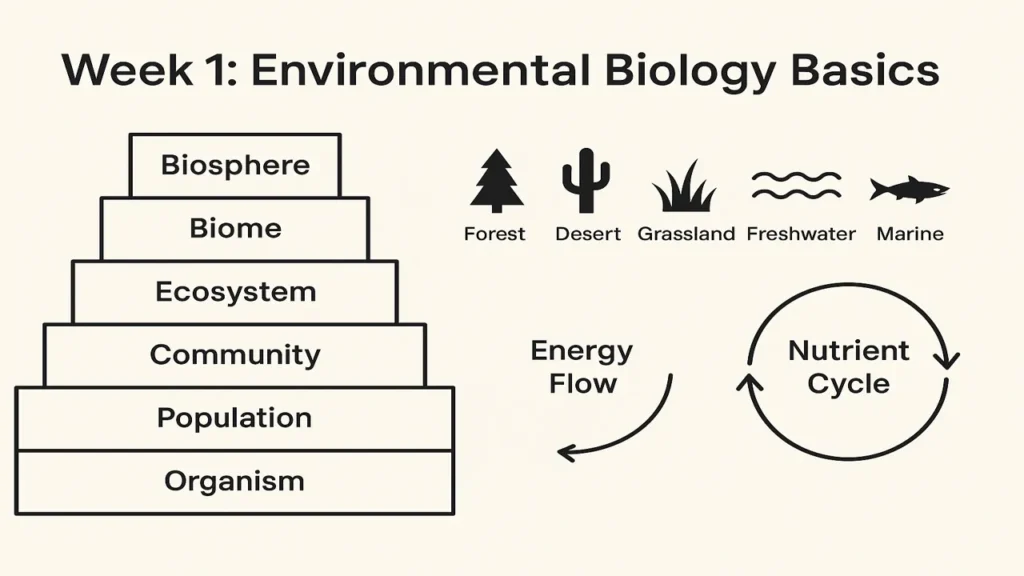
Environmental Biology with clear foundations: definition & scope, biosphere hierarchy, biomes, ecosystem structure & function, and biodiversity with Pakistan examples.
What is Environmental Biology?
Environmental Biology studies how organisms interact with each other and with physical/chemical components of their environment. It integrates ecology, evolution, geology, climatology, toxicology, and conservation biology to understand and solve environmental problems.
Scope (why it matters)
- Understanding change: climate variability, land-use change, invasive species.
- Managing resources: water, soil, forests, fisheries, rangelands.
- Human health: pollution exposure, ecosystem services (clean air/water, crop pollination, disease regulation).
- Policy & sustainability: evidence for EIA, protected areas, restoration, SDGs.
The Biosphere & Levels of Organization
- Biosphere: the global life-support system where life exists—land, water, lower atmosphere.
- Levels (largest → smallest):Biosphere → Biome → Ecosystem → Community → Population → Organism.
- Community: interacting populations (e.g., mangrove trees, crabs, fish, microbes).
- Population: individuals of one species in one area.
- Organism: a single living individual.
Pakistan context: From Himalayan alpine zones to Thar Desert and Indus Delta mangroves, local gradients in temperature, rainfall, and soils shape communities and adaptations.
Biomes (climate-driven life zones)
Biomes are broad ecological regions defined by climate (temperature/precipitation) and vegetation structure.
- Tropical/Subtropical Dry Forests & Thorn Scrub: seasonal drought, acacias; south Pakistan.
- Temperate Coniferous Forests: pines/deodars; Hindukush–Himalaya.
- Grasslands/Steppes (Rangelands): bunchgrasses/shrubs; Balochistan & Potohar.
- Deserts: Thar; xerophytes, CAM plants, nocturnal fauna.
- Freshwater: rivers (Indus), lakes, wetlands; critical for irrigation and migratory birds.
- Marine: Arabian Sea shelf, Indus Delta mangroves (Avicennia), turtle nesting beaches at Hingol/Sonmiani.
Exam tip: name each biome with its climate, dominant plants, adaptations.
Ecosystems: Structure & Function
Structure
- Abiotic: sunlight, water, air, minerals, temperature, pH, salinity.
- Biotic: producers (plants/algae), consumers (herbivores, carnivores, omnivores), decomposers (bacteria/fungi).
Function
- Energy Flow: one-way; Sun → producers → consumers → decomposers. Only ~10% energy passes to next trophic level (10% law).
- Food Chains & Webs: multiple interconnected paths increase stability.
- Nutrient Cycling: matter recycles (C, N, P, S) via biogeochemical cycles; wetlands and soils act as major stores.
- Homeostasis & Feedback: ecosystems self-regulate (e.g., predator–prey dynamics, plant–soil feedbacks) until thresholds are crossed.
Case snapshot: In the Indus River floodplain, seasonal floods deposit silt (nutrients), boost primary productivity, and support fisheries altered by dams/diversions, requiring adaptive management.
Biodiversity: Types, Values, Threats
- Genetic diversity: variation within species; enables adaptation (e.g., drought-tolerant wheat varieties).
- Species diversity: richness and evenness of species (e.g., Markhor, Indus River dolphin).
- Ecosystem diversity: range of ecosystem types across landscapes.
Why it matters
- Provisioning: food, fiber, medicine (e.g., neem, ephedra).
- Regulating: pollination, water purification, pest & disease control.
- Cultural & Recreational: ecotourism, heritage landscapes.
- Insurance value: diverse systems recover faster after drought, floods, or pests.
Major threats (preview of later weeks): habitat loss/fragmentation, over-exploitation, pollution, invasive species, climate change.
Summary
Environmental Biology connects life with its environment from the biosphere down to the organism. Biomes are climate-driven life zones. Ecosystems combine abiotic and biotic parts where energy flows and nutrients cycle. Biodiversity genetic, species, ecosystem underpins ecosystem services and resilience; safeguarding it is central to sustainable development.
The approach followed at E Lectures reflects both academic depth and easy-to-understand explanations.
People also ask:
Ecology is the scientific study of interactions among organisms and their environment; Environmental Biology applies ecological and allied sciences to real-world problems pollution, resources, conservation, policy.
Climate shapes vegetation, and vegetation largely defines the biome; animal communities then adapt to and depend on that vegetation structure.
It explains why food chains are short and why top predators are few energy diminishes at higher trophic levels.
Yes species richness may be lower, but functional and physiological diversity is high, with remarkable drought adaptations.
Protect and restore urban wetlands and riparian buffers; they filter pollutants, reduce floods, and create corridors for wildlife.