Is groundwater always renewable?
Week 2 – Evolution and Extinction; Environmental Resources (Water, Land, Energy)
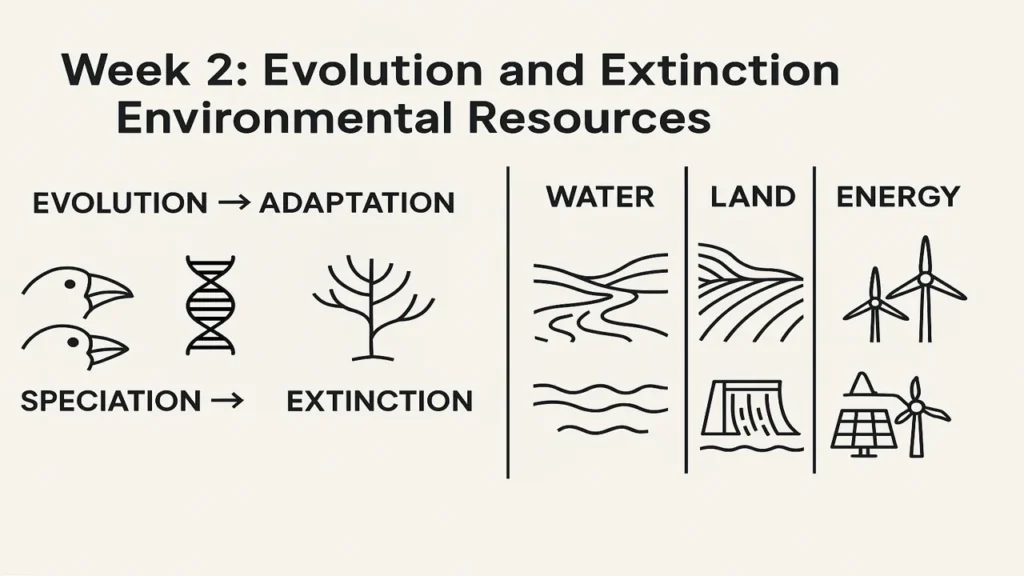
how evolution and extinction shape life, then survey environmental resources water, land, and energy with Pakistan-specific examples, threats, and sustainable solutions.
Evolution & Adaptation
- Evolution: change in heritable traits in populations over generations.
- Mechanisms: natural selection, mutation, gene flow, genetic drift.
- Adaptation: trait that increases fitness (e.g., xerophytic leaves in Thar Desert shrubs).
- Speciation: formation of new species (allopatric along altitudinal gradients in the Himalaya).
Extinction
- Background extinction: continuous, low rate.
- Mass extinction: global, many taxa; today’s biodiversity crisis is human-driven.
- Drivers (Pakistan examples):
- Habitat loss/fragmentation: river regulation affecting Indus River Dolphin.
- Over-exploitation: rangeland overgrazing in Balochistan.
- Pollution: agro-chemicals in canal command areas.
- Invasive species: mesquite (Prosopis juliflora) in Sindh rangelands.
- Climate change: glacier retreat influencing alpine endemics.
Why it matters: Extirpations reduce ecosystem resilience and services (fisheries, pollination, water purification).
Environmental Resources Overview
- Renewable: replenished naturally (surface water, groundwater if managed, soils with proper stewardship, solar/wind/hydro).
- Non-renewable: form slowly (fossil fuels, some aquifers, mineral soils).
- Resource triad this week: Water, Land, Energy strongly coupled through agriculture and cities.
Lecture 1- Environmental Biology Introduction, Scope, Biosphere, Biomes, Ecosystems & Biodiversity
Water Resources (Pakistan focus)
Stocks: Indus River system (glaciers–snowmelt–monsoon), reservoirs (Tarbela, Mangla), canals, wetlands; aquifers in alluvial plains.
Pressures: seasonal variability, high conveyance losses, salinity/sodicity, industrial/agri pollution, groundwater over-abstraction in Lahore Faisalabad Multan corridor.
Sustainable actions
- Demand management: shift to high-efficiency irrigation (drip/sprinkler), laser land-levelling, crop calendars matched to water budgets.
- Supply & storage: recharge wells, managed aquifer recharge (MAR), small check dams in foothills.
- Quality: buffer strips, constructed wetlands near drains, enforcement of effluent standards.
- Ecosystem flows: maintain environmental releases for deltaic mangroves and fisheries.
Land Resources
Assets: arable alluvium, loess plains, mountain terraces, rangelands, forests, coastal belts.
Degradation drivers: erosion, salinization, waterlogging, urban sprawl, mining, improper tillage.
Best practices
- Soil conservation: contour bunds, terraces, vegetative strips on slopes of KP/GB.
- Salinity management: gypsum + drainage + salt-tolerant varieties in Indus Basin.
- Agroforestry: shelterbelts in wind-eroded Thal/Cholistan.
- Urban planning: protect floodplains/ wetlands; enforce land-use zoning.
Energy Resources
Conventional: natural gas, oil, coal (Thar lignite) security vs emissions trade-off.
Renewables (high potential):
- Hydropower: run-of-river + storage; sediment handling critical.
- Solar PV: high insolation in south Punjab, Sindh, Balochistan; rooftop + agrivoltaics.
- Wind: Gharo–Jhimpir corridor.
- Biomass/biogas: livestock hubs; manage air quality and residue burning.
Just transition: prioritize grid upgrades, distributed solar for schools/clinics, and hybrid solutions for desert and mountain communities.
Summary
Evolution produces biodiversity; mismanaged water, land, and energy undermine that diversity and human wellbeing. A resource strategy that saves water, heals soils, and accelerates renewables reduces extinction drivers and strengthens climate resilience.
The approach followed at E Lectures reflects both academic depth and easy-to-understand explanations.
People also ask:
Not necessarily. In many aquifers recharge is slower than pumping; treat as finite unless monitored.
Rapid solar + wind where grid exists, paired with storage and hydro flexibility; remote areas benefit from rooftop or mini-grids.
High evaporation + shallow water tables + salts from parent material; canal seepage worsens it.
Storage helps reliability, but demand management and efficiency usually save more water at lower cost.
Sometimes if habitat, flows, and threats are restored (e.g., dolphin sanctuaries, wetland recovery).