Why is Pakistan vulnerable to climate change?
Week 3 – Environmental Threats, Global Climate Change, Pollution Dynamics, Pest and Pest Control
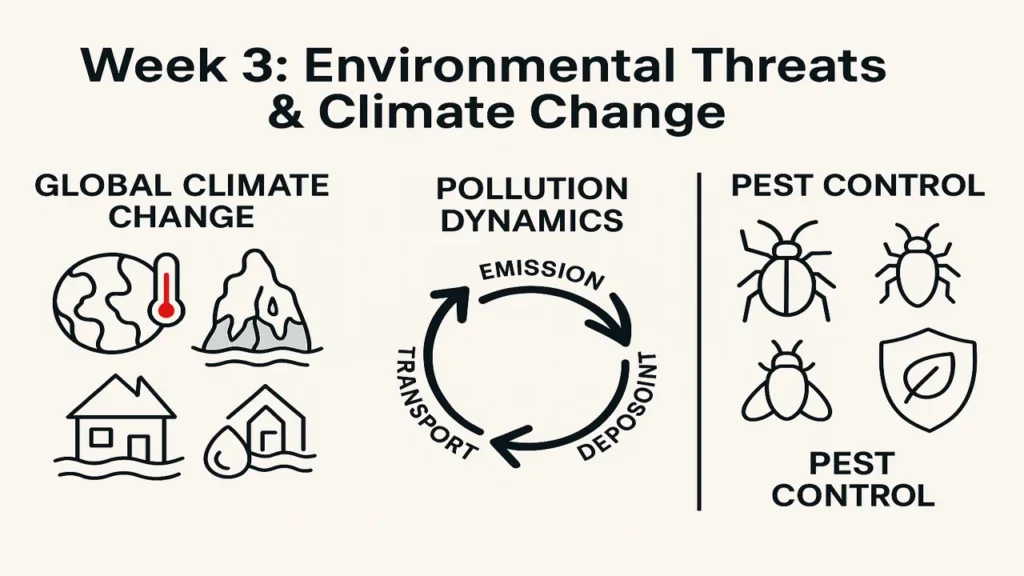
Major environmental threats, global climate change impacts, pollution dynamics, and integrated pest control with real-world Pakistan examples and sustainable solutions.
Major Environmental Threats
Definition: Any human or natural activity that disturbs ecological balance or reduces environmental quality.
Categories of threats:
- Physical: deforestation, soil erosion, floods, droughts.
- Chemical: air/water/soil pollution, pesticide residues, heavy metals.
- Biological: invasive species, pest outbreaks, loss of pollinators.
- Socioeconomic: urban sprawl, waste mismanagement, industrialization without treatment facilities.
Pakistan Context:
- Deforestation in Northern Areas for timber/fuel.
- Urban heat islands in Karachi/Lahore.
- Plastic and e-waste accumulation in rivers.
- Water scarcity in Balochistan and Thar.
Impacts: resource depletion, biodiversity loss, food insecurity, and public health crises.
Global Climate Change
Definition: Long-term alteration in temperature, precipitation, and weather patterns primarily due to anthropogenic greenhouse gas emissions (GHGs).
Major GHGs: Carbon dioxide (CO₂), Methane (CH₄), Nitrous oxide (N₂O), Fluorinated gases (CFCs/HFCs).
Sources: fossil fuels, deforestation, livestock, rice paddies, industrial emissions.
Impacts (Pakistan):
- Temperature Rise: +1°C increase since 1960s.
- Glacial Melting: rapid retreat of Siachen and Batura glaciers affecting Indus flows.
- Extreme Events: floods (2010, 2022), heatwaves (Jacobabad, Nawabshah), droughts (Sindh, Balochistan).
- Agriculture: crop yield shifts (wheat, cotton), pest migration patterns.
- Health: dengue spread, heatstroke, malnutrition.
Mitigation: renewable energy, forest restoration, waste-to-energy, carbon sequestration, smart irrigation.
Adaptation: climate-resilient crops, early warning systems, mangrove protection, and community education.
Week 2 – Evolution and Extinction; Environmental Resources (Water, Land, Energy)
Pollution Dynamics
Definition: Study of how pollutants are generated, transported, transformed, and deposited in the environment.
Stages:
- Emission: release of pollutants (vehicle exhaust, industry smoke, fertilizers).
- Transport: movement by wind/water currents.
- Transformation: chemical/biological alteration (e.g., SO₂ → acid rain).
- Deposition: settling on land or water (dry/wet deposition).
Example:
- Industrial zone emissions → transported to cities → converted to smog → inhaled → respiratory diseases.
Pakistan Examples:
- Smog season in Punjab (burning crops, vehicles, factories).
- River Ravi & Lyari pollution: untreated industrial discharge.
- Noise pollution: urban traffic and generators.
Control: emission limits, catalytic converters, afforestation, green transport, monitoring sensors (PM2.5).
Pest and Pest Control
Pests: organisms causing economic or ecological damage (insects, weeds, rodents, fungi).
Common Agricultural Pests: cotton bollworm, locusts, aphids, mealy bugs.
Types of Control
- Chemical Control: pesticides, herbicides (quick but harmful if misused).
- Biological Control: using predators, parasitoids, pathogens (e.g., ladybird beetles vs. aphids).
- Cultural Control: crop rotation, field sanitation, resistant varieties.
- Mechanical Control: traps, light barriers, tillage.
- Integrated Pest Management (IPM): combines all above minimal chemicals, ecosystem balance maintained.
Case: Pakistan’s Desert Locust 2020 outbreak managed via aerial surveys, early warning, and biological agents.
Summary
Week 3 connects the dots between environmental threats, climate change, pollution, and pest management. These issues interact climate shifts drive pollution cycles and pest outbreaks, threatening food and ecosystem security. The sustainable path is integrating clean energy, adaptive agriculture, and ecological pest control.
The approach followed at E Lectures reflects both academic depth and easy-to-understand explanations.
People also ask:
Because of geographic exposure (glaciers + deserts), high population density, agriculture dependency, and limited adaptive capacity.
Global warming refers to rising Earth’s average temperature; climate change includes shifts in precipitation, storms, and sea levels.
Ban stubble burning, improve vehicle standards, shift to electric transport, and increase urban tree cover.
Not if used correctly. However, overuse causes resistance, kills pollinators, and pollutes water.
Integrated Pest Management (IPM) balances environment and productivity.