Is the greenhouse effect always harmful?
Week 8 – Agricultural Pollution, Greenhouse Effect, Global Warming, Ozone Depletion and Its Effects
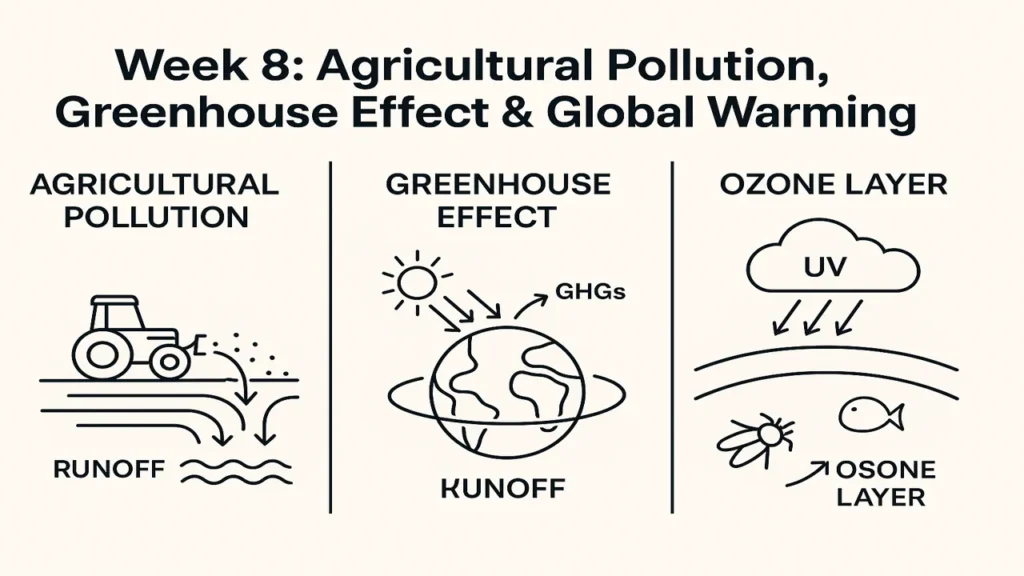
Greenhouse effect and global warming process, ozone depletion causes and effects, and agricultural pollution control with Pakistan-specific examples.
Agricultural Pollution
Definition:
Contamination of soil and water through agricultural activities such as overuse of fertilizers, pesticides, and livestock waste.
Major Pollutants:
- Chemical fertilizers: nitrates, phosphates → eutrophication.
- Pesticides: organophosphates, DDT residues → bioaccumulation.
- Animal waste: ammonia, methane → air and water pollution.
- Irrigation runoff: salts, heavy metals → soil salinization.
Pakistan Context:
- Overuse of urea and DAP fertilizers in Punjab rice–wheat zones.
- Pesticide misuse in cotton-growing districts of Multan and Bahawalpur.
- Poor livestock waste disposal around peri-urban dairy farms polluting local drains.
Control Measures:
- Organic fertilizers and composting.
- Integrated Pest Management (IPM).
- Efficient irrigation (drip, sprinkler).
- Soil testing before fertilizer application.
Greenhouse Effect
Definition:
The greenhouse effect is the natural warming of Earth’s atmosphere by gases that trap solar energy.
Major Greenhouse Gases (GHGs):
| Gas | Source | Relative Impact |
|---|---|---|
| CO₂ | Fossil fuels, deforestation | High |
| CH₄ | Cattle, rice paddies, landfills | 25× stronger than CO₂ |
| N₂O | Fertilizers, waste treatment | 300× stronger than CO₂ |
| CFCs | Refrigerants, aerosols | Ozone-depleting, long-lived |
Mechanism:
- Sunlight enters the atmosphere.
- Earth absorbs energy and emits infrared radiation.
- GHGs trap part of this heat, warming the atmosphere.
Importance:
Without greenhouse gases, Earth’s average temperature would be –18°C instead of +15°C.
Problem:
Human activity enhances this natural effect → global warming.
Global Warming
Definition:
A steady rise in Earth’s average temperature due to excessive greenhouse gas accumulation.
Consequences:
- Melting glaciers → sea level rise.
- Desertification, droughts.
- Intense floods (e.g., Pakistan 2022 floods).
- Shift in rainfall patterns.
- Loss of biodiversity.
Pakistan Impacts:
- Melting of Himalayan glaciers affecting Indus River flow.
- Extreme summer heat in Jacobabad and Sukkur (>50°C).
- Decline in wheat and cotton yields due to heat stress.
Control Measures:
- Reduce fossil fuel dependency.
- Promote solar and wind power.
- Reforestation campaigns (10 Billion Tree Tsunami).
- Sustainable agriculture practices.
Week 7 – Eutrophication, Sewage and Water Treatment, and Thermal Pollution
Ozone Depletion and Its Effects
Definition:
Destruction of stratospheric ozone due to CFCs, halons, and other ozone-depleting substances (ODS).
Effects:
- Increased UV-B radiation → skin cancer, cataracts.
- Reduced photosynthesis in crops.
- Damage to plankton, base of marine food chains.
International Action:
- Montreal Protocol (1987): global agreement to phase out ODS.
- Pakistan banned CFC imports and switched to HFCs by 2010.
Current Status:
Ozone layer recovering gradually; expected to heal by 2060 if global cooperation continues.
Relationship Between Greenhouse Effect, Global Warming & Ozone Layer
Though often linked, they differ:
| Concept | Layer | Key Cause | Main Impact |
|---|---|---|---|
| Greenhouse Effect | Troposphere | GHGs | Heat retention |
| Global Warming | Troposphere | Enhanced GHGs | Climate change |
| Ozone Depletion | Stratosphere | CFCs, halons | UV radiation increase |
However, some gases like CFCs cause both warming and ozone loss, linking the two phenomena.
Summary
Week 8 connects agricultural pollution, greenhouse effect, global warming, and ozone depletion—all products of human activity altering atmospheric balance. Sustainable agriculture, clean energy, and international cooperation are vital to restoring equilibrium.
The approach followed at E Lectures reflects both academic depth and easy-to-understand explanations.
People also ask:
No, it’s essential for maintaining Earth’s temperature, but human activity intensifies it unnaturally.
By releasing methane (from livestock) and nitrous oxide (from fertilizers).
By banning CFCs and using eco-friendly refrigerants.
Global warming is temperature rise; climate change includes all long-term weather pattern shifts.
Yes trees absorb CO₂, reducing global warming and improving air quality.