How is forest conservation different from afforestation?
Week 11 – Forests in Pakistan: Importance, Deforestation Causes & Conservation Strategy
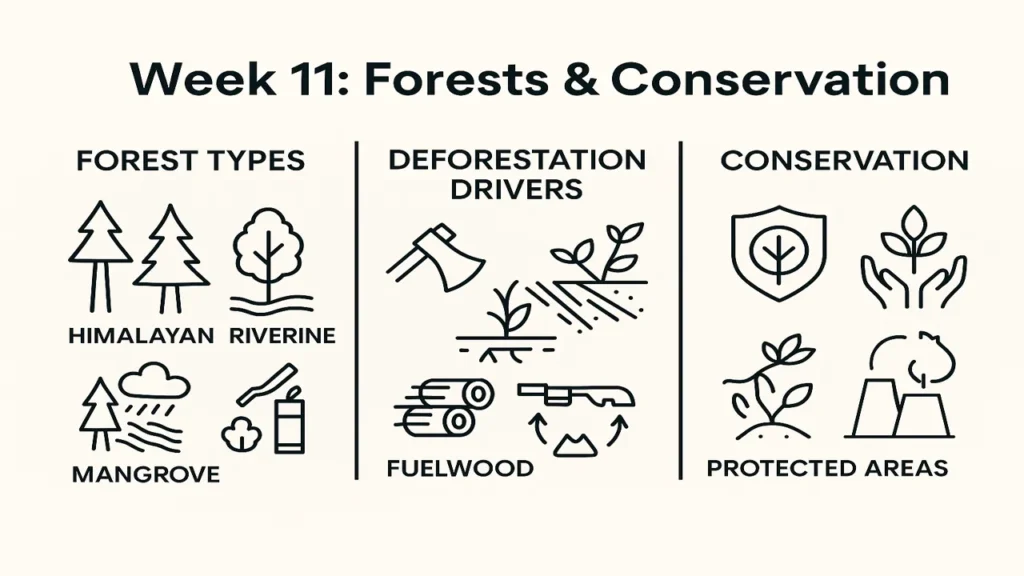
Forests in Pakistan their types, deforestation drivers, and national conservation efforts ensuring ecological balance and sustainability.
Why Forests Matter (Ecosystem Services)
- Regulating services: carbon storage, climate moderation, rainfall regulation, windbreaks.
- Provisioning: timber, fuelwood, NWFPs (honey, resin, medicinal plants).
- Supporting: soil formation, nutrient cycling, pollinator habitat.
- Cultural: recreation, ecotourism, heritage landscapes.
- Disaster risk reduction: stabilize slopes, reduce floods via watershed protection.
Pakistan biomes: Himalayan moist/conifer forests (KPK, GB), dry temperate forests (Balochistan), riverine forests (Indus), mangroves (Indus Delta), scrub forests (Potohar).
Deforestation & Forest Degradation Key Drivers
- Fuelwood demand & informal timber trade
- Agricultural expansion & encroachment in riverine belts
- Overgrazing in rangeland–forest mosaics
- Infrastructure & mining (roads, hydropower corridors)
- Coastal pressures on mangroves: altered freshwater flows, cutting for fuel, pollution
- Climate stress: drought, heat waves, pests (pine processionary, bark beetles)
Impacts: biodiversity loss (markhor, pheasants), erosion/landslides, siltation of dams, declining river baseflows, salinity downstream, livelihoods at risk.
Conservation & Sustainable Forest Management (SFM)
Policy & Planning
- Protected Areas System: National Parks, Wildlife Sanctuaries, Game Reserves.
- REDD+ readiness (results-based payments for reduced deforestation).
- Land-use zoning and EIA for projects affecting forests.
Field Tools
- Community/Joint Forest Management (JFM) & benefit-sharing.
- Afforestation/Restoration: native species, assisted natural regeneration (ANR), enrichment planting.
- Watershed/riverine restoration: riparian buffers, floodplain reforestation.
- Mangrove conservation: regulate freshwater/environmental flows, community guards, alternative energy for fuel substitution.
- Fire management: early-warning, fuel breaks, community brigades.
- Monitoring: forest inventories, drone/remote sensing (NDVI), permanent sample plots.
Livelihood Links
- NWFP value chains (pine nuts/“chilgoza”, honey, MAPs), eco-tourism guidelines, payments for ecosystem services (PES).
Week 10 – Noise and Radiation Pollution: Causes, Effects & Control
Pakistan’s National Conservation Strategy (NCS)
- Vision: integrate environment into development; conserve biodiversity; sustain resource base.
- Core areas: soil & water conservation, forest & rangeland management, biodiversity protection, pollution control, energy efficiency, and institutional strengthening.
- Operational themes: capacity building, public participation, environmental education, economic incentives & legislation.
Recent Flagship Initiatives
- Billion / Ten Billion Tree (BTAP/TBTTP): large-scale afforestation, range rehabilitation, mangrove expansion in Sindh, urban Miyawaki forests.
- Protected Area Initiative: new national parks, community co-management.
- Green Pakistan & Living Indus: riverine and wetland restoration with climate adaptation.
Summary
Forests underpin climate stability, water security, and livelihoods. Pakistan’s NCS and recent tree-planting/restoration programs work when paired with community management, native species, and strict protection of high-biodiversity areas. The priority is to prevent further degradation while restoring riverine and coastal buffers.
The approach followed at E Lectures reflects both academic depth and easy-to-understand explanations.
People also ask:
Conservation protects existing forests; afforestation creates new forests on non-forest land.
Mangroves in Sindh have increased through planting and protection efforts.
Clear tenure, benefit sharing, and local monitoring against illegal felling.
Use natives first; if exotics are used (e.g., eucalyptus), limit to specific sites with water–salinity checks.
Tree clubs, nursery raising of native species, GIS mapping of green cover, and awareness campaigns.