What are rangelands?
Week 14 – Sustainable Rangeland Management in Pakistan: Challenges & Solutions
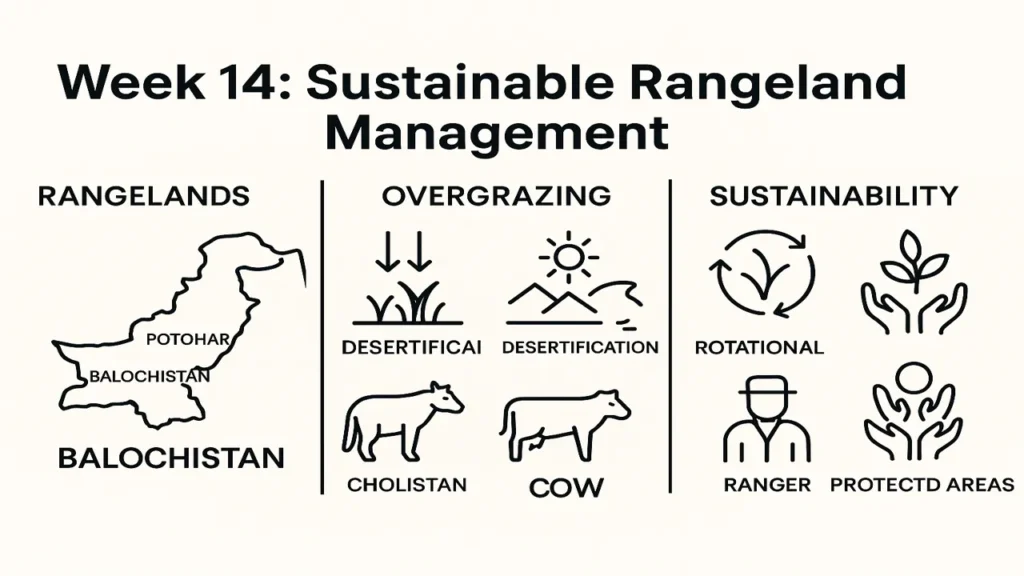
How sustainable rangeland management in Pakistan helps prevent overgrazing, restore ecosystems, and support livestock-based rural livelihoods.
Introduction to Rangelands
Rangelands are vast natural landscapes dominated by grasses, shrubs, and sparse trees, providing forage for livestock and wildlife.
They cover ~60% of Pakistan’s land area, making them vital for both pastoral livelihoods and ecosystem stability.
Major Rangeland Regions:
| Region | Dominant Vegetation | Key Province |
|---|---|---|
| Baluchistan Plateau | Artemisia, Haloxylon, Salsola | Balochistan |
| Thal & Cholistan Deserts | Haloxylon, Panicum, Cenchrus | Punjab |
| Potohar Plateau | Acacia, Cymbopogon | Punjab |
| Karakoram Foothills & Northern Valleys | Juniper, Artemisia | KPK & GB |
Ecological and Economic Importance
- Supports livestock grazing (sheep, goats, camels, cattle).
- Prevents soil erosion and stabilizes watersheds.
- Maintains biodiversity wild herbs, reptiles, and pollinators.
- Carbon sequestration and climate regulation.
- Source of medicinal plants, firewood, and thatch.
Livestock Dependence:
Over 70% of Pakistan’s livestock feed comes from natural rangelands.
Causes of Rangeland Degradation
- Overgrazing: Continuous grazing beyond carrying capacity.
- Deforestation and Fuelwood Cutting: Loss of shrubs and trees.
- Soil Erosion & Desertification: Due to bare soil exposure.
- Climate Change: Droughts and erratic rainfall.
- Unplanned Cultivation: Conversion of grasslands into farms.
Result: Reduced grass productivity, invasion of unpalatable weeds, loss of native species, and declining livestock health.
Sustainable Rangeland Management (SRM) Practices
a) Grazing Management
- Rotational Grazing: Alternate use of grazing plots to allow recovery.
- Deferred Grazing: Rest periods during seed-setting season.
- Stocking Rate Control: Match livestock numbers with forage capacity.
b) Reseeding & Restoration
- Use of native perennial grasses (e.g., Cenchrus ciliaris, Panicum antidotale).
- Rainwater harvesting and contour bunding for moisture retention.
c) Soil & Water Conservation
- Check dams, stone bunds, and terraces to control erosion.
- Planting leguminous species to improve soil fertility.
d) Community Participation
- Empower local herders through co-management and benefit-sharing.
- Establish Rangeland User Associations (RUAs).
e) Policy Interventions
- Integration with National Rangeland Policy (NRP).
- Support for livestock extension services and climate-smart grazing.
Week 13 – Environmental Problems in Pakistan and Their Solutions
Case Study: Cholistan Desert (Punjab)
Problem: Severe overgrazing and drought reduced carrying capacity to <10% of original productivity.
Solution:
- Community-managed grazing rotations.
- Drought-resistant species like Cenchrus setigerus introduced.
- Water ponds built to reduce long grazing distances.
Outcome: Increased forage yield and reduced livestock mortality during dry spells.
Benefits of Sustainable Rangeland Management
- Increases forage productivity by 30–50%.
- Reduces soil erosion and sand encroachment.
- Enhances carbon storage in soil and biomass.
- Promotes biodiversity and pollinator habitats.
- Improves livelihoods and food security for pastoral communities.
Summary
Rangelands are Pakistan’s largest renewable natural resource, sustaining millions of pastoralists. Their degradation threatens food security, climate stability, and biodiversity.
Sustainable Rangeland Management based on rotational grazing, reseeding, and community involvement offers a practical path toward resilient ecosystems and rural sustainability.
The approach followed at E Lectures reflects both academic depth and easy-to-understand explanations.
People also ask:
Land dominated by grasses and shrubs used for livestock and wildlife grazing.
Through rotational grazing, proper stocking rates, and rest periods.
Cenchrus ciliaris, Panicum antidotale, and Lasiurus sindicus.
By sequestering carbon in soil and preventing desertification.
They manage grazing schedules, protect restored plots, and share benefits.