What are gigawatt-scale AI data centers?
AI Infrastructure 2025: How Massive Compute + Humanoid Robots Are Reshaping the Future
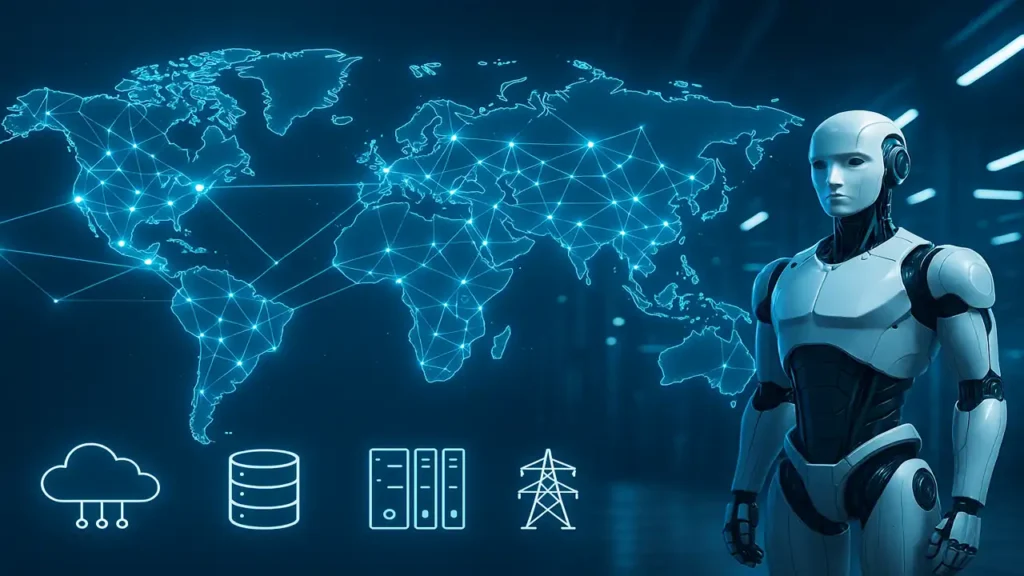
How global AI infrastructure, gigawatt-level data centers, and humanoid robots are reshaping the 2025 workforce. A deep dive into the next AI revolution.
Introduction
The AI revolution is no longer happening inside labs it is now transforming factories, hospitals, warehouses, research labs, and homes.
2025 marks a major shift: AI compute infrastructure is scaling to gigawatt levels, and humanoid robots are becoming full-time workers, powered by multimodal LLMs.
Leading companies in the US, Europe, and China have begun deploying AI-powered humanoids for manufacturing, logistics, customer-service, and high-precision industrial tasks.
This article explains how AI infrastructure scaling + humanoid robotics are combining to reshape the global workforce.
The Global Race for Massive AI Compute Infrastructure
The AI Infrastructure Boom
Countries and companies are building the world’s most powerful AI data centers featuring:
- ExaFLOP-scale GPU clusters
- Gigawatt power plants dedicated to AI
- Liquid-cooled AI supercomputers
- AI-optimized 3D stacked memory
Major players include:
- OpenAI + Microsoft (Wafer-scale inferencing clusters)
- Google (Gemini Nano integrated into devices)
- Nvidia (Blackwell/B200 GPU clusters)
- China’s DeepSeek (low-energy AI systems)
Rapid infrastructure growth is lowering AI costs and making humanoid robots more efficient.
Why Humanoid Robots Became Mainstream in 2025
Humanoid robots were limited before 2023 due to:
- Limited battery life
- Slow motion planning
- Weak on-device intelligence
- High hardware cost
But 2024-2025 changed everything:
5 Breakthroughs:
- Multimodal LLMs → real-time reasoning + planning
- Vision-language sensors → self-navigation
- Energy-efficient micro-motors → longer battery life
- Robotic cloud-training → instant updates
- Low-latency 5G/6G → seamless remote compute
Now humanoids can:
- Grip tools accurately
- Understand natural language
- Follow multi-step instructions
- Recognize objects + hazards
- Work continuously with minimal downtime
Industries Already Using Humanoid Robot Workers
Manufacturing
Humanoids assemble electronics, inspect machinery, transport materials.
Healthcare
Assist nurses, move equipment, deliver supplies, monitor patients.
Logistics
Operate warehouse forklifts, sort packages, load/unload shipments.
Food & Retail
Welcome customers, prepare simple meals, manage inventory.
Research Labs
Run repetitive experiments, handle chemicals, automate sample testing.
This shift is reducing workload on human teams and creating hybrid “AI + Human” work environments.
How Massive Compute Centers Power Humanoid Workers
Humanoid robots rely on:
- Cloud inference
- Edge computing
- Distributed training
- Shared behavior models
A robot in Germany can instantly adopt an improved walking model trained in Japan thanks to global compute clusters.
This creates the world’s first shared robotic intelligence network.
Challenges Ahead
Even with breakthroughs, issues remain:
- High power consumption
- Safety + regulation
- Ethical concerns about jobs
- Sensor failures
- Expensive maintenance
But experts expect humanoids to become cheaper than human labor within 5 years.
Summary
AI infrastructure and humanoid robots are forming the backbone of the next industrial revolution.
The next 24–36 months will define how humanity collaborates with AI workers not replaces them.
Companies that adopt AI infrastructure early will lead the global economy of 2030.
People also ask:
These are massive compute facilities powered by nearly 1 GW of electricity, enabling training of huge AI models and powering humanoid robots at scale.
They are shifting repetitive and hazardous work to robots, while humans move to high-level supervisory and creative roles.
Tesla, Figure AI, Agility Robotics, Sanctuary AI, and DeepSeek.
Through multimodal reasoning, long-horizon planning, and vision-language action mapping.
New safety standards and controlled work environments make adoption increasingly safe and regulated.