What is the main purpose of CNNs?
Lecture 6 – Convolutional Neural Networks (CNNs)
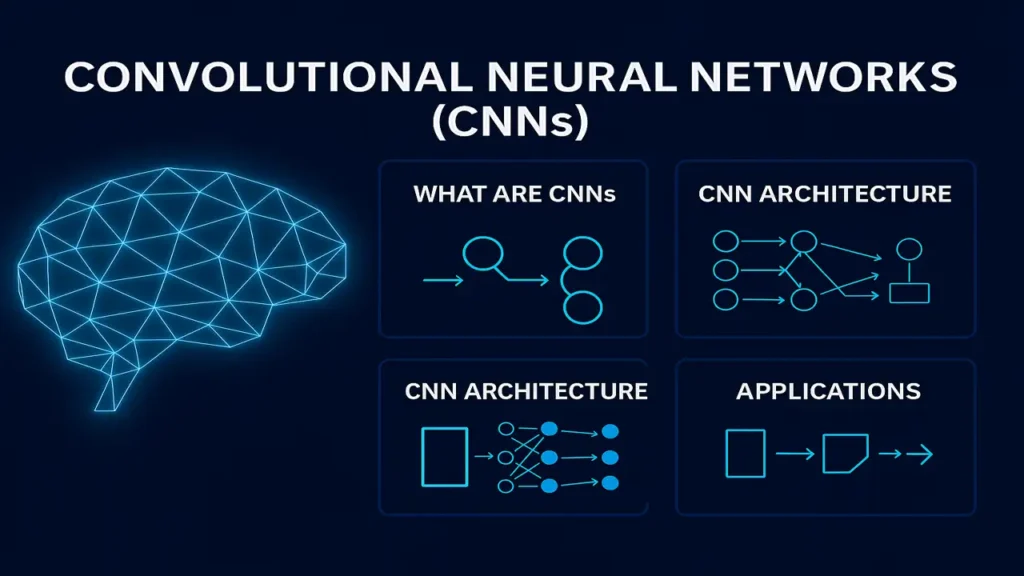
Introduction
Convolutional Neural Networks (CNNs) are the foundation of modern computer vision and one of the most important architectures in deep learning. CNNs excel at understanding images by automatically detecting edges, textures, shapes, and full objects, making them ideal for everything from face recognition to MRI analysis.
Traditional fully-connected networks fail with high-dimensional images, but CNNs solve this through convolutions, parameter sharing, and local receptive fields, making them efficient and powerful.
What Are Convolutional Neural Networks?
A CNN is a deep learning model designed to process grid-structured data, especially images.
Instead of manually defining features, CNNs automatically learn hierarchies:
- Layer 1: edges
- Layer 2: patterns/textures
- Layer 3: object parts
- Layer 4: complete objects
This makes CNNs far superior to classical machine learning in image-based tasks.
CNN Architecture (Core Building Blocks)
a) Convolution Layer
This is the heart of CNNs.
A convolution layer uses kernels (filters) that slide across the image and extract features.
Learns patterns like:
- vertical edges
- horizontal edges
- corners
- textures
- color gradients
Convolution Operation:
FeatureMap=Image∗Kernel
Each filter generates a new feature map.
Activation Function (ReLU)
After convolution, CNNs apply ReLU to introduce non-linearity so the network can learn complex patterns.
ReLU Example:
ReLU(x)=max(0,x)
Lecture 5 – Optimization Algorithms in Deep Learning: SGD, Momentum, RMSProp & Adam Explained
Pooling Layer (Downsampling)
Pooling reduces spatial size & prevents overfitting.
Types:
- Max Pooling → selects the highest value
- Average Pooling → takes average
Reduces computation
Extracts dominant features
Improves translation invariance
Fully Connected Layer
After feature extraction, the image is flattened and fed into a classic neural network for classification.
Example:
- Cat probability = 0.93
- Dog probability = 0.07
Why CNNs Work So Well?
- Local receptive fields → learn local patterns
- Weight sharing → fewer parameters
- Translation invariance → object recognized anywhere
- Scalability → works from small images to 4K data
- Automatic feature engineering
CNNs removed the need for manual feature design.
Real-World Applications of CNNs
| Domain | Application |
|---|---|
| Healthcare | Tumor detection, CT/MRI analysis |
| Security | Face recognition (FaceID), CCTV surveillance |
| Automotive | Self-driving car vision systems |
| Social Media | Filters, image enhancement |
| Retail | Barcode/QR detection |
| Satellite | Land classification, weather imaging |
Step-by-Step Example: Dog vs Cat Classifier
Step 1 – Input Image
Image resized to 128×128 pixels.
Step 2 – Convolution Layer
Extracts edges (whiskers, ears).
Step 3 – Pooling
Compresses size → keeps important features.
Step 4 – More Convolution Layers
Detects higher-level patterns (eyes, nose shape).
Step 5 – Fully Connected Layer
Combines all features → predicts category.
Step 6 – Softmax Output
Dog: 0.91
Cat: 0.09
Summary
Convolutional Neural Networks automatically learn visual features through convolution, pooling, and dense layers. They reduce computation, extract meaningful patterns, and achieve exceptional accuracy in modern image-based AI tasks.
People also ask:
CNNs are designed for image understanding by automatically extracting visual features.
They detect patterns like edges, textures, and shapes.
Pooling downsamples the feature map and prevents overfitting.
Mostly yes, but they can work on video, audio spectrograms, and some NLP tasks.
Small CNNs run on CPUs, but GPUs speed up training massively.