What is text preprocessing in Natural Language Processing?
Lecture 2 – Text Preprocessing and Standard Corpora in Natural Language Processing
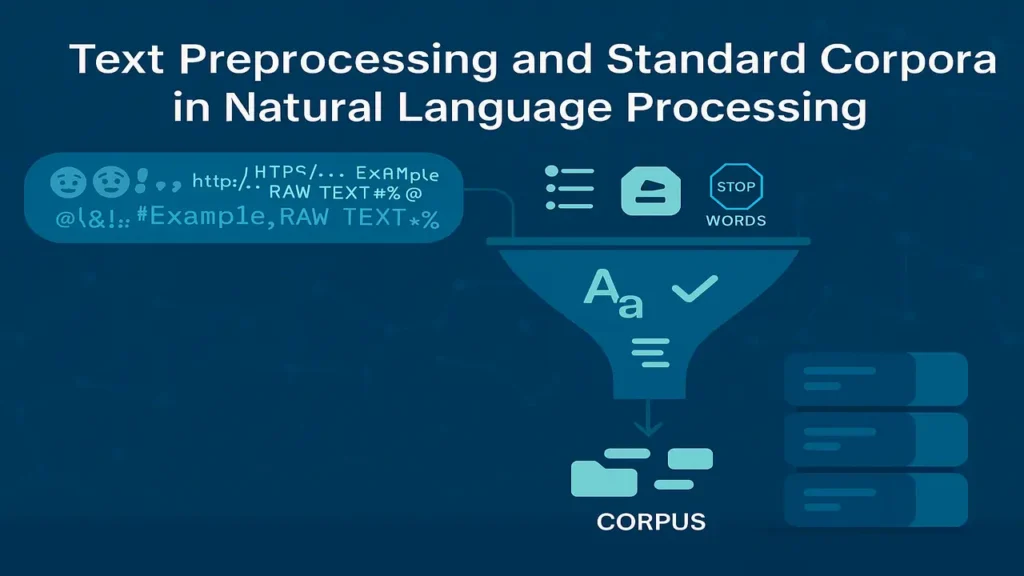
Natural Language Processing systems rarely work directly on raw, messy text. Before any model can classify, translate, summarise or retrieve documents, the text must pass through a careful cleaning and structuring phase. In addition, modern NLP research and development depends heavily on standard, well defined text collections called corpora. These corpora make it possible to evaluate methods fairly, compare results across papers and train models on realistic language data.
This lecture explains in depth the role of text preprocessing and standard corpora in NLP. It shows what preprocessing steps are commonly used, why they are important and how they affect downstream tasks. It also introduces the idea of corpora, discusses the advantages of using standard corpora and gives concrete examples of widely used resources and tools.
The focus is practical and conceptual. The explanations are grounded in real world scenarios, simple algorithms and short Python examples so that students can immediately connect theory with implementation.
Why text preprocessing matters ?
Real text is noisy. A single dataset may contain a mix of capitalisation styles, emoticons, emojis, hashtags, URLs, email addresses, numbers, spelling mistakes, repeated characters, mixed languages and inconsistent punctuation. If this raw text is sent directly to a classifier or translation model, performance often drops sharply.
Text preprocessing aims to transform raw text into a cleaner and more standard representation without losing important meaning. Good preprocessing has several benefits.
- It reduces superficial variation. Different surface forms that express essentially the same word or concept are normalized into a single representation.
- It improves statistical reliability. When words are normalized, counts and probabilities become more accurate because they are not split across many spelling variants.
- It simplifies modelling. Many machine learning models expect numeric feature vectors or token sequences in a consistent format. Preprocessing bridges the gap between raw text and these models.
- It improves reproducibility. When preprocessing is described clearly, other researchers can replicate experiments more easily.
In the context of a full NLP pipeline, preprocessing is an early but critical step. Errors introduced at this stage can propagate and damage all later stages such as tagging, parsing and classification.
Lecture 1 – Introduction to Natural Language Processing, History, Core Applications
Core steps of text preprocessing
Although exact pipelines vary by task and domain, several core steps appear repeatedly.
2.1 Normalization
Normalization aims to standardise the basic form of the text. Typical operations include.
- Converting all text to lowercase, so that Natural, natural and NATURAL are treated as the same word.
- Normalising whitespace by replacing multiple spaces, tabs and line breaks with single spaces.
- Handling or removing punctuation in a controlled way. For example, removing trailing punctuation from tokens but preserving apostrophes in contractions when needed.
- Standardising character encodings and removing non printable characters.
In some tasks, additional normalization is useful. For social media data, repeated characters in words like sooooo may be collapsed to so or soo. For noisy user generated content, obvious spelling variants may be mapped to a standard form using dictionaries or learned models.
2.2 Tokenization
Tokenization is the process of splitting text into basic units called tokens. Most often tokens are words, but for some applications subword or character tokens are used.
Tokenization operates at two levels.
- Sentence tokenization separates a document into individual sentences. This is important for tasks such as translation or summarisation where sentence boundaries matter.
- Word tokenization splits each sentence into words and symbols. The challenge is to decide what counts as a separate token. Contractions, hyphenated forms, abbreviations and punctuation marks must be handled carefully.
Simple tokenizers use whitespace splitting and basic punctuation rules. More advanced tokenizers rely on regular expressions or trained models. Libraries such as NLTK, spaCy and others provide robust tokenizers that work across many languages.
In deep learning based NLP, subword tokenization methods such as Byte Pair Encoding and WordPiece are frequently used. They break words into smaller subunits to handle unknown words and rich morphology more effectively, while still keeping sequence lengths manageable.
2.3 Stopword removal
Stopwords are very common words that often carry little content meaning by themselves, such as the, is, at and and. Removing stopwords can reduce vocabulary size and focus models on more informative words.
However, stopword removal is not always appropriate. For example, in sentiment analysis, words like not or never are critical for correct interpretation. Blindly removing them can reverse the polarity of a sentence. Therefore, stopword lists should be customised for each task and language.
2.4 Stemming and lemmatization
Stemming and lemmatization both aim to reduce different word forms to a common base form.
Stemming uses simple heuristic rules to chop off suffixes. For example playing, played and plays might all become play. Stemming is fast but can be aggressive and may produce non dictionary forms.
Lemmatization uses vocabulary and morphological analysis to return a proper base form or lemma. It takes into account part of speech information. For example, better would be mapped to good and running to run. Lemmatization is more accurate but typically slower and requires language specific resources.
For tasks such as retrieval over large document collections, stemming is often sufficient. For more fine grained semantic tasks, lemmatization may be preferred.
2.5 Handling numbers, URLs, emojis and special tokens
Modern text contains many elements beyond plain words. Preprocessing must decide what to do with them.
- Numbers may be kept as they are, mapped to a generic placeholder such as NUM, or normalized to ranges, depending on the task.
- URLs and email addresses are often replaced by placeholders so that the model learns their presence without memorising specific values.
- Emojis, emoticons and hashtags can carry important sentiment and topical information. In social media analysis they are often preserved as separate tokens.
- User mentions in social platforms may be mapped to a generic USER token.
Thoughtful design at this level can significantly improve downstream performance, especially for sentiment analysis and social media mining.
What is a corpus ?
A corpus in NLP is a large, structured collection of texts stored in machine readable form. Corpora may contain raw text only, or they may be annotated with various linguistic labels such as part of speech tags, parse trees, named entities or semantic roles.
Using corpora allows researchers and practitioners to.
- Train statistical and neural models on realistic data.
- Evaluate the performance of algorithms on shared benchmarks.
- Compare methods fairly by using exactly the same datasets.
- Study language variation across genres, regions and time periods.
Some corpora are general purpose, representing broad language use such as newspapers or web text. Others are specialised, focusing on legal documents, biomedical abstracts, tweets or dialogue.
Advantages of using standard corpora
Standard corpora are those that are widely known, documented and used by the research community. Examples include the Brown Corpus, the Penn Treebank and the British National Corpus among many others.
Working with such corpora has numerous advantages.
- Reproducibility. When an experiment uses a standard corpus, others can reproduce the results using the same data.
- Benchmarking. Standard corpora serve as benchmarks where researchers can directly compare the accuracy of different methods.
- Shared resources. Preprocessing scripts, annotation guidelines and baseline models for standard corpora are often publicly available, reducing duplicated effort.
- Quality control. Most widely used corpora are carefully designed and checked, which improves data quality and reduces noise in evaluation.
- Coverage. Large corpora spanning multiple domains improve the generalisability of trained models.
For teaching purposes, standard corpora also provide a common platform for exercises and projects. Students can follow textbook examples and then extend them with their own ideas.
Examples of widely used corpora
The NLP community uses many corpora, but a few have become especially influential.
- Brown Corpus. One of the earliest and most famous corpora, containing text samples from different genres of American English. It has been used for language modelling, tagging and many other tasks.
- British National Corpus. A large collection of written and spoken British English designed to represent a wide cross section of language use.
- Penn Treebank. A corpus of Wall Street Journal and other texts annotated with part of speech tags and phrase structure trees. This resource has been central to research on statistical parsing and tagging.
- CoNLL shared task datasets. Various corpora released for shared tasks on chunking, named entity recognition, dependency parsing and other structured prediction tasks.
- Open web text and Wikipedia. Although not originally designed as corpora, they are widely used as training data for large language models, often after careful cleaning and filtering.
Python libraries such as the Natural Language Toolkit provide interfaces to dozens of corpora, making it easy to explore them in code.
Real world examples of preprocessing and corpora
Several simple scenarios highlight the role of preprocessing and standard corpora.
Example one. News classification. A team wants to build a model that classifies news articles into politics, sports and technology. Without preprocessing, the vocabulary contains many duplicated forms such as Government, government and government. repeated at the beginning of sentences. After applying lowercasing, tokenization and stopword removal, the vocabulary becomes more compact, and the classifier achieves higher accuracy with fewer parameters. A standard news corpus also allows the team to compare their model with previously published baselines.
Example two. Search over legal documents. A law firm stores thousands of contracts and court judgments. To implement document search, they must first clean OCR errors, normalise whitespace, tokenize the text and index it. They adopt an existing legal corpus to evaluate their retrieval performance against known queries and relevance judgements.
Example three. Sentiment analysis on social media. A company wants to measure customer satisfaction from tweets. Preprocessing must handle hashtags, mentions, emojis, URLs and informal spellings. The choice to keep emojis as tokens significantly improves the system’s ability to detect positive and negative sentiment. Training data is built by combining internal data with a public, annotated sentiment corpus.
These examples show that preprocessing and corpus selection are not abstract topics but central design choices in real NLP projects.
Step by step algorithm for a basic preprocessing pipeline
The following high level algorithm describes a typical preprocessing pipeline for English text classification.
Step 1. Input collection.
Receive a raw text document as input.
Step 2. Lowercasing.
Convert the entire document to lowercase to reduce case based variation.
Step 3. Sentence segmentation.
Apply a sentence tokenizer to split the document into sentences. This can be a rule based or model based component from a library.
Step 4. Word tokenization.
For each sentence, use a word tokenizer to split into tokens. Handle punctuation carefully, separating it from words where appropriate.
Step 5. Noise removal.
Remove or replace URLs, email addresses and user mentions with placeholders. Optionally remove very long sequences of repeated characters.
Step 6. Stopword handling.
Remove stopwords using a custom stopword list crafted for the domain. Preserve critical words such as not if sentiment is important.
Step 7. Normalization of numbers and emojis.
Map numbers to a generic token or keep them depending on the task. Decide how to represent emojis and hashtags.
Step 8. Stemming or lemmatization.
Apply a stemmer or lemmatizer to reduce different morphological forms to a base representation.
Step 9. Output generation.
Return the cleaned and tokenized text as a list of tokens or sentences, ready for feature extraction and model input.
This generic algorithm can be adapted for other languages and domains by replacing tokenizers and normalization rules with appropriate components.
Code example. preprocessing and corpus access in Python
The following small example demonstrates basic preprocessing and the use of a standard corpus through the Natural Language Toolkit.
import nltk
from nltk.corpus import brown
from nltk.corpus import stopwords
from nltk.tokenize import word_tokenize
import string

# Make sure required resources are downloaded once in your environment:
# nltk.download('brown')
# nltk.download('punkt')
# nltk.download('stopwords')

# 1. Load a sample sentence from the Brown Corpus
sample_sentence = " ".join(brown.sents(categories='news')[0])
print("Original sentence:")
print(sample_sentence)

# 2. Lowercase
text_lower = sample_sentence.lower()

# 3. Word tokenization
tokens = word_tokenize(text_lower)

# 4. Remove punctuation tokens
tokens_no_punct = [
    t for t in tokens if t not in string.punctuation
]

# 5. Remove English stopwords
stop_words = set(stopwords.words('english'))
tokens_filtered = [
    t for t in tokens_no_punct if t not in stop_words
]

print("\nTokens after preprocessing:")
print(tokens_filtered)
This code illustrates several important points.
- It accesses a standard corpus. the Brown Corpus. which is widely used in NLP research and teaching.
- It performs lowercasing and word tokenization, using NLTK’s built in tools.
- It removes punctuation and English stopwords to produce a simple cleaned token list.
Students can extend this example by adding lemmatization, custom stopword lists or additional corpora.
Summary
Text preprocessing and standard corpora form the foundation of practical Natural Language Processing. Before any deep model or advanced algorithm can perform well, the text must be cleaned, normalized and tokenized in a consistent way. At the same time, the choice of corpus determines how representative and reliable the training and evaluation data will be.
This lecture has explained the main preprocessing operations including normalization, tokenization, stopword handling, stemming and lemmatization. It has clarified what a corpus is, why it is necessary to use standard corpora and which resources are commonly employed in NLP research and teaching. Real examples from news classification, legal search and social media sentiment analysis illustrate how these ideas appear in real projects.
By mastering text preprocessing and corpora, students prepare themselves for the more advanced topics that follow, such as edit distance, language modelling, tagging, parsing, semantics, sentiment analysis, information retrieval, information extraction, translation and question answering.
Next. Lecture 3 – Minimum Edit Distance and Spelling Correction in NLP
People also ask:
Text preprocessing is the set of steps used to clean and standardize raw text before it is given to an NLP model. It may include lowercasing, tokenization, stopword removal, stemming, lemmatization and handling of numbers, URLs and emojis. Good preprocessing improves model accuracy and makes experiments more reproducible.
A corpus is a large collection of texts stored in digital form, often with linguistic annotations. Corpora are essential in NLP because they provide realistic data for training and evaluating models. Standard corpora allow researchers to compare methods fairly on shared benchmarks.
Well known corpora include the Brown Corpus, the British National Corpus and the Penn Treebank. The Brown Corpus contains samples of written American English. The British National Corpus covers written and spoken British English. The Penn Treebank includes texts annotated with part of speech tags and parse trees.
The Natural Language Toolkit NLTK is a widely used library that provides tokenizers, stemmers, lemmatizers and access to over 50 corpora. Other libraries such as spaCy offer industrial strength tokenization, tagging and parsing with efficient implementations for production use.
Stopword removal is useful in many tasks because it reduces vocabulary size and focuses on content words. However, it should not be applied blindly. In sentiment analysis and certain classification tasks, words like not, never or very can be critical. It is important to design a stopword list that fits the specific problem and language.