What is Data Mining?
Lecture 1 – Introduction to Data Mining Concepts, Tasks & Real-World Applications
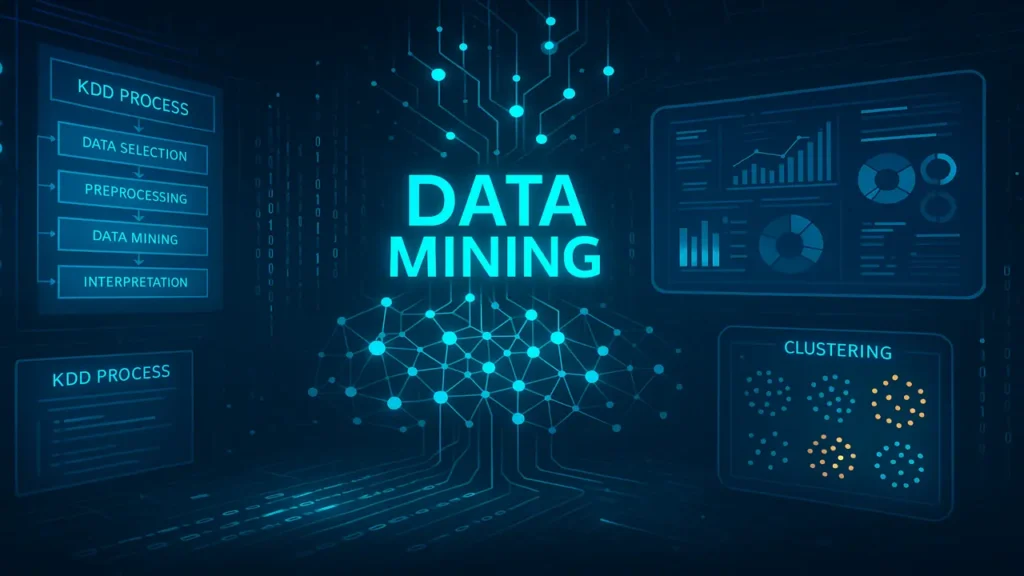
Lecture 1 provides a complete introduction to Data Mining, including definitions, KDD process, data mining tasks, tools, step-by-step examples, diagrams, real-world applications, and Python demonstrations for students and teachers of BS CS, BS AI, BS IT, and Data Science.
Data Mining is one of the most important fields in modern computing. It helps organizations discover patterns, trends, and hidden knowledge from massive datasets. Whether it’s healthcare predicting patient risks, e-commerce recommending products, or banks detecting fraud Data Mining is the backbone of today’s intelligent systems.
In this lecture, you will explore Data Mining from the ground up: its meaning, its connection to the KDD process, major tasks, data types, real-world examples, and industry tools. This foundational lecture prepares you for the rest of the course as you move toward preprocessing, association rules, classification, clustering, and advanced topics.
Understanding the Concept of Data Mining
What is Data Mining?
Data Mining is the process of discovering meaningful patterns and insights from large datasets using mathematics, machine learning, statistics, and database systems.
It is NOT just about collecting data it is about extracting valuable information from raw data.
In simple words:
“Data Mining is the art and science of finding hidden patterns.”
Machine Learning → https://electuresai.com/machine-learning
The Knowledge Discovery in Databases (KDD) Process
KDD is the broader process that includes Data Mining as one of its steps.
Think of Data Mining as the “heart” of the KDD process.
Here is the KDD Pipeline in simple form:
Raw Data → Selection → Cleaning → Transformation → Data Mining → Interpretation → KnowledgeStep-by-Step Breakdown
- Selection: Choosing the relevant data sources
- Cleaning: Fixing missing or incorrect data
- Transformation: Converting data into useful formats
- Data Mining: Applying algorithms
- Evaluation: Interpreting discovered patterns
Scikit-learn Docs → https://scikit-learn.org
Types of Data Mining Tasks
Data Mining involves a variety of tasks. Here are the most important ones:
1. Classification
Assigning data to predefined categories.
Example: Classifying emails as Spam or Not Spam.
2. Prediction
Forecasting future outcomes based on historical data.
Example: Predicting stock prices.
3. Clustering
Grouping data based on similarity, without predefined labels.
Example: Grouping customers based on shopping habits.
4. Association Rule Mining
Discovering relationships between items.
Example:
“If a customer buys milk, they are likely to buy bread.”
5. Outlier or Anomaly Detection
Identifying unusual data points.
Example: Detecting fraudulent credit card transactions.
Types of Data Used in Data Mining
Structured Data
Well-organized data stored in tables.
Examples:
- SQL Database
- Excel Sheets
- Inventory Tables
Semi-Structured Data
Data with tags or markers.
Examples:
- XML
- JSON
- Log files
Unstructured Data
Data without a fixed format.
Examples:
- Text (tweets, reviews)
- Images
- Video & Audio
- Social media posts
Real-World Applications of Data Mining
Data Mining is everywhere. Here are the most impactful areas:
1. Business & Marketing
- Customer segmentation
- Recommendation systems
- Sales forecasting
Example: Netflix recommending movies using user viewing patterns.
2. Healthcare
- Disease prediction
- Diagnostic image processing
- Drug effectiveness analysis
3. Cybersecurity
- Malware detection
- Suspicious login detection
- Fraud detection
4. E-Commerce & Retail
- Market basket analysis
- Inventory optimization
- Price prediction
Tools & Technologies Used in Data Mining
Python Libraries
- Pandas
- NumPy
- Matplotlib
- Scikit-learn
WEKA & RapidMiner
Drag-and-drop tools for beginners.
Cloud Platforms
- AWS ML
- Google Cloud AI
- Azure Machine Learning
KDD Pipeline
[Data Sources]
      ↓
[Selection]
      ↓
[Cleaning]
      ↓
[Transformation]
      ↓
[Data Mining Algorithms]
      ↓
[Patterns / Knowledge]
      ↓
[Evaluation & Decision Making]
Classification vs Clustering (Comparison Table)
| Feature | Classification | Clustering |
|---|---|---|
| Labels | Predefined | No labels |
| Supervision | Supervised | Unsupervised |
| Example | Email Spam | Customer Segments |
Association Rule Example (Text Illustration)
Transaction 1: Milk, Bread, Butter
Transaction 2: Milk, Eggs
Transaction 3: Bread, Butter

Rule Example:
IF Milk → THEN Bread
Python Example
import pandas as pd
from sklearn.preprocessing import LabelEncoder

data = pd.DataFrame({
    "Product": ["Milk", "Bread", "Butter", "Eggs"]
})

encoder = LabelEncoder()
data["Encoded"] = encoder.fit_transform(data["Product"])

print(data)
Common Mistakes Beginners Make
- Assuming Data Mining = Machine Learning (they are related but different)
- Not preprocessing the dataset
- Using the wrong algorithm for the wrong data type
- Ignoring outliers
- Misinterpreting patterns
Summary
Lecture 1 introduced the fundamental concepts of Data Mining, including definition, KDD process, task types, data types, diagrams, tools, and examples. You explored classification, clustering, prediction, association rules, and anomaly detection. This foundation prepares you for advanced topics in upcoming lectures.
People also ask:
It is the process of extracting patterns and insights from large datasets.
KDD is the entire process; Data Mining is one step within it.
It helps make better decisions based on trends and patterns.
Healthcare, banking, e-commerce, cybersecurity, education, and more.
Python, WEKA, RapidMiner, Tableau, and cloud AI platforms.