What is the biggest trend in data mining today?
Lecture 9 – Data Mining Trends and Research Frontiers
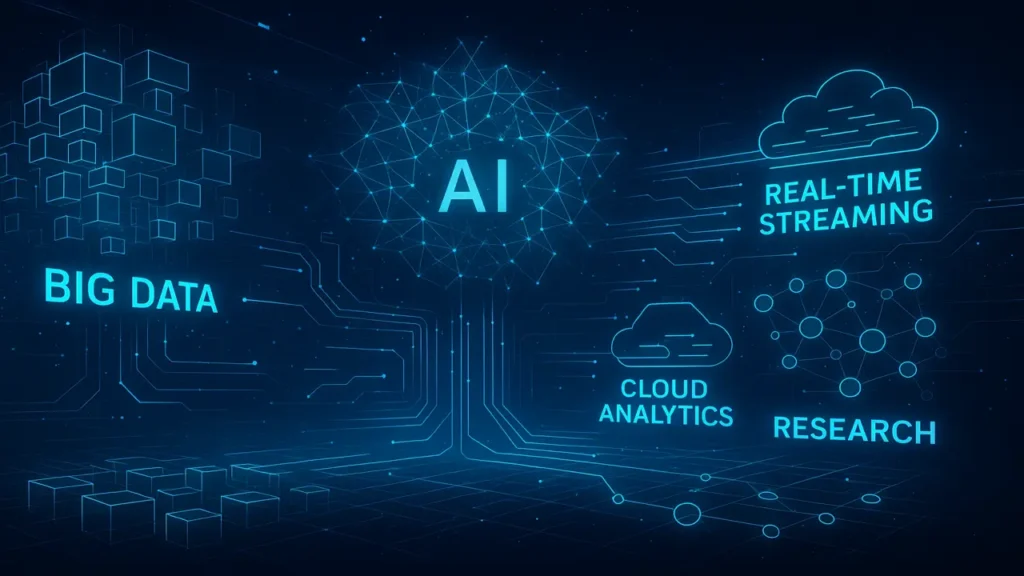
Lecture 9 explores current Data Mining trends and future research frontiers, including big data, AI integration, IoT, cloud analytics, privacy-preserving models, multimodal data, quantum computing, and modern industry applications.
Data Mining is no longer limited to simple classification, clustering, or association algorithms. The explosion of big data, advancements in AI, and increasing global connectivity have pushed data mining into a new era. Modern systems now analyze massive datasets, high-dimensional inputs, streaming data, multimodal signals, and unstructured content.
This lecture highlights the major trends shaping Data Mining today and outlines the research directions that define the future of the field.
Introduction to Modern Data Mining
Why Data Mining Is Evolving
Traditional data mining struggled with:
- Massive scale
- Real-time data
- Video, audio, text
- IoT streams
- Cloud integration
Modern applications require:
- Faster processing
- More intelligent algorithms
- Secure privacy protections
- Automated model building
- Distributed computation
Drivers of New Trends
- Explosion of big data
- Advancements in deep learning
- Cloud-native architectures
- IoT & edge devices
- Social media influence
- Awareness of ethical AI
Trend 1: Big Data & Distributed Mining
Modern organizations operate at petabyte scale.
Hadoop Ecosystem
Built for large-scale, batch processing:
- HDFS
- MapReduce
- Hive
- Pig
Suitable for:
- Log mining
- Batch analytics
- ETL pipelines
Spark & In-Memory Processing
Spark improved performance by keeping data in memory.
Used for:
- Machine learning
- Streaming processing
- Graph mining
Spark MLlib includes:
- Clustering
- Classification
- Collaborative filtering
Real-Time Data Streams
Tools:
- Apache Kafka
- Apache Flink
- Spark Streaming
Used in:
- Fraud detection
- Real-time dashboards
- IoT analytics
Trend 2: AI + Data Mining Integration
AI and Data Mining now work hand-in-hand.
Deep Learning Integration
Used for:
- Pattern learning
- Feature extraction
- Image/video analytics
Neural networks outperform manual feature engineering.
Feature Learning vs Feature Engineering
Old approach: manual selection
New approach: deep models learn features automatically.
Hybrid Models
Combining:
- Neural networks + traditional ML
- Graph models + statistics
- Reinforcement learning + mining
Examples:
- Deep & Wide models
- DeepFM (Recommender systems)
Trend 3: Mining Unstructured & High-Dimensional Data
Structured data represents less than 20% of modern datasets.
Text Mining
Includes:
- Topic modeling
- Document clustering
- NER
- Sentiment analysis
Image/Video Mining
Examples:
- Object detection
- Facial analysis
- Medical imaging
- Autonomous driving
Multimodal Data Mining
Combines:
- Text
- Image
- Audio
- Video
- Sensor data
Applications:
- Smart cities
- AR/VR
- Social AI assistants
Trend 4: Cloud & Edge Computing for Data Mining
Data is increasingly processed in the cloud or at the edge.
Cloud Platforms
- AWS EMR
- Google BigQuery
- Azure Synapse
Benefits:
- Scalability
- Low maintenance
- Global access
Serverless Mining Pipelines
Tools:
- AWS Lambda
- Google Cloud Functions
Advantages:
- No infrastructure
- Pay-per-use
- Automatic scaling
Edge AI & On-Device Mining
Critical for:
- IoT sensors
- Smart manufacturing
- Autonomous vehicles
Benefits:
- Low latency
- Privacy protection
- Offline capability
Trend 5: IoT & Sensor Data Mining
IoT generates continuous, real-time data.
Time-Series Analytics
Used for:
- Forecasting
- Control systems
- Environmental monitoring
Real-Time Anomaly Detection
Detect:
- Faults
- Attacks
- Irregular behavior
Predictive Maintenance
Mining vibration, temperature, or pressure to reduce machine downtime.
Trend 6: Social & Web Intelligence
Modern analytics heavily uses social signals.
Sentiment & Opinion Mining
Used for:
- Brand monitoring
- Political analysis
- Crisis detection
Influence Modeling
Identifies:
- Key influencers
- Trend propagators
- Fake accounts
Misinformation Detection
Using graph patterns + NLP.
Trend 7: Privacy, Security & Ethical Data Mining
With global regulations, privacy & ethics are essential.
Federated Learning
Data stays on the device only model updates move.
Used by:
- Google keyboard
- Healthcare systems
Differential Privacy
Adds controlled “noise” to protect individuals.
Bias & Fairness
Ensuring models do not discriminate based on:
- Gender
- Race
- Ethnicity
- Location
Trend 8: Explainable, Responsible & Trustworthy AI
Users demand transparency.
XAI Techniques
- SHAP values
- LIME
- Saliency maps
Model Interpretability Tools
- TensorBoard
- What-If Tool
- Explainable AI dashboards
Regulatory Frameworks
- GDPR
- CCPA
- EU AI Act
Trend 9: Automation of Data Mining (AutoML)
AutoML automates:
- Feature selection
- Model selection
- Hyperparameter tuning
- Validation
Tools:
- AutoKeras
- Google AutoML
- H2O AutoML
- TPOT
Trend 10: Quantum Data Mining
Quantum computing introduces new possibilities.
Quantum Computing Basics
Qubits replace classical bits.
Quantum Machine Learning
Algorithms:
- QKNN
- QSVM
- Variational circuits
Challenges
- Hardware limitations
- High error rates
- Expensive systems
Research Frontiers in Data Mining
1. Multimodal Learning
Models understanding text + image + audio together.
2. Graph Neural Networks (GNNs)
For:
- Social networks
- Traffic networks
- Biological networks
3. Generative Models
GANs and diffusion models used for:
- Synthetic data
- Anomaly detection
- Data augmentation
Big Data Pipeline
Data Sources → ETL → Data Lake → ML Models → DashboardsFederated Learning
Device 1 → Train locally
Device 2 → Train locally
Device 3 → Train locally
        ↓
    Aggregated Global Model
Graph Neural Network Pipeline
Nodes → Edges → Message Passing → Aggregation → PredictionsCase Studies Across Industries
Healthcare
- Radiology imaging analysis
- Disease outbreak prediction
- Patient risk scoring
E-Commerce
- Personalized recommendations
- Price optimization
- Review sentiment modeling
Cybersecurity
- Real-time attack detection
- User anomaly behavior
- Malware classification
Summary
Lecture 9 explored the latest Data Mining trends and research frontiers. From big data and AI integration to IoT, privacy-preserving models, edge analytics, AutoML, quantum computing, and GNNs you now understand how modern data mining is evolving rapidly across industries and research domains.
Next. Lecture 10 – Data Mining Implementation Using Python
People also ask:
Integration of AI/Deep Learning with traditional data mining.
Cloud platforms provide scalable, distributed, and cost-efficient mining environments.
A privacy-preserving technique where data stays on the device.
Healthcare, cybersecurity, e-commerce, IoT, and finance.
Quantum mining, GNNs, multimodal AI, and automated pipelines.