Use
map() to cube all numbers in a list.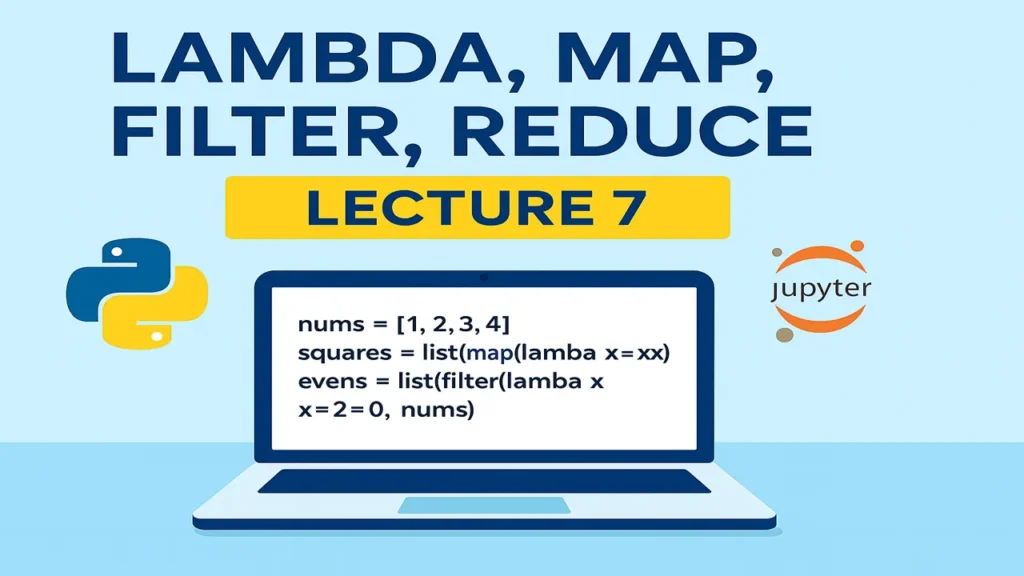
Learn Python functional programming in Lecture 7. Understand lambda expressions, map(), filter(), and reduce() with easy examples, real Data Science use-cases, MCQs, and practice tasks for beginners.
By the end of this lecture, you will understand:
What lambda (anonymous functions) are
How to write lambda expressions
When to use lambda vs normal functions
How map() transforms data
How filter() extracts useful data
How reduce() combines data
Functional programming patterns
Real Data Science examples
MCQs + practice problems
A lambda is a small, anonymous function without a name.
def square(x):
return x * xsquare = lambda x: x * xBoth give the same result.
square = lambda x: x * x
print(square(6))add = lambda a, b: a + b
print(add(5, 3))is_even = lambda n: n % 2 == 0
print(is_even(10))last_char = lambda text: text[-1]
print(last_char("Python"))data = [(1, 4), (3, 1), (2, 5)]
sorted_data = sorted(data, key=lambda x: x[1])
print(sorted_data)map(function, iterable)nums = [1, 2, 3, 4]
squares = list(map(lambda x: x * x, nums))
print(squares)raw = ["10", "20", "30"]
clean = list(map(lambda x: int(x), raw))
print(clean)temps = [0, 10, 25, 30]
fahrenheit = list(map(lambda c: (c * 9/5) + 32, temps))
print(fahrenheit)filter(function, iterable)nums = [1, 2, 3, 4, 5, 6]
evens = list(filter(lambda x: x % 2 == 0, nums))
print(evens)names = ["Ali", "Sara", "Ayesha", "Hamza"]
a_names = list(filter(lambda x: x.startswith("A"), names))
print(a_names)values = [-5, 0, 10, -2, 15]
positive = list(filter(lambda x: x > 0, values))
print(positive)Lecture 6 – Functions
(Must import from functools)
from functools import reduce
reduce(function, iterable)from functools import reduce
nums = [1, 2, 3, 4]
total = reduce(lambda a, b: a + b, nums)
print(total)product = reduce(lambda a, b: a * b, nums)
print(product)words = ["AI", "Python", "ElecturesAI"]
longest = reduce(lambda a, b: a if len(a) > len(b) else b, words)
print(longest)data = ["12", "15", "N/A", "20"]
clean = list(filter(lambda x: x != "N/A", data))
clean = list(map(lambda x: int(x), clean))
print(clean)nums = [10, 20, 30, 40]
normalized = list(map(lambda x: x / max(nums), nums))
print(normalized)values = [10, 12, 13, 500, 11, 14]
filtered = list(filter(lambda x: x < 100, values))
print(filtered)from functools import reduce
nums = [2, 3, 4]
result = reduce(lambda a, b: a + b, map(lambda x: x*x, nums))
print(result)names = ["talha", "ali", "sara"]
upper = list(map(lambda x: x.upper(), names))
print(upper)Lambda functions are:
a) Named functions
b) Anonymous functions
c) Loops
d) Classes
Answer: b) Anonymous functions
map() is used to:
a) Filter items
b) Loop manually
c) Transform each item
d) Delete items
Answer: c) Transform each item
Which module contains reduce()?
a) math
b) numpy
c) functools
d) itertools
Answer: c) functools
What will this return?
list(filter(lambda x: x > 3, [1,2,3,4,5]))Answer: [4, 5]
Next Lecture 8 – Modules & Packages
nums = [1, 2, 3, 4]
cubes = list(map(lambda x: x**3, nums))
print(cubes)words = ["python", "ai", "data", "science"]
result = list(filter(lambda x: len(x) > 5, words))
print(result)from functools import reduce
nums = [10, 55, 42, 99, 3]
max_val = reduce(lambda a, b: a if a > b else b, nums)
print(max_val)check = lambda x: x % 3 == 0
print(check(9))nums = [2, 3, 4, 5]
result = list(
filter(lambda x: x > 20,
map(lambda x: x*x, nums))
)
print(result)