What makes time-series different from normal data?
Lecture 14 – Time Series Data Mining & Sequential Pattern Analysis
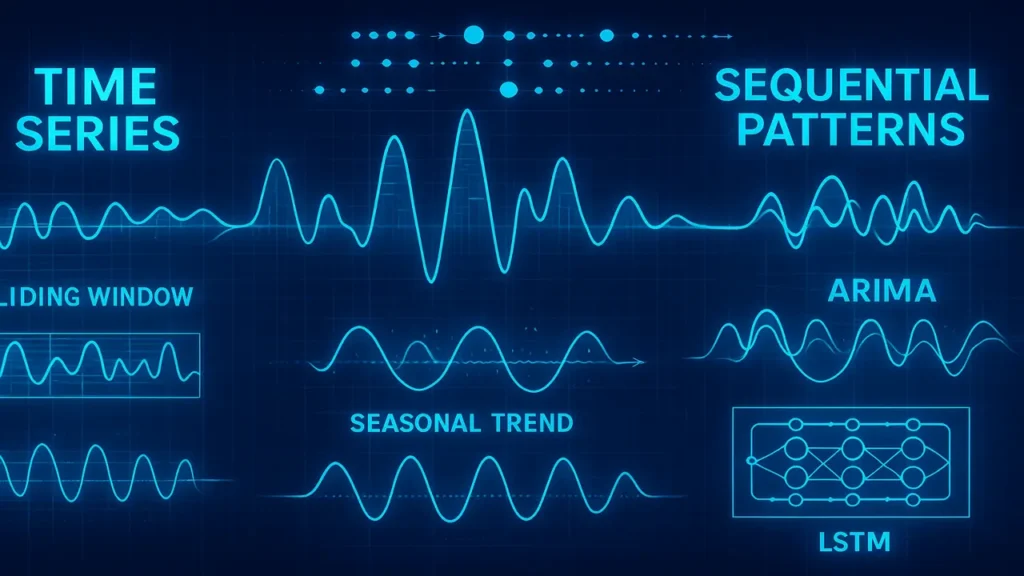
Lecture 14 explains time series data mining, sequential pattern algorithms, forecasting models (ARIMA, LSTM), preprocessing, similarity measures, anomaly detection, and real-world applications in finance, healthcare, IoT, and cybersecurity.
Time-series data is everywhere stock markets, weather sensors, medical signals, website traffic, electricity consumption, and network logs. Unlike static datasets, time-series data captures values across time, meaning patterns, trends, seasonal behaviors, and anomalies can reveal powerful insights.
This lecture teaches how to prepare, analyze, model, and mine time-series and sequential patterns for real-world AI applications.
Introduction to Time-Series Mining
What Is Time-Series Data?
Time-series data is any information recorded at regular time intervals.
Examples:
- Daily temperature
- Hourly electricity usage
- Minute-by-minute heart rate
- Stock prices every second
Why Time-Series Matters in Data Mining
Because the order of data points matters.
Time influences:
- Trends
- Cycles
- Correlations
- Patterns
- Predictions
Components of Time-Series
Trend
Long-term increase or decrease over years.
Seasonality
Repeating patterns (daily, monthly, yearly).
Cyclic Behavior
Irregular economic cycles (booms, recessions).
Noise
Random fluctuations caused by unpredictable events.
Time-Series Preprocessing
Preparing time-series data is more complex than normal datasets.
Handling Missing Time Steps
Methods:
- Forward fill
- Interpolation
- Model-based imputation
Example (Python-style):
df = df.asfreq('D').interpolate()Smoothing & Filtering
Used to remove noise.
Methods:
- Moving average
- Exponential smoothing
- Low-pass filters
Stationarity
For many forecasting models (ARIMA), data must be stationary.
Check with:
- ADF test
- Rolling mean
Fix using:
- Differencing
- Log transforms
- Detrending
Normalization & Scaling
Common techniques:
- Min-Max Scaling
- Z-score Standardization
Essential for neural networks.
Time-Series Feature Extraction
Statistical Features
- Mean
- Variance
- Skewness
- Kurtosis
Rolling Windows
Extract features over sliding windows.
Example:
df['mean_7'] = df['value'].rolling(7).mean()Fourier & Wavelet Transforms
Used to analyze frequency patterns.
Applications:
- Speech mining
- ECG signals
- Machinery vibration analysis
Sequential Pattern Mining
Sequential Pattern Mining discovers frequent sequences in ordered datasets.
GSP Algorithm (Generalized Sequential Patterns)
Steps:
- Generate candidate sequences
- Count support
- Keep frequent sequences
- Repeat
PrefixSpan Algorithm
Avoids candidate generation.
Build sequences by growing prefixes.
SPADE Algorithm
Uses vertical data format for scalability.
Time-Series Similarity Measures
Euclidean Distance
Works for equal-length, aligned sequences.
Dynamic Time Warping (DTW)
Handles sequences with different speeds.
Used for:
- Speech
- Handwriting
- Wearables
Correlation-Based Similarity
Measures how two sequences move together.
Time-Series Classification
Distance-Based Methods
- 1-NN + DTW
- Shapelet transforms
Feature-Based Methods
Extract features → use ML models.
Deep Learning Approaches
- CNN on time-series images
- RNN/LSTM
- Transformer models
Time-Series Forecasting Models
AR, MA & ARMA
Classical statistical models.
ARIMA & SARIMA
ARIMA handles:
- Trends
- Autocorrelation
- Noise
SARIMA adds:
- Seasonality
Prophet Model (by Meta/Facebook)
Great for:
- Missing data
- Holidays
- Seasonality
LSTM & GRU Models
Best for:
- Long temporal patterns
- Irregular data
- Multi-step forecasting
Diagram:
Input Sequence → LSTM Cells → Dense → ForecastLecture 13 – Deep Learning for Data Mining Foundations, Architectures & Applications
Anomaly Detection in Time-Series
Statistical Thresholding
Find outliers based on:
- Z-score
- Confidence intervals
- IQR
Isolation-Based Methods
Isolation forest isolates anomalies easily.
Autoencoder Detection
Autoencoders produce high reconstruction error for anomalies.
Real-World Applications
Finance
- Stock market prediction
- Fraud detection
- Risk scoring
Healthcare
- ECG/EEG analysis
- Patient monitoring
- Disease detection
IoT & Sensor Data
- Smart home automation
- Industrial machinery
- Environmental monitoring
Cybersecurity
- Botnet detection
- Intrusion detection
- Network traffic anomalies
Summary
Lecture 14 explored the complete world of time-series data mining: data preparation, rolling windows, sequential patterns, similarity measures, forecasting models including ARIMA and LSTM, anomaly detection, and real-world applications. Students now understand how to mine temporal data and build forecasting systems used across finance, medicine, IoT, and cyber analytics.
People also ask:
The order and timing of observations matter.
ARIMA for small datasets, LSTM for large, complex sequences.
Comparing sequences with different speeds or lengths.
Using smoothing techniques like moving averages.
Discovering common behavior sequences such as user actions or purchase paths.