10 Powerful AI Weapons Changing Warfare in 2026
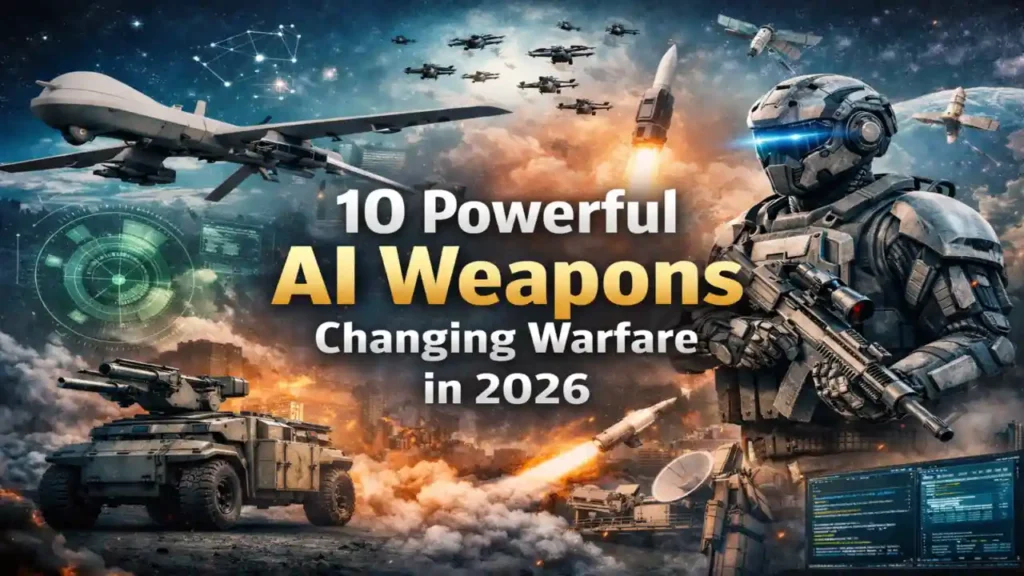
Discover 10 powerful AI weapons transforming modern warfare in 2026, including autonomous drones, military robots, missile defense systems, and AI battlefield tech.
Artificial Intelligence is rapidly transforming modern warfare. Military forces across the world are investing billions of dollars in AI-powered weapons, autonomous drones, surveillance systems, and battlefield analytics.
In recent years, AI has shifted from experimental technology to a core component of modern military strategy. Governments now rely on AI to process intelligence data, improve defense systems, and enhance battlefield awareness.
From AI drone swarms to autonomous combat vehicles, these technologies are reshaping how wars are fought and how military power is projected around the world.
In this article, we explore the top 10 military AI technologies currently used in warfare, how they work, and why they are becoming critical for national defense.
1. AI-Powered Drone Warfare
One of the most visible uses of artificial intelligence in modern warfare is AI-powered drone technology.
Military drones are now capable of performing complex tasks using AI algorithms, including:
- Target identification
- Autonomous navigation
- Real-time surveillance
- Threat detection
AI allows drones to analyze their surroundings using computer vision and machine learning models, enabling them to recognize vehicles, buildings, and potential targets.
Modern drones can also communicate with command centers and share data instantly, allowing military operators to make decisions faster.
Some advanced drones can operate semi-autonomously, meaning they can carry out missions with minimal human control.
AI drones are widely used for:
- Reconnaissance missions
- Border monitoring
- Target tracking
- Precision strikes
Because drones are cheaper than traditional aircraft, they allow militaries to conduct operations with lower costs and reduced risk to human pilots.
2. Autonomous Weapon Systems
Autonomous weapon systems represent one of the most controversial developments in military AI.
These weapons can detect, track, and attack targets automatically using AI systems.
They rely on a combination of technologies:
- Sensor networks
- Machine learning models
- Computer vision
- Real-time targeting algorithms
Examples of autonomous weapons include:
- Automated defense turrets
- Robotic combat vehicles
- AI-guided missile launch systems
Autonomous weapons are designed to react faster than human operators, which can be crucial in high-speed combat scenarios.
However, critics argue that allowing machines to make lethal decisions raises serious ethical and legal concerns.
Because of these concerns, many countries are discussing international regulations for lethal autonomous weapons systems (LAWS).
3. AI Surveillance and Military Intelligence Analysis
Modern military operations depend heavily on intelligence gathering.
Satellites, drones, radar systems, and sensors produce enormous amounts of data every day. Human analysts alone cannot process this data fast enough.
Artificial intelligence helps solve this problem.
AI systems can analyze massive datasets and identify important patterns such as:
- Enemy troop movements
- Suspicious activities
- Military equipment locations
- Supply chain logistics
Using machine learning models, AI can scan thousands of hours of surveillance footage and highlight events that require human attention.
This significantly improves situational awareness on the battlefield.
AI-powered intelligence analysis helps military leaders make better decisions and respond to threats more quickly.
4. AI Cyber Warfare Systems
Cyber warfare has become one of the most important aspects of modern military strategy.
Artificial intelligence plays a major role in both cyber defense and cyber offense.
AI-powered cybersecurity tools can:
- Detect cyber attacks instantly
- Analyze suspicious network activity
- Identify malware patterns
- Automate defensive responses
Machine learning algorithms are especially effective at detecting unusual behavior within networks, allowing systems to stop attacks before they spread.
Some governments are also exploring AI systems that can conduct cyber operations against enemy infrastructure, targeting communication networks, power grids, or military databases.
Because cyber attacks can happen within seconds, AI is becoming essential for protecting national digital infrastructure.
NATO reports when discussing AI strategy and military innovation.
5. Drone Swarm Technology
Drone swarms are groups of autonomous drones that work together using artificial intelligence.
Instead of controlling each drone individually, AI algorithms allow drones to communicate and coordinate with each other.
This enables swarm drones to:
- Share sensor information
- Adjust flight paths
- Surround targets
- Overwhelm enemy defenses
Drone swarm technology is particularly powerful because large numbers of small drones can defeat expensive defense systems.
Even if some drones are destroyed, the remaining drones can continue the mission.
Military researchers believe drone swarms could become one of the most influential technologies in future warfare.
6. AI Missile Defense Systems
Missile defense systems are becoming increasingly sophisticated thanks to artificial intelligence.
These systems use AI to analyze incoming threats and determine the best way to intercept them.
AI improves missile defense systems by:
- Predicting missile trajectories
- Identifying different types of threats
- Coordinating interception systems
- Prioritizing multiple targets
In modern defense systems, AI can analyze radar data in milliseconds, allowing faster responses than human operators.
This technology is especially important for defending against ballistic missiles, cruise missiles, and drone attacks.
7. Autonomous Military Vehicles
Artificial intelligence is also being used to develop autonomous ground vehicles for military operations.
These vehicles can perform tasks such as:
- Transporting supplies
- Scouting dangerous areas
- Supporting combat operations
- Evacuating wounded soldiers
Autonomous military vehicles rely on AI navigation systems similar to those used in self-driving cars.
They use sensors such as:
- Lidar
- Radar
- Cameras
- GPS
By removing soldiers from dangerous missions, these vehicles help reduce casualties while improving operational efficiency.
8. AI Satellite Surveillance
Satellites provide essential intelligence for military planning.
However, satellite images generate massive amounts of data that must be analyzed quickly.
AI helps by automatically scanning satellite imagery and identifying important features such as:
- Military bases
- Missile launch sites
- Aircraft movements
- Naval activity
Machine learning models trained on satellite imagery can recognize objects with remarkable accuracy.
This allows governments to monitor global military activity in near real time.
AI satellite surveillance has become a crucial tool for national security and strategic intelligence.
9. Predictive Battlefield Analytics
Artificial intelligence can also be used to predict how battles may unfold.
Predictive battlefield analytics systems analyze:
- Historical combat data
- Weather conditions
- Terrain information
- Enemy behavior patterns
Using these factors, AI can simulate potential scenarios and help military planners evaluate different strategies.
For example, AI might predict how an enemy force will react to a particular attack strategy.
This helps commanders prepare for multiple possibilities and choose the most effective approach.
Predictive analytics is becoming a key part of modern military decision-making.
10. AI-Powered Soldier Systems
Artificial intelligence is also being integrated directly into soldier equipment.
These systems aim to enhance the abilities of soldiers by providing real-time information.
Examples include:
- Smart combat helmets
- AI targeting assistance
- Augmented reality battlefield displays
- Real-time translation systems
AI-powered soldier systems can analyze battlefield data and provide recommendations instantly.
For example, a smart helmet could highlight potential threats or show nearby friendly forces on a display.
These technologies help soldiers make better decisions under stressful conditions.
The Future of AI in Warfare
Artificial intelligence is likely to become even more important in military operations over the coming decades.
Future developments may include:
- Fully autonomous combat systems
- Advanced drone swarm strategies
- AI-controlled naval fleets
- Intelligent battlefield command centers
However, these advancements also raise serious concerns.
Many experts worry about the risks of autonomous weapons and algorithmic warfare, including:
- Reduced human oversight
- Unpredictable AI behavior
- Escalation of conflicts
Because of these concerns, international organizations are discussing potential regulations for military AI technologies.
Despite the challenges, AI will continue to play a major role in shaping the future of global security.
FAQ: AI in Modern Warfare
Is artificial intelligence currently used in war?
Yes. Many modern militaries use AI for surveillance, cyber defense, drone operations, and intelligence analysis.
Which countries are leading military AI development?
Countries such as the United States, China, Israel, Russia, and the United Kingdom are major investors in military AI research.
Are autonomous weapons legal?
There is currently no universal international law banning autonomous weapons, but many organizations are calling for global regulations.
Why is AI important for modern warfare?
AI allows militaries to analyze large amounts of data, react faster to threats, and improve decision-making on the battlefield.