Digital Logic Design – 300 MCQs with Answers (Exam Prep Guide)
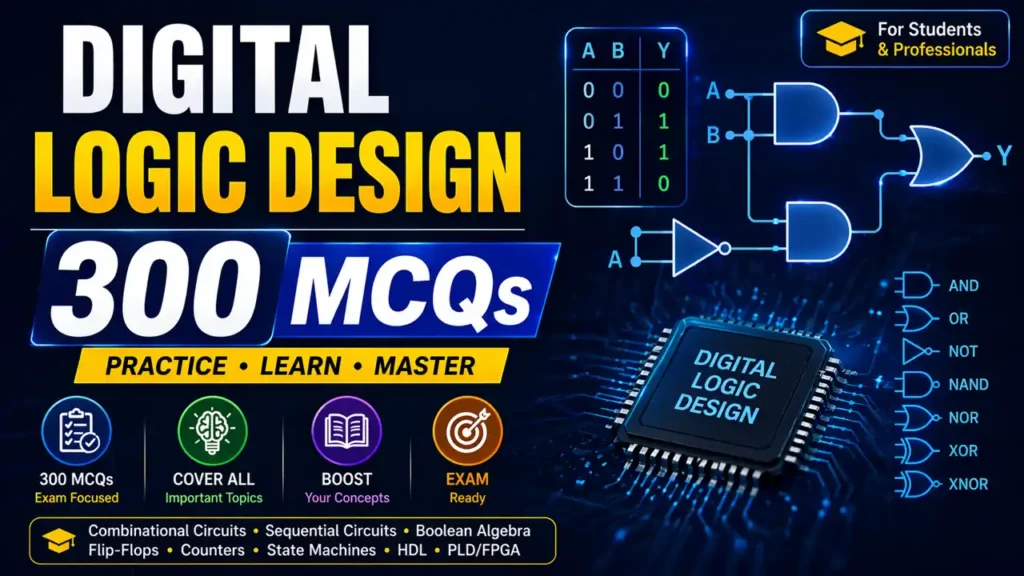
Digital Logic Design – 300 MCQs

Digital Logic Design – 300 MCQs

Course-Aligned Multiple Choice Questions for Exam Preparation

Number Systems, Gates, Boolean Algebra, K-Maps, Combinational and Sequential Circuits

300 MCQs8 Sections3 (2-3) Credit HoursSearchable
300
Total MCQs
8
Sections
DLD
Course
3 (2-3)
Credit Hours
SECTION 1: Number Systems, Codes and Binary Arithmetic (Q1-Q38)
Q1

The radix of the binary number system is:

  • A2
  • B8
  • C10
  • D16
Q2

The radix of the octal number system is:

  • A2
  • B8
  • C10
  • D16
Q3

The radix of the hexadecimal number system is:

  • A2
  • B8
  • C10
  • D16
Q4

Decimal 13 is equal to which binary number?

  • A1101
  • B1011
  • C1110
  • D1001
Q5

Binary 1010 is equal to decimal:

  • A8
  • B10
  • C12
  • D14
Q6

Binary 1111 is equal to decimal:

  • A12
  • B13
  • C14
  • D15
Q7

Hexadecimal A is equal to decimal:

  • A8
  • B9
  • C10
  • D11
Q8

Hexadecimal F is equal to decimal:

  • A13
  • B14
  • C15
  • D16
Q9

Octal 17 is equal to decimal:

  • A13
  • B14
  • C15
  • D16
Q10

The decimal number 255 in hexadecimal is:

  • AEE
  • BEF
  • CFE
  • DFF
Q11

A binary digit is called a:

  • Abyte
  • Bbit
  • Cnibble
  • Dword
Q12

A nibble contains:

  • A2 bits
  • B4 bits
  • C8 bits
  • D16 bits
Q13

A byte contains:

  • A4 bits
  • B6 bits
  • C8 bits
  • D10 bits
Q14

BCD stands for:

  • ABinary Coded Decimal
  • BBit Carry Data
  • CBinary Count Design
  • DBase Code Digit
Q15

Which of the following is a valid BCD code for decimal 9?

  • A1001
  • B1010
  • C1111
  • D1100
Q16

The 1's complement of 101100 is:

  • A010011
  • B010100
  • C101011
  • D110100
Q17

The 2's complement of 101100 is:

  • A010011
  • B010100
  • C101011
  • D110101
Q18

The 1's complement operation simply:

  • Aadds 1
  • Breverses bit order
  • Cinverts each bit
  • Ddivides by 2
Q19

The 2's complement of 0000 is:

  • A0000
  • B0001
  • C1111
  • D1000
Q20

In signed 2's complement, the MSB usually represents the:

  • Acarry bit
  • Bsign bit
  • Cparity bit
  • Dborrow bit
Q21

Adding binary 1 + 1 gives:

  • A00
  • B01
  • C10
  • D11
Q22

Adding binary 1 + 1 + 1 gives:

  • A10
  • B11
  • C100
  • D101
Q23

The carry generated by 1 + 1 in binary is:

  • A0
  • B1
  • C2
  • Ddepends on word size
Q24

Gray code is useful because adjacent numbers:

  • Ahave the same parity
  • Bdiffer in only one bit
  • Care always even
  • Duse fewer bits
Q25

Which code is non-weighted?

  • A8421 BCD
  • B2421 code
  • CGray code
  • DBinary
Q26

ASCII is primarily used to represent:

  • Alogic gates
  • Bcharacters
  • Cparity
  • Dmemory cells
Q27

The maximum unsigned decimal value of 4 bits is:

  • A7
  • B8
  • C15
  • D16
Q28

The range of an unsigned 8-bit number is:

  • A0 to 127
  • B0 to 255
  • C-128 to 127
  • D1 to 256
Q29

The binary equivalent of decimal 32 is:

  • A100000
  • B1000000
  • C10000
  • D11111
Q30

The hexadecimal equivalent of binary 1110 is:

  • AD
  • BE
  • CF
  • DA
Q31

The octal equivalent of binary 111111 is:

  • A57
  • B63
  • C77
  • D73
Q32

The decimal equivalent of binary 100000 is:

  • A16
  • B24
  • C31
  • D32
Q33

Overflow in binary addition occurs when:

  • Athe result has too many bits for the register
  • Bthe LSB becomes 1
  • Cany carry is generated
  • Dinputs are unequal
Q34

The signed 8-bit 2's complement range is:

  • A-127 to 127
  • B-128 to 127
  • C0 to 255
  • D-255 to 255
Q35

To convert a hexadecimal number to binary, each hex digit is replaced by:

  • A2 bits
  • B3 bits
  • C4 bits
  • D8 bits
Q36

To convert an octal number to binary, each octal digit is replaced by:

  • A2 bits
  • B3 bits
  • C4 bits
  • D8 bits
Q37

Which representation is commonly used for error-free mechanical position sensing?

  • ABCD
  • BGray code
  • CASCII
  • DExcess-3
Q38

Excess-3 code is obtained by adding ____ to each decimal digit in BCD.

  • A1
  • B2
  • C3
  • D4
SECTION 2: Logic Gates and Boolean Algebra (Q39-Q76)
Q39

An AND gate produces logic 1 only when:

  • Aall inputs are 0
  • Ball inputs are 1
  • Cany one input is 1
  • Dinputs are different
Q40

An OR gate produces logic 0 only when:

  • Aall inputs are 0
  • Ball inputs are 1
  • Cexactly one input is 1
  • Dinputs are different
Q41

A NOT gate is also called an:

  • Aencoder
  • Binverter
  • Cbuffer
  • Dlatch
Q42

A NAND gate is an AND gate followed by a:

  • Abuffer
  • BXOR gate
  • Cinverter
  • Dlatch
Q43

A NOR gate is an OR gate followed by a:

  • Adecoder
  • Binverter
  • Cbuffer
  • Dflip-flop
Q44

The XOR gate output is 1 when its inputs are:

  • Aboth 0
  • Bboth 1
  • Cdifferent
  • Dequal
Q45

The XNOR gate output is 1 when its inputs are:

  • Adifferent
  • Bequal
  • Cboth changing
  • Dall 0 only
Q46

Which gate is known as a universal gate?

  • AXOR only
  • BNAND only
  • CXNOR only
  • DBuffer
Q47

Which pair of gates are universal gates?

  • AAND and OR
  • BNOR and NAND
  • CXOR and XNOR
  • DAND and NOT
Q48

The Boolean expression for an AND operation is usually written with:

  • A+
  • B·
  • C'
  • D
Q49

The Boolean expression for an OR operation is usually written with:

  • A+
  • B·
  • C'
  • D
Q50

The complement of A is commonly written as:

  • AA+B
  • BA·B
  • CA'
  • DA^2
Q51

According to the identity law, A + 0 equals:

  • A0
  • B1
  • CA
  • DA'
Q52

According to the identity law, A·1 equals:

  • A0
  • B1
  • CA
  • DA'
Q53

According to the null law, A + 1 equals:

  • A0
  • B1
  • CA
  • DA'
Q54

According to the null law, A·0 equals:

  • A0
  • B1
  • CA
  • DA'
Q55

According to the idempotent law, A + A equals:

  • A0
  • B1
  • CA
  • DA'
Q56

According to the idempotent law, A·A equals:

  • A0
  • B1
  • CA
  • DA'
Q57

According to the complement law, A + A' equals:

  • A0
  • B1
  • CA
  • DA'
Q58

According to the complement law, A·A' equals:

  • A0
  • B1
  • CA
  • DA'
Q59

The involution law states that (A')' equals:

  • A0
  • B1
  • CA
  • DA'
Q60

The commutative law for OR is:

  • AA + (B + C) = (A + B) + C
  • BA + B = B + A
  • CA(B + C) = AB + AC
  • DA + AB = A
Q61

The commutative law for AND is:

  • AAB = BA
  • BA + B = B + A
  • CA + AB = A
  • DA + BC = (A + B)(A + C)
Q62

The associative law for OR is:

  • AA + (B + C) = (A + B) + C
  • BA + B = B + A
  • CAB = BA
  • DA(B + C)=AB+AC
Q63

The distributive law of AND over OR is:

  • AA(B + C) = AB + AC
  • BA + BC = (A + B)C
  • CA + B = B + A
  • DA + A' = 1
Q64

De Morgan's theorem states that (AB)' equals:

  • AA'B'
  • BA' + B'
  • CAB'
  • DA + B
Q65

De Morgan's theorem states that (A + B)' equals:

  • AA' + B'
  • BAB
  • CA'B'
  • DA + B
Q66

The absorption law A + AB simplifies to:

  • AAB
  • BA
  • CB
  • DA + B
Q67

The absorption law A(A + B) simplifies to:

  • AAB
  • BA
  • CA + B
  • DB
Q68

A buffer gate is used mainly to:

  • Ainvert a signal
  • Bstore a bit
  • Crepeat/strengthen a signal
  • Dtoggle a signal
Q69

The output of a 2-input XOR gate for inputs 1 and 1 is:

  • A0
  • B1
  • CX
  • Ddepends on delay
Q70

The output of a 2-input XNOR gate for inputs 0 and 0 is:

  • A0
  • B1
  • CX
  • Ddepends on delay
Q71

The Boolean expression A + BC can be converted using distributive law to:

  • A(A + B)(A + C)
  • BAB + AC
  • CA(B + C)
  • D(AB)C
Q72

A truth table lists:

  • Aonly input combinations
  • Bonly output states
  • Call possible input combinations and their outputs
  • Donly minimized expressions
Q73

The number of rows in the truth table of a 3-variable function is:

  • A3
  • B6
  • C8
  • D16
Q74

A minterm is a product term that contains:

  • Asome variables only
  • Ball variables exactly once
  • Conly complemented variables
  • Donly uncomplemented variables
Q75

A maxterm is a sum term that contains:

  • Aall variables exactly once
  • Bonly two variables
  • Conly literals with complements
  • Dno literals
Q76

The expression Y = A⊕B⊕Cin is commonly the sum output of a:

  • Adecoder
  • Bfull adder
  • Cmultiplexer
  • Dregister
SECTION 3: Simplification Methods: K-Map and Quine-McCluskey (Q77-Q113)
Q77

A Karnaugh map is primarily used to:

  • Astore data
  • Bminimize Boolean expressions
  • Cdraw timing diagrams
  • Dimplement memory
Q78

A 2-variable K-map contains:

  • A2 cells
  • B4 cells
  • C8 cells
  • D16 cells
Q79

A 3-variable K-map contains:

  • A4 cells
  • B6 cells
  • C8 cells
  • D16 cells
Q80

A 4-variable K-map contains:

  • A8 cells
  • B12 cells
  • C16 cells
  • D32 cells
Q81

Adjacent cells in a K-map differ in:

  • Aall bits
  • Btwo bits
  • Cone bit
  • Dthree bits
Q82

K-map adjacency follows:

  • Abinary order only
  • BGray code order
  • Cdecimal order
  • DASCII order
Q83

In K-map grouping, valid group sizes are powers of:

  • A2
  • B3
  • C5
  • D10
Q84

Which of the following is a valid K-map group size?

  • A3
  • B5
  • C6
  • D8
Q85

The purpose of making the largest possible K-map groups is to:

  • Aincrease gate count
  • Breduce literals
  • Cincrease delay
  • Davoid don't cares
Q86

A pair in a K-map eliminates:

  • A0 variables
  • B1 variable
  • C2 variables
  • D3 variables
Q87

A quad in a K-map eliminates:

  • A1 variable
  • B2 variables
  • C3 variables
  • D4 variables
Q88

An octet in a 4-variable K-map eliminates:

  • A1 variable
  • B2 variables
  • C3 variables
  • D4 variables
Q89

A group of 16 in a 4-variable K-map simplifies to:

  • Aone literal
  • Bzero literals (logic 1)
  • Ctwo literals
  • Dfour literals
Q90

K-map edges are considered adjacent because the map:

  • Ais circular conceptually
  • Buses decimal numbers
  • Chas hidden cells
  • Dhas no corners
Q91

A don't-care condition may be used to:

  • Aforce output 0 only
  • Bsimplify the expression further
  • Cavoid simplification
  • Dindicate a short circuit
Q92

The term essential prime implicant means:

  • Aa group with 2 cells
  • Ba prime implicant that covers at least one unique 1
  • Cany largest group
  • Da group using don't-cares only
Q93

Prime implicants are:

  • Aall possible non-overlapping groups
  • Bgroups that cannot be combined into larger valid groups
  • Conly essential groups
  • Dsingle-cell groups only
Q94

The Quine-McCluskey method is also called the:

  • Atabulation method
  • Bmatrix method
  • Ctruth-table method
  • Dtiming method
Q95

The Quine-McCluskey method is especially useful for:

  • Avery small functions only
  • Bcomputer-based minimization
  • Cdrawing waveforms
  • Dmemory design only
Q96

In the tabulation method, terms are first grouped by:

  • Avariable names
  • Bnumber of 1s
  • Cnumber of 0s
  • Dminterm value only
Q97

Two terms can be combined in Quine-McCluskey if they differ in:

  • Atwo bits
  • Bthree bits
  • Cone bit
  • Dno bits
Q98

The symbol '-' in Quine-McCluskey indicates:

  • Asubtraction
  • Ba don't-care bit position
  • Clogic 0
  • Dinvalid term
Q99

Sum-of-products form is an OR of:

  • Asums
  • Bproducts
  • Cminterms only
  • Dmaxterms only
Q100

Product-of-sums form is an AND of:

  • Asums
  • Bproducts
  • Cminterms
  • Dliterals only
Q101

A canonical SOP expression is formed from:

  • Amaxterms
  • Bminterms
  • Conly prime implicants
  • Donly essential implicants
Q102

A canonical POS expression is formed from:

  • Aminterms
  • Bmaxterms
  • Cpairs only
  • Dquads only
Q103

Boolean simplification aims to reduce:

  • Apower only
  • Bcost, gates, and literals
  • Cclock frequency
  • Dmemory size only
Q104

The simplified expression usually produces the same:

  • Acircuit shape
  • Btruth table
  • Cnumber of gates
  • Ddelay model
Q105

In a K-map, overlapping groups are:

  • Anever allowed
  • Ballowed when useful for simplification
  • Conly allowed for zeros
  • Dused only in POS
Q106

For POS minimization using a K-map, we group:

  • A1s
  • B0s
  • CXOR cells
  • Ddiagonals
Q107

A singleton 1 in a K-map represents:

  • Aan essential large group
  • Ba single minterm
  • Ca maxterm
  • Da don't-care only
Q108

The minimum number of literals in an implicant occurs with:

  • Athe smallest groups
  • Bthe largest groups
  • Cdiagonal groups
  • Dcorner-only groups
Q109

K-maps are practical mainly up to about:

  • A2 variables
  • B4 to 6 variables
  • C10 variables
  • D20 variables
Q110

The main limitation of K-maps is that they become hard to use for:

  • Asmall expressions
  • Bmany variables
  • CSOP forms
  • DPOS forms
Q111

A redundant group in K-map minimization is one that:

  • Acovers no needed 1s
  • Bis always essential
  • Cmust be included
  • Dcontains zeros only
Q112

When minimizing a function, don't-care cells may be treated as:

  • Aeither 0 or 1, whichever helps
  • Balways 0
  • Calways 1
  • Dinvalid
Q113

The tabulation method gives a systematic way to find:

  • Atiming hazards
  • Bprime implicants
  • Cmemory addresses
  • Dclock edges
SECTION 4: Combinational Logic Circuits and Design (Q114-Q151)
Q114

A combinational circuit's output depends on:

  • Apresent inputs only
  • Bpast history only
  • Cclock pulses only
  • Dmemory state only
Q115

A half adder adds:

  • Atwo bits and carry-in
  • Btwo bits only
  • Cthree bits
  • Dfour bits
Q116

The outputs of a half adder are:

  • Asum and difference
  • Bsum and carry
  • Cborrow and carry
  • Dproduct and carry
Q117

The sum output of a half adder is implemented using:

  • AAND
  • BOR
  • CXOR
  • DXNOR
Q118

The carry output of a half adder is implemented using:

  • AAND
  • BOR
  • CXOR
  • DNOT
Q119

A full adder adds:

  • Atwo bits
  • Btwo bits and a carry-in
  • Cthree bytes
  • Dfour inputs only
Q120

A full adder has how many inputs?

  • A2
  • B3
  • C4
  • D5
Q121

The carry-out of a full adder is 1 when:

  • Aat least two inputs are 1
  • Ball inputs are 0
  • Cexactly one input is 1
  • DCin is always 1
Q122

A half subtractor provides:

  • Asum and carry
  • Bdifference and borrow
  • Cproduct and borrow
  • Dsum and borrow
Q123

A full subtractor has inputs A, B and:

  • ACin
  • BBin
  • CClock
  • DEnable
Q124

An encoder converts:

  • Abinary information into one active output line
  • Bone active input line into binary code
  • Cserial to parallel only
  • Danalog to digital
Q125

A decoder converts:

  • Abinary code to one active output line
  • Bone active input to binary code
  • Cparallel to serial only
  • Ddecimal to BCD only
Q126

A 2-to-4 decoder has:

  • A2 inputs and 4 outputs
  • B4 inputs and 2 outputs
  • C2 outputs only
  • D4 select lines
Q127

The number of outputs of an n-to-2^n decoder is:

  • An
  • B2n
  • C2^n
  • Dn^2
Q128

A priority encoder is different from a normal encoder because it:

  • Auses memory
  • Bassigns priority to simultaneous active inputs
  • Cneeds a clock
  • Dhas only one input
Q129

A multiplexer selects:

  • Aone of many inputs to a single output
  • Bmany outputs to one input
  • Canalog levels only
  • Dmemory addresses
Q130

A 4-to-1 multiplexer has:

  • A2 select lines
  • B4 select lines
  • C1 select line
  • D8 select lines
Q131

A demultiplexer routes:

  • Aone input to one of many outputs
  • Bmany inputs to one output
  • Cbinary to decimal
  • Dsum to carry
Q132

Which combinational block can implement Boolean functions by data selection?

  • ARegister
  • BMultiplexer
  • CCounter
  • DLatch
Q133

A comparator is used to:

  • Astore binary data
  • Bcompare two binary numbers
  • Cshift data
  • Dcount pulses
Q134

A magnitude comparator determines whether:

  • AA > B, A = B, or A < B
  • BA and B are complements
  • Ccarry equals sum
  • Da number is prime
Q135

A code converter changes:

  • Afrequency
  • Bone data code to another
  • Cclock speed
  • Dmemory size
Q136

A BCD-to-7-segment decoder drives:

  • Aflip-flops
  • Bdisplays
  • CRAM cells
  • Dcounters
Q137

A parity generator is used for:

  • Aminimization
  • Berror detection support
  • Cclock generation
  • Daddress decoding only
Q138

Even parity means the total number of 1s is:

  • Aodd
  • Beven
  • Cprime
  • Dzero
Q139

A carry look-ahead adder is designed to:

  • Areduce propagation delay
  • Bincrease memory
  • Cconvert codes
  • Dstore carry bits
Q140

Ripple carry adders are slower because carry:

  • Ais ignored
  • Bpropagates stage by stage
  • Cis generated externally
  • Dis stored in RAM
Q141

The output of a decoder is usually:

  • Amutually exclusive for one input combination
  • Ball 1s always
  • Canalog
  • Dclocked
Q142

An active-low output is asserted when it is:

  • A1
  • B0
  • Cfloating
  • Dtri-stated
Q143

A tri-state buffer can output:

  • Aonly 0 or 1
  • B0, 1, or high impedance
  • Conly high impedance
  • Danalog levels
Q144

High impedance state is commonly denoted by:

  • AX
  • BZ
  • CH
  • DL
Q145

A bus is typically shared using:

  • Ahalf adders
  • Btri-state outputs
  • Clatches only
  • DXOR gates
Q146

A PLA stands for:

  • AProgrammable Logic Array
  • BParallel Logic Adapter
  • CPulse Logic Amplifier
  • DPrimary Latch Array
Q147

A ROM-based combinational design stores:

  • Aclock pulses
  • Btruth tables
  • Canalog voltages
  • Dshift operations
Q148

A combinational circuit has ____ memory.

  • Ano
  • Btemporary
  • Cinfinite
  • Dsequential
Q149

Hazards in combinational logic are unwanted:

  • Amemory states
  • Btransient glitches
  • Cclock pulses
  • Dborrows
Q150

Static hazards are often reduced by adding:

  • Aextra essential consensus terms
  • Bmore clocks
  • Cmemory cells
  • Dencoders
Q151

A full adder can be built using:

  • Atwo half adders and an OR gate
  • Bone decoder only
  • Ctwo latches
  • Done multiplexer only
SECTION 5: Flip-Flops, Latches and Sequential Circuits (Q152-Q189)
Q152

A sequential circuit differs from a combinational circuit because it has:

  • Afewer gates
  • Bmemory
  • Cno outputs
  • Donly one input
Q153

The basic memory element in digital electronics is a:

  • Adecoder
  • Blatch
  • Cencoder
  • Dadder
Q154

An SR latch has inputs:

  • AS and R
  • BJ and K
  • CD and C
  • DT and Q
Q155

The forbidden condition in a NOR-based SR latch occurs when:

  • AS=0,R=0
  • BS=0,R=1
  • CS=1,R=0
  • DS=1,R=1
Q156

A gated latch is controlled by an:

  • Aaddress line
  • Benable signal
  • Coscillator only
  • Doutput pin
Q157

A D latch eliminates the invalid SR condition by ensuring:

  • AS and R are always equal
  • BS and R are complements
  • CQ is always 1
  • Dclock is always high
Q158

A flip-flop is generally:

  • Alevel-triggered only
  • Bedge-triggered storage element
  • Canalog device
  • Dmemoryless
Q159

A D flip-flop stores the value of D on the:

  • Apower line
  • Btriggering clock edge
  • Creset line
  • Dborrow input
Q160

The characteristic equation of a D flip-flop is:

  • AQ(next)=D
  • BQ(next)=Q'
  • CQ(next)=T⊕Q
  • DQ(next)=JQ'+K'Q
Q161

A T flip-flop toggles when T equals:

  • A0
  • B1
  • CQ
  • Dclock
Q162

A T flip-flop holds its state when T equals:

  • A0
  • B1
  • CQ'
  • Denable
Q163

The JK flip-flop removes the invalid state of the:

  • AD flip-flop
  • BSR flip-flop
  • CT flip-flop
  • Dmaster-slave only
Q164

A JK flip-flop toggles when:

  • AJ=0,K=0
  • BJ=1,K=0
  • CJ=0,K=1
  • DJ=1,K=1
Q165

Asynchronous inputs in flip-flops usually include:

  • AJ and K
  • Bpreset and clear
  • Csum and carry
  • Daddress and data
Q166

The preset input forces Q to:

  • A0
  • B1
  • Ctoggle
  • Dhigh impedance
Q167

The clear input forces Q to:

  • A0
  • B1
  • Ctoggle
  • Dlatch previous state
Q168

Level-triggered devices respond during:

  • Aa clock transition only
  • Bthe active clock level
  • Cpower-up only
  • Dreset only
Q169

Edge-triggered devices respond at:

  • Aall times
  • Ba clock edge
  • Clogic 1 only
  • Dlogic 0 only
Q170

Race-around problem is associated with:

  • AD flip-flop
  • BJK flip-flop
  • CT latch
  • Dencoder
Q171

The race-around problem can be reduced by using:

  • Amaster-slave JK flip-flop
  • Bmore OR gates
  • Clarger K-map
  • Dtri-state buffers
Q172

A master-slave flip-flop uses:

  • Atwo latches in cascade
  • Btwo counters in series
  • Cone ROM and one latch
  • Dfour adders
Q173

Setup time is the minimum time data must be stable ____ the active clock edge.

  • Aafter
  • Bbefore
  • Cduring
  • Dinstead of
Q174

Hold time is the minimum time data must remain stable ____ the active clock edge.

  • Abefore
  • Bafter
  • Cwithout
  • Dinstead of
Q175

Clock-to-Q delay is the time from:

  • Ainput to output immediately
  • Bclock edge to output change
  • Cpower on to first output
  • Dreset to preset
Q176

A transparent latch means the output follows the input when:

  • Aenable is active
  • Bclock is absent
  • Creset is active
  • DQ is 1
Q177

A synchronous sequential circuit changes state based on:

  • Aclocked events
  • Btemperature
  • Cpower level only
  • Danalog inputs
Q178

The present state and input determine the:

  • Asupply voltage
  • Bnext state
  • Cradix
  • Dfan-out only
Q179

A state table lists:

  • ABoolean identities
  • Bpresent states, inputs, next states, and outputs
  • Conly gate symbols
  • Donly waveforms
Q180

A state diagram represents:

  • Amemory layout
  • Bstate transitions graphically
  • CK-map groups
  • Dnumber systems
Q181

The output of a Moore machine depends on:

  • Apresent state only
  • Bpresent input only
  • Cpresent state and input
  • Dclock frequency
Q182

The output of a Mealy machine depends on:

  • Apresent state only
  • Bpresent input only
  • Cpresent state and input
  • Dprevious output only
Q183

A Mealy machine often reacts:

  • Aslower because output waits for state change
  • Bfaster to input changes
  • Conly on reset
  • Donly after two clocks
Q184

State reduction aims to:

  • Aincrease states
  • Bremove equivalent states
  • Cremove all outputs
  • Davoid clocks
Q185

Equivalent states are states that:

  • Ahave same name
  • Bproduce identical behavior for all inputs
  • Cuse same flip-flop
  • Dhave different outputs always
Q186

State assignment means:

  • Aassigning binary codes to symbolic states
  • Bassigning addresses to RAM
  • Cchoosing power supply
  • Dselecting clock speed
Q187

Sequential logic analysis often starts with:

  • AK-map only
  • Bstate equations and flip-flop characteristics
  • CROM contents only
  • Ddecimal conversion
Q188

The characteristic equation of a T flip-flop is:

  • AQ(next)=D
  • BQ(next)=T⊕Q
  • CQ(next)=Q
  • DQ(next)=J+K
Q189

The characteristic equation of a JK flip-flop is:

  • AQ(next)=JQ'+K'Q
  • BQ(next)=D
  • CQ(next)=TQ
  • DQ(next)=Q'
SECTION 6: Counters and Shift Registers (Q190-Q226)
Q190

A counter is a sequential circuit that:

  • Acompares numbers
  • Bcounts clock pulses
  • Cstores analog values
  • Dsimplifies expressions
Q191

An asynchronous counter is also called a:

  • Aring counter
  • Bripple counter
  • CJohnson counter
  • Ddown counter
Q192

A synchronous counter clocks all flip-flops:

  • Aat different times
  • Bsimultaneously
  • Cthrough the output of previous stage
  • Dthrough RAM
Q193

Ripple counters are simpler but have more:

  • Apower gain
  • Bpropagation delay
  • Cmemory capacity
  • Dfan-in
Q194

A mod-8 counter requires how many flip-flops?

  • A2
  • B3
  • C4
  • D8
Q195

A mod-16 counter requires how many flip-flops?

  • A2
  • B3
  • C4
  • D5
Q196

The modulus of a counter is the:

  • Aclock frequency
  • Bnumber of states
  • Cnumber of inputs
  • Dnumber of outputs
Q197

A binary up-counter counts:

  • Ahighest to lowest only
  • Bin increasing binary sequence
  • Cin Gray code only
  • Dodd numbers only
Q198

A down-counter counts:

  • Aupward only
  • Bin decreasing sequence
  • Cin Gray order
  • Drandomly
Q199

An up/down counter can count:

  • Aonly up
  • Bonly down
  • Cboth upward and downward
  • Donly mod-2
Q200

A decade counter is a:

  • Amod-8 counter
  • Bmod-10 counter
  • Cmod-12 counter
  • Dmod-16 counter
Q201

A truncated counter is one that:

  • Auses all states
  • Buses fewer than 2^n states
  • Chas no outputs
  • Dcounts only once
Q202

Counter decoding is used to:

  • Adetect a particular count
  • Binvert a signal
  • Cstore data
  • Dincrease setup time
Q203

A ring counter is made from a shift register with:

  • Acomplement feedback
  • Bdirect feedback of one output
  • Cno feedback
  • Ddecoder feedback
Q204

A Johnson counter is also called a:

  • Atwisted ring counter
  • Bpriority counter
  • Clook-ahead counter
  • Dripple subtractor
Q205

An n-bit ring counter has how many valid states?

  • An
  • B2n
  • C2^n
  • Dn^2
Q206

An n-bit Johnson counter has how many valid states?

  • An
  • B2n
  • C2^n
  • Dn^2
Q207

A shift register is used to:

  • Acount only
  • Bshift stored bits left or right
  • Ccompare numbers only
  • Dminimize logic
Q208

A SISO register stands for:

  • ASerial-In Serial-Out
  • BSingle-In Single-Out
  • CSynchronous-In Shift-Out
  • DSerial-In Shift-Only
Q209

A SIPO register stands for:

  • ASerial-In Parallel-Out
  • BSingle-In Parallel-Out
  • CSerial-In Pulse-Out
  • DShift-In Parallel-Out
Q210

A PISO register stands for:

  • AParallel-In Serial-Out
  • BPulse-In Shift-Out
  • CParallel-In Synchronous-Out
  • DPriority-In Serial-Out
Q211

A PIPO register stands for:

  • AParallel-In Parallel-Out
  • BParallel-In Pulse-Out
  • CPulse-In Parallel-Out
  • DPriority-In Parallel-Out
Q212

Shifting left by one bit in unsigned binary is equivalent to:

  • Adividing by 2
  • Bmultiplying by 2
  • Cadding 1
  • Dsubtracting 1
Q213

Shifting right by one bit in unsigned binary is equivalent to:

  • Amultiplying by 2
  • Bdividing by 2
  • Cadding 2
  • Dcomplementing
Q214

A universal shift register can:

  • Aonly shift left
  • Bonly shift right
  • Conly load parallel data
  • Dperform multiple modes including shift and parallel load
Q215

The serial output of a shift register is usually taken from:

  • Aone end stage
  • Ball stages at once
  • Cthe clock line
  • Dthe reset line
Q216

A bidirectional shift register can shift:

  • Aonly left
  • Bonly right
  • Cleft and right
  • Dnot at all
Q217

Parallel load means:

  • Aloading all bits simultaneously
  • Bloading one bit per clock
  • Cresetting all outputs
  • Dreading outputs only
Q218

A ring counter typically starts with:

  • Aall zeros
  • Bone-hot pattern
  • CGray code
  • Dalternating ones
Q219

A Johnson counter sequence length of a 4-bit design is:

  • A4
  • B6
  • C8
  • D16
Q220

In a ripple counter, the clock of each stage is driven by:

  • Acommon system clock
  • Bprevious stage output
  • Cdecoder output
  • Dpreset line
Q221

Synchronous counters are generally preferred for high speed because they:

  • Ause fewer gates always
  • Breduce cumulative ripple delay
  • Cneed no clock
  • Dstore more bits
Q222

The terminal count output usually indicates:

  • Athe counter is disabled
  • Ba specific count has been reached
  • Cthe clock is low
  • Dmemory overflow
Q223

A load input on a counter is used to:

  • Aclear the counter only
  • Bpreset a value
  • Cdouble the frequency
  • Dinvert all bits
Q224

A ring counter is less hardware-efficient than a binary counter because it uses:

  • Amore flip-flops for same number of states
  • Bfewer outputs
  • Cno feedback
  • Danalog storage
Q225

Frequency division can be achieved using:

  • Ashift registers only
  • Bcounters
  • Cencoders only
  • Ddecoders only
Q226

A divide-by-2 circuit can be realized using a toggle flip-flop driven by:

  • Areset
  • Bclock
  • Cpreset
  • Ddata bus
SECTION 7: Memory Elements and State Machines (Q227-Q263)
Q227

RAM stands for:

  • ARead Access Memory
  • BRandom Access Memory
  • CReadily Available Memory
  • DRandom Array Module
Q228

ROM stands for:

  • ARead Only Memory
  • BRandom Output Memory
  • CRegister Only Memory
  • DRead Open Module
Q229

SRAM stores data using:

  • Acapacitors
  • Bflip-flop cells
  • Cmagnetic cores
  • DEPROM cells
Q230

DRAM stores data using:

  • Aflip-flops
  • Bcapacitors
  • Cfuses
  • Dinductors
Q231

DRAM needs periodic:

  • Aminimization
  • Brefresh
  • Cencoding
  • Dtri-stating
Q232

SRAM is generally ____ than DRAM.

  • Aslower and denser
  • Bfaster and less dense
  • Cslower and cheaper
  • Didentical in structure
Q233

ROM is mainly used for:

  • Atemporary data storage
  • Bpermanent or fixed data
  • Cclock generation
  • Dcounting pulses
Q234

PROM can be programmed:

  • Amany times electrically
  • Bonce only
  • Cnever
  • Donly by CPU at runtime
Q235

EPROM can be erased using:

  • Amagnetic field
  • Bultraviolet light
  • Csound waves
  • Dclock pulses
Q236

EEPROM can be erased:

  • Aelectrically
  • Bonly by UV light
  • Conly once
  • Dmechanically
Q237

Flash memory is a type of:

  • Avolatile RAM
  • Bnon-volatile EEPROM family
  • Cdecoder
  • Dregister
Q238

A memory cell stores:

  • Aone bit
  • Bone byte always
  • Cone word always
  • Done address
Q239

The number of address lines needed for 1024 locations is:

  • A8
  • B9
  • C10
  • D11
Q240

The number of data lines determines the memory:

  • Aspeed only
  • Bword width
  • Cnumber of locations
  • Drefresh rate
Q241

MAR in a computer system typically stands for:

  • AMemory Address Register
  • BMain Access RAM
  • CMapped Array Register
  • DMemory Arithmetic Register
Q242

MDR or MBR is used to hold:

  • Aaddresses
  • Bdata being read or written
  • Cclock signals
  • Donly instructions
Q243

An address decoder in memory selects:

  • Athe required location
  • Bthe clock edge
  • Cthe parity bit
  • Dthe carry line
Q244

Read operation means:

  • Adata is stored
  • Bdata is retrieved from memory
  • Call memory is cleared
  • Daddress is encoded
Q245

Write operation means:

  • Adata is retrieved
  • Bdata is stored into memory
  • Caddress bus is disabled
  • Dclock is halted
Q246

Volatile memory loses data when:

  • Aclock stops
  • Bpower is removed
  • Caddress changes
  • Doutput is disabled
Q247

Non-volatile memory retains data when:

  • Apower is off
  • Bclock is high only
  • Caddress is zero
  • Doutput is floating
Q248

Cache memory is typically implemented with:

  • ADRAM
  • BSRAM
  • CROM
  • DPROM
Q249

Main memory is commonly implemented with:

  • ASRAM only
  • BDRAM
  • CEPROM
  • Dflip-flops only
Q250

A register is a group of:

  • Acounters
  • Bflip-flops
  • Cdecoders
  • DMUXes only
Q251

The finite state machine model is used to design:

  • Asequential control circuits
  • Bnumber systems
  • Cstatic truth tables only
  • Donly memories
Q252

A state variable represents:

  • Asupply voltage
  • Bstored information about current state
  • Cinput polarity
  • Dfan-out
Q253

Unused states in sequential design should generally be:

  • Aignored completely
  • Bconsidered for safe recovery
  • Cforced to analog
  • Dmade outputs only
Q254

A state assignment with fewer bit changes may reduce:

  • Agate delays and glitches
  • Bmemory width
  • Cclock count
  • Dnumber systems
Q255

A one-hot state assignment uses:

  • Aone flip-flop per state
  • Bone state per clock
  • Conly one gate total
  • Done input per state
Q256

Binary state assignment tries to use:

  • Amaximum flip-flops
  • Bminimum number of state bits
  • Canalog encoding
  • DASCII encoding
Q257

The excitation table of a flip-flop tells the inputs needed for:

  • Aa desired state transition
  • Ba K-map group
  • Ca memory address
  • Da Gray code conversion
Q258

For a D flip-flop, the required excitation to get next state 1 is:

  • AD=0
  • BD=1
  • Ctoggle only
  • Ddepends on present state
Q259

For a T flip-flop, if present state equals next state, T should be:

  • A0
  • B1
  • CX only
  • Dinvalid
Q260

For a T flip-flop, if present state must change, T should be:

  • A0
  • B1
  • CQ
  • DQ'
Q261

FSM outputs can be represented conveniently in a:

  • Afrequency plot
  • Bstate table or state diagram
  • CBCD code only
  • Dmemory map only
Q262

Synchronous memory interfaces often use control lines such as:

  • Aread/write and chip select
  • Bsum and carry
  • CJ and K
  • Dpreset and clear only
Q263

Memory expansion can be done by increasing:

  • Aaddress space, word width, or both
  • Bclock edge only
  • CGray code only
  • Dfan-out only
SECTION 8: Programmable Logic Devices, HDL and Simulation Tools (Q264-Q300)
Q264

CPLD stands for:

  • AComplex Programmable Logic Device
  • BCentral Programmable Logic Design
  • CConfigured Pulse Logic Device
  • DComplex Pulse Logic Driver
Q265

FPGA stands for:

  • AField Programmable Gate Array
  • BFixed Programmable Gate Array
  • CField Pulse Gate Array
  • DFast Programmable Grid Array
Q266

A PLD is mainly used to:

  • Adesign configurable digital logic
  • Bstore analog waveforms
  • Creplace power supplies
  • Dmeasure voltage
Q267

Compared with discrete gates, PLDs usually offer:

  • Aless flexibility
  • Bmore integration and reconfigurability
  • Conly analog behavior
  • Dno debugging support
Q268

An FPGA is built from configurable logic blocks and:

  • Atransistors only
  • Bprogrammable interconnects
  • Cmagnetic cores
  • Dvacuum tubes
Q269

A CPLD usually has architecture based on:

  • ALUT arrays only
  • Bsum-of-products macro cells
  • Canalog switches only
  • DDRAM banks only
Q270

FPGA configuration is typically stored in:

  • Amask ROM permanently only
  • Bconfiguration memory loaded at startup
  • CSR latch only
  • DBCD cells
Q271

A hardware description language is used to:

  • Adraw only schematics
  • Bdescribe digital circuits textually
  • Csimulate analog noise only
  • Dreplace compilers
Q272

Verilog HDL is commonly used for:

  • Adigital design and simulation
  • Bonly database queries
  • Cmechanical drawing
  • Dnetwork routing
Q273

VHDL stands for:

  • AVery High-speed Hardware Description Language
  • BVisual Hardware Design Logic
  • CVerified HDL
  • DVirtual Hardware Definition Language
Q274

A module in Verilog is similar to a:

  • Amemory cell
  • Bdesign block/entity
  • Cclock source
  • DK-map
Q275

The keyword used to declare a module in Verilog is:

  • Aentity
  • Bmodule
  • Cdesign
  • Dblock
Q276

In Verilog, an always block is commonly used to model:

  • Abehavioral or sequential logic
  • Bonly comments
  • Cdecimal conversions
  • Dpower rails
Q277

A continuous assignment in Verilog uses the keyword:

  • Areg
  • Balways
  • Cassign
  • Dmodule
Q278

The non-blocking assignment operator in Verilog is:

  • A=
  • B<=
  • C=>
  • D:=
Q279

Non-blocking assignments are generally preferred in clocked always blocks to model:

  • Acombinational logic
  • Bsequential logic
  • Canalog signals
  • Dpower states
Q280

A testbench is used to:

  • Afabricate a chip
  • Bverify a design by simulation
  • Cminimize K-maps
  • Dincrease fan-out
Q281

Simulation helps designers to:

  • Aavoid all hardware forever
  • Bverify functionality before implementation
  • Creplace logic equations
  • Dremove clocks
Q282

Synthesis converts HDL into:

  • AEnglish text
  • Bhardware implementation netlist
  • Canalog plots
  • Dmemory dumps
Q283

Timing simulation checks:

  • Aonly Boolean correctness
  • Bbehavior with delays
  • Conly syntax
  • Donly comments
Q284

A LUT inside an FPGA is primarily used to implement:

  • Amemory refresh
  • Bcombinational logic functions
  • Cpower regulation
  • Dserial communication only
Q285

An HDL description can be written at behavioral, dataflow, and:

  • Amechanical
  • Bstructural
  • Cchemical
  • Ddecimal
Q286

MultiSim is commonly used for:

  • Acircuit simulation
  • Bword processing
  • Cdatabase management
  • Dvideo editing
Q287

In laboratory work, waveform viewers help observe:

  • Asignal changes over time
  • BK-map groups only
  • Conly decimal values
  • Dpower consumption only
Q288

A pin constraint file in FPGA flow is used to:

  • Aassign top-level ports to physical pins
  • Bstore RAM contents
  • Cminimize logic
  • Dcreate K-maps
Q289

A clock constraint in FPGA design is used to:

  • Arename signals
  • Bdefine timing requirements
  • Cerase configuration
  • Dcreate ROM
Q290

Debouncing is often needed for:

  • Amechanical push buttons
  • BROM cells
  • Cdecoders
  • DK-map cells
Q291

Metastability is a concern when:

  • Aadding binary numbers
  • Bcrossing asynchronous signals into clocked logic
  • Cdrawing truth tables
  • Dusing Gray code only
Q292

A synchronizer is used to:

  • Aincrease memory size
  • Breduce metastability risk
  • Cminimize SOP
  • Dimplement a decoder
Q293

Finite state machines on FPGA are usually coded using:

  • AHDL processes/always blocks
  • Bspreadsheets only
  • CASCII tables
  • Danalog equations
Q294

Bitstream file in FPGA flow contains:

  • Asource comments
  • Bconfiguration data for the FPGA
  • Ctiming waveforms only
  • Dtruth tables only
Q295

A schematic capture tool allows designers to:

  • Adraw circuits graphically
  • Bcompile C code
  • Crefresh DRAM
  • Derase EEPROM
Q296

Design hierarchy in HDL helps by:

  • Amaking designs modular and reusable
  • Bremoving all bugs automatically
  • Celiminating clocks
  • Davoiding simulation
Q297

A combinational always block in Verilog should be sensitive to:

  • Aclock only
  • Ball relevant inputs
  • Creset only
  • Doutput only
Q298

The statement `case` in HDL is often used to model:

  • Aselection behavior
  • Banalog oscillation
  • Cmemory fabrication
  • Dpower gating
Q299

In FPGA labs, seven-segment displays, LEDs and switches are examples of:

  • AI/O peripherals
  • Bmemory arrays
  • CK-maps
  • DHDL operators
Q300

The main purpose of learning HDL in Digital Logic Design is to:

  • Awrite essays
  • Bmodel, simulate and implement hardware circuits
  • Creplace Boolean algebra completely
  • Davoid understanding logic

4 Comments

    • 📚 Boost Your Learning with Quality Educational Content!

      Are you looking for well-structured notes, clear lectures, and exam-ready questions with answers — all in proper English?
      Join our WhatsApp channel and stay ahead in your studies! 🚀
      ✔️ Easy-to-understand notes
      ✔️ Concept-based lectures
      ✔️ Important MCQs & solved questions
      ✔️ Regular updates for exam preparation

      👉 Follow now and never miss an important update:
      https://whatsapp.com/channel/0029VbCBele72WU5CJvllA0p

      📢 Don’t just study… study smart!

    • 📚 Boost Your Learning with Quality Educational Content!

      Are you looking for well-structured notes, clear lectures, and exam-ready questions with answers — all in proper English?
      Join our WhatsApp channel and stay ahead in your studies! 🚀
      ✔️ Easy-to-understand notes
      ✔️ Concept-based lectures
      ✔️ Important MCQs & solved questions
      ✔️ Regular updates for exam preparation

      👉 Follow now and never miss an important update:
      https://whatsapp.com/channel/0029VbCBele72WU5CJvllA0p

      📢 Don’t just study… study smart!

Leave a Reply

Your email address will not be published. Required fields are marked *