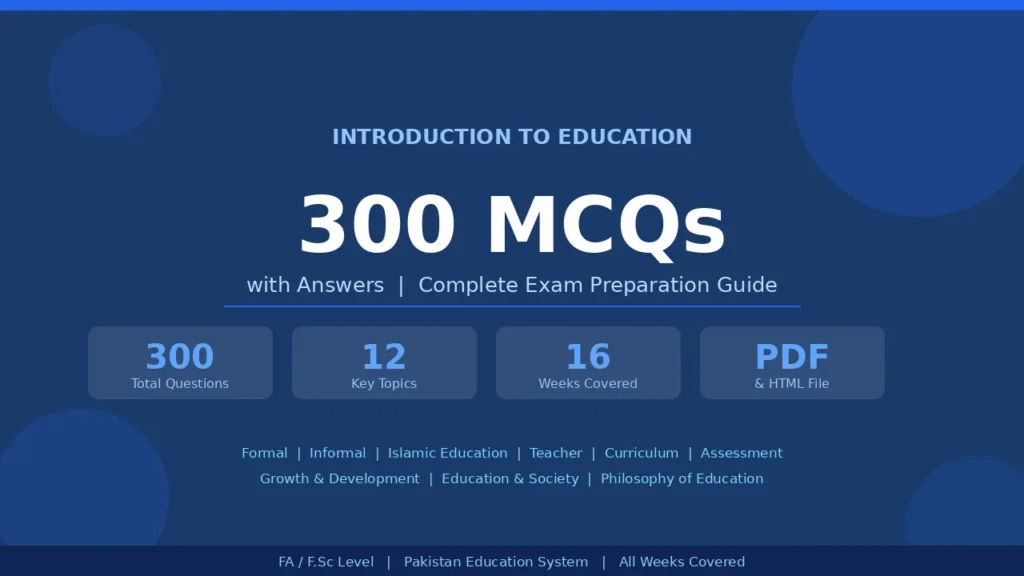
Introduction to Education – 300 MCQs with Answers | Complete Exam Preparation Guide
📚 Introduction to Education
Complete MCQ Preparation Guide
Course: Education History, Foundations & Philosophy
300 MCQs
9 Sections
Weeks 1–16
FA/F.Sc Level
Showing 300 of 300 questions
Section 1: Concept and Meaning of Education
Q1
Education is derived from the Latin word:
Q2
Which of the following BEST defines education?
Q3
Education is a:
Q4
Which philosopher defined education as ‘the creation of a sound mind in a sound body’?
Q5
John Dewey defined education as:
Q6
Effective education focuses on:
Q7
Which is NOT a characteristic of effective education?
Q8
The concept of effective education emphasizes:
Q9
Education that develops the capacity to think independently is called:
Q10
The main aim of education according to Islamic philosophy is:
Q11
Education helps an individual to:
Q12
Which of the following is a NARROW definition of education?
Q13
Which is a BROAD definition of education?
Q14
Plato believed the aim of education is to:
Q15
Education as a social process means:
Q16
The word ‘pedagogy’ refers to:
Q17
Which element is essential for effective education?
Q18
Education that focuses only on passing exams is called:
Q19
Informal education is characterized by:
Q20
Which is the most important goal of education?
Section 2: Teacher and Education
Q21
The most important personal characteristic of an effective teacher is:
Q22
An effective teacher must have:
Q23
Which professional characteristic is essential for an effective teacher?
Q24
A teacher who adapts teaching methods to student needs demonstrates:
Q25
Good communication is a _____ characteristic of an effective teacher:
Q26
Which personal trait helps a teacher build trust with students?
Q27
An effective teacher should be:
Q28
Patience is a _____ characteristic of an effective teacher:
Q29
A teacher’s professional characteristic includes:
Q30
Which of the following reflects a teacher’s professionalism?
Q31
An effective teacher uses feedback to:
Q32
The role of a teacher in modern education is:
Q33
Which is a personal characteristic of a teacher?
Q34
Teachers who update their knowledge regularly demonstrate:
Q35
A teacher’s enthusiasm for the subject:
Q36
Which is NOT a professional characteristic of a teacher?
Q37
A teacher who respects cultural differences in the classroom shows:
Q38
Creativity in teaching means:
Q39
A teacher’s relationship with students should be based on:
Q40
Effective questioning by a teacher helps to:
Q41
Which characteristic makes a teacher a role model?
Q42
Classroom management is a _____ skill of the teacher:
Q43
Which of the following is an example of a teacher’s personal characteristic?
Q44
A teacher who maintains student records and grades carefully is showing:
Q45
Collaboration with other teachers is a sign of:
Section 3: Islamic Education
Q46
The first word revealed in the Quran was:
Q47
In Islamic education, the primary source of knowledge is:
Q48
The Hadith refers to:
Q49
Islamic education aims to develop:
Q50
The traditional mode of Islamic education in Pakistan includes:
Q51
In Islamic thought, seeking knowledge is:
Q52
The Quran promotes which type of education?
Q53
A Maktab is:
Q54
Ijtihad in Islamic education refers to:
Q55
Which Caliph established the famous Bayt al-Hikmah (House of Wisdom)?
Q56
In Islamic education, the teacher is compared to:
Q57
The concept of ‘Tarbiyah’ in Islamic education means:
Q58
The concept of ‘Taleem’ in Islamic education refers to:
Q59
Islamic Golden Age scholars contributed to:
Q60
Ibn Khaldun is famous for his contribution to:
Q61
The Hadith ‘Seek knowledge from the cradle to the grave’ emphasizes:
Q62
In Islamic education, both religious and worldly knowledge is:
Q63
The Madrassa system in Pakistan primarily teaches:
Q64
Character building in Islamic education is done through:
Q65
Which mode of Islamic education focuses on memorization of the Holy Quran?
Section 4: Modes of Education
Q66
Formal education is characterized by:
Q67
Informal education occurs:
Q68
Non-formal education is:
Q69
An example of formal education is:
Q70
An example of informal education is:
Q71
An example of non-formal education is:
Q72
Formal education awards:
Q73
Informal education is:
Q74
Distance education is an example of:
Q75
Which mode of education has a fixed curriculum and timetable?
Q76
Learning traffic rules by living in a city is an example of:
Q77
AIOU (Allama Iqbal Open University) represents:
Q78
Which mode of education is most flexible in terms of time and place?
Q79
Formal education is delivered by:
Q80
Non-formal education primarily serves:
Q81
Learning moral values from family and community is:
Q82
Which mode of education is evaluated through standardized exams?
Q83
A skill development workshop is an example of:
Q84
Which mode of education lasts throughout life without deliberate planning?
Q85
Primary school education in Pakistan is part of:
Q86
Which mode of education has no recognized qualifications?
Q87
Learning from watching YouTube videos casually at home is:
Q88
Which of the following is true about non-formal education?
Q89
Community-based literacy programs in Pakistan represent:
Q90
Which mode of education is the OLDEST form of education?
Section 5: Fundamentals of Education
Q91
The role of a teacher includes:
Q92
Curriculum refers to:
Q93
The hidden curriculum refers to:
Q94
A teacher’s primary responsibility is to:
Q95
Curriculum design begins with defining:
Q96
Which factor is most important in curriculum development?
Q97
The meaning of curriculum in Latin is:
Q98
A teacher as a ‘facilitator’ means:
Q99
Which is NOT a role of a teacher?
Q100
Co-curricular activities are part of:
Q101
The concept of curriculum includes:
Q102
A teacher who motivates students to achieve their best is fulfilling which role?
Q103
Curriculum evaluation is done to:
Q104
A teacher’s role as a counselor involves:
Q105
Effective curriculum considers students’:
Q106
Which is a foundation of education?
Q107
Philosophical foundation of education deals with:
Q108
Sociological foundation of education studies:
Q109
Psychological foundation of education focuses on:
Q110
Historical foundation of education helps us understand:
Q111
Teacher as a ‘nation builder’ implies:
Q112
The term ‘pedagogy’ is best described as:
Q113
Subject-centered curriculum focuses on:
Q114
Child-centered curriculum focuses on:
Q115
Society-centered curriculum focuses on:
Section 6: Teaching-Learning Process
Q116
Instruction refers to:
Q117
Effective instruction must be aligned with:
Q118
The primary purpose of instruction is:
Q119
Assessment in education means:
Q120
Formative assessment is done:
Q121
Summative assessment is done:
Q122
Which is an example of formative assessment?
Q123
Methods of educational assessment include:
Q124
The learning environment refers to:
Q125
A positive learning environment is characterized by:
Q126
Student motivation in teaching-learning means:
Q127
Intrinsic motivation is driven by:
Q128
Extrinsic motivation comes from:
Q129
Maslow’s Hierarchy of Needs is relevant to motivation because:
Q130
A motivated student is more likely to:
Q131
Teaching methods refer to:
Q132
The lecture method is best described as:
Q133
Discussion method encourages:
Q134
A good teaching method should:
Q135
Effective instruction is:
Q136
The concept of ‘teaching’ means:
Q137
Learning is defined as:
Q138
Characteristics of a positive learning environment include:
Q139
The importance of student motivation in learning is that:
Q140
Which method promotes hands-on learning and problem solving?
Q141
Concept mapping as a teaching tool helps students:
Q142
Teacher’s feedback to students should be:
Q143
The concept of ‘chrematistics’ of good teaching methods refers to:
Q144
Good teaching methods should be:
Q145
Educational assessment helps teachers to:
Section 7: Education and Individual
Q146
Growth in education refers to:
Q147
Development in education refers to:
Q148
The main difference between growth and development is:
Q149
Educational psychological development studies:
Q150
Piaget’s theory of cognitive development describes:
Q151
Erikson’s theory focuses on:
Q152
Vygotsky’s concept of Zone of Proximal Development (ZPD) means:
Q153
Social development of an individual refers to:
Q154
Moral development of an individual involves:
Q155
Kohlberg’s theory of moral development has how many stages?
Q156
Which psychologist is famous for the theory of 8 stages of psychosocial development?
Q157
The principle of ‘individual differences’ in education means:
Q158
Scaffolding in education refers to:
Q159
Social and moral development is important because:
Q160
Difference between social and moral development is that:
Q161
Educational psychology helps teachers to:
Q162
Behavioral learning theory is associated with:
Q163
Cognitive learning theory focuses on:
Q164
Which stage of Piaget’s theory involves abstract thinking?
Q165
An adolescent’s social development is influenced by:
Q166
Emotional development is important in education because:
Q167
Heredity as a factor in development refers to:
Q168
Environment as a factor in development includes:
Q169
Nature vs. Nurture debate in education concerns:
Q170
Inclusive education means:
Q171
Special education serves:
Q172
The development of an individual is affected by:
Q173
The pre-operational stage of Piaget (ages 2-7) is characterized by:
Q174
Concrete operational stage of Piaget (ages 7-11) involves:
Q175
What does ‘holistic development’ of an individual mean?
Section 8: Education and Society
Q176
Education and Economics are related because:
Q177
Human capital theory in education states:
Q178
Education contributes to societal uplift by:
Q179
Ethics in education refers to:
Q180
Social mobility through education means:
Q181
Education promotes democratic values by:
Q182
Social inequality in education refers to:
Q183
Education for Sustainable Development (ESD) focuses on:
Q184
Universal education means:
Q185
Education eliminates social problems by:
Q186
Gender equality in education means:
Q187
Education and national development are related because:
Q188
The role of education in cultural preservation is to:
Q189
Education promotes peace by:
Q190
The social function of education includes:
Q191
Education and societal uplift in Pakistan requires:
Q192
The relationship between education and ethics means:
Q193
Critical thinking developed through education helps society by:
Q194
Education reduces poverty by:
Q195
Professional ethics for teachers requires:
Q196
Pakistan’s Education Policy aims to:
Q197
Social problems like child labor are connected to education because:
Q198
Civic education develops:
Q199
Access to education in Pakistan is affected by:
Q200
Education contributes to health and well-being by:
Q201
The relationship between education and economics in Pakistan suggests:
Q202
Social responsibility in education means:
Q203
Multicultural education promotes:
Q204
The SDG 4 (Sustainable Development Goal 4) aims to:
Q205
Education and Contemporary Issues require schools to address:
Section 9: Education and Contemporary Issues
Q206
Social problems in Pakistan that education must address include:
Q207
Education’s role in addressing extremism is:
Q208
Technology in education refers to:
Q209
E-learning is best described as:
Q210
The challenge of educational access in Pakistan is mainly due to:
Q211
Globalization affects education by:
Q212
Environmental education teaches students to:
Q213
Peace education aims to:
Q214
Which is a major contemporary challenge to education in Pakistan?
Q215
Social media’s impact on education includes:
Q216
21st century education skills include:
Q217
Education for citizenship in modern times means:
Q218
Health education in schools promotes:
Q219
Digital literacy in modern education means:
Q220
Population explosion as a social problem affects education by:
Q221
Education’s role in women’s empowerment is:
Q222
Vocational education addresses social problems by:
Q223
Drug abuse education in schools aims to:
Q224
Inclusive education as a contemporary issue requires:
Q225
The historical development of education in Pakistan shows:
Q226
Which is a contemporary issue in global education?
Q227
Historical development of education in Pakistan began with:
Q228
Philosophical theories affecting education in Pakistan include:
Q229
The psycho-sociological foundation of education focuses on:
Q230
The key challenge of education in the 21st century is:
Section 10: Historical Development of Education in Pakistan
Q231
The pre-Islamic education system in the subcontinent was known as:
Q232
The British introduced formal western education in the subcontinent through:
Q233
The first Education Conference of Pakistan was held in:
Q234
Quaid-e-Azam emphasized education for:
Q235
The National Education Policy 1970 in Pakistan focused on:
Q236
Pakistan’s medium of instruction controversy involves:
Q237
The educational philosophy of Pakistan is based on:
Q238
Article 25-A of Pakistan’s Constitution relates to:
Q239
Allama Iqbal’s philosophy of education emphasized:
Q240
Sir Syed Ahmad Khan founded:
Q241
The literacy rate in Pakistan today is approximately:
Q242
Technical and vocational education in Pakistan is overseen by:
Q243
Higher Education Commission (HEC) of Pakistan was established in:
Q244
The Deoband school of thought focused on:
Q245
The Aligarh Movement promoted:
Q246
Education in the Mughal period was characterized by:
Q247
Pakistan’s National Curriculum Framework aims to:
Q248
The Single National Curriculum (SNC) in Pakistan was introduced to:
Q249
Pre-colonial education in the subcontinent relied mainly on:
Q250
The role of Waqf (religious endowment) in historical Islamic education was:
Section 11: Philosophical Theories in Education
Q251
Idealism in education believes that:
Q252
Realism in education believes:
Q253
Pragmatism in education is associated with:
Q254
Existentialism in education focuses on:
Q255
Perennialism in education believes:
Q256
Progressivism in education emphasizes:
Q257
Reconstructionism in education argues that:
Q258
The Socratic method in education involves:
Q259
Maria Montessori’s educational approach emphasizes:
Q260
Paulo Freire criticized traditional education as:
Q261
Constructivism in education holds that learners:
Q262
Behaviorism in education is associated with:
Q263
Humanism in education believes in:
Q264
Critical pedagogy in education encourages:
Q265
The philosophy of pragmatism teaches that knowledge is:
Section 12: Assessment and Evaluation
Q266
Diagnostic assessment is used to:
Q267
Portfolio assessment involves:
Q268
Authentic assessment evaluates:
Q269
Peer assessment involves:
Q270
Self-assessment in education helps students to:
Q271
A valid assessment measures:
Q272
A reliable assessment is:
Q273
Norm-referenced assessment compares students to:
Q274
Criterion-referenced assessment compares students to:
Q275
Continuous Assessment System (CAS) means:
Q276
Bloom’s Taxonomy classifies educational objectives into:
Q277
The affective domain in Bloom’s Taxonomy deals with:
Q278
The psychomotor domain in Bloom’s Taxonomy covers:
Q279
Lesson planning is important because:
Q280
An Individualized Education Program (IEP) is designed for:
Q281
Reflective teaching means:
Q282
Action research in education involves:
Q283
Teacher professional development includes:
Q284
Cooperative learning is a method where:
Q285
Differentiated instruction means:
Q286
The aim of education evaluation is to:
Q287
Question bank in education refers to:
Q288
Objective type questions in exams include:
Q289
Subjective type questions require students to:
Q290
The purpose of examination reform in Pakistan is to:
Q291
Grading system in education aims to:
Q292
Cumulative record in schools keeps track of:
Q293
Examination anxiety in students can be reduced by:
Q294
School counseling helps students with:
Q295
Educational research in Pakistan is important for:
Q296
The concept of ‘lifelong learning’ emphasizes:
Q297
The purpose of school inspection is:
Q298
A balanced assessment system includes:
Q299
The role of parents in education is:
Q300
Teacher training colleges in Pakistan prepare teachers for: