Animal Diversity-II Chordates MCQs with Answers
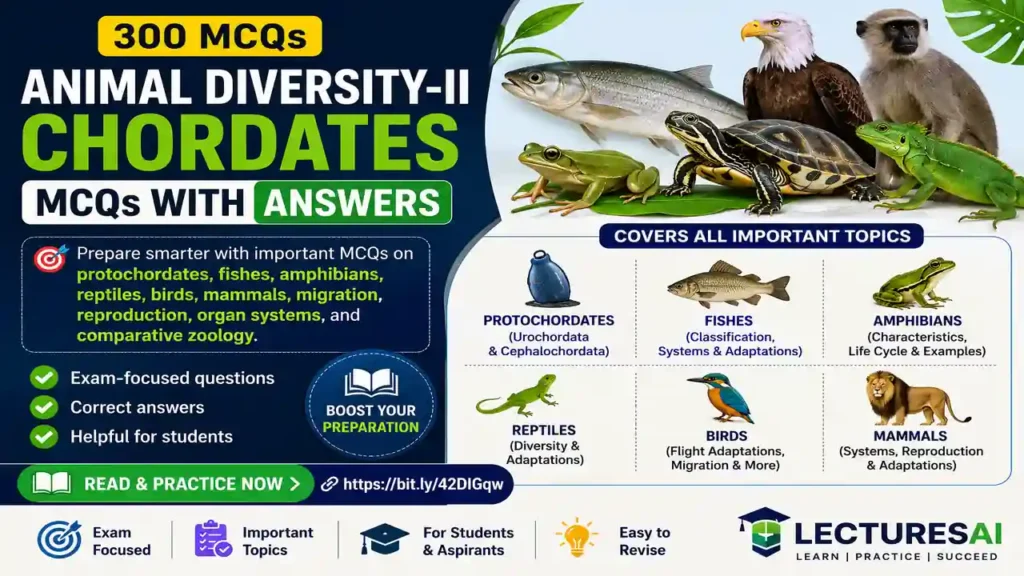
Practice 300 Animal Diversity-II Chordates MCQs with answers covering protochordates, fishes, amphibians, reptiles, birds, mammals, migration, reproduction, organ systems, and comparative zoology.
Animal Diversity-II Chordates MCQs with Answers
A complete zoology practice question bank covering protochordates, fishes, amphibians, reptiles, birds, mammals and comparative chordate systems.
Covered Topics
- ProtochordatesChordate characters, tunicates, lancelets, organ systems, life histories and metamorphosis.
- FishesAgnatha, Gnathostomata, locomotion, gills, circulation, osmoregulation, reproduction and development.
- AmphibiansFirst terrestrial vertebrates, Caudata, Gymnophiona, Anura, respiration, metamorphosis and adaptation.
- ReptilesFirst amniotes, amniotic egg, Testudines, Squamata, Rhynchocephalia, Crocodilia and terrestrial adaptations.
- BirdsFeathers, flight, endothermy, ancient birds, modern diversity, migration and navigation.
- MammalsHair, specialized teeth, viviparity, endothermy, organ systems, behavior, reproduction and development.
This page is designed for quick revision, self-testing and concept building. Use the search box to find a topic, then open the answer only after attempting the MCQ.
Animal Diversity-II Chordates MCQs
Q1. Which option correctly describes Chordata?
- a bacterial process used only for asexual reproduction in prokaryotes
- feathers that streamline the body and form wing and tail surfaces
- the evolutionary success of fishes in water due to streamlined bodies, fins, gills, sensory systems and osmoregulatory adaptations
- a phylum of animals characterized at some stage by a notochord, dorsal hollow nerve cord, pharyngeal slits, endostyle or thyroid gland, and a post-anal tail
Show Answer
Answer: a phylum of animals characterized at some stage by a notochord, dorsal hollow nerve cord, pharyngeal slits, endostyle or thyroid gland, and a post-anal tail
Explanation: Chordata is important in protochordates and chordate basics because it helps explain chordate structure, function, adaptation and evolutionary relationships.
Q2. For exam preparation, Chordata refers to:
- a mineral storage structure found only in invertebrate exoskeletons
- a phylum of animals characterized at some stage by a notochord, dorsal hollow nerve cord, pharyngeal slits, endostyle or thyroid gland, and a post-anal tail
- a heart with one atrium and one ventricle that pumps deoxygenated blood to the gills
- the process by which fishes gain water osmotically, excrete dilute urine and actively absorb salts
Show Answer
Answer: a phylum of animals characterized at some stage by a notochord, dorsal hollow nerve cord, pharyngeal slits, endostyle or thyroid gland, and a post-anal tail
Explanation: Chordata is important in protochordates and chordate basics because it helps explain chordate structure, function, adaptation and evolutionary relationships.
Q3. In animal diversity and chordate study, which statement is correct about Chordata?
- a type of chemical reaction unrelated to animal classification or function
- light air-filled bones that reduce body weight while maintaining strength
- a storage pouch in the esophagus that temporarily holds food
- a phylum of animals characterized at some stage by a notochord, dorsal hollow nerve cord, pharyngeal slits, endostyle or thyroid gland, and a post-anal tail
Show Answer
Answer: a phylum of animals characterized at some stage by a notochord, dorsal hollow nerve cord, pharyngeal slits, endostyle or thyroid gland, and a post-anal tail
Explanation: Chordata is important in protochordates and chordate basics because it helps explain chordate structure, function, adaptation and evolutionary relationships.
Q4. Which option correctly describes Notochord?
- invertebrate chordates that show basic chordate characters but lack a true vertebral column
- a tail extending beyond the anus that aids locomotion or balance in many chordates
- a social behavior found only in insects and not relevant to chordates
- a flexible rod-like supporting structure that appears during chordate development and is replaced or supported by vertebral elements in vertebrates
Show Answer
Answer: a flexible rod-like supporting structure that appears during chordate development and is replaced or supported by vertebral elements in vertebrates
Explanation: Notochord is important in protochordates and chordate basics because it helps explain chordate structure, function, adaptation and evolutionary relationships.
Q5. For exam preparation, Notochord refers to:
- the membrane that stores and transfers nutrients to the developing embryo
- a method of seed dispersal in flowering plants
- movement using sprawling, limbless, swimming or specialized walking patterns according to body plan
- a flexible rod-like supporting structure that appears during chordate development and is replaced or supported by vertebral elements in vertebrates
Show Answer
Answer: a flexible rod-like supporting structure that appears during chordate development and is replaced or supported by vertebral elements in vertebrates
Explanation: Notochord is important in protochordates and chordate basics because it helps explain chordate structure, function, adaptation and evolutionary relationships.
Q6. In animal diversity and chordate study, which statement is correct about Notochord?
- large wing and tail feathers that generate lift, thrust and control during flight
- seasonal movement between breeding and non-breeding areas to optimize food, climate and reproduction
- a flexible rod-like supporting structure that appears during chordate development and is replaced or supported by vertebral elements in vertebrates
- a storage carbohydrate used as the main structural material in fungi
Show Answer
Answer: a flexible rod-like supporting structure that appears during chordate development and is replaced or supported by vertebral elements in vertebrates
Explanation: Notochord is important in protochordates and chordate basics because it helps explain chordate structure, function, adaptation and evolutionary relationships.
Q7. Which option correctly describes Dorsal hollow nerve cord?
- release of eggs and sperm into water, common in many bony fishes
- circulation usually involving a three-chambered heart with partial separation, while crocodilians have four chambers
- a purely aquatic plant adaptation with no role in vertebrate biology
- a tubular nerve cord located above the notochord that develops into the central nervous system in vertebrates
Show Answer
Answer: a tubular nerve cord located above the notochord that develops into the central nervous system in vertebrates
Explanation: Dorsal hollow nerve cord is important in protochordates and chordate basics because it helps explain chordate structure, function, adaptation and evolutionary relationships.
Q8. For exam preparation, Dorsal hollow nerve cord refers to:
- release of eggs and sperm into water, common in many bony fishes
- a plant tissue responsible mainly for photosynthesis and water transport
- a tubular nerve cord located above the notochord that develops into the central nervous system in vertebrates
- the amphibian order including caecilians, limbless burrowing amphibians
Show Answer
Answer: a tubular nerve cord located above the notochord that develops into the central nervous system in vertebrates
Explanation: Dorsal hollow nerve cord is important in protochordates and chordate basics because it helps explain chordate structure, function, adaptation and evolutionary relationships.
Q9. In animal diversity and chordate study, which statement is correct about Dorsal hollow nerve cord?
- the evolutionary connection among animal groups based on shared ancestry and derived characters
- the arrangement of specialized organs into systems such as digestive, circulatory, respiratory, excretory and nervous systems
- a tubular nerve cord located above the notochord that develops into the central nervous system in vertebrates
- a bacterial process used only for asexual reproduction in prokaryotes
Show Answer
Answer: a tubular nerve cord located above the notochord that develops into the central nervous system in vertebrates
Explanation: Dorsal hollow nerve cord is important in protochordates and chordate basics because it helps explain chordate structure, function, adaptation and evolutionary relationships.
Q10. Which option correctly describes Pharyngeal slits?
- a mineral storage structure found only in invertebrate exoskeletons
- amphibian skin that supports cutaneous respiration and must remain moist for gas exchange
- openings in the pharyngeal region that are used in filter feeding in protochordates and are modified for respiration or development in vertebrates
- movement using sprawling, limbless, swimming or specialized walking patterns according to body plan
Show Answer
Answer: openings in the pharyngeal region that are used in filter feeding in protochordates and are modified for respiration or development in vertebrates
Explanation: Pharyngeal slits is important in protochordates and chordate basics because it helps explain chordate structure, function, adaptation and evolutionary relationships.
Q11. For exam preparation, Pharyngeal slits refers to:
- jawless vertebrates such as lampreys and hagfishes that lack true jaws and paired fins
- the reptile order including lizards and snakes, often with kinetic skulls and paired copulatory organs
- openings in the pharyngeal region that are used in filter feeding in protochordates and are modified for respiration or development in vertebrates
- a type of chemical reaction unrelated to animal classification or function
Show Answer
Answer: openings in the pharyngeal region that are used in filter feeding in protochordates and are modified for respiration or development in vertebrates
Explanation: Pharyngeal slits is important in protochordates and chordate basics because it helps explain chordate structure, function, adaptation and evolutionary relationships.
Q12. In animal diversity and chordate study, which statement is correct about Pharyngeal slits?
- keratinized structures used in flight, insulation, display and protection
- openings in the pharyngeal region that are used in filter feeding in protochordates and are modified for respiration or development in vertebrates
- a social behavior found only in insects and not relevant to chordates
- feathered endothermic vertebrates derived from theropod dinosaurs and highly adapted for flight or secondary flightlessness
Show Answer
Answer: openings in the pharyngeal region that are used in filter feeding in protochordates and are modified for respiration or development in vertebrates
Explanation: Pharyngeal slits is important in protochordates and chordate basics because it helps explain chordate structure, function, adaptation and evolutionary relationships.
Q13. Which option correctly describes Post-anal tail?
- a heart that completely separates oxygenated and deoxygenated blood for high metabolic demands
- a method of seed dispersal in flowering plants
- the transformation from a free-swimming larva with chordate features into a sessile adult form
- a tail extending beyond the anus that aids locomotion or balance in many chordates
Show Answer
Answer: a tail extending beyond the anus that aids locomotion or balance in many chordates
Explanation: Post-anal tail is important in protochordates and chordate basics because it helps explain chordate structure, function, adaptation and evolutionary relationships.
Q14. For exam preparation, Post-anal tail refers to:
- incubation, feeding and protection of young that increase offspring survival
- movement of fishes from the sea into freshwater to breed, as seen in salmon
- a storage carbohydrate used as the main structural material in fungi
- a tail extending beyond the anus that aids locomotion or balance in many chordates
Show Answer
Answer: a tail extending beyond the anus that aids locomotion or balance in many chordates
Explanation: Post-anal tail is important in protochordates and chordate basics because it helps explain chordate structure, function, adaptation and evolutionary relationships.
Q15. In animal diversity and chordate study, which statement is correct about Post-anal tail?
- a tail extending beyond the anus that aids locomotion or balance in many chordates
- circulation with pulmonary and systemic circuits, though mixing may occur in the ventricle
- release of eggs and sperm into water, common in many bony fishes
- a purely aquatic plant adaptation with no role in vertebrate biology
Show Answer
Answer: a tail extending beyond the anus that aids locomotion or balance in many chordates
Explanation: Post-anal tail is important in protochordates and chordate basics because it helps explain chordate structure, function, adaptation and evolutionary relationships.
Q16. Which option correctly describes Protochordates?
- a plant tissue responsible mainly for photosynthesis and water transport
- a bony flap covering the gills in many bony fishes and helping water flow over the gills
- invertebrate chordates that show basic chordate characters but lack a true vertebral column
- a heart with two atria and one ventricle that allows partial separation of oxygenated and deoxygenated blood
Show Answer
Answer: invertebrate chordates that show basic chordate characters but lack a true vertebral column
Explanation: Protochordates is important in protochordates and chordate basics because it helps explain chordate structure, function, adaptation and evolutionary relationships.
Q17. For exam preparation, Protochordates refers to:
- a respiratory pattern in birds that moves air through parabronchi in a continuous direction
- a bacterial process used only for asexual reproduction in prokaryotes
- a breastbone with a large keel for attachment of powerful flight muscles
- invertebrate chordates that show basic chordate characters but lack a true vertebral column
Show Answer
Answer: invertebrate chordates that show basic chordate characters but lack a true vertebral column
Explanation: Protochordates is important in protochordates and chordate basics because it helps explain chordate structure, function, adaptation and evolutionary relationships.
Q18. In animal diversity and chordate study, which statement is correct about Protochordates?
- variation in beak shape according to feeding habits such as seed cracking, probing, tearing or filtering
- a mineral storage structure found only in invertebrate exoskeletons
- invertebrate chordates that show basic chordate characters but lack a true vertebral column
- the reptile order including lizards and snakes, often with kinetic skulls and paired copulatory organs
Show Answer
Answer: invertebrate chordates that show basic chordate characters but lack a true vertebral column
Explanation: Protochordates is important in protochordates and chordate basics because it helps explain chordate structure, function, adaptation and evolutionary relationships.
Q19. Which option correctly describes Urochordata?
- tunicates or sea squirts in which the larva shows chordate characters and the adult is usually sessile and filter-feeding
- a type of chemical reaction unrelated to animal classification or function
- a system adapted to diet type, including mouth, pharynx, stomach or intestine and accessory organs for digestion
- circulation with pulmonary and systemic circuits, though mixing may occur in the ventricle
Show Answer
Answer: tunicates or sea squirts in which the larva shows chordate characters and the adult is usually sessile and filter-feeding
Explanation: Urochordata is important in protochordates and chordate basics because it helps explain chordate structure, function, adaptation and evolutionary relationships.
Q20. For exam preparation, Urochordata refers to:
- a mucus-secreting groove in protochordates that helps in filter feeding and is considered homologous to the vertebrate thyroid gland
- a social behavior found only in insects and not relevant to chordates
- tunicates or sea squirts in which the larva shows chordate characters and the adult is usually sessile and filter-feeding
- incubation, feeding and protection of young that increase offspring survival
Show Answer
Answer: tunicates or sea squirts in which the larva shows chordate characters and the adult is usually sessile and filter-feeding
Explanation: Urochordata is important in protochordates and chordate basics because it helps explain chordate structure, function, adaptation and evolutionary relationships.
Q21. In animal diversity and chordate study, which statement is correct about Urochordata?
- a system adapted to diet type, including mouth, pharynx, stomach or intestine and accessory organs for digestion
- the aquatic larval stage of frogs and toads, usually with gills and a tail
- a method of seed dispersal in flowering plants
- tunicates or sea squirts in which the larva shows chordate characters and the adult is usually sessile and filter-feeding
Show Answer
Answer: tunicates or sea squirts in which the larva shows chordate characters and the adult is usually sessile and filter-feeding
Explanation: Urochordata is important in protochordates and chordate basics because it helps explain chordate structure, function, adaptation and evolutionary relationships.
Q22. Which option correctly describes Cephalochordata?
- lancelets that retain the notochord, dorsal nerve cord and pharyngeal slits throughout life
- large wing and tail feathers that generate lift, thrust and control during flight
- a circulatory pattern in which blood passes once through the heart during one complete circuit
- a storage carbohydrate used as the main structural material in fungi
Show Answer
Answer: lancelets that retain the notochord, dorsal nerve cord and pharyngeal slits throughout life
Explanation: Cephalochordata is important in protochordates and chordate basics because it helps explain chordate structure, function, adaptation and evolutionary relationships.
Q23. For exam preparation, Cephalochordata refers to:
- buoyancy support achieved mainly through a large oily liver, cartilage skeleton and dynamic lift from fins
- a purely aquatic plant adaptation with no role in vertebrate biology
- lancelets that retain the notochord, dorsal nerve cord and pharyngeal slits throughout life
- cartilaginous fishes such as sharks and rays with cartilage skeletons, placoid scales and internal fertilization
Show Answer
Answer: lancelets that retain the notochord, dorsal nerve cord and pharyngeal slits throughout life
Explanation: Cephalochordata is important in protochordates and chordate basics because it helps explain chordate structure, function, adaptation and evolutionary relationships.
Q24. In animal diversity and chordate study, which statement is correct about Cephalochordata?
- lancelets that retain the notochord, dorsal nerve cord and pharyngeal slits throughout life
- a muscular stomach chamber that grinds food, often with swallowed grit
- a semi-solid nitrogenous waste that helps reptiles conserve water in dry habitats
- a plant tissue responsible mainly for photosynthesis and water transport
Show Answer
Answer: lancelets that retain the notochord, dorsal nerve cord and pharyngeal slits throughout life
Explanation: Cephalochordata is important in protochordates and chordate basics because it helps explain chordate structure, function, adaptation and evolutionary relationships.
Q25. Which option correctly describes Endostyle?
- a mucus-secreting groove in protochordates that helps in filter feeding and is considered homologous to the vertebrate thyroid gland
- a bacterial process used only for asexual reproduction in prokaryotes
- a heart with one atrium and one ventricle that pumps deoxygenated blood to the gills
- gas exchange through simple lungs often supported by buccal pumping
Show Answer
Answer: a mucus-secreting groove in protochordates that helps in filter feeding and is considered homologous to the vertebrate thyroid gland
Explanation: Endostyle is important in protochordates and chordate basics because it helps explain chordate structure, function, adaptation and evolutionary relationships.
Q26. For exam preparation, Endostyle refers to:
- the evolutionary connection among animal groups based on shared ancestry and derived characters
- nitrogenous waste removal mainly as uric acid to save water and reduce weight
- a mineral storage structure found only in invertebrate exoskeletons
- a mucus-secreting groove in protochordates that helps in filter feeding and is considered homologous to the vertebrate thyroid gland
Show Answer
Answer: a mucus-secreting groove in protochordates that helps in filter feeding and is considered homologous to the vertebrate thyroid gland
Explanation: Endostyle is important in protochordates and chordate basics because it helps explain chordate structure, function, adaptation and evolutionary relationships.
Q27. In animal diversity and chordate study, which statement is correct about Endostyle?
- keratinized structures used in flight, insulation, display and protection
- a mucus-secreting groove in protochordates that helps in filter feeding and is considered homologous to the vertebrate thyroid gland
- a bony flap covering the gills in many bony fishes and helping water flow over the gills
- a type of chemical reaction unrelated to animal classification or function
Show Answer
Answer: a mucus-secreting groove in protochordates that helps in filter feeding and is considered homologous to the vertebrate thyroid gland
Explanation: Endostyle is important in protochordates and chordate basics because it helps explain chordate structure, function, adaptation and evolutionary relationships.
Q28. Which option correctly describes Metamorphosis in tunicates?
- the transformation from a free-swimming larva with chordate features into a sessile adult form
- a breathing mechanism in amphibians that uses mouth-floor movements to force air into the lungs
- circulation with pulmonary and systemic circuits, though mixing may occur in the ventricle
- a social behavior found only in insects and not relevant to chordates
Show Answer
Answer: the transformation from a free-swimming larva with chordate features into a sessile adult form
Explanation: Metamorphosis in tunicates is important in protochordates and chordate basics because it helps explain chordate structure, function, adaptation and evolutionary relationships.
Q29. For exam preparation, Metamorphosis in tunicates refers to:
- a method of seed dispersal in flowering plants
- the reptile order including crocodiles, alligators and gharials with advanced hearts and parental care
- a flexible rod-like supporting structure that appears during chordate development and is replaced or supported by vertebral elements in vertebrates
- the transformation from a free-swimming larva with chordate features into a sessile adult form
Show Answer
Answer: the transformation from a free-swimming larva with chordate features into a sessile adult form
Explanation: Metamorphosis in tunicates is important in protochordates and chordate basics because it helps explain chordate structure, function, adaptation and evolutionary relationships.
Q30. In animal diversity and chordate study, which statement is correct about Metamorphosis in tunicates?
- a storage carbohydrate used as the main structural material in fungi
- incubation, feeding and protection of young that increase offspring survival
- the transformation from a free-swimming larva with chordate features into a sessile adult form
- soft feathers that trap air and provide insulation
Show Answer
Answer: the transformation from a free-swimming larva with chordate features into a sessile adult form
Explanation: Metamorphosis in tunicates is important in protochordates and chordate basics because it helps explain chordate structure, function, adaptation and evolutionary relationships.
Q31. Which option correctly describes Filter feeding?
- a bony flap covering the gills in many bony fishes and helping water flow over the gills
- dependence on environmental heat sources for body temperature regulation
- a feeding method in which suspended food particles are trapped from water by mucus and pharyngeal structures
- a purely aquatic plant adaptation with no role in vertebrate biology
Show Answer
Answer: a feeding method in which suspended food particles are trapped from water by mucus and pharyngeal structures
Explanation: Filter feeding is important in protochordates and chordate basics because it helps explain chordate structure, function, adaptation and evolutionary relationships.
Q32. For exam preparation, Filter feeding refers to:
- a plant tissue responsible mainly for photosynthesis and water transport
- a feeding method in which suspended food particles are trapped from water by mucus and pharyngeal structures
- reproduction by laying eggs with hard calcareous shells
- the membrane that stores and transfers nutrients to the developing embryo
Show Answer
Answer: a feeding method in which suspended food particles are trapped from water by mucus and pharyngeal structures
Explanation: Filter feeding is important in protochordates and chordate basics because it helps explain chordate structure, function, adaptation and evolutionary relationships.
Q33. In animal diversity and chordate study, which statement is correct about Filter feeding?
- early development after hatching that may include yolk absorption, growth and changes in form before adulthood
- a bacterial process used only for asexual reproduction in prokaryotes
- a feeding method in which suspended food particles are trapped from water by mucus and pharyngeal structures
- keratinized structures used in flight, insulation, display and protection
Show Answer
Answer: a feeding method in which suspended food particles are trapped from water by mucus and pharyngeal structures
Explanation: Filter feeding is important in protochordates and chordate basics because it helps explain chordate structure, function, adaptation and evolutionary relationships.
Q34. Which option correctly describes Amphioxus?
- a mineral storage structure found only in invertebrate exoskeletons
- reproduction by laying eggs with hard calcareous shells
- a bony flap covering the gills in many bony fishes and helping water flow over the gills
- a lancelet commonly used to understand primitive chordate structure and early chordate evolution
Show Answer
Answer: a lancelet commonly used to understand primitive chordate structure and early chordate evolution
Explanation: Amphioxus is important in protochordates and chordate basics because it helps explain chordate structure, function, adaptation and evolutionary relationships.
Q35. For exam preparation, Amphioxus refers to:
- a type of chemical reaction unrelated to animal classification or function
- a tubular nerve cord located above the notochord that develops into the central nervous system in vertebrates
- the extraembryonic membrane involved in gas exchange around the embryo
- a lancelet commonly used to understand primitive chordate structure and early chordate evolution
Show Answer
Answer: a lancelet commonly used to understand primitive chordate structure and early chordate evolution
Explanation: Amphioxus is important in protochordates and chordate basics because it helps explain chordate structure, function, adaptation and evolutionary relationships.
Q36. In animal diversity and chordate study, which statement is correct about Amphioxus?
- a social behavior found only in insects and not relevant to chordates
- a lancelet commonly used to understand primitive chordate structure and early chordate evolution
- lancelets that retain the notochord, dorsal nerve cord and pharyngeal slits throughout life
- the tail fin mainly responsible for forward thrust in many fishes
Show Answer
Answer: a lancelet commonly used to understand primitive chordate structure and early chordate evolution
Explanation: Amphioxus is important in protochordates and chordate basics because it helps explain chordate structure, function, adaptation and evolutionary relationships.
Q37. Which option correctly describes Phylogenetic relationship?
- a feeding method in which suspended food particles are trapped from water by mucus and pharyngeal structures
- variation in beak shape according to feeding habits such as seed cracking, probing, tearing or filtering
- the evolutionary connection among animal groups based on shared ancestry and derived characters
- a method of seed dispersal in flowering plants
Show Answer
Answer: the evolutionary connection among animal groups based on shared ancestry and derived characters
Explanation: Phylogenetic relationship is important in protochordates and chordate basics because it helps explain chordate structure, function, adaptation and evolutionary relationships.
Q38. For exam preparation, Phylogenetic relationship refers to:
- jawed vertebrates that evolved jaws, paired appendages and improved feeding ability
- the evolutionary connection among animal groups based on shared ancestry and derived characters
- internal heat production that supports constant high body temperature and active lifestyles
- a storage carbohydrate used as the main structural material in fungi
Show Answer
Answer: the evolutionary connection among animal groups based on shared ancestry and derived characters
Explanation: Phylogenetic relationship is important in protochordates and chordate basics because it helps explain chordate structure, function, adaptation and evolutionary relationships.
Q39. In animal diversity and chordate study, which statement is correct about Phylogenetic relationship?
- buoyancy support achieved mainly through a large oily liver, cartilage skeleton and dynamic lift from fins
- the reptile group including turtles and tortoises with a protective shell
- the evolutionary connection among animal groups based on shared ancestry and derived characters
- a purely aquatic plant adaptation with no role in vertebrate biology
Show Answer
Answer: the evolutionary connection among animal groups based on shared ancestry and derived characters
Explanation: Phylogenetic relationship is important in protochordates and chordate basics because it helps explain chordate structure, function, adaptation and evolutionary relationships.
Q40. Which option correctly describes Vertebral column?
- the backbone that supports the body, protects the spinal cord and distinguishes vertebrates from protochordates
- seasonal movement between breeding and non-breeding areas to optimize food, climate and reproduction
- the first major vertebrate group to colonize land while remaining strongly linked to water for reproduction and skin moisture
- a plant tissue responsible mainly for photosynthesis and water transport
Show Answer
Answer: the backbone that supports the body, protects the spinal cord and distinguishes vertebrates from protochordates
Explanation: Vertebral column is important in protochordates and chordate basics because it helps explain chordate structure, function, adaptation and evolutionary relationships.
Q41. For exam preparation, Vertebral column refers to:
- adaptations such as eyes, tympanum and lateral-line remnants that support life in water and on land
- fertilization inside the female body, supporting reproduction away from aquatic environments
- the backbone that supports the body, protects the spinal cord and distinguishes vertebrates from protochordates
- a bacterial process used only for asexual reproduction in prokaryotes
Show Answer
Answer: the backbone that supports the body, protects the spinal cord and distinguishes vertebrates from protochordates
Explanation: Vertebral column is important in protochordates and chordate basics because it helps explain chordate structure, function, adaptation and evolutionary relationships.
Q42. In animal diversity and chordate study, which statement is correct about Vertebral column?
- a heart with one atrium and one ventricle that pumps deoxygenated blood to the gills
- a mineral storage structure found only in invertebrate exoskeletons
- the backbone that supports the body, protects the spinal cord and distinguishes vertebrates from protochordates
- a mucus-secreting groove in protochordates that helps in filter feeding and is considered homologous to the vertebrate thyroid gland
Show Answer
Answer: the backbone that supports the body, protects the spinal cord and distinguishes vertebrates from protochordates
Explanation: Vertebral column is important in protochordates and chordate basics because it helps explain chordate structure, function, adaptation and evolutionary relationships.
Q43. Which option correctly describes Organ-system level organization?
- circulation usually involving a three-chambered heart with partial separation, while crocodilians have four chambers
- a heart with one atrium and one ventricle that pumps deoxygenated blood to the gills
- a type of chemical reaction unrelated to animal classification or function
- the arrangement of specialized organs into systems such as digestive, circulatory, respiratory, excretory and nervous systems
Show Answer
Answer: the arrangement of specialized organs into systems such as digestive, circulatory, respiratory, excretory and nervous systems
Explanation: Organ-system level organization is important in protochordates and chordate basics because it helps explain chordate structure, function, adaptation and evolutionary relationships.
Q44. For exam preparation, Organ-system level organization refers to:
- a mucus-secreting groove in protochordates that helps in filter feeding and is considered homologous to the vertebrate thyroid gland
- a social behavior found only in insects and not relevant to chordates
- paired and unpaired appendages that provide propulsion, steering, stability and braking in fishes
- the arrangement of specialized organs into systems such as digestive, circulatory, respiratory, excretory and nervous systems
Show Answer
Answer: the arrangement of specialized organs into systems such as digestive, circulatory, respiratory, excretory and nervous systems
Explanation: Organ-system level organization is important in protochordates and chordate basics because it helps explain chordate structure, function, adaptation and evolutionary relationships.
Q45. In animal diversity and chordate study, which statement is correct about Organ-system level organization?
- the arrangement of specialized organs into systems such as digestive, circulatory, respiratory, excretory and nervous systems
- dry protective body coverings that reduce water loss in reptiles
- a method of seed dispersal in flowering plants
- the tail fin mainly responsible for forward thrust in many fishes
Show Answer
Answer: the arrangement of specialized organs into systems such as digestive, circulatory, respiratory, excretory and nervous systems
Explanation: Organ-system level organization is important in protochordates and chordate basics because it helps explain chordate structure, function, adaptation and evolutionary relationships.
Q46. Which option correctly describes Aquatic vertebrate success?
- the evolutionary success of fishes in water due to streamlined bodies, fins, gills, sensory systems and osmoregulatory adaptations
- a storage carbohydrate used as the main structural material in fungi
- the reptile lineage represented today mainly by tuatara and important for understanding reptile evolution
- a circulatory pattern in which blood passes once through the heart during one complete circuit
Show Answer
Answer: the evolutionary success of fishes in water due to streamlined bodies, fins, gills, sensory systems and osmoregulatory adaptations
Explanation: Aquatic vertebrate success is important in fishes and aquatic vertebrates because it helps explain chordate structure, function, adaptation and evolutionary relationships.
Q47. For exam preparation, Aquatic vertebrate success refers to:
- the process by which fishes gain water osmotically, excrete dilute urine and actively absorb salts
- an egg with extraembryonic membranes that protect the embryo and reduce dependence on water for reproduction
- the evolutionary success of fishes in water due to streamlined bodies, fins, gills, sensory systems and osmoregulatory adaptations
- a purely aquatic plant adaptation with no role in vertebrate biology
Show Answer
Answer: the evolutionary success of fishes in water due to streamlined bodies, fins, gills, sensory systems and osmoregulatory adaptations
Explanation: Aquatic vertebrate success is important in fishes and aquatic vertebrates because it helps explain chordate structure, function, adaptation and evolutionary relationships.
Q48. In animal diversity and chordate study, which statement is correct about Aquatic vertebrate success?
- the evolutionary success of fishes in water due to streamlined bodies, fins, gills, sensory systems and osmoregulatory adaptations
- internal heat production that supports constant high body temperature and active lifestyles
- the evolutionary connection among animal groups based on shared ancestry and derived characters
- a plant tissue responsible mainly for photosynthesis and water transport
Show Answer
Answer: the evolutionary success of fishes in water due to streamlined bodies, fins, gills, sensory systems and osmoregulatory adaptations
Explanation: Aquatic vertebrate success is important in fishes and aquatic vertebrates because it helps explain chordate structure, function, adaptation and evolutionary relationships.
Q49. Which option correctly describes Agnatha?
- fertilization outside the body, common in frogs where eggs are usually laid in water
- a bacterial process used only for asexual reproduction in prokaryotes
- amniote vertebrates with dry keratinized skin, internal fertilization and adaptations for terrestrial life
- jawless vertebrates such as lampreys and hagfishes that lack true jaws and paired fins
Show Answer
Answer: jawless vertebrates such as lampreys and hagfishes that lack true jaws and paired fins
Explanation: Agnatha is important in fishes and aquatic vertebrates because it helps explain chordate structure, function, adaptation and evolutionary relationships.
Q50. For exam preparation, Agnatha refers to:
- lancelets that retain the notochord, dorsal nerve cord and pharyngeal slits throughout life
- a mineral storage structure found only in invertebrate exoskeletons
- jawless vertebrates such as lampreys and hagfishes that lack true jaws and paired fins
- the aquatic larval stage of frogs and toads, usually with gills and a tail
Show Answer
Answer: jawless vertebrates such as lampreys and hagfishes that lack true jaws and paired fins
Explanation: Agnatha is important in fishes and aquatic vertebrates because it helps explain chordate structure, function, adaptation and evolutionary relationships.
Q51. In animal diversity and chordate study, which statement is correct about Agnatha?
- the reptile order including lizards and snakes, often with kinetic skulls and paired copulatory organs
- a mechanoreceptive sensory system in fishes that detects water movements, vibrations and pressure changes
- jawless vertebrates such as lampreys and hagfishes that lack true jaws and paired fins
- a type of chemical reaction unrelated to animal classification or function
Show Answer
Answer: jawless vertebrates such as lampreys and hagfishes that lack true jaws and paired fins
Explanation: Agnatha is important in fishes and aquatic vertebrates because it helps explain chordate structure, function, adaptation and evolutionary relationships.
Q52. Which option correctly describes Gnathostomata?
- thin overlapping scales of many bony fishes that protect the body while allowing flexibility
- release of eggs and sperm into water, common in many bony fishes
- jawed vertebrates that evolved jaws, paired appendages and improved feeding ability
- a social behavior found only in insects and not relevant to chordates
Show Answer
Answer: jawed vertebrates that evolved jaws, paired appendages and improved feeding ability
Explanation: Gnathostomata is important in fishes and aquatic vertebrates because it helps explain chordate structure, function, adaptation and evolutionary relationships.
Q53. For exam preparation, Gnathostomata refers to:
- adaptations such as eyes, tympanum and lateral-line remnants that support life in water and on land
- the reptile order including crocodiles, alligators and gharials with advanced hearts and parental care
- a method of seed dispersal in flowering plants
- jawed vertebrates that evolved jaws, paired appendages and improved feeding ability
Show Answer
Answer: jawed vertebrates that evolved jaws, paired appendages and improved feeding ability
Explanation: Gnathostomata is important in fishes and aquatic vertebrates because it helps explain chordate structure, function, adaptation and evolutionary relationships.
Q54. In animal diversity and chordate study, which statement is correct about Gnathostomata?
- nitrogenous waste removal mainly as uric acid to save water and reduce weight
- a storage carbohydrate used as the main structural material in fungi
- jawed vertebrates that evolved jaws, paired appendages and improved feeding ability
- a lancelet commonly used to understand primitive chordate structure and early chordate evolution
Show Answer
Answer: jawed vertebrates that evolved jaws, paired appendages and improved feeding ability
Explanation: Gnathostomata is important in fishes and aquatic vertebrates because it helps explain chordate structure, function, adaptation and evolutionary relationships.
Q55. Which option correctly describes Placoderms?
- the extraembryonic membrane that surrounds the embryo with fluid and provides protection
- extinct armored jawed fishes important in understanding early gnathostome evolution
- a purely aquatic plant adaptation with no role in vertebrate biology
- the extraembryonic membrane involved in gas exchange around the embryo
Show Answer
Answer: extinct armored jawed fishes important in understanding early gnathostome evolution
Explanation: Placoderms is important in fishes and aquatic vertebrates because it helps explain chordate structure, function, adaptation and evolutionary relationships.
Q56. For exam preparation, Placoderms refers to:
- a plant tissue responsible mainly for photosynthesis and water transport
- circulation with pulmonary and systemic circuits, though mixing may occur in the ventricle
- a gas-filled organ in many bony fishes that helps control buoyancy
- extinct armored jawed fishes important in understanding early gnathostome evolution
Show Answer
Answer: extinct armored jawed fishes important in understanding early gnathostome evolution
Explanation: Placoderms is important in fishes and aquatic vertebrates because it helps explain chordate structure, function, adaptation and evolutionary relationships.
Q57. In animal diversity and chordate study, which statement is correct about Placoderms?
- extinct armored jawed fishes important in understanding early gnathostome evolution
- high sensitivity to habitat loss, pollution, disease and climate change because of permeable skin and complex life cycles
- fertilization inside the female using male claspers, common in sharks and rays
- a bacterial process used only for asexual reproduction in prokaryotes
Show Answer
Answer: extinct armored jawed fishes important in understanding early gnathostome evolution
Explanation: Placoderms is important in fishes and aquatic vertebrates because it helps explain chordate structure, function, adaptation and evolutionary relationships.
Q58. Which option correctly describes Chondrichthyes?
- bony fishes that have a bony skeleton and often possess an operculum and swim bladder
- a mineral storage structure found only in invertebrate exoskeletons
- cartilaginous fishes such as sharks and rays with cartilage skeletons, placoid scales and internal fertilization
- a mechanoreceptive sensory system in fishes that detects water movements, vibrations and pressure changes
Show Answer
Answer: cartilaginous fishes such as sharks and rays with cartilage skeletons, placoid scales and internal fertilization
Explanation: Chondrichthyes is important in fishes and aquatic vertebrates because it helps explain chordate structure, function, adaptation and evolutionary relationships.
Q59. For exam preparation, Chondrichthyes refers to:
- a type of chemical reaction unrelated to animal classification or function
- a semi-solid nitrogenous waste that helps reptiles conserve water in dry habitats
- a storage pouch in the esophagus that temporarily holds food
- cartilaginous fishes such as sharks and rays with cartilage skeletons, placoid scales and internal fertilization
Show Answer
Answer: cartilaginous fishes such as sharks and rays with cartilage skeletons, placoid scales and internal fertilization
Explanation: Chondrichthyes is important in fishes and aquatic vertebrates because it helps explain chordate structure, function, adaptation and evolutionary relationships.
Q60. In animal diversity and chordate study, which statement is correct about Chondrichthyes?
- lancelets that retain the notochord, dorsal nerve cord and pharyngeal slits throughout life
- cartilaginous fishes such as sharks and rays with cartilage skeletons, placoid scales and internal fertilization
- tunicates or sea squirts in which the larva shows chordate characters and the adult is usually sessile and filter-feeding
- a social behavior found only in insects and not relevant to chordates
Show Answer
Answer: cartilaginous fishes such as sharks and rays with cartilage skeletons, placoid scales and internal fertilization
Explanation: Chondrichthyes is important in fishes and aquatic vertebrates because it helps explain chordate structure, function, adaptation and evolutionary relationships.
Q61. Which option correctly describes Osteichthyes?
- lancelets that retain the notochord, dorsal nerve cord and pharyngeal slits throughout life
- dry protective body coverings that reduce water loss in reptiles
- a method of seed dispersal in flowering plants
- bony fishes that have a bony skeleton and often possess an operculum and swim bladder
Show Answer
Answer: bony fishes that have a bony skeleton and often possess an operculum and swim bladder
Explanation: Osteichthyes is important in fishes and aquatic vertebrates because it helps explain chordate structure, function, adaptation and evolutionary relationships.
Q62. For exam preparation, Osteichthyes refers to:
- a mucus-secreting groove in protochordates that helps in filter feeding and is considered homologous to the vertebrate thyroid gland
- bony fishes that have a bony skeleton and often possess an operculum and swim bladder
- a storage carbohydrate used as the main structural material in fungi
- a heart with two atria and two ventricles that allows efficient separation of blood flow
Show Answer
Answer: bony fishes that have a bony skeleton and often possess an operculum and swim bladder
Explanation: Osteichthyes is important in fishes and aquatic vertebrates because it helps explain chordate structure, function, adaptation and evolutionary relationships.
Q63. In animal diversity and chordate study, which statement is correct about Osteichthyes?
- body temperature regulation largely through behavioral use of external heat sources
- a purely aquatic plant adaptation with no role in vertebrate biology
- the process by which fishes gain water osmotically, excrete dilute urine and actively absorb salts
- bony fishes that have a bony skeleton and often possess an operculum and swim bladder
Show Answer
Answer: bony fishes that have a bony skeleton and often possess an operculum and swim bladder
Explanation: Osteichthyes is important in fishes and aquatic vertebrates because it helps explain chordate structure, function, adaptation and evolutionary relationships.
Q64. Which option correctly describes Operculum?
- a plant tissue responsible mainly for photosynthesis and water transport
- a bony flap covering the gills in many bony fishes and helping water flow over the gills
- a reproductive clasping behavior in frogs and toads that helps coordinate egg and sperm release
- internal heat production that supports constant high body temperature and active lifestyles
Show Answer
Answer: a bony flap covering the gills in many bony fishes and helping water flow over the gills
Explanation: Operculum is important in fishes and aquatic vertebrates because it helps explain chordate structure, function, adaptation and evolutionary relationships.
Q65. For exam preparation, Operculum refers to:
- a bacterial process used only for asexual reproduction in prokaryotes
- an ancient bird-like fossil important in understanding the evolution of flight
- a bony flap covering the gills in many bony fishes and helping water flow over the gills
- seasonal movement between breeding and non-breeding areas to optimize food, climate and reproduction
Show Answer
Answer: a bony flap covering the gills in many bony fishes and helping water flow over the gills
Explanation: Operculum is important in fishes and aquatic vertebrates because it helps explain chordate structure, function, adaptation and evolutionary relationships.
Q66. In animal diversity and chordate study, which statement is correct about Operculum?
- a bony flap covering the gills in many bony fishes and helping water flow over the gills
- a mineral storage structure found only in invertebrate exoskeletons
- the change from aquatic larva to terrestrial or semi-terrestrial adult involving major structural and physiological changes
- jawless vertebrates such as lampreys and hagfishes that lack true jaws and paired fins
Show Answer
Answer: a bony flap covering the gills in many bony fishes and helping water flow over the gills
Explanation: Operculum is important in fishes and aquatic vertebrates because it helps explain chordate structure, function, adaptation and evolutionary relationships.
Q67. Which option correctly describes Swim bladder?
- the transformation from a free-swimming larva with chordate features into a sessile adult form
- a type of chemical reaction unrelated to animal classification or function
- nitrogenous waste removal mainly as uric acid to save water and reduce weight
- a gas-filled organ in many bony fishes that helps control buoyancy
Show Answer
Answer: a gas-filled organ in many bony fishes that helps control buoyancy
Explanation: Swim bladder is important in fishes and aquatic vertebrates because it helps explain chordate structure, function, adaptation and evolutionary relationships.
Q68. For exam preparation, Swim bladder refers to:
- a gas-filled organ in many bony fishes that helps control buoyancy
- a social behavior found only in insects and not relevant to chordates
- the reptile order including lizards and snakes, often with kinetic skulls and paired copulatory organs
- the transformation from a free-swimming larva with chordate features into a sessile adult form
Show Answer
Answer: a gas-filled organ in many bony fishes that helps control buoyancy
Explanation: Swim bladder is important in fishes and aquatic vertebrates because it helps explain chordate structure, function, adaptation and evolutionary relationships.
Q69. In animal diversity and chordate study, which statement is correct about Swim bladder?
- amphibian skin that supports cutaneous respiration and must remain moist for gas exchange
- jawless vertebrates such as lampreys and hagfishes that lack true jaws and paired fins
- a method of seed dispersal in flowering plants
- a gas-filled organ in many bony fishes that helps control buoyancy
Show Answer
Answer: a gas-filled organ in many bony fishes that helps control buoyancy
Explanation: Swim bladder is important in fishes and aquatic vertebrates because it helps explain chordate structure, function, adaptation and evolutionary relationships.
Q70. Which option correctly describes Placoid scales?
- tooth-like scales found in cartilaginous fishes that reduce drag and protect the body
- fertilization inside the female using male claspers, common in sharks and rays
- bony fishes that have a bony skeleton and often possess an operculum and swim bladder
- a storage carbohydrate used as the main structural material in fungi
Show Answer
Answer: tooth-like scales found in cartilaginous fishes that reduce drag and protect the body
Explanation: Placoid scales is important in fishes and aquatic vertebrates because it helps explain chordate structure, function, adaptation and evolutionary relationships.
Q71. For exam preparation, Placoid scales refers to:
- a purely aquatic plant adaptation with no role in vertebrate biology
- the evolutionary interpretation of reptile groups using shared derived characters and amniote relationships
- large wing and tail feathers that generate lift, thrust and control during flight
- tooth-like scales found in cartilaginous fishes that reduce drag and protect the body
Show Answer
Answer: tooth-like scales found in cartilaginous fishes that reduce drag and protect the body
Explanation: Placoid scales is important in fishes and aquatic vertebrates because it helps explain chordate structure, function, adaptation and evolutionary relationships.
Q72. In animal diversity and chordate study, which statement is correct about Placoid scales?
- the backbone that supports the body, protects the spinal cord and distinguishes vertebrates from protochordates
- tooth-like scales found in cartilaginous fishes that reduce drag and protect the body
- a plant tissue responsible mainly for photosynthesis and water transport
- internal heat production that supports constant high body temperature and active lifestyles
Show Answer
Answer: tooth-like scales found in cartilaginous fishes that reduce drag and protect the body
Explanation: Placoid scales is important in fishes and aquatic vertebrates because it helps explain chordate structure, function, adaptation and evolutionary relationships.
Q73. Which option correctly describes Cycloid and ctenoid scales?
- thin overlapping scales of many bony fishes that protect the body while allowing flexibility
- a muscular stomach chamber that grinds food, often with swallowed grit
- a bacterial process used only for asexual reproduction in prokaryotes
- the backbone that supports the body, protects the spinal cord and distinguishes vertebrates from protochordates
Show Answer
Answer: thin overlapping scales of many bony fishes that protect the body while allowing flexibility
Explanation: Cycloid and ctenoid scales is important in fishes and aquatic vertebrates because it helps explain chordate structure, function, adaptation and evolutionary relationships.
Q74. For exam preparation, Cycloid and ctenoid scales refers to:
- a mineral storage structure found only in invertebrate exoskeletons
- movement using sprawling, limbless, swimming or specialized walking patterns according to body plan
- thin overlapping scales of many bony fishes that protect the body while allowing flexibility
- a mechanism in fish gills where water and blood flow in opposite directions to maximize oxygen uptake
Show Answer
Answer: thin overlapping scales of many bony fishes that protect the body while allowing flexibility
Explanation: Cycloid and ctenoid scales is important in fishes and aquatic vertebrates because it helps explain chordate structure, function, adaptation and evolutionary relationships.
Q75. In animal diversity and chordate study, which statement is correct about Cycloid and ctenoid scales?
- the membrane that stores and transfers nutrients to the developing embryo
- a type of chemical reaction unrelated to animal classification or function
- thin overlapping scales of many bony fishes that protect the body while allowing flexibility
- the extraembryonic membrane involved in gas exchange around the embryo
Show Answer
Answer: thin overlapping scales of many bony fishes that protect the body while allowing flexibility
Explanation: Cycloid and ctenoid scales is important in fishes and aquatic vertebrates because it helps explain chordate structure, function, adaptation and evolutionary relationships.
Q76. Which option correctly describes Lateral line system?
- feathers that streamline the body and form wing and tail surfaces
- a social behavior found only in insects and not relevant to chordates
- a mechanoreceptive sensory system in fishes that detects water movements, vibrations and pressure changes
- control of water and salt balance through skin, kidneys and behavior in moist habitats
Show Answer
Answer: a mechanoreceptive sensory system in fishes that detects water movements, vibrations and pressure changes
Explanation: Lateral line system is important in fishes and aquatic vertebrates because it helps explain chordate structure, function, adaptation and evolutionary relationships.
Q77. For exam preparation, Lateral line system refers to:
- a mechanoreceptive sensory system in fishes that detects water movements, vibrations and pressure changes
- a method of seed dispersal in flowering plants
- incubation, feeding and protection of young that increase offspring survival
- the amphibian order including frogs and toads, typically tailless as adults and adapted for jumping
Show Answer
Answer: a mechanoreceptive sensory system in fishes that detects water movements, vibrations and pressure changes
Explanation: Lateral line system is important in fishes and aquatic vertebrates because it helps explain chordate structure, function, adaptation and evolutionary relationships.
Q78. In animal diversity and chordate study, which statement is correct about Lateral line system?
- a mechanoreceptive sensory system in fishes that detects water movements, vibrations and pressure changes
- bony fishes that have a bony skeleton and often possess an operculum and swim bladder
- a storage pouch in the esophagus that temporarily holds food
- a storage carbohydrate used as the main structural material in fungi
Show Answer
Answer: a mechanoreceptive sensory system in fishes that detects water movements, vibrations and pressure changes
Explanation: Lateral line system is important in fishes and aquatic vertebrates because it helps explain chordate structure, function, adaptation and evolutionary relationships.
Q79. Which option correctly describes Gills?
- more complex lungs than amphibians, usually ventilated by rib movements
- a flexible rod-like supporting structure that appears during chordate development and is replaced or supported by vertebral elements in vertebrates
- a purely aquatic plant adaptation with no role in vertebrate biology
- respiratory organs in aquatic vertebrates that extract dissolved oxygen from water
Show Answer
Answer: respiratory organs in aquatic vertebrates that extract dissolved oxygen from water
Explanation: Gills is important in fishes and aquatic vertebrates because it helps explain chordate structure, function, adaptation and evolutionary relationships.
Q80. For exam preparation, Gills refers to:
- the reptile lineage represented today mainly by tuatara and important for understanding reptile evolution
- respiratory organs in aquatic vertebrates that extract dissolved oxygen from water
- a plant tissue responsible mainly for photosynthesis and water transport
- a tail extending beyond the anus that aids locomotion or balance in many chordates
Show Answer
Answer: respiratory organs in aquatic vertebrates that extract dissolved oxygen from water
Explanation: Gills is important in fishes and aquatic vertebrates because it helps explain chordate structure, function, adaptation and evolutionary relationships.
Q81. In animal diversity and chordate study, which statement is correct about Gills?
- a bacterial process used only for asexual reproduction in prokaryotes
- jawless vertebrates such as lampreys and hagfishes that lack true jaws and paired fins
- dependence on environmental heat sources for body temperature regulation
- respiratory organs in aquatic vertebrates that extract dissolved oxygen from water
Show Answer
Answer: respiratory organs in aquatic vertebrates that extract dissolved oxygen from water
Explanation: Gills is important in fishes and aquatic vertebrates because it helps explain chordate structure, function, adaptation and evolutionary relationships.
Q82. Which option correctly describes Countercurrent exchange?
- a mineral storage structure found only in invertebrate exoskeletons
- a mechanism in fish gills where water and blood flow in opposite directions to maximize oxygen uptake
- gas exchange through the skin, important in many amphibians
- invertebrate chordates that show basic chordate characters but lack a true vertebral column
Show Answer
Answer: a mechanism in fish gills where water and blood flow in opposite directions to maximize oxygen uptake
Explanation: Countercurrent exchange is important in fishes and aquatic vertebrates because it helps explain chordate structure, function, adaptation and evolutionary relationships.
Q83. For exam preparation, Countercurrent exchange refers to:
- a mechanism in fish gills where water and blood flow in opposite directions to maximize oxygen uptake
- an ancient bird-like fossil important in understanding the evolution of flight
- a type of chemical reaction unrelated to animal classification or function
- the backbone that supports the body, protects the spinal cord and distinguishes vertebrates from protochordates
Show Answer
Answer: a mechanism in fish gills where water and blood flow in opposite directions to maximize oxygen uptake
Explanation: Countercurrent exchange is important in fishes and aquatic vertebrates because it helps explain chordate structure, function, adaptation and evolutionary relationships.
Q84. In animal diversity and chordate study, which statement is correct about Countercurrent exchange?
- a social behavior found only in insects and not relevant to chordates
- a muscular stomach chamber that grinds food, often with swallowed grit
- a mechanism in fish gills where water and blood flow in opposite directions to maximize oxygen uptake
- feathered endothermic vertebrates derived from theropod dinosaurs and highly adapted for flight or secondary flightlessness
Show Answer
Answer: a mechanism in fish gills where water and blood flow in opposite directions to maximize oxygen uptake
Explanation: Countercurrent exchange is important in fishes and aquatic vertebrates because it helps explain chordate structure, function, adaptation and evolutionary relationships.
Q85. Which option correctly describes Single circulation in fishes?
- fertilization outside the body, common in frogs where eggs are usually laid in water
- a gas-filled organ in many bony fishes that helps control buoyancy
- a method of seed dispersal in flowering plants
- a circulatory pattern in which blood passes once through the heart during one complete circuit
Show Answer
Answer: a circulatory pattern in which blood passes once through the heart during one complete circuit
Explanation: Single circulation in fishes is important in fishes and aquatic vertebrates because it helps explain chordate structure, function, adaptation and evolutionary relationships.
Q86. For exam preparation, Single circulation in fishes refers to:
- an ancient bird-like fossil important in understanding the evolution of flight
- a circulatory pattern in which blood passes once through the heart during one complete circuit
- a storage carbohydrate used as the main structural material in fungi
- fertilization outside the body, common in frogs where eggs are usually laid in water
Show Answer
Answer: a circulatory pattern in which blood passes once through the heart during one complete circuit
Explanation: Single circulation in fishes is important in fishes and aquatic vertebrates because it helps explain chordate structure, function, adaptation and evolutionary relationships.
Q87. In animal diversity and chordate study, which statement is correct about Single circulation in fishes?
- the backbone that supports the body, protects the spinal cord and distinguishes vertebrates from protochordates
- a respiratory pattern in birds that moves air through parabronchi in a continuous direction
- a circulatory pattern in which blood passes once through the heart during one complete circuit
- a purely aquatic plant adaptation with no role in vertebrate biology
Show Answer
Answer: a circulatory pattern in which blood passes once through the heart during one complete circuit
Explanation: Single circulation in fishes is important in fishes and aquatic vertebrates because it helps explain chordate structure, function, adaptation and evolutionary relationships.
Q88. Which option correctly describes Two-chambered fish heart?
- a heart with one atrium and one ventricle that pumps deoxygenated blood to the gills
- a mechanoreceptive sensory system in fishes that detects water movements, vibrations and pressure changes
- a circulatory pattern in which blood passes once through the heart during one complete circuit
- a plant tissue responsible mainly for photosynthesis and water transport
Show Answer
Answer: a heart with one atrium and one ventricle that pumps deoxygenated blood to the gills
Explanation: Two-chambered fish heart is important in fishes and aquatic vertebrates because it helps explain chordate structure, function, adaptation and evolutionary relationships.
Q89. For exam preparation, Two-chambered fish heart refers to:
- paired and unpaired appendages that provide propulsion, steering, stability and braking in fishes
- a bacterial process used only for asexual reproduction in prokaryotes
- a circulatory pattern in which blood passes once through the heart during one complete circuit
- a heart with one atrium and one ventricle that pumps deoxygenated blood to the gills
Show Answer
Answer: a heart with one atrium and one ventricle that pumps deoxygenated blood to the gills
Explanation: Two-chambered fish heart is important in fishes and aquatic vertebrates because it helps explain chordate structure, function, adaptation and evolutionary relationships.
Q90. In animal diversity and chordate study, which statement is correct about Two-chambered fish heart?
- a mineral storage structure found only in invertebrate exoskeletons
- the aquatic larval stage of frogs and toads, usually with gills and a tail
- a heart with one atrium and one ventricle that pumps deoxygenated blood to the gills
- the amphibian order including frogs and toads, typically tailless as adults and adapted for jumping
Show Answer
Answer: a heart with one atrium and one ventricle that pumps deoxygenated blood to the gills
Explanation: Two-chambered fish heart is important in fishes and aquatic vertebrates because it helps explain chordate structure, function, adaptation and evolutionary relationships.
Q91. Which option correctly describes Fins?
- paired and unpaired appendages that provide propulsion, steering, stability and braking in fishes
- amphibian skin that supports cutaneous respiration and must remain moist for gas exchange
- soft feathers that trap air and provide insulation
- a type of chemical reaction unrelated to animal classification or function
Show Answer
Answer: paired and unpaired appendages that provide propulsion, steering, stability and braking in fishes
Explanation: Fins is important in fishes and aquatic vertebrates because it helps explain chordate structure, function, adaptation and evolutionary relationships.
Q92. For exam preparation, Fins refers to:
- a social behavior found only in insects and not relevant to chordates
- openings in the pharyngeal region that are used in filter feeding in protochordates and are modified for respiration or development in vertebrates
- paired and unpaired appendages that provide propulsion, steering, stability and braking in fishes
- the arrangement of specialized organs into systems such as digestive, circulatory, respiratory, excretory and nervous systems
Show Answer
Answer: paired and unpaired appendages that provide propulsion, steering, stability and braking in fishes
Explanation: Fins is important in fishes and aquatic vertebrates because it helps explain chordate structure, function, adaptation and evolutionary relationships.
Q93. In animal diversity and chordate study, which statement is correct about Fins?
- paired and unpaired appendages that provide propulsion, steering, stability and braking in fishes
- the backbone that supports the body, protects the spinal cord and distinguishes vertebrates from protochordates
- a tail extending beyond the anus that aids locomotion or balance in many chordates
- a method of seed dispersal in flowering plants
Show Answer
Answer: paired and unpaired appendages that provide propulsion, steering, stability and braking in fishes
Explanation: Fins is important in fishes and aquatic vertebrates because it helps explain chordate structure, function, adaptation and evolutionary relationships.
Q94. Which option correctly describes Caudal fin?
- movement using sprawling, limbless, swimming or specialized walking patterns according to body plan
- a storage carbohydrate used as the main structural material in fungi
- dependence on environmental heat sources for body temperature regulation
- the tail fin mainly responsible for forward thrust in many fishes
Show Answer
Answer: the tail fin mainly responsible for forward thrust in many fishes
Explanation: Caudal fin is important in fishes and aquatic vertebrates because it helps explain chordate structure, function, adaptation and evolutionary relationships.
Q95. For exam preparation, Caudal fin refers to:
- the process by which fishes drink seawater, excrete salts and conserve water
- invertebrate chordates that show basic chordate characters but lack a true vertebral column
- the tail fin mainly responsible for forward thrust in many fishes
- a purely aquatic plant adaptation with no role in vertebrate biology
Show Answer
Answer: the tail fin mainly responsible for forward thrust in many fishes
Explanation: Caudal fin is important in fishes and aquatic vertebrates because it helps explain chordate structure, function, adaptation and evolutionary relationships.
Q96. In animal diversity and chordate study, which statement is correct about Caudal fin?
- a plant tissue responsible mainly for photosynthesis and water transport
- gas exchange through simple lungs often supported by buccal pumping
- dependence on environmental heat sources for body temperature regulation
- the tail fin mainly responsible for forward thrust in many fishes
Show Answer
Answer: the tail fin mainly responsible for forward thrust in many fishes
Explanation: Caudal fin is important in fishes and aquatic vertebrates because it helps explain chordate structure, function, adaptation and evolutionary relationships.
Q97. Which option correctly describes Osmoregulation in freshwater fishes?
- a bacterial process used only for asexual reproduction in prokaryotes
- feathered endothermic vertebrates derived from theropod dinosaurs and highly adapted for flight or secondary flightlessness
- the evolutionary transition from lobe-finned fishes to four-limbed vertebrates adapted for land
- the process by which fishes gain water osmotically, excrete dilute urine and actively absorb salts
Show Answer
Answer: the process by which fishes gain water osmotically, excrete dilute urine and actively absorb salts
Explanation: Osmoregulation in freshwater fishes is important in fishes and aquatic vertebrates because it helps explain chordate structure, function, adaptation and evolutionary relationships.
Q98. For exam preparation, Osmoregulation in freshwater fishes refers to:
- the process by which fishes gain water osmotically, excrete dilute urine and actively absorb salts
- the first major vertebrate group to colonize land while remaining strongly linked to water for reproduction and skin moisture
- the membrane that stores and transfers nutrients to the developing embryo
- a mineral storage structure found only in invertebrate exoskeletons
Show Answer
Answer: the process by which fishes gain water osmotically, excrete dilute urine and actively absorb salts
Explanation: Osmoregulation in freshwater fishes is important in fishes and aquatic vertebrates because it helps explain chordate structure, function, adaptation and evolutionary relationships.
Q99. In animal diversity and chordate study, which statement is correct about Osmoregulation in freshwater fishes?
- movement of fishes from the sea into freshwater to breed, as seen in salmon
- a type of chemical reaction unrelated to animal classification or function
- the process by which fishes gain water osmotically, excrete dilute urine and actively absorb salts
- a respiratory pattern in birds that moves air through parabronchi in a continuous direction
Show Answer
Answer: the process by which fishes gain water osmotically, excrete dilute urine and actively absorb salts
Explanation: Osmoregulation in freshwater fishes is important in fishes and aquatic vertebrates because it helps explain chordate structure, function, adaptation and evolutionary relationships.
Q100. Which option correctly describes Osmoregulation in marine bony fishes?
- the process by which fishes drink seawater, excrete salts and conserve water
- a social behavior found only in insects and not relevant to chordates
- circulation with pulmonary and systemic circuits, though mixing may occur in the ventricle
- an ancient bird-like fossil important in understanding the evolution of flight
Show Answer
Answer: the process by which fishes drink seawater, excrete salts and conserve water
Explanation: Osmoregulation in marine bony fishes is important in fishes and aquatic vertebrates because it helps explain chordate structure, function, adaptation and evolutionary relationships.
Q101. For exam preparation, Osmoregulation in marine bony fishes refers to:
- a method of seed dispersal in flowering plants
- the reptile order including crocodiles, alligators and gharials with advanced hearts and parental care
- the aquatic larval stage of frogs and toads, usually with gills and a tail
- the process by which fishes drink seawater, excrete salts and conserve water
Show Answer
Answer: the process by which fishes drink seawater, excrete salts and conserve water
Explanation: Osmoregulation in marine bony fishes is important in fishes and aquatic vertebrates because it helps explain chordate structure, function, adaptation and evolutionary relationships.
Q102. In animal diversity and chordate study, which statement is correct about Osmoregulation in marine bony fishes?
- the process by which fishes drink seawater, excrete salts and conserve water
- a storage carbohydrate used as the main structural material in fungi
- respiratory organs in aquatic vertebrates that extract dissolved oxygen from water
- dependence on environmental heat sources for body temperature regulation
Show Answer
Answer: the process by which fishes drink seawater, excrete salts and conserve water
Explanation: Osmoregulation in marine bony fishes is important in fishes and aquatic vertebrates because it helps explain chordate structure, function, adaptation and evolutionary relationships.
Q103. Which option correctly describes Shark buoyancy?
- buoyancy support achieved mainly through a large oily liver, cartilage skeleton and dynamic lift from fins
- a purely aquatic plant adaptation with no role in vertebrate biology
- light air-filled bones that reduce body weight while maintaining strength
- adaptations such as eyes, tympanum and lateral-line remnants that support life in water and on land
Show Answer
Answer: buoyancy support achieved mainly through a large oily liver, cartilage skeleton and dynamic lift from fins
Explanation: Shark buoyancy is important in fishes and aquatic vertebrates because it helps explain chordate structure, function, adaptation and evolutionary relationships.
Q104. For exam preparation, Shark buoyancy refers to:
- a plant tissue responsible mainly for photosynthesis and water transport
- a bony flap covering the gills in many bony fishes and helping water flow over the gills
- a storage pouch in the esophagus that temporarily holds food
- buoyancy support achieved mainly through a large oily liver, cartilage skeleton and dynamic lift from fins
Show Answer
Answer: buoyancy support achieved mainly through a large oily liver, cartilage skeleton and dynamic lift from fins
Explanation: Shark buoyancy is important in fishes and aquatic vertebrates because it helps explain chordate structure, function, adaptation and evolutionary relationships.
Q105. In animal diversity and chordate study, which statement is correct about Shark buoyancy?
- buoyancy support achieved mainly through a large oily liver, cartilage skeleton and dynamic lift from fins
- a bacterial process used only for asexual reproduction in prokaryotes
- nitrogenous waste removal mainly as uric acid to save water and reduce weight
- a lancelet commonly used to understand primitive chordate structure and early chordate evolution
Show Answer
Answer: buoyancy support achieved mainly through a large oily liver, cartilage skeleton and dynamic lift from fins
Explanation: Shark buoyancy is important in fishes and aquatic vertebrates because it helps explain chordate structure, function, adaptation and evolutionary relationships.
Q106. Which option correctly describes Fish digestive system?
- a mineral storage structure found only in invertebrate exoskeletons
- a mechanoreceptive sensory system in fishes that detects water movements, vibrations and pressure changes
- a system adapted to diet type, including mouth, pharynx, stomach or intestine and accessory organs for digestion
- a circulatory pattern in which blood passes once through the heart during one complete circuit
Show Answer
Answer: a system adapted to diet type, including mouth, pharynx, stomach or intestine and accessory organs for digestion
Explanation: Fish digestive system is important in fishes and aquatic vertebrates because it helps explain chordate structure, function, adaptation and evolutionary relationships.
Q107. For exam preparation, Fish digestive system refers to:
- a type of chemical reaction unrelated to animal classification or function
- an egg with extraembryonic membranes that protect the embryo and reduce dependence on water for reproduction
- the tail fin mainly responsible for forward thrust in many fishes
- a system adapted to diet type, including mouth, pharynx, stomach or intestine and accessory organs for digestion
Show Answer
Answer: a system adapted to diet type, including mouth, pharynx, stomach or intestine and accessory organs for digestion
Explanation: Fish digestive system is important in fishes and aquatic vertebrates because it helps explain chordate structure, function, adaptation and evolutionary relationships.
Q108. In animal diversity and chordate study, which statement is correct about Fish digestive system?
- a system adapted to diet type, including mouth, pharynx, stomach or intestine and accessory organs for digestion
- a social behavior found only in insects and not relevant to chordates
- nitrogenous waste removal commonly as uric acid to conserve water
- keratinized structures used in flight, insulation, display and protection
Show Answer
Answer: a system adapted to diet type, including mouth, pharynx, stomach or intestine and accessory organs for digestion
Explanation: Fish digestive system is important in fishes and aquatic vertebrates because it helps explain chordate structure, function, adaptation and evolutionary relationships.
Q109. Which option correctly describes External fertilization in fishes?
- a method of seed dispersal in flowering plants
- the aquatic larval stage of frogs and toads, usually with gills and a tail
- release of eggs and sperm into water, common in many bony fishes
- the extraembryonic membrane that stores nitrogenous wastes and assists respiration in the amniotic egg
Show Answer
Answer: release of eggs and sperm into water, common in many bony fishes
Explanation: External fertilization in fishes is important in fishes and aquatic vertebrates because it helps explain chordate structure, function, adaptation and evolutionary relationships.
Q110. For exam preparation, External fertilization in fishes refers to:
- incubation, feeding and protection of young that increase offspring survival
- a storage carbohydrate used as the main structural material in fungi
- nitrogenous waste removal mainly as uric acid to save water and reduce weight
- release of eggs and sperm into water, common in many bony fishes
Show Answer
Answer: release of eggs and sperm into water, common in many bony fishes
Explanation: External fertilization in fishes is important in fishes and aquatic vertebrates because it helps explain chordate structure, function, adaptation and evolutionary relationships.
Q111. In animal diversity and chordate study, which statement is correct about External fertilization in fishes?
- a gas-filled organ in many bony fishes that helps control buoyancy
- a respiratory pattern in birds that moves air through parabronchi in a continuous direction
- release of eggs and sperm into water, common in many bony fishes
- a purely aquatic plant adaptation with no role in vertebrate biology
Show Answer
Answer: release of eggs and sperm into water, common in many bony fishes
Explanation: External fertilization in fishes is important in fishes and aquatic vertebrates because it helps explain chordate structure, function, adaptation and evolutionary relationships.
Q112. Which option correctly describes Internal fertilization in cartilaginous fishes?
- fertilization inside the female using male claspers, common in sharks and rays
- high sensitivity to habitat loss, pollution, disease and climate change because of permeable skin and complex life cycles
- a plant tissue responsible mainly for photosynthesis and water transport
- the evolutionary success of fishes in water due to streamlined bodies, fins, gills, sensory systems and osmoregulatory adaptations
Show Answer
Answer: fertilization inside the female using male claspers, common in sharks and rays
Explanation: Internal fertilization in cartilaginous fishes is important in fishes and aquatic vertebrates because it helps explain chordate structure, function, adaptation and evolutionary relationships.
Q113. For exam preparation, Internal fertilization in cartilaginous fishes refers to:
- fertilization inside the female using male claspers, common in sharks and rays
- nitrogenous waste removal mainly as uric acid to save water and reduce weight
- adaptations such as eyes, tympanum and lateral-line remnants that support life in water and on land
- a bacterial process used only for asexual reproduction in prokaryotes
Show Answer
Answer: fertilization inside the female using male claspers, common in sharks and rays
Explanation: Internal fertilization in cartilaginous fishes is important in fishes and aquatic vertebrates because it helps explain chordate structure, function, adaptation and evolutionary relationships.
Q114. In animal diversity and chordate study, which statement is correct about Internal fertilization in cartilaginous fishes?
- fertilization inside the female using male claspers, common in sharks and rays
- a muscular stomach chamber that grinds food, often with swallowed grit
- bony fishes that have a bony skeleton and often possess an operculum and swim bladder
- a mineral storage structure found only in invertebrate exoskeletons
Show Answer
Answer: fertilization inside the female using male claspers, common in sharks and rays
Explanation: Internal fertilization in cartilaginous fishes is important in fishes and aquatic vertebrates because it helps explain chordate structure, function, adaptation and evolutionary relationships.
Q115. Which option correctly describes Anadromous migration?
- movement of fishes from the sea into freshwater to breed, as seen in salmon
- nitrogenous waste removal mainly as uric acid to save water and reduce weight
- a type of chemical reaction unrelated to animal classification or function
- the tail fin mainly responsible for forward thrust in many fishes
Show Answer
Answer: movement of fishes from the sea into freshwater to breed, as seen in salmon
Explanation: Anadromous migration is important in fishes and aquatic vertebrates because it helps explain chordate structure, function, adaptation and evolutionary relationships.
Q116. For exam preparation, Anadromous migration refers to:
- a social behavior found only in insects and not relevant to chordates
- movement of fishes from the sea into freshwater to breed, as seen in salmon
- keratinized structures used in flight, insulation, display and protection
- paired and unpaired appendages that provide propulsion, steering, stability and braking in fishes
Show Answer
Answer: movement of fishes from the sea into freshwater to breed, as seen in salmon
Explanation: Anadromous migration is important in fishes and aquatic vertebrates because it helps explain chordate structure, function, adaptation and evolutionary relationships.
Q117. In animal diversity and chordate study, which statement is correct about Anadromous migration?
- movement of fishes from the sea into freshwater to breed, as seen in salmon
- release of eggs and sperm into water, common in many bony fishes
- a method of seed dispersal in flowering plants
- seasonal movement between breeding and non-breeding areas to optimize food, climate and reproduction
Show Answer
Answer: movement of fishes from the sea into freshwater to breed, as seen in salmon
Explanation: Anadromous migration is important in fishes and aquatic vertebrates because it helps explain chordate structure, function, adaptation and evolutionary relationships.
Q118. Which option correctly describes Larval development in fishes?
- the evolutionary transition from lobe-finned fishes to four-limbed vertebrates adapted for land
- the reptile lineage represented today mainly by tuatara and important for understanding reptile evolution
- a storage carbohydrate used as the main structural material in fungi
- early development after hatching that may include yolk absorption, growth and changes in form before adulthood
Show Answer
Answer: early development after hatching that may include yolk absorption, growth and changes in form before adulthood
Explanation: Larval development in fishes is important in fishes and aquatic vertebrates because it helps explain chordate structure, function, adaptation and evolutionary relationships.
Q119. For exam preparation, Larval development in fishes refers to:
- a purely aquatic plant adaptation with no role in vertebrate biology
- early development after hatching that may include yolk absorption, growth and changes in form before adulthood
- a breathing mechanism in amphibians that uses mouth-floor movements to force air into the lungs
- a heart with one atrium and one ventricle that pumps deoxygenated blood to the gills
Show Answer
Answer: early development after hatching that may include yolk absorption, growth and changes in form before adulthood
Explanation: Larval development in fishes is important in fishes and aquatic vertebrates because it helps explain chordate structure, function, adaptation and evolutionary relationships.
Q120. In animal diversity and chordate study, which statement is correct about Larval development in fishes?
- early development after hatching that may include yolk absorption, growth and changes in form before adulthood
- a reproductive clasping behavior in frogs and toads that helps coordinate egg and sperm release
- a mucus-secreting groove in protochordates that helps in filter feeding and is considered homologous to the vertebrate thyroid gland
- a plant tissue responsible mainly for photosynthesis and water transport
Show Answer
Answer: early development after hatching that may include yolk absorption, growth and changes in form before adulthood
Explanation: Larval development in fishes is important in fishes and aquatic vertebrates because it helps explain chordate structure, function, adaptation and evolutionary relationships.
Q121. Which option correctly describes Amphibians?
- the first major vertebrate group to colonize land while remaining strongly linked to water for reproduction and skin moisture
- lancelets that retain the notochord, dorsal nerve cord and pharyngeal slits throughout life
- a bacterial process used only for asexual reproduction in prokaryotes
- a reproductive clasping behavior in frogs and toads that helps coordinate egg and sperm release
Show Answer
Answer: the first major vertebrate group to colonize land while remaining strongly linked to water for reproduction and skin moisture
Explanation: Amphibians is important in amphibians because it helps explain chordate structure, function, adaptation and evolutionary relationships.
Q122. For exam preparation, Amphibians refers to:
- a mineral storage structure found only in invertebrate exoskeletons
- incubation, feeding and protection of young that increase offspring survival
- a semi-solid nitrogenous waste that helps reptiles conserve water in dry habitats
- the first major vertebrate group to colonize land while remaining strongly linked to water for reproduction and skin moisture
Show Answer
Answer: the first major vertebrate group to colonize land while remaining strongly linked to water for reproduction and skin moisture
Explanation: Amphibians is important in amphibians because it helps explain chordate structure, function, adaptation and evolutionary relationships.
Q123. In animal diversity and chordate study, which statement is correct about Amphibians?
- the first major vertebrate group to colonize land while remaining strongly linked to water for reproduction and skin moisture
- a type of chemical reaction unrelated to animal classification or function
- the extraembryonic membrane that surrounds the embryo with fluid and provides protection
- a phylum of animals characterized at some stage by a notochord, dorsal hollow nerve cord, pharyngeal slits, endostyle or thyroid gland, and a post-anal tail
Show Answer
Answer: the first major vertebrate group to colonize land while remaining strongly linked to water for reproduction and skin moisture
Explanation: Amphibians is important in amphibians because it helps explain chordate structure, function, adaptation and evolutionary relationships.
Q124. Which option correctly describes Tetrapod origin?
- the reptile order including lizards and snakes, often with kinetic skulls and paired copulatory organs
- the evolutionary transition from lobe-finned fishes to four-limbed vertebrates adapted for land
- a social behavior found only in insects and not relevant to chordates
- a reproductive clasping behavior in frogs and toads that helps coordinate egg and sperm release
Show Answer
Answer: the evolutionary transition from lobe-finned fishes to four-limbed vertebrates adapted for land
Explanation: Tetrapod origin is important in amphibians because it helps explain chordate structure, function, adaptation and evolutionary relationships.
Q125. For exam preparation, Tetrapod origin refers to:
- dependence on environmental heat sources for body temperature regulation
- buoyancy support achieved mainly through a large oily liver, cartilage skeleton and dynamic lift from fins
- the evolutionary transition from lobe-finned fishes to four-limbed vertebrates adapted for land
- a method of seed dispersal in flowering plants
Show Answer
Answer: the evolutionary transition from lobe-finned fishes to four-limbed vertebrates adapted for land
Explanation: Tetrapod origin is important in amphibians because it helps explain chordate structure, function, adaptation and evolutionary relationships.
Q126. In animal diversity and chordate study, which statement is correct about Tetrapod origin?
- the amphibian order including caecilians, limbless burrowing amphibians
- the evolutionary transition from lobe-finned fishes to four-limbed vertebrates adapted for land
- an ancient bird-like fossil important in understanding the evolution of flight
- a storage carbohydrate used as the main structural material in fungi
Show Answer
Answer: the evolutionary transition from lobe-finned fishes to four-limbed vertebrates adapted for land
Explanation: Tetrapod origin is important in amphibians because it helps explain chordate structure, function, adaptation and evolutionary relationships.
Q127. Which option correctly describes Caudata?
- jawless vertebrates such as lampreys and hagfishes that lack true jaws and paired fins
- a purely aquatic plant adaptation with no role in vertebrate biology
- amniote vertebrates with dry keratinized skin, internal fertilization and adaptations for terrestrial life
- the amphibian order including salamanders and newts, usually with tails in adults
Show Answer
Answer: the amphibian order including salamanders and newts, usually with tails in adults
Explanation: Caudata is important in amphibians because it helps explain chordate structure, function, adaptation and evolutionary relationships.
Q128. For exam preparation, Caudata refers to:
- soft feathers that trap air and provide insulation
- a feeding method in which suspended food particles are trapped from water by mucus and pharyngeal structures
- the amphibian order including salamanders and newts, usually with tails in adults
- a plant tissue responsible mainly for photosynthesis and water transport
Show Answer
Answer: the amphibian order including salamanders and newts, usually with tails in adults
Explanation: Caudata is important in amphibians because it helps explain chordate structure, function, adaptation and evolutionary relationships.
Q129. In animal diversity and chordate study, which statement is correct about Caudata?
- the amphibian order including salamanders and newts, usually with tails in adults
- a bacterial process used only for asexual reproduction in prokaryotes
- tooth-like scales found in cartilaginous fishes that reduce drag and protect the body
- tunicates or sea squirts in which the larva shows chordate characters and the adult is usually sessile and filter-feeding
Show Answer
Answer: the amphibian order including salamanders and newts, usually with tails in adults
Explanation: Caudata is important in amphibians because it helps explain chordate structure, function, adaptation and evolutionary relationships.
Q130. Which option correctly describes Anura?
- the amphibian order including frogs and toads, typically tailless as adults and adapted for jumping
- a mineral storage structure found only in invertebrate exoskeletons
- a mechanism in fish gills where water and blood flow in opposite directions to maximize oxygen uptake
- high sensitivity to habitat loss, pollution, disease and climate change because of permeable skin and complex life cycles
Show Answer
Answer: the amphibian order including frogs and toads, typically tailless as adults and adapted for jumping
Explanation: Anura is important in amphibians because it helps explain chordate structure, function, adaptation and evolutionary relationships.
Q131. For exam preparation, Anura refers to:
- nitrogenous waste removal mainly as uric acid to save water and reduce weight
- the amphibian order including frogs and toads, typically tailless as adults and adapted for jumping
- a system adapted to diet type, including mouth, pharynx, stomach or intestine and accessory organs for digestion
- a type of chemical reaction unrelated to animal classification or function
Show Answer
Answer: the amphibian order including frogs and toads, typically tailless as adults and adapted for jumping
Explanation: Anura is important in amphibians because it helps explain chordate structure, function, adaptation and evolutionary relationships.
Q132. In animal diversity and chordate study, which statement is correct about Anura?
- a tubular nerve cord located above the notochord that develops into the central nervous system in vertebrates
- a social behavior found only in insects and not relevant to chordates
- an egg with extraembryonic membranes that protect the embryo and reduce dependence on water for reproduction
- the amphibian order including frogs and toads, typically tailless as adults and adapted for jumping
Show Answer
Answer: the amphibian order including frogs and toads, typically tailless as adults and adapted for jumping
Explanation: Anura is important in amphibians because it helps explain chordate structure, function, adaptation and evolutionary relationships.
Q133. Which option correctly describes Gymnophiona?
- large wing and tail feathers that generate lift, thrust and control during flight
- a mucus-secreting groove in protochordates that helps in filter feeding and is considered homologous to the vertebrate thyroid gland
- a method of seed dispersal in flowering plants
- the amphibian order including caecilians, limbless burrowing amphibians
Show Answer
Answer: the amphibian order including caecilians, limbless burrowing amphibians
Explanation: Gymnophiona is important in amphibians because it helps explain chordate structure, function, adaptation and evolutionary relationships.
Q134. For exam preparation, Gymnophiona refers to:
- a storage carbohydrate used as the main structural material in fungi
- a tubular nerve cord located above the notochord that develops into the central nervous system in vertebrates
- the amphibian order including caecilians, limbless burrowing amphibians
- a mechanoreceptive sensory system in fishes that detects water movements, vibrations and pressure changes
Show Answer
Answer: the amphibian order including caecilians, limbless burrowing amphibians
Explanation: Gymnophiona is important in amphibians because it helps explain chordate structure, function, adaptation and evolutionary relationships.
Q135. In animal diversity and chordate study, which statement is correct about Gymnophiona?
- an egg with extraembryonic membranes that protect the embryo and reduce dependence on water for reproduction
- a purely aquatic plant adaptation with no role in vertebrate biology
- an ancient bird-like fossil important in understanding the evolution of flight
- the amphibian order including caecilians, limbless burrowing amphibians
Show Answer
Answer: the amphibian order including caecilians, limbless burrowing amphibians
Explanation: Gymnophiona is important in amphibians because it helps explain chordate structure, function, adaptation and evolutionary relationships.
Q136. Which option correctly describes Moist glandular skin?
- a plant tissue responsible mainly for photosynthesis and water transport
- amphibian skin that supports cutaneous respiration and must remain moist for gas exchange
- amniote vertebrates with dry keratinized skin, internal fertilization and adaptations for terrestrial life
- a respiratory pattern in birds that moves air through parabronchi in a continuous direction
Show Answer
Answer: amphibian skin that supports cutaneous respiration and must remain moist for gas exchange
Explanation: Moist glandular skin is important in amphibians because it helps explain chordate structure, function, adaptation and evolutionary relationships.
Q137. For exam preparation, Moist glandular skin refers to:
- a muscular stomach chamber that grinds food, often with swallowed grit
- movement using sprawling, limbless, swimming or specialized walking patterns according to body plan
- a bacterial process used only for asexual reproduction in prokaryotes
- amphibian skin that supports cutaneous respiration and must remain moist for gas exchange
Show Answer
Answer: amphibian skin that supports cutaneous respiration and must remain moist for gas exchange
Explanation: Moist glandular skin is important in amphibians because it helps explain chordate structure, function, adaptation and evolutionary relationships.
Q138. In animal diversity and chordate study, which statement is correct about Moist glandular skin?
- a mineral storage structure found only in invertebrate exoskeletons
- a semi-solid nitrogenous waste that helps reptiles conserve water in dry habitats
- the backbone that supports the body, protects the spinal cord and distinguishes vertebrates from protochordates
- amphibian skin that supports cutaneous respiration and must remain moist for gas exchange
Show Answer
Answer: amphibian skin that supports cutaneous respiration and must remain moist for gas exchange
Explanation: Moist glandular skin is important in amphibians because it helps explain chordate structure, function, adaptation and evolutionary relationships.
Q139. Which option correctly describes Cutaneous respiration?
- a type of chemical reaction unrelated to animal classification or function
- seasonal movement between breeding and non-breeding areas to optimize food, climate and reproduction
- gas exchange through the skin, important in many amphibians
- the change from aquatic larva to terrestrial or semi-terrestrial adult involving major structural and physiological changes
Show Answer
Answer: gas exchange through the skin, important in many amphibians
Explanation: Cutaneous respiration is important in amphibians because it helps explain chordate structure, function, adaptation and evolutionary relationships.
Q140. For exam preparation, Cutaneous respiration refers to:
- the backbone that supports the body, protects the spinal cord and distinguishes vertebrates from protochordates
- gas exchange through the skin, important in many amphibians
- a social behavior found only in insects and not relevant to chordates
- a respiratory pattern in birds that moves air through parabronchi in a continuous direction
Show Answer
Answer: gas exchange through the skin, important in many amphibians
Explanation: Cutaneous respiration is important in amphibians because it helps explain chordate structure, function, adaptation and evolutionary relationships.
Q141. In animal diversity and chordate study, which statement is correct about Cutaneous respiration?
- gas exchange through the skin, important in many amphibians
- body temperature regulation largely through behavioral use of external heat sources
- a method of seed dispersal in flowering plants
- invertebrate chordates that show basic chordate characters but lack a true vertebral column
Show Answer
Answer: gas exchange through the skin, important in many amphibians
Explanation: Cutaneous respiration is important in amphibians because it helps explain chordate structure, function, adaptation and evolutionary relationships.
Q142. Which option correctly describes Pulmonary respiration in amphibians?
- a storage carbohydrate used as the main structural material in fungi
- internal heat production that supports constant high body temperature and active lifestyles
- a heart with two atria and one ventricle that allows partial separation of oxygenated and deoxygenated blood
- gas exchange through simple lungs often supported by buccal pumping
Show Answer
Answer: gas exchange through simple lungs often supported by buccal pumping
Explanation: Pulmonary respiration in amphibians is important in amphibians because it helps explain chordate structure, function, adaptation and evolutionary relationships.
Q143. For exam preparation, Pulmonary respiration in amphibians refers to:
- a reproductive clasping behavior in frogs and toads that helps coordinate egg and sperm release
- a flexible rod-like supporting structure that appears during chordate development and is replaced or supported by vertebral elements in vertebrates
- gas exchange through simple lungs often supported by buccal pumping
- a purely aquatic plant adaptation with no role in vertebrate biology
Show Answer
Answer: gas exchange through simple lungs often supported by buccal pumping
Explanation: Pulmonary respiration in amphibians is important in amphibians because it helps explain chordate structure, function, adaptation and evolutionary relationships.
Q144. In animal diversity and chordate study, which statement is correct about Pulmonary respiration in amphibians?
- gas exchange through the skin, important in many amphibians
- gas exchange through simple lungs often supported by buccal pumping
- feathers that streamline the body and form wing and tail surfaces
- a plant tissue responsible mainly for photosynthesis and water transport
Show Answer
Answer: gas exchange through simple lungs often supported by buccal pumping
Explanation: Pulmonary respiration in amphibians is important in amphibians because it helps explain chordate structure, function, adaptation and evolutionary relationships.
Q145. Which option correctly describes Three-chambered amphibian heart?
- a heart with two atria and one ventricle that allows partial separation of oxygenated and deoxygenated blood
- dependence on environmental heat sources for body temperature regulation
- a bacterial process used only for asexual reproduction in prokaryotes
- a gas-filled organ in many bony fishes that helps control buoyancy
Show Answer
Answer: a heart with two atria and one ventricle that allows partial separation of oxygenated and deoxygenated blood
Explanation: Three-chambered amphibian heart is important in amphibians because it helps explain chordate structure, function, adaptation and evolutionary relationships.
Q146. For exam preparation, Three-chambered amphibian heart refers to:
- a mineral storage structure found only in invertebrate exoskeletons
- a heart with two atria and one ventricle that allows partial separation of oxygenated and deoxygenated blood
- amniote vertebrates with dry keratinized skin, internal fertilization and adaptations for terrestrial life
- dependence on environmental heat sources for body temperature regulation
Show Answer
Answer: a heart with two atria and one ventricle that allows partial separation of oxygenated and deoxygenated blood
Explanation: Three-chambered amphibian heart is important in amphibians because it helps explain chordate structure, function, adaptation and evolutionary relationships.
Q147. In animal diversity and chordate study, which statement is correct about Three-chambered amphibian heart?
- a system adapted to diet type, including mouth, pharynx, stomach or intestine and accessory organs for digestion
- a lancelet commonly used to understand primitive chordate structure and early chordate evolution
- a heart with two atria and one ventricle that allows partial separation of oxygenated and deoxygenated blood
- a type of chemical reaction unrelated to animal classification or function
Show Answer
Answer: a heart with two atria and one ventricle that allows partial separation of oxygenated and deoxygenated blood
Explanation: Three-chambered amphibian heart is important in amphibians because it helps explain chordate structure, function, adaptation and evolutionary relationships.
Q148. Which option correctly describes Double circulation in amphibians?
- the evolutionary interpretation of reptile groups using shared derived characters and amniote relationships
- circulation with pulmonary and systemic circuits, though mixing may occur in the ventricle
- body temperature regulation largely through behavioral use of external heat sources
- a social behavior found only in insects and not relevant to chordates
Show Answer
Answer: circulation with pulmonary and systemic circuits, though mixing may occur in the ventricle
Explanation: Double circulation in amphibians is important in amphibians because it helps explain chordate structure, function, adaptation and evolutionary relationships.
Q149. For exam preparation, Double circulation in amphibians refers to:
- the evolutionary transition from lobe-finned fishes to four-limbed vertebrates adapted for land
- circulation with pulmonary and systemic circuits, though mixing may occur in the ventricle
- a method of seed dispersal in flowering plants
- the extraembryonic membrane that stores nitrogenous wastes and assists respiration in the amniotic egg
Show Answer
Answer: circulation with pulmonary and systemic circuits, though mixing may occur in the ventricle
Explanation: Double circulation in amphibians is important in amphibians because it helps explain chordate structure, function, adaptation and evolutionary relationships.
Q150. In animal diversity and chordate study, which statement is correct about Double circulation in amphibians?
- circulation with pulmonary and systemic circuits, though mixing may occur in the ventricle
- a storage carbohydrate used as the main structural material in fungi
- amphibian skin that supports cutaneous respiration and must remain moist for gas exchange
- the process by which fishes drink seawater, excrete salts and conserve water
Show Answer
Answer: circulation with pulmonary and systemic circuits, though mixing may occur in the ventricle
Explanation: Double circulation in amphibians is important in amphibians because it helps explain chordate structure, function, adaptation and evolutionary relationships.
Q151. Which option correctly describes Buccal pumping?
- a purely aquatic plant adaptation with no role in vertebrate biology
- a flexible rod-like supporting structure that appears during chordate development and is replaced or supported by vertebral elements in vertebrates
- a breathing mechanism in amphibians that uses mouth-floor movements to force air into the lungs
- more complex lungs than amphibians, usually ventilated by rib movements
Show Answer
Answer: a breathing mechanism in amphibians that uses mouth-floor movements to force air into the lungs
Explanation: Buccal pumping is important in amphibians because it helps explain chordate structure, function, adaptation and evolutionary relationships.
Q152. For exam preparation, Buccal pumping refers to:
- orientation using cues such as sun, stars, magnetic fields, landmarks and smell
- a breathing mechanism in amphibians that uses mouth-floor movements to force air into the lungs
- fertilization outside the body, common in frogs where eggs are usually laid in water
- a plant tissue responsible mainly for photosynthesis and water transport
Show Answer
Answer: a breathing mechanism in amphibians that uses mouth-floor movements to force air into the lungs
Explanation: Buccal pumping is important in amphibians because it helps explain chordate structure, function, adaptation and evolutionary relationships.
Q153. In animal diversity and chordate study, which statement is correct about Buccal pumping?
- an egg with extraembryonic membranes that protect the embryo and reduce dependence on water for reproduction
- a breathing mechanism in amphibians that uses mouth-floor movements to force air into the lungs
- thin-walled sacs that help maintain one-way airflow through the lungs and improve respiratory efficiency
- a bacterial process used only for asexual reproduction in prokaryotes
Show Answer
Answer: a breathing mechanism in amphibians that uses mouth-floor movements to force air into the lungs
Explanation: Buccal pumping is important in amphibians because it helps explain chordate structure, function, adaptation and evolutionary relationships.
Q154. Which option correctly describes Amphibian metamorphosis?
- fertilization inside the female using male claspers, common in sharks and rays
- the change from aquatic larva to terrestrial or semi-terrestrial adult involving major structural and physiological changes
- a mineral storage structure found only in invertebrate exoskeletons
- a lancelet commonly used to understand primitive chordate structure and early chordate evolution
Show Answer
Answer: the change from aquatic larva to terrestrial or semi-terrestrial adult involving major structural and physiological changes
Explanation: Amphibian metamorphosis is important in amphibians because it helps explain chordate structure, function, adaptation and evolutionary relationships.
Q155. For exam preparation, Amphibian metamorphosis refers to:
- the change from aquatic larva to terrestrial or semi-terrestrial adult involving major structural and physiological changes
- a type of chemical reaction unrelated to animal classification or function
- early development after hatching that may include yolk absorption, growth and changes in form before adulthood
- internal heat production that supports constant high body temperature and active lifestyles
Show Answer
Answer: the change from aquatic larva to terrestrial or semi-terrestrial adult involving major structural and physiological changes
Explanation: Amphibian metamorphosis is important in amphibians because it helps explain chordate structure, function, adaptation and evolutionary relationships.
Q156. In animal diversity and chordate study, which statement is correct about Amphibian metamorphosis?
- the change from aquatic larva to terrestrial or semi-terrestrial adult involving major structural and physiological changes
- a social behavior found only in insects and not relevant to chordates
- control of water and salt balance through skin, kidneys and behavior in moist habitats
- a muscular stomach chamber that grinds food, often with swallowed grit
Show Answer
Answer: the change from aquatic larva to terrestrial or semi-terrestrial adult involving major structural and physiological changes
Explanation: Amphibian metamorphosis is important in amphibians because it helps explain chordate structure, function, adaptation and evolutionary relationships.
Q157. Which option correctly describes Tadpole?
- buoyancy support achieved mainly through a large oily liver, cartilage skeleton and dynamic lift from fins
- a method of seed dispersal in flowering plants
- the aquatic larval stage of frogs and toads, usually with gills and a tail
- early development after hatching that may include yolk absorption, growth and changes in form before adulthood
Show Answer
Answer: the aquatic larval stage of frogs and toads, usually with gills and a tail
Explanation: Tadpole is important in amphibians because it helps explain chordate structure, function, adaptation and evolutionary relationships.
Q158. For exam preparation, Tadpole refers to:
- orientation using cues such as sun, stars, magnetic fields, landmarks and smell
- a storage carbohydrate used as the main structural material in fungi
- the aquatic larval stage of frogs and toads, usually with gills and a tail
- thin overlapping scales of many bony fishes that protect the body while allowing flexibility
Show Answer
Answer: the aquatic larval stage of frogs and toads, usually with gills and a tail
Explanation: Tadpole is important in amphibians because it helps explain chordate structure, function, adaptation and evolutionary relationships.
Q159. In animal diversity and chordate study, which statement is correct about Tadpole?
- the aquatic larval stage of frogs and toads, usually with gills and a tail
- a mechanism in fish gills where water and blood flow in opposite directions to maximize oxygen uptake
- thin overlapping scales of many bony fishes that protect the body while allowing flexibility
- a purely aquatic plant adaptation with no role in vertebrate biology
Show Answer
Answer: the aquatic larval stage of frogs and toads, usually with gills and a tail
Explanation: Tadpole is important in amphibians because it helps explain chordate structure, function, adaptation and evolutionary relationships.
Q160. Which option correctly describes External fertilization in amphibians?
- a plant tissue responsible mainly for photosynthesis and water transport
- the evolutionary connection among animal groups based on shared ancestry and derived characters
- fertilization outside the body, common in frogs where eggs are usually laid in water
- thin overlapping scales of many bony fishes that protect the body while allowing flexibility
Show Answer
Answer: fertilization outside the body, common in frogs where eggs are usually laid in water
Explanation: External fertilization in amphibians is important in amphibians because it helps explain chordate structure, function, adaptation and evolutionary relationships.
Q161. For exam preparation, External fertilization in amphibians refers to:
- a gas-filled organ in many bony fishes that helps control buoyancy
- a bacterial process used only for asexual reproduction in prokaryotes
- movement of fishes from the sea into freshwater to breed, as seen in salmon
- fertilization outside the body, common in frogs where eggs are usually laid in water
Show Answer
Answer: fertilization outside the body, common in frogs where eggs are usually laid in water
Explanation: External fertilization in amphibians is important in amphibians because it helps explain chordate structure, function, adaptation and evolutionary relationships.
Q162. In animal diversity and chordate study, which statement is correct about External fertilization in amphibians?
- a mineral storage structure found only in invertebrate exoskeletons
- a system adapted to diet type, including mouth, pharynx, stomach or intestine and accessory organs for digestion
- invertebrate chordates that show basic chordate characters but lack a true vertebral column
- fertilization outside the body, common in frogs where eggs are usually laid in water
Show Answer
Answer: fertilization outside the body, common in frogs where eggs are usually laid in water
Explanation: External fertilization in amphibians is important in amphibians because it helps explain chordate structure, function, adaptation and evolutionary relationships.
Q163. Which option correctly describes Amplexus?
- a respiratory pattern in birds that moves air through parabronchi in a continuous direction
- jawless vertebrates such as lampreys and hagfishes that lack true jaws and paired fins
- a reproductive clasping behavior in frogs and toads that helps coordinate egg and sperm release
- a type of chemical reaction unrelated to animal classification or function
Show Answer
Answer: a reproductive clasping behavior in frogs and toads that helps coordinate egg and sperm release
Explanation: Amplexus is important in amphibians because it helps explain chordate structure, function, adaptation and evolutionary relationships.
Q164. For exam preparation, Amplexus refers to:
- a reproductive clasping behavior in frogs and toads that helps coordinate egg and sperm release
- release of eggs and sperm into water, common in many bony fishes
- nitrogenous waste removal commonly as uric acid to conserve water
- a social behavior found only in insects and not relevant to chordates
Show Answer
Answer: a reproductive clasping behavior in frogs and toads that helps coordinate egg and sperm release
Explanation: Amplexus is important in amphibians because it helps explain chordate structure, function, adaptation and evolutionary relationships.
Q165. In animal diversity and chordate study, which statement is correct about Amplexus?
- a method of seed dispersal in flowering plants
- tooth-like scales found in cartilaginous fishes that reduce drag and protect the body
- the amphibian order including frogs and toads, typically tailless as adults and adapted for jumping
- a reproductive clasping behavior in frogs and toads that helps coordinate egg and sperm release
Show Answer
Answer: a reproductive clasping behavior in frogs and toads that helps coordinate egg and sperm release
Explanation: Amplexus is important in amphibians because it helps explain chordate structure, function, adaptation and evolutionary relationships.
Q166. Which option correctly describes Amphibian osmoregulation?
- a mucus-secreting groove in protochordates that helps in filter feeding and is considered homologous to the vertebrate thyroid gland
- control of water and salt balance through skin, kidneys and behavior in moist habitats
- the arrangement of specialized organs into systems such as digestive, circulatory, respiratory, excretory and nervous systems
- a storage carbohydrate used as the main structural material in fungi
Show Answer
Answer: control of water and salt balance through skin, kidneys and behavior in moist habitats
Explanation: Amphibian osmoregulation is important in amphibians because it helps explain chordate structure, function, adaptation and evolutionary relationships.
Q167. For exam preparation, Amphibian osmoregulation refers to:
- nitrogenous waste removal commonly as uric acid to conserve water
- keratinized structures used in flight, insulation, display and protection
- a purely aquatic plant adaptation with no role in vertebrate biology
- control of water and salt balance through skin, kidneys and behavior in moist habitats
Show Answer
Answer: control of water and salt balance through skin, kidneys and behavior in moist habitats
Explanation: Amphibian osmoregulation is important in amphibians because it helps explain chordate structure, function, adaptation and evolutionary relationships.
Q168. In animal diversity and chordate study, which statement is correct about Amphibian osmoregulation?
- body temperature regulation largely through behavioral use of external heat sources
- movement of fishes from the sea into freshwater to breed, as seen in salmon
- a plant tissue responsible mainly for photosynthesis and water transport
- control of water and salt balance through skin, kidneys and behavior in moist habitats
Show Answer
Answer: control of water and salt balance through skin, kidneys and behavior in moist habitats
Explanation: Amphibian osmoregulation is important in amphibians because it helps explain chordate structure, function, adaptation and evolutionary relationships.
Q169. Which option correctly describes Ectothermy in amphibians?
- more complex lungs than amphibians, usually ventilated by rib movements
- dependence on environmental heat sources for body temperature regulation
- reproduction by laying eggs with hard calcareous shells
- a bacterial process used only for asexual reproduction in prokaryotes
Show Answer
Answer: dependence on environmental heat sources for body temperature regulation
Explanation: Ectothermy in amphibians is important in amphibians because it helps explain chordate structure, function, adaptation and evolutionary relationships.
Q170. For exam preparation, Ectothermy in amphibians refers to:
- dependence on environmental heat sources for body temperature regulation
- a heart with two atria and one ventricle that allows partial separation of oxygenated and deoxygenated blood
- fertilization inside the female body, supporting reproduction away from aquatic environments
- a mineral storage structure found only in invertebrate exoskeletons
Show Answer
Answer: dependence on environmental heat sources for body temperature regulation
Explanation: Ectothermy in amphibians is important in amphibians because it helps explain chordate structure, function, adaptation and evolutionary relationships.
Q171. In animal diversity and chordate study, which statement is correct about Ectothermy in amphibians?
- circulation usually involving a three-chambered heart with partial separation, while crocodilians have four chambers
- dependence on environmental heat sources for body temperature regulation
- a type of chemical reaction unrelated to animal classification or function
- a reproductive clasping behavior in frogs and toads that helps coordinate egg and sperm release
Show Answer
Answer: dependence on environmental heat sources for body temperature regulation
Explanation: Ectothermy in amphibians is important in amphibians because it helps explain chordate structure, function, adaptation and evolutionary relationships.
Q172. Which option correctly describes Amphibian sensory adaptation?
- the evolutionary interpretation of reptile groups using shared derived characters and amniote relationships
- a storage pouch in the esophagus that temporarily holds food
- a social behavior found only in insects and not relevant to chordates
- adaptations such as eyes, tympanum and lateral-line remnants that support life in water and on land
Show Answer
Answer: adaptations such as eyes, tympanum and lateral-line remnants that support life in water and on land
Explanation: Amphibian sensory adaptation is important in amphibians because it helps explain chordate structure, function, adaptation and evolutionary relationships.
Q173. For exam preparation, Amphibian sensory adaptation refers to:
- the process by which fishes drink seawater, excrete salts and conserve water
- internal heat production that supports constant high body temperature and active lifestyles
- a method of seed dispersal in flowering plants
- adaptations such as eyes, tympanum and lateral-line remnants that support life in water and on land
Show Answer
Answer: adaptations such as eyes, tympanum and lateral-line remnants that support life in water and on land
Explanation: Amphibian sensory adaptation is important in amphibians because it helps explain chordate structure, function, adaptation and evolutionary relationships.
Q174. In animal diversity and chordate study, which statement is correct about Amphibian sensory adaptation?
- a gas-filled organ in many bony fishes that helps control buoyancy
- the reptile order including crocodiles, alligators and gharials with advanced hearts and parental care
- a storage carbohydrate used as the main structural material in fungi
- adaptations such as eyes, tympanum and lateral-line remnants that support life in water and on land
Show Answer
Answer: adaptations such as eyes, tympanum and lateral-line remnants that support life in water and on land
Explanation: Amphibian sensory adaptation is important in amphibians because it helps explain chordate structure, function, adaptation and evolutionary relationships.
Q175. Which option correctly describes Amphibian locomotion?
- adaptations such as eyes, tympanum and lateral-line remnants that support life in water and on land
- movement by jumping, walking, swimming or burrowing depending on body form and habitat
- the aquatic larval stage of frogs and toads, usually with gills and a tail
- a purely aquatic plant adaptation with no role in vertebrate biology
Show Answer
Answer: movement by jumping, walking, swimming or burrowing depending on body form and habitat
Explanation: Amphibian locomotion is important in amphibians because it helps explain chordate structure, function, adaptation and evolutionary relationships.
Q176. For exam preparation, Amphibian locomotion refers to:
- movement by jumping, walking, swimming or burrowing depending on body form and habitat
- a heart with one atrium and one ventricle that pumps deoxygenated blood to the gills
- a plant tissue responsible mainly for photosynthesis and water transport
- release of eggs and sperm into water, common in many bony fishes
Show Answer
Answer: movement by jumping, walking, swimming or burrowing depending on body form and habitat
Explanation: Amphibian locomotion is important in amphibians because it helps explain chordate structure, function, adaptation and evolutionary relationships.
Q177. In animal diversity and chordate study, which statement is correct about Amphibian locomotion?
- a breastbone with a large keel for attachment of powerful flight muscles
- movement by jumping, walking, swimming or burrowing depending on body form and habitat
- a bacterial process used only for asexual reproduction in prokaryotes
- the transformation from a free-swimming larva with chordate features into a sessile adult form
Show Answer
Answer: movement by jumping, walking, swimming or burrowing depending on body form and habitat
Explanation: Amphibian locomotion is important in amphibians because it helps explain chordate structure, function, adaptation and evolutionary relationships.
Q178. Which option correctly describes Conservation concern in amphibians?
- a mineral storage structure found only in invertebrate exoskeletons
- high sensitivity to habitat loss, pollution, disease and climate change because of permeable skin and complex life cycles
- the arrangement of specialized organs into systems such as digestive, circulatory, respiratory, excretory and nervous systems
- a reproductive clasping behavior in frogs and toads that helps coordinate egg and sperm release
Show Answer
Answer: high sensitivity to habitat loss, pollution, disease and climate change because of permeable skin and complex life cycles
Explanation: Conservation concern in amphibians is important in amphibians because it helps explain chordate structure, function, adaptation and evolutionary relationships.
Q179. For exam preparation, Conservation concern in amphibians refers to:
- buoyancy support achieved mainly through a large oily liver, cartilage skeleton and dynamic lift from fins
- extinct armored jawed fishes important in understanding early gnathostome evolution
- a type of chemical reaction unrelated to animal classification or function
- high sensitivity to habitat loss, pollution, disease and climate change because of permeable skin and complex life cycles
Show Answer
Answer: high sensitivity to habitat loss, pollution, disease and climate change because of permeable skin and complex life cycles
Explanation: Conservation concern in amphibians is important in amphibians because it helps explain chordate structure, function, adaptation and evolutionary relationships.
Q180. In animal diversity and chordate study, which statement is correct about Conservation concern in amphibians?
- a social behavior found only in insects and not relevant to chordates
- high sensitivity to habitat loss, pollution, disease and climate change because of permeable skin and complex life cycles
- early development after hatching that may include yolk absorption, growth and changes in form before adulthood
- a heart with two atria and two ventricles that allows efficient separation of blood flow
Show Answer
Answer: high sensitivity to habitat loss, pollution, disease and climate change because of permeable skin and complex life cycles
Explanation: Conservation concern in amphibians is important in amphibians because it helps explain chordate structure, function, adaptation and evolutionary relationships.
Q181. Which option correctly describes Reptiles?
- amniote vertebrates with dry keratinized skin, internal fertilization and adaptations for terrestrial life
- high sensitivity to habitat loss, pollution, disease and climate change because of permeable skin and complex life cycles
- a method of seed dispersal in flowering plants
- thin-walled sacs that help maintain one-way airflow through the lungs and improve respiratory efficiency
Show Answer
Answer: amniote vertebrates with dry keratinized skin, internal fertilization and adaptations for terrestrial life
Explanation: Reptiles is important in reptiles and amniotes because it helps explain chordate structure, function, adaptation and evolutionary relationships.
Q182. For exam preparation, Reptiles refers to:
- the membrane that stores and transfers nutrients to the developing embryo
- amniote vertebrates with dry keratinized skin, internal fertilization and adaptations for terrestrial life
- buoyancy support achieved mainly through a large oily liver, cartilage skeleton and dynamic lift from fins
- a storage carbohydrate used as the main structural material in fungi
Show Answer
Answer: amniote vertebrates with dry keratinized skin, internal fertilization and adaptations for terrestrial life
Explanation: Reptiles is important in reptiles and amniotes because it helps explain chordate structure, function, adaptation and evolutionary relationships.
Q183. In animal diversity and chordate study, which statement is correct about Reptiles?
- amniote vertebrates with dry keratinized skin, internal fertilization and adaptations for terrestrial life
- a heart with two atria and two ventricles that allows efficient separation of blood flow
- invertebrate chordates that show basic chordate characters but lack a true vertebral column
- a purely aquatic plant adaptation with no role in vertebrate biology
Show Answer
Answer: amniote vertebrates with dry keratinized skin, internal fertilization and adaptations for terrestrial life
Explanation: Reptiles is important in reptiles and amniotes because it helps explain chordate structure, function, adaptation and evolutionary relationships.
Q184. Which option correctly describes Amniotic egg?
- movement using sprawling, limbless, swimming or specialized walking patterns according to body plan
- the process by which fishes gain water osmotically, excrete dilute urine and actively absorb salts
- a plant tissue responsible mainly for photosynthesis and water transport
- an egg with extraembryonic membranes that protect the embryo and reduce dependence on water for reproduction
Show Answer
Answer: an egg with extraembryonic membranes that protect the embryo and reduce dependence on water for reproduction
Explanation: Amniotic egg is important in reptiles and amniotes because it helps explain chordate structure, function, adaptation and evolutionary relationships.
Q185. For exam preparation, Amniotic egg refers to:
- a bacterial process used only for asexual reproduction in prokaryotes
- light air-filled bones that reduce body weight while maintaining strength
- nitrogenous waste removal commonly as uric acid to conserve water
- an egg with extraembryonic membranes that protect the embryo and reduce dependence on water for reproduction
Show Answer
Answer: an egg with extraembryonic membranes that protect the embryo and reduce dependence on water for reproduction
Explanation: Amniotic egg is important in reptiles and amniotes because it helps explain chordate structure, function, adaptation and evolutionary relationships.
Q186. In animal diversity and chordate study, which statement is correct about Amniotic egg?
- an egg with extraembryonic membranes that protect the embryo and reduce dependence on water for reproduction
- invertebrate chordates that show basic chordate characters but lack a true vertebral column
- a mineral storage structure found only in invertebrate exoskeletons
- nitrogenous waste removal commonly as uric acid to conserve water
Show Answer
Answer: an egg with extraembryonic membranes that protect the embryo and reduce dependence on water for reproduction
Explanation: Amniotic egg is important in reptiles and amniotes because it helps explain chordate structure, function, adaptation and evolutionary relationships.
Q187. Which option correctly describes Amnion?
- the extraembryonic membrane that surrounds the embryo with fluid and provides protection
- a system adapted to diet type, including mouth, pharynx, stomach or intestine and accessory organs for digestion
- tooth-like scales found in cartilaginous fishes that reduce drag and protect the body
- a type of chemical reaction unrelated to animal classification or function
Show Answer
Answer: the extraembryonic membrane that surrounds the embryo with fluid and provides protection
Explanation: Amnion is important in reptiles and amniotes because it helps explain chordate structure, function, adaptation and evolutionary relationships.
Q188. For exam preparation, Amnion refers to:
- the extraembryonic membrane that surrounds the embryo with fluid and provides protection
- a social behavior found only in insects and not relevant to chordates
- a lancelet commonly used to understand primitive chordate structure and early chordate evolution
- amniote vertebrates with dry keratinized skin, internal fertilization and adaptations for terrestrial life
Show Answer
Answer: the extraembryonic membrane that surrounds the embryo with fluid and provides protection
Explanation: Amnion is important in reptiles and amniotes because it helps explain chordate structure, function, adaptation and evolutionary relationships.
Q189. In animal diversity and chordate study, which statement is correct about Amnion?
- an ancient bird-like fossil important in understanding the evolution of flight
- the evolutionary transition from lobe-finned fishes to four-limbed vertebrates adapted for land
- a method of seed dispersal in flowering plants
- the extraembryonic membrane that surrounds the embryo with fluid and provides protection
Show Answer
Answer: the extraembryonic membrane that surrounds the embryo with fluid and provides protection
Explanation: Amnion is important in reptiles and amniotes because it helps explain chordate structure, function, adaptation and evolutionary relationships.
Q190. Which option correctly describes Chorion?
- the extraembryonic membrane involved in gas exchange around the embryo
- thin-walled sacs that help maintain one-way airflow through the lungs and improve respiratory efficiency
- the aquatic larval stage of frogs and toads, usually with gills and a tail
- a storage carbohydrate used as the main structural material in fungi
Show Answer
Answer: the extraembryonic membrane involved in gas exchange around the embryo
Explanation: Chorion is important in reptiles and amniotes because it helps explain chordate structure, function, adaptation and evolutionary relationships.
Q191. For exam preparation, Chorion refers to:
- the reptile order including crocodiles, alligators and gharials with advanced hearts and parental care
- a purely aquatic plant adaptation with no role in vertebrate biology
- reproduction by laying eggs with hard calcareous shells
- the extraembryonic membrane involved in gas exchange around the embryo
Show Answer
Answer: the extraembryonic membrane involved in gas exchange around the embryo
Explanation: Chorion is important in reptiles and amniotes because it helps explain chordate structure, function, adaptation and evolutionary relationships.
Q192. In animal diversity and chordate study, which statement is correct about Chorion?
- a plant tissue responsible mainly for photosynthesis and water transport
- the first major vertebrate group to colonize land while remaining strongly linked to water for reproduction and skin moisture
- the extraembryonic membrane involved in gas exchange around the embryo
- the process by which fishes gain water osmotically, excrete dilute urine and actively absorb salts
Show Answer
Answer: the extraembryonic membrane involved in gas exchange around the embryo
Explanation: Chorion is important in reptiles and amniotes because it helps explain chordate structure, function, adaptation and evolutionary relationships.
Q193. Which option correctly describes Allantois?
- a phylum of animals characterized at some stage by a notochord, dorsal hollow nerve cord, pharyngeal slits, endostyle or thyroid gland, and a post-anal tail
- the extraembryonic membrane that stores nitrogenous wastes and assists respiration in the amniotic egg
- dry protective body coverings that reduce water loss in reptiles
- a bacterial process used only for asexual reproduction in prokaryotes
Show Answer
Answer: the extraembryonic membrane that stores nitrogenous wastes and assists respiration in the amniotic egg
Explanation: Allantois is important in reptiles and amniotes because it helps explain chordate structure, function, adaptation and evolutionary relationships.
Q194. For exam preparation, Allantois refers to:
- the extraembryonic membrane that stores nitrogenous wastes and assists respiration in the amniotic egg
- thin overlapping scales of many bony fishes that protect the body while allowing flexibility
- a mineral storage structure found only in invertebrate exoskeletons
- fertilization inside the female body, supporting reproduction away from aquatic environments
Show Answer
Answer: the extraembryonic membrane that stores nitrogenous wastes and assists respiration in the amniotic egg
Explanation: Allantois is important in reptiles and amniotes because it helps explain chordate structure, function, adaptation and evolutionary relationships.
Q195. In animal diversity and chordate study, which statement is correct about Allantois?
- dependence on environmental heat sources for body temperature regulation
- keratinized structures used in flight, insulation, display and protection
- a type of chemical reaction unrelated to animal classification or function
- the extraembryonic membrane that stores nitrogenous wastes and assists respiration in the amniotic egg
Show Answer
Answer: the extraembryonic membrane that stores nitrogenous wastes and assists respiration in the amniotic egg
Explanation: Allantois is important in reptiles and amniotes because it helps explain chordate structure, function, adaptation and evolutionary relationships.
Q196. Which option correctly describes Yolk sac?
- the membrane that stores and transfers nutrients to the developing embryo
- a social behavior found only in insects and not relevant to chordates
- the reptile order including crocodiles, alligators and gharials with advanced hearts and parental care
- jawless vertebrates such as lampreys and hagfishes that lack true jaws and paired fins
Show Answer
Answer: the membrane that stores and transfers nutrients to the developing embryo
Explanation: Yolk sac is important in reptiles and amniotes because it helps explain chordate structure, function, adaptation and evolutionary relationships.
Q197. For exam preparation, Yolk sac refers to:
- a method of seed dispersal in flowering plants
- the membrane that stores and transfers nutrients to the developing embryo
- openings in the pharyngeal region that are used in filter feeding in protochordates and are modified for respiration or development in vertebrates
- the evolutionary success of fishes in water due to streamlined bodies, fins, gills, sensory systems and osmoregulatory adaptations
Show Answer
Answer: the membrane that stores and transfers nutrients to the developing embryo
Explanation: Yolk sac is important in reptiles and amniotes because it helps explain chordate structure, function, adaptation and evolutionary relationships.
Q198. In animal diversity and chordate study, which statement is correct about Yolk sac?
- a storage carbohydrate used as the main structural material in fungi
- early development after hatching that may include yolk absorption, growth and changes in form before adulthood
- the reptile order including crocodiles, alligators and gharials with advanced hearts and parental care
- the membrane that stores and transfers nutrients to the developing embryo
Show Answer
Answer: the membrane that stores and transfers nutrients to the developing embryo
Explanation: Yolk sac is important in reptiles and amniotes because it helps explain chordate structure, function, adaptation and evolutionary relationships.
Q199. Which option correctly describes Keratinized scales?
- a circulatory pattern in which blood passes once through the heart during one complete circuit
- a purely aquatic plant adaptation with no role in vertebrate biology
- a lancelet commonly used to understand primitive chordate structure and early chordate evolution
- dry protective body coverings that reduce water loss in reptiles
Show Answer
Answer: dry protective body coverings that reduce water loss in reptiles
Explanation: Keratinized scales is important in reptiles and amniotes because it helps explain chordate structure, function, adaptation and evolutionary relationships.
Q200. For exam preparation, Keratinized scales refers to:
- dry protective body coverings that reduce water loss in reptiles
- soft feathers that trap air and provide insulation
- cartilaginous fishes such as sharks and rays with cartilage skeletons, placoid scales and internal fertilization
- a plant tissue responsible mainly for photosynthesis and water transport
Show Answer
Answer: dry protective body coverings that reduce water loss in reptiles
Explanation: Keratinized scales is important in reptiles and amniotes because it helps explain chordate structure, function, adaptation and evolutionary relationships.
Q201. In animal diversity and chordate study, which statement is correct about Keratinized scales?
- dry protective body coverings that reduce water loss in reptiles
- a bacterial process used only for asexual reproduction in prokaryotes
- the membrane that stores and transfers nutrients to the developing embryo
- a heart that completely separates oxygenated and deoxygenated blood for high metabolic demands
Show Answer
Answer: dry protective body coverings that reduce water loss in reptiles
Explanation: Keratinized scales is important in reptiles and amniotes because it helps explain chordate structure, function, adaptation and evolutionary relationships.
Q202. Which option correctly describes Internal fertilization in reptiles?
- amniote vertebrates with dry keratinized skin, internal fertilization and adaptations for terrestrial life
- fertilization inside the female body, supporting reproduction away from aquatic environments
- the tail fin mainly responsible for forward thrust in many fishes
- a mineral storage structure found only in invertebrate exoskeletons
Show Answer
Answer: fertilization inside the female body, supporting reproduction away from aquatic environments
Explanation: Internal fertilization in reptiles is important in reptiles and amniotes because it helps explain chordate structure, function, adaptation and evolutionary relationships.
Q203. For exam preparation, Internal fertilization in reptiles refers to:
- thin overlapping scales of many bony fishes that protect the body while allowing flexibility
- a type of chemical reaction unrelated to animal classification or function
- fertilization inside the female body, supporting reproduction away from aquatic environments
- circulation with pulmonary and systemic circuits, though mixing may occur in the ventricle
Show Answer
Answer: fertilization inside the female body, supporting reproduction away from aquatic environments
Explanation: Internal fertilization in reptiles is important in reptiles and amniotes because it helps explain chordate structure, function, adaptation and evolutionary relationships.
Q204. In animal diversity and chordate study, which statement is correct about Internal fertilization in reptiles?
- fertilization inside the female body, supporting reproduction away from aquatic environments
- incubation, feeding and protection of young that increase offspring survival
- a social behavior found only in insects and not relevant to chordates
- fertilization outside the body, common in frogs where eggs are usually laid in water
Show Answer
Answer: fertilization inside the female body, supporting reproduction away from aquatic environments
Explanation: Internal fertilization in reptiles is important in reptiles and amniotes because it helps explain chordate structure, function, adaptation and evolutionary relationships.
Q205. Which option correctly describes Testudines or Chelonia?
- the reptile group including turtles and tortoises with a protective shell
- a phylum of animals characterized at some stage by a notochord, dorsal hollow nerve cord, pharyngeal slits, endostyle or thyroid gland, and a post-anal tail
- a method of seed dispersal in flowering plants
- release of eggs and sperm into water, common in many bony fishes
Show Answer
Answer: the reptile group including turtles and tortoises with a protective shell
Explanation: Testudines or Chelonia is important in reptiles and amniotes because it helps explain chordate structure, function, adaptation and evolutionary relationships.
Q206. For exam preparation, Testudines or Chelonia refers to:
- the reptile group including turtles and tortoises with a protective shell
- adaptations such as eyes, tympanum and lateral-line remnants that support life in water and on land
- cartilaginous fishes such as sharks and rays with cartilage skeletons, placoid scales and internal fertilization
- a storage carbohydrate used as the main structural material in fungi
Show Answer
Answer: the reptile group including turtles and tortoises with a protective shell
Explanation: Testudines or Chelonia is important in reptiles and amniotes because it helps explain chordate structure, function, adaptation and evolutionary relationships.
Q207. In animal diversity and chordate study, which statement is correct about Testudines or Chelonia?
- the reptile group including turtles and tortoises with a protective shell
- reproduction by laying eggs with hard calcareous shells
- the reptile order including crocodiles, alligators and gharials with advanced hearts and parental care
- a purely aquatic plant adaptation with no role in vertebrate biology
Show Answer
Answer: the reptile group including turtles and tortoises with a protective shell
Explanation: Testudines or Chelonia is important in reptiles and amniotes because it helps explain chordate structure, function, adaptation and evolutionary relationships.
Q208. Which option correctly describes Squamata?
- the reptile order including lizards and snakes, often with kinetic skulls and paired copulatory organs
- a plant tissue responsible mainly for photosynthesis and water transport
- a respiratory pattern in birds that moves air through parabronchi in a continuous direction
- thin overlapping scales of many bony fishes that protect the body while allowing flexibility
Show Answer
Answer: the reptile order including lizards and snakes, often with kinetic skulls and paired copulatory organs
Explanation: Squamata is important in reptiles and amniotes because it helps explain chordate structure, function, adaptation and evolutionary relationships.
Q209. For exam preparation, Squamata refers to:
- a bacterial process used only for asexual reproduction in prokaryotes
- the aquatic larval stage of frogs and toads, usually with gills and a tail
- a heart with one atrium and one ventricle that pumps deoxygenated blood to the gills
- the reptile order including lizards and snakes, often with kinetic skulls and paired copulatory organs
Show Answer
Answer: the reptile order including lizards and snakes, often with kinetic skulls and paired copulatory organs
Explanation: Squamata is important in reptiles and amniotes because it helps explain chordate structure, function, adaptation and evolutionary relationships.
Q210. In animal diversity and chordate study, which statement is correct about Squamata?
- a heart that completely separates oxygenated and deoxygenated blood for high metabolic demands
- the reptile order including lizards and snakes, often with kinetic skulls and paired copulatory organs
- a heart with two atria and one ventricle that allows partial separation of oxygenated and deoxygenated blood
- a mineral storage structure found only in invertebrate exoskeletons
Show Answer
Answer: the reptile order including lizards and snakes, often with kinetic skulls and paired copulatory organs
Explanation: Squamata is important in reptiles and amniotes because it helps explain chordate structure, function, adaptation and evolutionary relationships.
Q211. Which option correctly describes Rhynchocephalia?
- the reptile lineage represented today mainly by tuatara and important for understanding reptile evolution
- a type of chemical reaction unrelated to animal classification or function
- a tail extending beyond the anus that aids locomotion or balance in many chordates
- the extraembryonic membrane involved in gas exchange around the embryo
Show Answer
Answer: the reptile lineage represented today mainly by tuatara and important for understanding reptile evolution
Explanation: Rhynchocephalia is important in reptiles and amniotes because it helps explain chordate structure, function, adaptation and evolutionary relationships.
Q212. For exam preparation, Rhynchocephalia refers to:
- a social behavior found only in insects and not relevant to chordates
- the evolutionary connection among animal groups based on shared ancestry and derived characters
- dependence on environmental heat sources for body temperature regulation
- the reptile lineage represented today mainly by tuatara and important for understanding reptile evolution
Show Answer
Answer: the reptile lineage represented today mainly by tuatara and important for understanding reptile evolution
Explanation: Rhynchocephalia is important in reptiles and amniotes because it helps explain chordate structure, function, adaptation and evolutionary relationships.
Q213. In animal diversity and chordate study, which statement is correct about Rhynchocephalia?
- orientation using cues such as sun, stars, magnetic fields, landmarks and smell
- the reptile lineage represented today mainly by tuatara and important for understanding reptile evolution
- a method of seed dispersal in flowering plants
- a flexible rod-like supporting structure that appears during chordate development and is replaced or supported by vertebral elements in vertebrates
Show Answer
Answer: the reptile lineage represented today mainly by tuatara and important for understanding reptile evolution
Explanation: Rhynchocephalia is important in reptiles and amniotes because it helps explain chordate structure, function, adaptation and evolutionary relationships.
Q214. Which option correctly describes Crocodilia?
- the reptile order including crocodiles, alligators and gharials with advanced hearts and parental care
- a storage carbohydrate used as the main structural material in fungi
- the transformation from a free-swimming larva with chordate features into a sessile adult form
- amniote vertebrates with dry keratinized skin, internal fertilization and adaptations for terrestrial life
Show Answer
Answer: the reptile order including crocodiles, alligators and gharials with advanced hearts and parental care
Explanation: Crocodilia is important in reptiles and amniotes because it helps explain chordate structure, function, adaptation and evolutionary relationships.
Q215. For exam preparation, Crocodilia refers to:
- the reptile order including crocodiles, alligators and gharials with advanced hearts and parental care
- large wing and tail feathers that generate lift, thrust and control during flight
- a purely aquatic plant adaptation with no role in vertebrate biology
- a feeding method in which suspended food particles are trapped from water by mucus and pharyngeal structures
Show Answer
Answer: the reptile order including crocodiles, alligators and gharials with advanced hearts and parental care
Explanation: Crocodilia is important in reptiles and amniotes because it helps explain chordate structure, function, adaptation and evolutionary relationships.
Q216. In animal diversity and chordate study, which statement is correct about Crocodilia?
- the first major vertebrate group to colonize land while remaining strongly linked to water for reproduction and skin moisture
- the reptile order including crocodiles, alligators and gharials with advanced hearts and parental care
- keratinized structures used in flight, insulation, display and protection
- a plant tissue responsible mainly for photosynthesis and water transport
Show Answer
Answer: the reptile order including crocodiles, alligators and gharials with advanced hearts and parental care
Explanation: Crocodilia is important in reptiles and amniotes because it helps explain chordate structure, function, adaptation and evolutionary relationships.
Q217. Which option correctly describes Reptile lungs?
- more complex lungs than amphibians, usually ventilated by rib movements
- a bacterial process used only for asexual reproduction in prokaryotes
- a mucus-secreting groove in protochordates that helps in filter feeding and is considered homologous to the vertebrate thyroid gland
- feathered endothermic vertebrates derived from theropod dinosaurs and highly adapted for flight or secondary flightlessness
Show Answer
Answer: more complex lungs than amphibians, usually ventilated by rib movements
Explanation: Reptile lungs is important in reptiles and amniotes because it helps explain chordate structure, function, adaptation and evolutionary relationships.
Q218. For exam preparation, Reptile lungs refers to:
- a muscular stomach chamber that grinds food, often with swallowed grit
- a mineral storage structure found only in invertebrate exoskeletons
- a heart with one atrium and one ventricle that pumps deoxygenated blood to the gills
- more complex lungs than amphibians, usually ventilated by rib movements
Show Answer
Answer: more complex lungs than amphibians, usually ventilated by rib movements
Explanation: Reptile lungs is important in reptiles and amniotes because it helps explain chordate structure, function, adaptation and evolutionary relationships.
Q219. In animal diversity and chordate study, which statement is correct about Reptile lungs?
- feathers that streamline the body and form wing and tail surfaces
- a type of chemical reaction unrelated to animal classification or function
- reproduction by laying eggs with hard calcareous shells
- more complex lungs than amphibians, usually ventilated by rib movements
Show Answer
Answer: more complex lungs than amphibians, usually ventilated by rib movements
Explanation: Reptile lungs is important in reptiles and amniotes because it helps explain chordate structure, function, adaptation and evolutionary relationships.
Q220. Which option correctly describes Ectothermy in reptiles?
- movement of fishes from the sea into freshwater to breed, as seen in salmon
- thin-walled sacs that help maintain one-way airflow through the lungs and improve respiratory efficiency
- a social behavior found only in insects and not relevant to chordates
- body temperature regulation largely through behavioral use of external heat sources
Show Answer
Answer: body temperature regulation largely through behavioral use of external heat sources
Explanation: Ectothermy in reptiles is important in reptiles and amniotes because it helps explain chordate structure, function, adaptation and evolutionary relationships.
Q221. For exam preparation, Ectothermy in reptiles refers to:
- body temperature regulation largely through behavioral use of external heat sources
- a method of seed dispersal in flowering plants
- lancelets that retain the notochord, dorsal nerve cord and pharyngeal slits throughout life
- fertilization inside the female using male claspers, common in sharks and rays
Show Answer
Answer: body temperature regulation largely through behavioral use of external heat sources
Explanation: Ectothermy in reptiles is important in reptiles and amniotes because it helps explain chordate structure, function, adaptation and evolutionary relationships.
Q222. In animal diversity and chordate study, which statement is correct about Ectothermy in reptiles?
- extinct armored jawed fishes important in understanding early gnathostome evolution
- body temperature regulation largely through behavioral use of external heat sources
- the tail fin mainly responsible for forward thrust in many fishes
- a storage carbohydrate used as the main structural material in fungi
Show Answer
Answer: body temperature regulation largely through behavioral use of external heat sources
Explanation: Ectothermy in reptiles is important in reptiles and amniotes because it helps explain chordate structure, function, adaptation and evolutionary relationships.
Q223. Which option correctly describes Reptile excretion?
- a purely aquatic plant adaptation with no role in vertebrate biology
- a bony flap covering the gills in many bony fishes and helping water flow over the gills
- a gas-filled organ in many bony fishes that helps control buoyancy
- nitrogenous waste removal commonly as uric acid to conserve water
Show Answer
Answer: nitrogenous waste removal commonly as uric acid to conserve water
Explanation: Reptile excretion is important in reptiles and amniotes because it helps explain chordate structure, function, adaptation and evolutionary relationships.
Q224. For exam preparation, Reptile excretion refers to:
- a breastbone with a large keel for attachment of powerful flight muscles
- nitrogenous waste removal commonly as uric acid to conserve water
- a plant tissue responsible mainly for photosynthesis and water transport
- feathered endothermic vertebrates derived from theropod dinosaurs and highly adapted for flight or secondary flightlessness
Show Answer
Answer: nitrogenous waste removal commonly as uric acid to conserve water
Explanation: Reptile excretion is important in reptiles and amniotes because it helps explain chordate structure, function, adaptation and evolutionary relationships.
Q225. In animal diversity and chordate study, which statement is correct about Reptile excretion?
- nitrogenous waste removal commonly as uric acid to conserve water
- a bacterial process used only for asexual reproduction in prokaryotes
- a heart with one atrium and one ventricle that pumps deoxygenated blood to the gills
- high sensitivity to habitat loss, pollution, disease and climate change because of permeable skin and complex life cycles
Show Answer
Answer: nitrogenous waste removal commonly as uric acid to conserve water
Explanation: Reptile excretion is important in reptiles and amniotes because it helps explain chordate structure, function, adaptation and evolutionary relationships.
Q226. Which option correctly describes Uric acid?
- a flexible rod-like supporting structure that appears during chordate development and is replaced or supported by vertebral elements in vertebrates
- a semi-solid nitrogenous waste that helps reptiles conserve water in dry habitats
- an ancient bird-like fossil important in understanding the evolution of flight
- a mineral storage structure found only in invertebrate exoskeletons
Show Answer
Answer: a semi-solid nitrogenous waste that helps reptiles conserve water in dry habitats
Explanation: Uric acid is important in reptiles and amniotes because it helps explain chordate structure, function, adaptation and evolutionary relationships.
Q227. For exam preparation, Uric acid refers to:
- a semi-solid nitrogenous waste that helps reptiles conserve water in dry habitats
- the transformation from a free-swimming larva with chordate features into a sessile adult form
- a type of chemical reaction unrelated to animal classification or function
- dependence on environmental heat sources for body temperature regulation
Show Answer
Answer: a semi-solid nitrogenous waste that helps reptiles conserve water in dry habitats
Explanation: Uric acid is important in reptiles and amniotes because it helps explain chordate structure, function, adaptation and evolutionary relationships.
Q228. In animal diversity and chordate study, which statement is correct about Uric acid?
- a semi-solid nitrogenous waste that helps reptiles conserve water in dry habitats
- a social behavior found only in insects and not relevant to chordates
- feathers that streamline the body and form wing and tail surfaces
- a reproductive clasping behavior in frogs and toads that helps coordinate egg and sperm release
Show Answer
Answer: a semi-solid nitrogenous waste that helps reptiles conserve water in dry habitats
Explanation: Uric acid is important in reptiles and amniotes because it helps explain chordate structure, function, adaptation and evolutionary relationships.
Q229. Which option correctly describes Reptile circulation?
- a mechanoreceptive sensory system in fishes that detects water movements, vibrations and pressure changes
- circulation with pulmonary and systemic circuits, though mixing may occur in the ventricle
- circulation usually involving a three-chambered heart with partial separation, while crocodilians have four chambers
- a method of seed dispersal in flowering plants
Show Answer
Answer: circulation usually involving a three-chambered heart with partial separation, while crocodilians have four chambers
Explanation: Reptile circulation is important in reptiles and amniotes because it helps explain chordate structure, function, adaptation and evolutionary relationships.
Q230. For exam preparation, Reptile circulation refers to:
- circulation usually involving a three-chambered heart with partial separation, while crocodilians have four chambers
- a heart with two atria and one ventricle that allows partial separation of oxygenated and deoxygenated blood
- a storage carbohydrate used as the main structural material in fungi
- body temperature regulation largely through behavioral use of external heat sources
Show Answer
Answer: circulation usually involving a three-chambered heart with partial separation, while crocodilians have four chambers
Explanation: Reptile circulation is important in reptiles and amniotes because it helps explain chordate structure, function, adaptation and evolutionary relationships.
Q231. In animal diversity and chordate study, which statement is correct about Reptile circulation?
- a purely aquatic plant adaptation with no role in vertebrate biology
- a respiratory pattern in birds that moves air through parabronchi in a continuous direction
- fertilization inside the female using male claspers, common in sharks and rays
- circulation usually involving a three-chambered heart with partial separation, while crocodilians have four chambers
Show Answer
Answer: circulation usually involving a three-chambered heart with partial separation, while crocodilians have four chambers
Explanation: Reptile circulation is important in reptiles and amniotes because it helps explain chordate structure, function, adaptation and evolutionary relationships.
Q232. Which option correctly describes Crocodilian four-chambered heart?
- a plant tissue responsible mainly for photosynthesis and water transport
- a system adapted to diet type, including mouth, pharynx, stomach or intestine and accessory organs for digestion
- a flexible rod-like supporting structure that appears during chordate development and is replaced or supported by vertebral elements in vertebrates
- a heart with two atria and two ventricles that allows efficient separation of blood flow
Show Answer
Answer: a heart with two atria and two ventricles that allows efficient separation of blood flow
Explanation: Crocodilian four-chambered heart is important in reptiles and amniotes because it helps explain chordate structure, function, adaptation and evolutionary relationships.
Q233. For exam preparation, Crocodilian four-chambered heart refers to:
- release of eggs and sperm into water, common in many bony fishes
- a bacterial process used only for asexual reproduction in prokaryotes
- a heart with two atria and two ventricles that allows efficient separation of blood flow
- a heart with one atrium and one ventricle that pumps deoxygenated blood to the gills
Show Answer
Answer: a heart with two atria and two ventricles that allows efficient separation of blood flow
Explanation: Crocodilian four-chambered heart is important in reptiles and amniotes because it helps explain chordate structure, function, adaptation and evolutionary relationships.
Q234. In animal diversity and chordate study, which statement is correct about Crocodilian four-chambered heart?
- a mineral storage structure found only in invertebrate exoskeletons
- a heart with two atria and two ventricles that allows efficient separation of blood flow
- the process by which fishes gain water osmotically, excrete dilute urine and actively absorb salts
- feathered endothermic vertebrates derived from theropod dinosaurs and highly adapted for flight or secondary flightlessness
Show Answer
Answer: a heart with two atria and two ventricles that allows efficient separation of blood flow
Explanation: Crocodilian four-chambered heart is important in reptiles and amniotes because it helps explain chordate structure, function, adaptation and evolutionary relationships.
Q235. Which option correctly describes Reptile locomotion?
- a type of chemical reaction unrelated to animal classification or function
- soft feathers that trap air and provide insulation
- keratinized structures used in flight, insulation, display and protection
- movement using sprawling, limbless, swimming or specialized walking patterns according to body plan
Show Answer
Answer: movement using sprawling, limbless, swimming or specialized walking patterns according to body plan
Explanation: Reptile locomotion is important in reptiles and amniotes because it helps explain chordate structure, function, adaptation and evolutionary relationships.
Q236. For exam preparation, Reptile locomotion refers to:
- a tail extending beyond the anus that aids locomotion or balance in many chordates
- movement using sprawling, limbless, swimming or specialized walking patterns according to body plan
- a social behavior found only in insects and not relevant to chordates
- nitrogenous waste removal commonly as uric acid to conserve water
Show Answer
Answer: movement using sprawling, limbless, swimming or specialized walking patterns according to body plan
Explanation: Reptile locomotion is important in reptiles and amniotes because it helps explain chordate structure, function, adaptation and evolutionary relationships.
Q237. In animal diversity and chordate study, which statement is correct about Reptile locomotion?
- movement using sprawling, limbless, swimming or specialized walking patterns according to body plan
- a lancelet commonly used to understand primitive chordate structure and early chordate evolution
- a method of seed dispersal in flowering plants
- fertilization inside the female using male claspers, common in sharks and rays
Show Answer
Answer: movement using sprawling, limbless, swimming or specialized walking patterns according to body plan
Explanation: Reptile locomotion is important in reptiles and amniotes because it helps explain chordate structure, function, adaptation and evolutionary relationships.
Q238. Which option correctly describes Reptile phylogeny?
- the evolutionary interpretation of reptile groups using shared derived characters and amniote relationships
- a storage carbohydrate used as the main structural material in fungi
- a mechanoreceptive sensory system in fishes that detects water movements, vibrations and pressure changes
- a gas-filled organ in many bony fishes that helps control buoyancy
Show Answer
Answer: the evolutionary interpretation of reptile groups using shared derived characters and amniote relationships
Explanation: Reptile phylogeny is important in reptiles and amniotes because it helps explain chordate structure, function, adaptation and evolutionary relationships.
Q239. For exam preparation, Reptile phylogeny refers to:
- a purely aquatic plant adaptation with no role in vertebrate biology
- fertilization inside the female body, supporting reproduction away from aquatic environments
- the evolutionary interpretation of reptile groups using shared derived characters and amniote relationships
- the extraembryonic membrane that stores nitrogenous wastes and assists respiration in the amniotic egg
Show Answer
Answer: the evolutionary interpretation of reptile groups using shared derived characters and amniote relationships
Explanation: Reptile phylogeny is important in reptiles and amniotes because it helps explain chordate structure, function, adaptation and evolutionary relationships.
Q240. In animal diversity and chordate study, which statement is correct about Reptile phylogeny?
- a plant tissue responsible mainly for photosynthesis and water transport
- an egg with extraembryonic membranes that protect the embryo and reduce dependence on water for reproduction
- the evolutionary interpretation of reptile groups using shared derived characters and amniote relationships
- fertilization inside the female using male claspers, common in sharks and rays
Show Answer
Answer: the evolutionary interpretation of reptile groups using shared derived characters and amniote relationships
Explanation: Reptile phylogeny is important in reptiles and amniotes because it helps explain chordate structure, function, adaptation and evolutionary relationships.
Q241. Which option correctly describes Birds?
- feathered endothermic vertebrates derived from theropod dinosaurs and highly adapted for flight or secondary flightlessness
- a bacterial process used only for asexual reproduction in prokaryotes
- extinct armored jawed fishes important in understanding early gnathostome evolution
- the transformation from a free-swimming larva with chordate features into a sessile adult form
Show Answer
Answer: feathered endothermic vertebrates derived from theropod dinosaurs and highly adapted for flight or secondary flightlessness
Explanation: Birds is important in birds because it helps explain chordate structure, function, adaptation and evolutionary relationships.
Q242. For exam preparation, Birds refers to:
- gas exchange through the skin, important in many amphibians
- a mineral storage structure found only in invertebrate exoskeletons
- the reptile order including crocodiles, alligators and gharials with advanced hearts and parental care
- feathered endothermic vertebrates derived from theropod dinosaurs and highly adapted for flight or secondary flightlessness
Show Answer
Answer: feathered endothermic vertebrates derived from theropod dinosaurs and highly adapted for flight or secondary flightlessness
Explanation: Birds is important in birds because it helps explain chordate structure, function, adaptation and evolutionary relationships.
Q243. In animal diversity and chordate study, which statement is correct about Birds?
- a type of chemical reaction unrelated to animal classification or function
- the reptile group including turtles and tortoises with a protective shell
- the process by which fishes drink seawater, excrete salts and conserve water
- feathered endothermic vertebrates derived from theropod dinosaurs and highly adapted for flight or secondary flightlessness
Show Answer
Answer: feathered endothermic vertebrates derived from theropod dinosaurs and highly adapted for flight or secondary flightlessness
Explanation: Birds is important in birds because it helps explain chordate structure, function, adaptation and evolutionary relationships.
Q244. Which option correctly describes Feathers?
- keratinized structures used in flight, insulation, display and protection
- light air-filled bones that reduce body weight while maintaining strength
- a social behavior found only in insects and not relevant to chordates
- a muscular stomach chamber that grinds food, often with swallowed grit
Show Answer
Answer: keratinized structures used in flight, insulation, display and protection
Explanation: Feathers is important in birds because it helps explain chordate structure, function, adaptation and evolutionary relationships.
Q245. For exam preparation, Feathers refers to:
- feathers that streamline the body and form wing and tail surfaces
- a method of seed dispersal in flowering plants
- gas exchange through simple lungs often supported by buccal pumping
- keratinized structures used in flight, insulation, display and protection
Show Answer
Answer: keratinized structures used in flight, insulation, display and protection
Explanation: Feathers is important in birds because it helps explain chordate structure, function, adaptation and evolutionary relationships.
Q246. In animal diversity and chordate study, which statement is correct about Feathers?
- amniote vertebrates with dry keratinized skin, internal fertilization and adaptations for terrestrial life
- keratinized structures used in flight, insulation, display and protection
- a storage carbohydrate used as the main structural material in fungi
- openings in the pharyngeal region that are used in filter feeding in protochordates and are modified for respiration or development in vertebrates
Show Answer
Answer: keratinized structures used in flight, insulation, display and protection
Explanation: Feathers is important in birds because it helps explain chordate structure, function, adaptation and evolutionary relationships.
Q247. Which option correctly describes Contour feathers?
- feathers that streamline the body and form wing and tail surfaces
- soft feathers that trap air and provide insulation
- a mucus-secreting groove in protochordates that helps in filter feeding and is considered homologous to the vertebrate thyroid gland
- a purely aquatic plant adaptation with no role in vertebrate biology
Show Answer
Answer: feathers that streamline the body and form wing and tail surfaces
Explanation: Contour feathers is important in birds because it helps explain chordate structure, function, adaptation and evolutionary relationships.
Q248. For exam preparation, Contour feathers refers to:
- large wing and tail feathers that generate lift, thrust and control during flight
- the aquatic larval stage of frogs and toads, usually with gills and a tail
- a plant tissue responsible mainly for photosynthesis and water transport
- feathers that streamline the body and form wing and tail surfaces
Show Answer
Answer: feathers that streamline the body and form wing and tail surfaces
Explanation: Contour feathers is important in birds because it helps explain chordate structure, function, adaptation and evolutionary relationships.
Q249. In animal diversity and chordate study, which statement is correct about Contour feathers?
- a tail extending beyond the anus that aids locomotion or balance in many chordates
- movement of fishes from the sea into freshwater to breed, as seen in salmon
- feathers that streamline the body and form wing and tail surfaces
- a bacterial process used only for asexual reproduction in prokaryotes
Show Answer
Answer: feathers that streamline the body and form wing and tail surfaces
Explanation: Contour feathers is important in birds because it helps explain chordate structure, function, adaptation and evolutionary relationships.
Q250. Which option correctly describes Down feathers?
- soft feathers that trap air and provide insulation
- the reptile group including turtles and tortoises with a protective shell
- a mineral storage structure found only in invertebrate exoskeletons
- paired and unpaired appendages that provide propulsion, steering, stability and braking in fishes
Show Answer
Answer: soft feathers that trap air and provide insulation
Explanation: Down feathers is important in birds because it helps explain chordate structure, function, adaptation and evolutionary relationships.
Q251. For exam preparation, Down feathers refers to:
- gas exchange through simple lungs often supported by buccal pumping
- soft feathers that trap air and provide insulation
- an ancient bird-like fossil important in understanding the evolution of flight
- a type of chemical reaction unrelated to animal classification or function
Show Answer
Answer: soft feathers that trap air and provide insulation
Explanation: Down feathers is important in birds because it helps explain chordate structure, function, adaptation and evolutionary relationships.
Q252. In animal diversity and chordate study, which statement is correct about Down feathers?
- a social behavior found only in insects and not relevant to chordates
- large wing and tail feathers that generate lift, thrust and control during flight
- fertilization outside the body, common in frogs where eggs are usually laid in water
- soft feathers that trap air and provide insulation
Show Answer
Answer: soft feathers that trap air and provide insulation
Explanation: Down feathers is important in birds because it helps explain chordate structure, function, adaptation and evolutionary relationships.
Q253. Which option correctly describes Flight feathers?
- a method of seed dispersal in flowering plants
- a system adapted to diet type, including mouth, pharynx, stomach or intestine and accessory organs for digestion
- large wing and tail feathers that generate lift, thrust and control during flight
- a tail extending beyond the anus that aids locomotion or balance in many chordates
Show Answer
Answer: large wing and tail feathers that generate lift, thrust and control during flight
Explanation: Flight feathers is important in birds because it helps explain chordate structure, function, adaptation and evolutionary relationships.
Q254. For exam preparation, Flight feathers refers to:
- a storage carbohydrate used as the main structural material in fungi
- dependence on environmental heat sources for body temperature regulation
- large wing and tail feathers that generate lift, thrust and control during flight
- paired and unpaired appendages that provide propulsion, steering, stability and braking in fishes
Show Answer
Answer: large wing and tail feathers that generate lift, thrust and control during flight
Explanation: Flight feathers is important in birds because it helps explain chordate structure, function, adaptation and evolutionary relationships.
Q255. In animal diversity and chordate study, which statement is correct about Flight feathers?
- a purely aquatic plant adaptation with no role in vertebrate biology
- the reptile order including lizards and snakes, often with kinetic skulls and paired copulatory organs
- large wing and tail feathers that generate lift, thrust and control during flight
- feathers that streamline the body and form wing and tail surfaces
Show Answer
Answer: large wing and tail feathers that generate lift, thrust and control during flight
Explanation: Flight feathers is important in birds because it helps explain chordate structure, function, adaptation and evolutionary relationships.
Q256. Which option correctly describes Endothermy in birds?
- thin overlapping scales of many bony fishes that protect the body while allowing flexibility
- a plant tissue responsible mainly for photosynthesis and water transport
- a system adapted to diet type, including mouth, pharynx, stomach or intestine and accessory organs for digestion
- internal heat production that supports constant high body temperature and active lifestyles
Show Answer
Answer: internal heat production that supports constant high body temperature and active lifestyles
Explanation: Endothermy in birds is important in birds because it helps explain chordate structure, function, adaptation and evolutionary relationships.
Q257. For exam preparation, Endothermy in birds refers to:
- a mechanism in fish gills where water and blood flow in opposite directions to maximize oxygen uptake
- large wing and tail feathers that generate lift, thrust and control during flight
- a bacterial process used only for asexual reproduction in prokaryotes
- internal heat production that supports constant high body temperature and active lifestyles
Show Answer
Answer: internal heat production that supports constant high body temperature and active lifestyles
Explanation: Endothermy in birds is important in birds because it helps explain chordate structure, function, adaptation and evolutionary relationships.
Q258. In animal diversity and chordate study, which statement is correct about Endothermy in birds?
- a mineral storage structure found only in invertebrate exoskeletons
- jawless vertebrates such as lampreys and hagfishes that lack true jaws and paired fins
- internal heat production that supports constant high body temperature and active lifestyles
- the tail fin mainly responsible for forward thrust in many fishes
Show Answer
Answer: internal heat production that supports constant high body temperature and active lifestyles
Explanation: Endothermy in birds is important in birds because it helps explain chordate structure, function, adaptation and evolutionary relationships.
Q259. Which option correctly describes Archaeopteryx?
- a mechanism in fish gills where water and blood flow in opposite directions to maximize oxygen uptake
- an ancient bird-like fossil important in understanding the evolution of flight
- a type of chemical reaction unrelated to animal classification or function
- a semi-solid nitrogenous waste that helps reptiles conserve water in dry habitats
Show Answer
Answer: an ancient bird-like fossil important in understanding the evolution of flight
Explanation: Archaeopteryx is important in birds because it helps explain chordate structure, function, adaptation and evolutionary relationships.
Q260. For exam preparation, Archaeopteryx refers to:
- circulation usually involving a three-chambered heart with partial separation, while crocodilians have four chambers
- a social behavior found only in insects and not relevant to chordates
- an ancient bird-like fossil important in understanding the evolution of flight
- a phylum of animals characterized at some stage by a notochord, dorsal hollow nerve cord, pharyngeal slits, endostyle or thyroid gland, and a post-anal tail
Show Answer
Answer: an ancient bird-like fossil important in understanding the evolution of flight
Explanation: Archaeopteryx is important in birds because it helps explain chordate structure, function, adaptation and evolutionary relationships.
Q261. In animal diversity and chordate study, which statement is correct about Archaeopteryx?
- a method of seed dispersal in flowering plants
- the process by which fishes gain water osmotically, excrete dilute urine and actively absorb salts
- an ancient bird-like fossil important in understanding the evolution of flight
- the reptile order including lizards and snakes, often with kinetic skulls and paired copulatory organs
Show Answer
Answer: an ancient bird-like fossil important in understanding the evolution of flight
Explanation: Archaeopteryx is important in birds because it helps explain chordate structure, function, adaptation and evolutionary relationships.
Q262. Which option correctly describes Pneumatic bones?
- a storage carbohydrate used as the main structural material in fungi
- jawless vertebrates such as lampreys and hagfishes that lack true jaws and paired fins
- light air-filled bones that reduce body weight while maintaining strength
- a flexible rod-like supporting structure that appears during chordate development and is replaced or supported by vertebral elements in vertebrates
Show Answer
Answer: light air-filled bones that reduce body weight while maintaining strength
Explanation: Pneumatic bones is important in birds because it helps explain chordate structure, function, adaptation and evolutionary relationships.
Q263. For exam preparation, Pneumatic bones refers to:
- a tubular nerve cord located above the notochord that develops into the central nervous system in vertebrates
- a purely aquatic plant adaptation with no role in vertebrate biology
- light air-filled bones that reduce body weight while maintaining strength
- a gas-filled organ in many bony fishes that helps control buoyancy
Show Answer
Answer: light air-filled bones that reduce body weight while maintaining strength
Explanation: Pneumatic bones is important in birds because it helps explain chordate structure, function, adaptation and evolutionary relationships.
Q264. In animal diversity and chordate study, which statement is correct about Pneumatic bones?
- a storage pouch in the esophagus that temporarily holds food
- a plant tissue responsible mainly for photosynthesis and water transport
- fertilization outside the body, common in frogs where eggs are usually laid in water
- light air-filled bones that reduce body weight while maintaining strength
Show Answer
Answer: light air-filled bones that reduce body weight while maintaining strength
Explanation: Pneumatic bones is important in birds because it helps explain chordate structure, function, adaptation and evolutionary relationships.
Q265. Which option correctly describes Keeled sternum?
- amniote vertebrates with dry keratinized skin, internal fertilization and adaptations for terrestrial life
- a breastbone with a large keel for attachment of powerful flight muscles
- a bacterial process used only for asexual reproduction in prokaryotes
- adaptations such as eyes, tympanum and lateral-line remnants that support life in water and on land
Show Answer
Answer: a breastbone with a large keel for attachment of powerful flight muscles
Explanation: Keeled sternum is important in birds because it helps explain chordate structure, function, adaptation and evolutionary relationships.
Q266. For exam preparation, Keeled sternum refers to:
- a mineral storage structure found only in invertebrate exoskeletons
- a breastbone with a large keel for attachment of powerful flight muscles
- the extraembryonic membrane that stores nitrogenous wastes and assists respiration in the amniotic egg
- adaptations such as eyes, tympanum and lateral-line remnants that support life in water and on land
Show Answer
Answer: a breastbone with a large keel for attachment of powerful flight muscles
Explanation: Keeled sternum is important in birds because it helps explain chordate structure, function, adaptation and evolutionary relationships.
Q267. In animal diversity and chordate study, which statement is correct about Keeled sternum?
- a type of chemical reaction unrelated to animal classification or function
- a breastbone with a large keel for attachment of powerful flight muscles
- variation in beak shape according to feeding habits such as seed cracking, probing, tearing or filtering
- large wing and tail feathers that generate lift, thrust and control during flight
Show Answer
Answer: a breastbone with a large keel for attachment of powerful flight muscles
Explanation: Keeled sternum is important in birds because it helps explain chordate structure, function, adaptation and evolutionary relationships.
Q268. Which option correctly describes Air sacs in birds?
- an egg with extraembryonic membranes that protect the embryo and reduce dependence on water for reproduction
- thin-walled sacs that help maintain one-way airflow through the lungs and improve respiratory efficiency
- lancelets that retain the notochord, dorsal nerve cord and pharyngeal slits throughout life
- a social behavior found only in insects and not relevant to chordates
Show Answer
Answer: thin-walled sacs that help maintain one-way airflow through the lungs and improve respiratory efficiency
Explanation: Air sacs in birds is important in birds because it helps explain chordate structure, function, adaptation and evolutionary relationships.
Q269. For exam preparation, Air sacs in birds refers to:
- the extraembryonic membrane that surrounds the embryo with fluid and provides protection
- seasonal movement between breeding and non-breeding areas to optimize food, climate and reproduction
- thin-walled sacs that help maintain one-way airflow through the lungs and improve respiratory efficiency
- a method of seed dispersal in flowering plants
Show Answer
Answer: thin-walled sacs that help maintain one-way airflow through the lungs and improve respiratory efficiency
Explanation: Air sacs in birds is important in birds because it helps explain chordate structure, function, adaptation and evolutionary relationships.
Q270. In animal diversity and chordate study, which statement is correct about Air sacs in birds?
- a storage carbohydrate used as the main structural material in fungi
- a heart with two atria and two ventricles that allows efficient separation of blood flow
- thin-walled sacs that help maintain one-way airflow through the lungs and improve respiratory efficiency
- the evolutionary transition from lobe-finned fishes to four-limbed vertebrates adapted for land
Show Answer
Answer: thin-walled sacs that help maintain one-way airflow through the lungs and improve respiratory efficiency
Explanation: Air sacs in birds is important in birds because it helps explain chordate structure, function, adaptation and evolutionary relationships.
Q271. Which option correctly describes One-way airflow?
- a respiratory pattern in birds that moves air through parabronchi in a continuous direction
- a purely aquatic plant adaptation with no role in vertebrate biology
- a system adapted to diet type, including mouth, pharynx, stomach or intestine and accessory organs for digestion
- the evolutionary interpretation of reptile groups using shared derived characters and amniote relationships
Show Answer
Answer: a respiratory pattern in birds that moves air through parabronchi in a continuous direction
Explanation: One-way airflow is important in birds because it helps explain chordate structure, function, adaptation and evolutionary relationships.
Q272. For exam preparation, One-way airflow refers to:
- movement by jumping, walking, swimming or burrowing depending on body form and habitat
- the extraembryonic membrane that stores nitrogenous wastes and assists respiration in the amniotic egg
- a respiratory pattern in birds that moves air through parabronchi in a continuous direction
- a plant tissue responsible mainly for photosynthesis and water transport
Show Answer
Answer: a respiratory pattern in birds that moves air through parabronchi in a continuous direction
Explanation: One-way airflow is important in birds because it helps explain chordate structure, function, adaptation and evolutionary relationships.
Q273. In animal diversity and chordate study, which statement is correct about One-way airflow?
- a respiratory pattern in birds that moves air through parabronchi in a continuous direction
- incubation, feeding and protection of young that increase offspring survival
- a bacterial process used only for asexual reproduction in prokaryotes
- soft feathers that trap air and provide insulation
Show Answer
Answer: a respiratory pattern in birds that moves air through parabronchi in a continuous direction
Explanation: One-way airflow is important in birds because it helps explain chordate structure, function, adaptation and evolutionary relationships.
Q274. Which option correctly describes Four-chambered bird heart?
- a heart that completely separates oxygenated and deoxygenated blood for high metabolic demands
- a mineral storage structure found only in invertebrate exoskeletons
- a heart with one atrium and one ventricle that pumps deoxygenated blood to the gills
- the aquatic larval stage of frogs and toads, usually with gills and a tail
Show Answer
Answer: a heart that completely separates oxygenated and deoxygenated blood for high metabolic demands
Explanation: Four-chambered bird heart is important in birds because it helps explain chordate structure, function, adaptation and evolutionary relationships.
Q275. For exam preparation, Four-chambered bird heart refers to:
- a type of chemical reaction unrelated to animal classification or function
- variation in beak shape according to feeding habits such as seed cracking, probing, tearing or filtering
- fertilization outside the body, common in frogs where eggs are usually laid in water
- a heart that completely separates oxygenated and deoxygenated blood for high metabolic demands
Show Answer
Answer: a heart that completely separates oxygenated and deoxygenated blood for high metabolic demands
Explanation: Four-chambered bird heart is important in birds because it helps explain chordate structure, function, adaptation and evolutionary relationships.
Q276. In animal diversity and chordate study, which statement is correct about Four-chambered bird heart?
- a social behavior found only in insects and not relevant to chordates
- a heart that completely separates oxygenated and deoxygenated blood for high metabolic demands
- the first major vertebrate group to colonize land while remaining strongly linked to water for reproduction and skin moisture
- internal heat production that supports constant high body temperature and active lifestyles
Show Answer
Answer: a heart that completely separates oxygenated and deoxygenated blood for high metabolic demands
Explanation: Four-chambered bird heart is important in birds because it helps explain chordate structure, function, adaptation and evolutionary relationships.
Q277. Which option correctly describes Bird migration?
- light air-filled bones that reduce body weight while maintaining strength
- amniote vertebrates with dry keratinized skin, internal fertilization and adaptations for terrestrial life
- a method of seed dispersal in flowering plants
- seasonal movement between breeding and non-breeding areas to optimize food, climate and reproduction
Show Answer
Answer: seasonal movement between breeding and non-breeding areas to optimize food, climate and reproduction
Explanation: Bird migration is important in birds because it helps explain chordate structure, function, adaptation and evolutionary relationships.
Q278. For exam preparation, Bird migration refers to:
- a storage carbohydrate used as the main structural material in fungi
- a lancelet commonly used to understand primitive chordate structure and early chordate evolution
- control of water and salt balance through skin, kidneys and behavior in moist habitats
- seasonal movement between breeding and non-breeding areas to optimize food, climate and reproduction
Show Answer
Answer: seasonal movement between breeding and non-breeding areas to optimize food, climate and reproduction
Explanation: Bird migration is important in birds because it helps explain chordate structure, function, adaptation and evolutionary relationships.
Q279. In animal diversity and chordate study, which statement is correct about Bird migration?
- a purely aquatic plant adaptation with no role in vertebrate biology
- jawless vertebrates such as lampreys and hagfishes that lack true jaws and paired fins
- the reptile order including crocodiles, alligators and gharials with advanced hearts and parental care
- seasonal movement between breeding and non-breeding areas to optimize food, climate and reproduction
Show Answer
Answer: seasonal movement between breeding and non-breeding areas to optimize food, climate and reproduction
Explanation: Bird migration is important in birds because it helps explain chordate structure, function, adaptation and evolutionary relationships.
Q280. Which option correctly describes Navigation in birds?
- orientation using cues such as sun, stars, magnetic fields, landmarks and smell
- the evolutionary success of fishes in water due to streamlined bodies, fins, gills, sensory systems and osmoregulatory adaptations
- internal heat production that supports constant high body temperature and active lifestyles
- a plant tissue responsible mainly for photosynthesis and water transport
Show Answer
Answer: orientation using cues such as sun, stars, magnetic fields, landmarks and smell
Explanation: Navigation in birds is important in birds because it helps explain chordate structure, function, adaptation and evolutionary relationships.
Q281. For exam preparation, Navigation in birds refers to:
- orientation using cues such as sun, stars, magnetic fields, landmarks and smell
- seasonal movement between breeding and non-breeding areas to optimize food, climate and reproduction
- a bacterial process used only for asexual reproduction in prokaryotes
- tunicates or sea squirts in which the larva shows chordate characters and the adult is usually sessile and filter-feeding
Show Answer
Answer: orientation using cues such as sun, stars, magnetic fields, landmarks and smell
Explanation: Navigation in birds is important in birds because it helps explain chordate structure, function, adaptation and evolutionary relationships.
Q282. In animal diversity and chordate study, which statement is correct about Navigation in birds?
- the backbone that supports the body, protects the spinal cord and distinguishes vertebrates from protochordates
- a mineral storage structure found only in invertebrate exoskeletons
- orientation using cues such as sun, stars, magnetic fields, landmarks and smell
- amphibian skin that supports cutaneous respiration and must remain moist for gas exchange
Show Answer
Answer: orientation using cues such as sun, stars, magnetic fields, landmarks and smell
Explanation: Navigation in birds is important in birds because it helps explain chordate structure, function, adaptation and evolutionary relationships.
Q283. Which option correctly describes Beak adaptation?
- variation in beak shape according to feeding habits such as seed cracking, probing, tearing or filtering
- a circulatory pattern in which blood passes once through the heart during one complete circuit
- a type of chemical reaction unrelated to animal classification or function
- the backbone that supports the body, protects the spinal cord and distinguishes vertebrates from protochordates
Show Answer
Answer: variation in beak shape according to feeding habits such as seed cracking, probing, tearing or filtering
Explanation: Beak adaptation is important in birds because it helps explain chordate structure, function, adaptation and evolutionary relationships.
Q284. For exam preparation, Beak adaptation refers to:
- the arrangement of specialized organs into systems such as digestive, circulatory, respiratory, excretory and nervous systems
- variation in beak shape according to feeding habits such as seed cracking, probing, tearing or filtering
- a social behavior found only in insects and not relevant to chordates
- reproduction by laying eggs with hard calcareous shells
Show Answer
Answer: variation in beak shape according to feeding habits such as seed cracking, probing, tearing or filtering
Explanation: Beak adaptation is important in birds because it helps explain chordate structure, function, adaptation and evolutionary relationships.
Q285. In animal diversity and chordate study, which statement is correct about Beak adaptation?
- a method of seed dispersal in flowering plants
- a reproductive clasping behavior in frogs and toads that helps coordinate egg and sperm release
- the reptile order including crocodiles, alligators and gharials with advanced hearts and parental care
- variation in beak shape according to feeding habits such as seed cracking, probing, tearing or filtering
Show Answer
Answer: variation in beak shape according to feeding habits such as seed cracking, probing, tearing or filtering
Explanation: Beak adaptation is important in birds because it helps explain chordate structure, function, adaptation and evolutionary relationships.
Q286. Which option correctly describes Bird digestive crop?
- a storage pouch in the esophagus that temporarily holds food
- openings in the pharyngeal region that are used in filter feeding in protochordates and are modified for respiration or development in vertebrates
- a storage carbohydrate used as the main structural material in fungi
- tooth-like scales found in cartilaginous fishes that reduce drag and protect the body
Show Answer
Answer: a storage pouch in the esophagus that temporarily holds food
Explanation: Bird digestive crop is important in birds because it helps explain chordate structure, function, adaptation and evolutionary relationships.
Q287. For exam preparation, Bird digestive crop refers to:
- the amphibian order including frogs and toads, typically tailless as adults and adapted for jumping
- the amphibian order including caecilians, limbless burrowing amphibians
- a purely aquatic plant adaptation with no role in vertebrate biology
- a storage pouch in the esophagus that temporarily holds food
Show Answer
Answer: a storage pouch in the esophagus that temporarily holds food
Explanation: Bird digestive crop is important in birds because it helps explain chordate structure, function, adaptation and evolutionary relationships.
Q288. In animal diversity and chordate study, which statement is correct about Bird digestive crop?
- more complex lungs than amphibians, usually ventilated by rib movements
- large wing and tail feathers that generate lift, thrust and control during flight
- a storage pouch in the esophagus that temporarily holds food
- a plant tissue responsible mainly for photosynthesis and water transport
Show Answer
Answer: a storage pouch in the esophagus that temporarily holds food
Explanation: Bird digestive crop is important in birds because it helps explain chordate structure, function, adaptation and evolutionary relationships.
Q289. Which option correctly describes Gizzard?
- variation in beak shape according to feeding habits such as seed cracking, probing, tearing or filtering
- keratinized structures used in flight, insulation, display and protection
- a bacterial process used only for asexual reproduction in prokaryotes
- a muscular stomach chamber that grinds food, often with swallowed grit
Show Answer
Answer: a muscular stomach chamber that grinds food, often with swallowed grit
Explanation: Gizzard is important in birds because it helps explain chordate structure, function, adaptation and evolutionary relationships.
Q290. For exam preparation, Gizzard refers to:
- fertilization outside the body, common in frogs where eggs are usually laid in water
- a muscular stomach chamber that grinds food, often with swallowed grit
- a heart with two atria and one ventricle that allows partial separation of oxygenated and deoxygenated blood
- a mineral storage structure found only in invertebrate exoskeletons
Show Answer
Answer: a muscular stomach chamber that grinds food, often with swallowed grit
Explanation: Gizzard is important in birds because it helps explain chordate structure, function, adaptation and evolutionary relationships.
Q291. In animal diversity and chordate study, which statement is correct about Gizzard?
- gas exchange through simple lungs often supported by buccal pumping
- a muscular stomach chamber that grinds food, often with swallowed grit
- a type of chemical reaction unrelated to animal classification or function
- early development after hatching that may include yolk absorption, growth and changes in form before adulthood
Show Answer
Answer: a muscular stomach chamber that grinds food, often with swallowed grit
Explanation: Gizzard is important in birds because it helps explain chordate structure, function, adaptation and evolutionary relationships.
Q292. Which option correctly describes Bird excretion?
- a social behavior found only in insects and not relevant to chordates
- nitrogenous waste removal mainly as uric acid to save water and reduce weight
- cartilaginous fishes such as sharks and rays with cartilage skeletons, placoid scales and internal fertilization
- tunicates or sea squirts in which the larva shows chordate characters and the adult is usually sessile and filter-feeding
Show Answer
Answer: nitrogenous waste removal mainly as uric acid to save water and reduce weight
Explanation: Bird excretion is important in birds because it helps explain chordate structure, function, adaptation and evolutionary relationships.
Q293. For exam preparation, Bird excretion refers to:
- nitrogenous waste removal mainly as uric acid to save water and reduce weight
- a method of seed dispersal in flowering plants
- an ancient bird-like fossil important in understanding the evolution of flight
- a feeding method in which suspended food particles are trapped from water by mucus and pharyngeal structures
Show Answer
Answer: nitrogenous waste removal mainly as uric acid to save water and reduce weight
Explanation: Bird excretion is important in birds because it helps explain chordate structure, function, adaptation and evolutionary relationships.
Q294. In animal diversity and chordate study, which statement is correct about Bird excretion?
- nitrogenous waste removal mainly as uric acid to save water and reduce weight
- a heart with two atria and two ventricles that allows efficient separation of blood flow
- the extraembryonic membrane that surrounds the embryo with fluid and provides protection
- a storage carbohydrate used as the main structural material in fungi
Show Answer
Answer: nitrogenous waste removal mainly as uric acid to save water and reduce weight
Explanation: Bird excretion is important in birds because it helps explain chordate structure, function, adaptation and evolutionary relationships.
Q295. Which option correctly describes Oviparity in birds?
- a purely aquatic plant adaptation with no role in vertebrate biology
- a muscular stomach chamber that grinds food, often with swallowed grit
- a mechanism in fish gills where water and blood flow in opposite directions to maximize oxygen uptake
- reproduction by laying eggs with hard calcareous shells
Show Answer
Answer: reproduction by laying eggs with hard calcareous shells
Explanation: Oviparity in birds is important in birds because it helps explain chordate structure, function, adaptation and evolutionary relationships.
Q296. For exam preparation, Oviparity in birds refers to:
- reproduction by laying eggs with hard calcareous shells
- the arrangement of specialized organs into systems such as digestive, circulatory, respiratory, excretory and nervous systems
- release of eggs and sperm into water, common in many bony fishes
- a plant tissue responsible mainly for photosynthesis and water transport
Show Answer
Answer: reproduction by laying eggs with hard calcareous shells
Explanation: Oviparity in birds is important in birds because it helps explain chordate structure, function, adaptation and evolutionary relationships.
Q297. In animal diversity and chordate study, which statement is correct about Oviparity in birds?
- invertebrate chordates that show basic chordate characters but lack a true vertebral column
- reproduction by laying eggs with hard calcareous shells
- a circulatory pattern in which blood passes once through the heart during one complete circuit
- a bacterial process used only for asexual reproduction in prokaryotes
Show Answer
Answer: reproduction by laying eggs with hard calcareous shells
Explanation: Oviparity in birds is important in birds because it helps explain chordate structure, function, adaptation and evolutionary relationships.
Q298. Which option correctly describes Parental care in birds?
- a phylum of animals characterized at some stage by a notochord, dorsal hollow nerve cord, pharyngeal slits, endostyle or thyroid gland, and a post-anal tail
- a mineral storage structure found only in invertebrate exoskeletons
- incubation, feeding and protection of young that increase offspring survival
- respiratory organs in aquatic vertebrates that extract dissolved oxygen from water
Show Answer
Answer: incubation, feeding and protection of young that increase offspring survival
Explanation: Parental care in birds is important in birds because it helps explain chordate structure, function, adaptation and evolutionary relationships.
Q299. For exam preparation, Parental care in birds refers to:
- a type of chemical reaction unrelated to animal classification or function
- incubation, feeding and protection of young that increase offspring survival
- nitrogenous waste removal mainly as uric acid to save water and reduce weight
- the process by which fishes gain water osmotically, excrete dilute urine and actively absorb salts
Show Answer
Answer: incubation, feeding and protection of young that increase offspring survival
Explanation: Parental care in birds is important in birds because it helps explain chordate structure, function, adaptation and evolutionary relationships.
Q300. In animal diversity and chordate study, which statement is correct about Parental care in birds?
- a phylum of animals characterized at some stage by a notochord, dorsal hollow nerve cord, pharyngeal slits, endostyle or thyroid gland, and a post-anal tail
- the extraembryonic membrane involved in gas exchange around the embryo
- incubation, feeding and protection of young that increase offspring survival
- a social behavior found only in insects and not relevant to chordates
Show Answer
Answer: incubation, feeding and protection of young that increase offspring survival
Explanation: Parental care in birds is important in birds because it helps explain chordate structure, function, adaptation and evolutionary relationships.
Join ElecturesAI for More Study Material
For updates, notes and exam-preparation material, join our WhatsApp channel or contact us directly.
WhatsApp Channel: https://whatsapp.com/channel/0029VbCBele72WU5CJvllA0p
WhatsApp: +971562492274
Brand: ElecturesAI