Advanced Database Management Systems: Complete Guide for Semester Exams
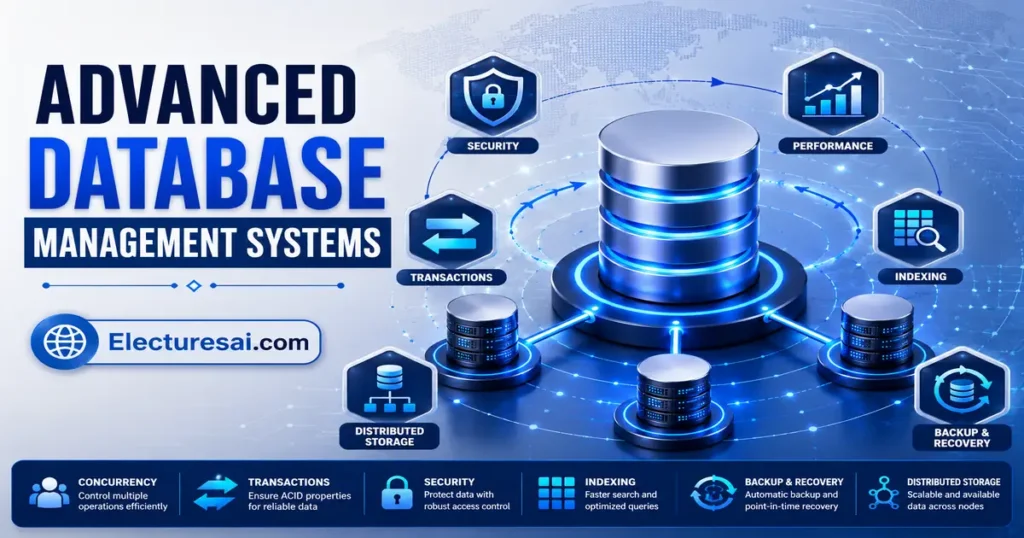
Advanced Database Management Systems is an important subject for students of Computer Science, Software Engineering, Information Technology, Data Science, and related degree programs. It explains how modern databases manage large amounts of information while maintaining speed, accuracy, security, and reliability.
During your semester, you may find this subject more difficult than introductory database courses. The reason is simple: Advanced DBMS does not stop at tables, primary keys, and basic SQL queries. It also covers transactions, concurrency control, query optimization, indexing, distributed databases, recovery techniques, and security.
These concepts may look separate in your notes, but they work together in real systems. A banking application, for example, needs transactions to transfer money safely, concurrency control to handle multiple customers, indexes to retrieve accounts quickly, and recovery mechanisms to protect data after a failure.
This guide explains the major concepts of Advanced Database Management Systems in simple academic language. It is designed to help you understand the theory, revise important exam topics, avoid common mistakes, and prepare for MCQs, short questions, and descriptive answers.
Table of Contents
- What Is Advanced Database Management Systems?
- Key Concepts in Advanced Database Management Systems
- Important Topics for Exam Preparation
- How to Study Advanced DBMS Effectively
- Common Mistakes Students Make
- Expert Tips for Scoring High
- Practice MCQs
- Frequently Asked Questions
- Conclusion
What Is Advanced Database Management Systems?
Advanced Database Management Systems is the study of techniques used to design, control, optimize, secure, distribute, and recover complex database systems.
A basic DBMS course teaches you how data is organized into tables and how SQL is used to insert, update, delete, and retrieve records. Advanced DBMS studies what happens when the database becomes larger, more complicated, or accessible to many users at the same time.
Consider an online shopping application. One customer places an order, another updates a delivery address, an administrator changes the product price, and the inventory system reduces the available stock. All these activities may occur within the same second.
The database must process these operations without losing information or creating conflicting results. It must also prevent unauthorized access and remain available if one server stops working.
Simple Definition for Exams
Advanced DBMS is a collection of database concepts and technologies used to manage complex data operations, multiple users, large datasets, distributed storage, database security, and system recovery.
Difference Between Basic DBMS and Advanced DBMS
| Basic DBMS | Advanced DBMS |
|---|---|
| Introduces tables, rows, and columns | Studies complex and large-scale database systems |
| Covers basic SQL queries | Covers query processing and optimization |
| Introduces keys and relationships | Examines advanced integrity and concurrency controls |
| Explains simple normalization | Studies normalization, denormalization, and performance trade-offs |
| Focuses on one database system | Covers distributed databases and replication |
| Provides basic security concepts | Includes roles, auditing, encryption, and recovery planning |
Key Concepts in Advanced Database Management Systems
Database Architecture
Database architecture describes how users, applications, and database servers communicate with one another.
In a one-tier architecture, the user directly interacts with the database system. This model is generally used for local development or small applications.
In a two-tier architecture, a client application communicates directly with a database server. A desktop inventory application connected to a central database is a common example.
In a three-tier architecture, the user interface communicates with an application server, and the application server communicates with the database. Most modern websites use this approach because business rules and database credentials remain separate from the user interface.
Text-described diagram:
User Interface → Application Server → Database Server
The application server validates requests, applies business rules, and then sends approved operations to the database.
Database Models
A database model defines how data is structured, stored, and connected.
The relational model organizes information into tables. It is suitable for systems where relationships, consistency, and transactions are important.
A document database stores data in flexible document-like records. It is useful when different records may contain different fields.
A graph database focuses on connections between entities. It can represent social networks, recommendation systems, transportation routes, and fraud detection relationships.
A key-value database stores each value with a unique key. It is commonly used for caching, sessions, and fast lookups.
Database Normalization
Normalization is the process of organizing data into related tables to reduce duplication and prevent data anomalies.
Imagine a student table that stores the department name, department office, and department phone number with every student record. If the phone number changes, the university may need to update hundreds of rows.
A better design stores department information in a separate Department table. The Student table then stores only the department identifier.
First Normal Form
A table is in First Normal Form when every column contains atomic values and repeating groups are removed.
Second Normal Form
A table is in Second Normal Form when it is already in First Normal Form and every non-key attribute fully depends on the complete primary key.
Third Normal Form
A table is in Third Normal Form when it is already in Second Normal Form and contains no transitive dependency between non-key attributes.
Boyce-Codd Normal Form
BCNF is a stronger version of Third Normal Form. In BCNF, every determinant must be a candidate key.
Denormalization
Denormalization intentionally introduces selected duplication to reduce complex joins and improve read performance.
It should not be applied simply because a query feels difficult. First measure the performance issue, study the execution plan, and then decide whether denormalization is justified.
For example, a reporting system may store a calculated monthly sales total so that it does not need to calculate the same result from millions of transaction records every time.
Transaction Management
A transaction is a sequence of database operations treated as one logical unit of work.
Consider a bank transfer of Rs. 10,000 from Account A to Account B:
- Subtract Rs. 10,000 from Account A.
- Add Rs. 10,000 to Account B.
- Record the transaction.
- Confirm the transfer.
If the system subtracts the amount but fails before adding it to Account B, the database becomes incorrect. Transaction management ensures that either the entire transfer succeeds or all incomplete changes are reversed.
ACID Properties
Reliable transactions are commonly described through ACID properties.
- Atomicity: The complete transaction succeeds or fails as one unit.
- Consistency: A transaction moves the database from one valid state to another.
- Isolation: Concurrent transactions should not interfere incorrectly.
- Durability: Committed changes remain saved even after a crash or restart.
A useful exam technique is to connect each property with a simple question:
- Atomicity: Did every operation complete?
- Consistency: Were all database rules maintained?
- Isolation: Did another transaction see or change incomplete work?
- Durability: Will the committed data survive a failure?
Transaction States
A transaction may move through several states:
- Active: The transaction is executing.
- Partially committed: The final statement has executed, but changes are not fully guaranteed.
- Committed: The transaction has completed successfully.
- Failed: The transaction cannot continue.
- Aborted: Its changes have been rolled back.
- Terminated: The transaction has left the system.
Concurrency Control
Concurrency control manages multiple transactions that access the database at the same time.
Suppose two staff members open the same inventory record showing ten units. The first person sells three units, while the second sells four. If both updates are based on the original quantity, one update may overwrite the other.
This is called a lost update problem.
Common Concurrency Problems
- Lost update: One transaction overwrites another transaction’s changes.
- Dirty read: A transaction reads data that another transaction has not committed.
- Non-repeatable read: The same row returns different values within one transaction.
- Phantom read: A repeated query returns additional or missing rows.
- Incorrect summary: A calculation reads a mixture of old and updated values.
Locking
Locks restrict access to database resources while a transaction is using them.
A shared lock normally allows reading but prevents conflicting modification. An exclusive lock is used when data is being changed and blocks other incompatible access.
Two-phase locking has two stages:
- Growing phase: The transaction obtains locks but does not release them.
- Shrinking phase: The transaction releases locks but cannot obtain new ones.
Deadlock
A deadlock occurs when transactions wait indefinitely for resources held by each other.
For example:
- Transaction 1 locks the Student table and waits for the Course table.
- Transaction 2 locks the Course table and waits for the Student table.
Neither transaction can continue unless the database detects the deadlock and cancels or rolls back one of them.
Database Indexing
An index is a data structure that helps the DBMS locate records efficiently.
Without an index, the system may need to scan every row. With a suitable index, it can directly locate the relevant part of the table.
Common index types include:
- Primary index
- Secondary index
- Clustered index
- Non-clustered index
- Dense index
- Sparse index
- B-tree index
- B+ tree index
- Hash index
Indexes improve many read operations, but they also require storage and maintenance. Every insert, update, or deletion may require the corresponding indexes to be updated.
Query Processing and Optimization
Query processing is the set of steps used to interpret and execute a database query.
A simplified query-processing flow is:
SQL Query → Parsing → Validation → Query Plan → Execution → Result
The query optimizer compares possible execution plans. It may decide whether to scan a table, use an index, change the join order, or select a particular join algorithm.
Consider this query:
SELECT student_name
FROM students
WHERE registration_number = 'BSCS-2026-101';
If the registration number is indexed, the DBMS can locate the record quickly. Without an index, it may scan the complete table.
Distributed Databases
A distributed database stores related data across multiple computers or locations while allowing users to interact with it as a coordinated system.
A university with campuses in Lahore, Islamabad, and Karachi may store local student records at each campus while maintaining shared academic and administrative information.
Data Fragmentation
Fragmentation divides a database into smaller parts.
- Horizontal fragmentation: Rows are divided among locations.
- Vertical fragmentation: Columns are divided among locations.
- Mixed fragmentation: Horizontal and vertical methods are combined.
Replication
Replication creates copies of data on multiple servers. It can improve availability and read performance, but it also creates synchronization and consistency challenges.
Synchronous replication waits for required replicas before confirming an operation. Asynchronous replication confirms the operation first and updates replicas afterward.
Database Security
Database security protects information against unauthorized reading, modification, deletion, disclosure, and disruption.
Important controls include:
- Authentication
- Authorization
- Role-based access control
- Least privilege
- Encryption
- Auditing
- Secure backups
- Activity monitoring
- Protection against SQL injection
Authentication verifies who the user is. Authorization decides what that user is allowed to do.
Backup and Recovery
Backups protect an organization from accidental deletion, hardware failure, software errors, and other disruptions.
- Full backup: Copies the complete database.
- Incremental backup: Copies changes since the most recent backup.
- Differential backup: Copies changes since the last full backup.
Recovery may also use transaction logs and checkpoints. A checkpoint records a known database state, reducing the amount of work required during recovery.
Remember this practical rule: a backup is not truly reliable until it has been restored successfully during a controlled test.
Important Topics for Advanced DBMS Exam Preparation
University exams often combine definitions, comparisons, diagrams, scenarios, and technical explanations. Give special attention to the following areas:
- Three-schema and client-server database architecture
- Relational and non-relational data models
- Normalization from 1NF to BCNF
- Functional and transitive dependencies
- Transactions and transaction states
- ACID properties
- Concurrency problems and isolation levels
- Shared and exclusive locks
- Two-phase locking
- Deadlock detection and prevention
- Indexes, B-trees, and B+ trees
- Query processing and optimization
- Distributed database fragmentation
- Replication and distributed transactions
- Authentication, authorization, and encryption
- Backup types, logs, checkpoints, and recovery
- SQL and NoSQL database differences
- OLTP and OLAP systems
Do not prepare only definitions. Examiners may describe a situation and ask you to identify the correct concept.
For example, if a question says that one transaction reads uncommitted changes from another transaction, the answer is a dirty read. If two transactions wait for each other’s locked resources, the situation is a deadlock.
Step-by-Step: How to Study Advanced Database Management Systems Effectively
Step 1: Revise Basic Database Concepts
Review tables, attributes, tuples, primary keys, foreign keys, relationships, and SQL operations. Advanced concepts are much easier when your foundation is clear.
Step 2: Study One Concept Group at a Time
Do not mix indexing, recovery, normalization, and distributed databases in one study session. Divide the subject into manageable groups.
A practical order is:
- Architecture and data models
- Normalization
- Transactions and ACID properties
- Concurrency control and deadlocks
- Indexing and query optimization
- Distributed databases
- Security and recovery
Step 3: Create Comparison Tables
Comparison questions are common in exams. Prepare short tables for:
- SQL versus NoSQL
- Normalization versus denormalization
- Shared lock versus exclusive lock
- Deadlock prevention versus detection
- Clustered index versus non-clustered index
- Synchronous versus asynchronous replication
- OLTP versus OLAP
Step 4: Draw Diagrams
Practice simple diagrams for three-tier architecture, transaction states, distributed database fragmentation, and deadlock wait-for graphs.
A clear diagram can help you remember the complete concept and improve the presentation of descriptive answers.
Step 5: Connect Theory With Real Scenarios
Use banking for transactions, online shopping for concurrency, libraries for indexing, multi-campus universities for distributed databases, and hospital systems for security examples.
Step 6: Practice MCQs After Every Topic
Do not wait until the complete syllabus is finished. Practice ten to twenty questions immediately after revising each topic.
Step 7: Review Incorrect Answers
Write down the reason for each mistake. A wrong answer can reveal whether your problem is a weak definition, a confused comparison, or poor scenario interpretation.
Step 8: Attempt a Timed Mixed Quiz
During the final stage of preparation, combine all topics and practice under a timer. This checks both knowledge and speed.
Common Mistakes Students Make
Memorizing ACID Without Understanding It
Students often remember the four words but cannot identify them in scenarios. Connect each property with a real transaction.
Confusing Authentication With Authorization
Authentication verifies identity. Authorization controls permissions. This distinction frequently appears in MCQs.
Treating Every Index as Beneficial
An index can speed up reading, but excessive indexes increase storage and write overhead.
Confusing Dirty Read and Non-Repeatable Read
A dirty read involves uncommitted data. A non-repeatable read occurs when a committed value changes between two reads in the same transaction.
Ignoring the Complete Normalization Process
Do not jump directly to 3NF. First identify keys, functional dependencies, repeating groups, partial dependencies, and transitive dependencies.
Writing Only Definitions in Long Questions
A strong answer normally includes a definition, explanation, diagram or process, example, advantages, limitations, and conclusion where relevant.
Assuming Replication Is the Same as Backup
Replication improves availability, but accidental deletion or corruption may also be copied to replicas. Independent backups are still necessary.
Expert Tips for Scoring High in Advanced DBMS
- Prepare a one-page glossary of important terms.
- Practice transaction and locking scenarios instead of definitions alone.
- Use diagrams in architecture, transaction, and distributed database questions.
- Write one practical example in every descriptive answer.
- Underline technical terms such as atomicity, deadlock, fragmentation, and rollback.
- Study previous papers to identify repeated topics.
- Practice SQL joins and query-result questions manually.
- Review weak topics through short quizzes instead of rereading the complete chapter.
- Attempt mixed-difficulty questions before the final exam.
- Reserve the final revision day for concepts, comparisons, and mistakes.
Practice MCQs
MCQ 1
Which ACID property ensures that a transaction is completed entirely or not performed at all?
A. Consistency
B. Atomicity
C. Isolation
D. Durability
Correct Answer: B. Atomicity
Explanation: Atomicity treats all operations of a transaction as one unit. If any operation fails, the completed operations are rolled back.
MCQ 2
Which problem occurs when one transaction reads uncommitted data written by another transaction?
A. Lost update
B. Phantom read
C. Dirty read
D. Deadlock
Correct Answer: C. Dirty read
Explanation: A dirty read occurs when uncommitted data becomes visible to another transaction. The value may later be rolled back.
MCQ 3
Which form of fragmentation divides a table by rows?
A. Vertical fragmentation
B. Horizontal fragmentation
C. Derived indexing
D. Schema replication
Correct Answer: B. Horizontal fragmentation
Explanation: Horizontal fragmentation distributes selected rows among database locations. Vertical fragmentation divides columns.
MCQ 4
What is the main purpose of a database index?
A. To remove all duplicated data
B. To encrypt database records
C. To speed up data retrieval
D. To replace database backups
Correct Answer: C. To speed up data retrieval
Explanation: An index gives the DBMS an efficient path to matching records. It does not automatically normalize, encrypt, or back up the database.
MCQ 5
What occurs when two transactions wait indefinitely for resources locked by each other?
A. Checkpoint
B. Deadlock
C. Replication
D. Denormalization
Correct Answer: B. Deadlock
Explanation: A deadlock is a circular waiting condition involving locked resources. The DBMS may resolve it by selecting and rolling back one transaction.
Frequently Asked Questions
Is Advanced Database Management Systems difficult?
The subject can feel difficult because it combines database theory, system architecture, and problem-solving. It becomes manageable when you study concepts in groups and connect each concept with a practical example.
Which topics are most important for an Advanced DBMS semester exam?
Transactions, ACID properties, normalization, concurrency control, deadlocks, indexing, query optimization, distributed databases, security, and recovery are commonly tested. Your university syllabus and past papers should determine the final priority.
What should I study before Advanced DBMS?
You should understand basic DBMS concepts, relational tables, primary and foreign keys, SQL queries, joins, and normalization. These topics provide the foundation for advanced database concepts.
How can I remember ACID properties?
Connect them with a bank transaction: Atomicity completes all steps, Consistency maintains rules, Isolation protects simultaneous transactions, and Durability preserves committed results.
What is the difference between normalization and denormalization?
Normalization reduces duplication by dividing data into related tables. Denormalization may add controlled duplication to reduce joins and improve selected read operations.
Why is concurrency control required?
Concurrency control prevents incorrect results when multiple users access or update data simultaneously. It helps avoid problems such as dirty reads, lost updates, and inconsistent values.
Does replication replace database backup?
No. Replication improves availability by maintaining copies of data, but errors or deletion may also be copied. A separate backup and tested recovery plan is still required.
How should I prepare Advanced DBMS MCQs?
Study one topic, attempt related MCQs, review explanations, and record your mistakes. After topic-wise preparation, attempt a mixed timed quiz to test speed and retention.
Conclusion
Advanced Database Management Systems explains how modern applications manage complex, valuable, and rapidly changing information. The subject connects database design with transactions, performance, concurrency, security, distribution, and recovery.
For strong exam preparation, avoid memorizing definitions without context. Understand how each concept solves a practical problem. Use diagrams, comparison tables, scenarios, and topic-wise MCQs to strengthen your preparation.
When your concepts are clear, Advanced DBMS becomes much easier. You can identify transaction problems, understand query performance, compare database designs, and explain how real systems protect and recover their information.
Ready to Test Your Knowledge?
If you want to practice Advanced Database Management Systems MCQs with a timer, instant score, and answer explanations, head over to TestInFlow. It is built specifically for semester exam preparation.
Practice Advanced Database Management Systems MCQs on TestInFlow →
Want to Explore More Topics?
ElecturesAI covers hundreds of university subjects with lecture notes, MCQs, and study guides. Browse more topics below.