Animal Diversity-I (Invertebrates): Complete Guide for Semester Exams
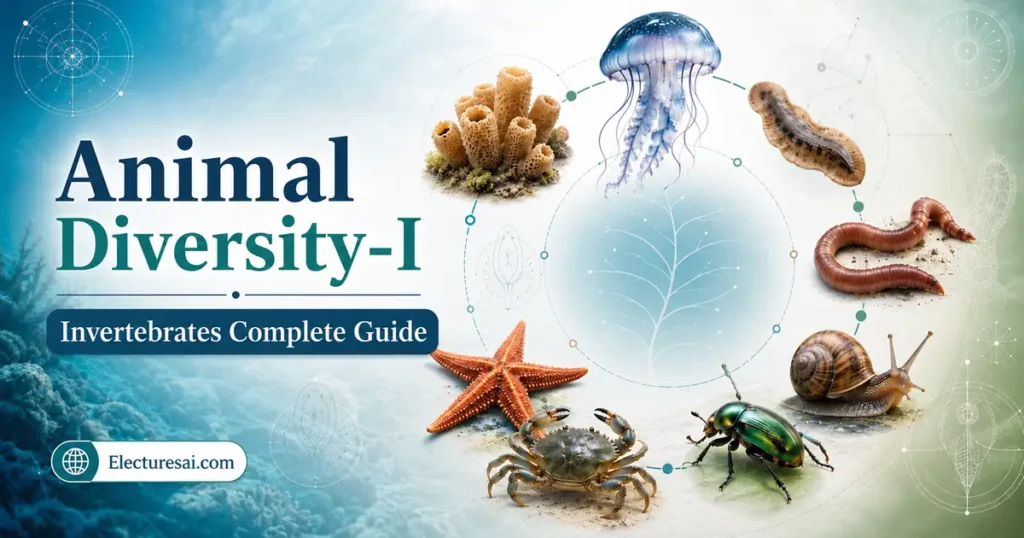
Animal Diversity-I (Invertebrates) is a fundamental subject for students of Zoology, Biology, Environmental Science, and related degree programs. It introduces the enormous variety of animals that do not possess a vertebral column and explains how their body plans, organ systems, habitats, and evolutionary adaptations differ.
At first, this subject may feel like a long list of phyla, classes, scientific terms, and examples. Students often try to memorize every characteristic separately. That approach usually creates confusion during the semester exam.
A better method is to understand the pattern behind animal classification. Why are sponges placed in Porifera? What makes cnidarians different from flatworms? Why are annelids considered more structurally advanced than nematodes? Once you connect each phylum with its body organization, symmetry, body cavity, digestive system, and special features, the subject becomes much easier.
This guide explains the major concepts of Animal Diversity-I (Invertebrates) in simple academic language. It will help you prepare for MCQs, short questions, diagrams, comparisons, practical identification, and descriptive semester-exam answers.
Table of Contents
- What Is Animal Diversity-I?
- Basis of Invertebrate Classification
- Major Invertebrate Phyla
- Important Topics for Exam Preparation
- How to Study Animal Diversity-I Effectively
- Common Mistakes Students Make
- Expert Tips for Scoring High
- Practice MCQs
- Frequently Asked Questions
- Conclusion
What Is Animal Diversity-I (Invertebrates)?
Animal Diversity-I is the study of animals without a vertebral column, with emphasis on their classification, body organization, evolutionary relationships, adaptations, habitats, reproduction, and representative examples.
The term invertebrate is a convenient descriptive term rather than one formal taxonomic group. It includes animals with extremely different body plans, ranging from simple pore-bearing sponges to highly organized insects, molluscs, and echinoderms.
Some invertebrates are microscopic, while others are large and complex. They may live in freshwater, seawater, soil, forests, deserts, animal bodies, or human settlements.
Common examples include:
- Sponges
- Hydra and jellyfish
- Flatworms and tapeworms
- Roundworms
- Earthworms and leeches
- Snails, clams, and octopuses
- Insects, spiders, prawns, and crabs
- Starfish and sea urchins
Why Is Invertebrate Diversity Important?
Invertebrates perform essential ecological functions. They pollinate plants, decompose organic matter, improve soil structure, form aquatic food webs, control pest populations, and provide food for many vertebrates.
Some species are economically useful. Honeybees produce honey and support pollination, silkworms produce silk, earthworms improve soil, and several molluscs provide food or pearls.
Other invertebrates may cause disease or economic loss. Mosquitoes transmit pathogens, parasitic worms affect humans and livestock, and some insects damage crops and stored food.
For this reason, Animal Diversity-I is not simply a classification subject. It helps students understand agriculture, medicine, fisheries, ecology, evolution, pest management, and wildlife conservation.
Key Concepts in Animal Diversity-I
Levels of Body Organization
Animals show different levels of structural organization.
- Cellular level: Cells perform different functions but are not organized into true tissues. Sponges show this level.
- Tissue level: Similar cells form functional tissues. Cnidarians show tissue-level organization.
- Organ level: Several tissues combine to form organs. Flatworms show organ-level organization.
- Organ-system level: Organs work together in systems. This level occurs in most advanced invertebrate groups.
This sequence is useful in exams because it shows the increasing complexity of animal body organization.
Body Symmetry
Symmetry describes how an animal’s body can be divided into similar parts.
Asymmetry
An asymmetrical body cannot be divided into equal halves through any regular plane. Many sponges are asymmetrical.
Radial Symmetry
A radially symmetrical animal can be divided into similar parts through several planes passing through a central axis. Hydra and jellyfish are common examples.
Radial symmetry is useful for animals that receive food, danger, or environmental signals from several directions.
Bilateral Symmetry
A bilaterally symmetrical animal can be divided into right and left halves through one main plane.
Bilateral symmetry is often associated with directional movement and cephalization. Animals moving forward tend to concentrate sensory organs and nervous tissue at the anterior end.
Cephalization
Cephalization is the concentration of sensory organs, nervous tissue, and feeding structures near the head region.
It is especially important in actively moving bilateral animals. A forward-moving animal encounters food, obstacles, and predators first at its anterior end, so sensory structures are useful in that region.
Germ Layers
Germ layers are embryonic tissue layers from which body structures develop.
- Ectoderm: Commonly forms the outer covering and nervous structures.
- Endoderm: Commonly forms the lining of the digestive region.
- Mesoderm: Contributes to muscles, connective tissues, reproductive structures, and many internal organs.
Animals with two primary germ layers are called diploblastic. Cnidarians are common examples.
Animals with ectoderm, mesoderm, and endoderm are called triploblastic. Flatworms, annelids, molluscs, arthropods, and many other groups are triploblastic.
Body Cavity
The body cavity is another major basis of animal classification.
Acoelomate Animals
Acoelomates do not have a fluid-filled body cavity between the digestive tract and body wall. The space is filled with tissue. Flatworms are standard examples.
Pseudocoelomate Animals
A pseudocoel is a body cavity that is not completely lined by mesoderm. Roundworms are common pseudocoelomates.
Coelomate Animals
A true coelom is completely lined by mesoderm. Annelids, molluscs, arthropods, and echinoderms are coelomate animals, although the coelom may be reduced or modified in some groups.
Text-described diagram:
Acoelomate → no body cavity
Pseudocoelomate → cavity not fully lined by mesoderm
Coelomate → cavity fully lined by mesoderm
Segmentation
Segmentation is the division of the body into repeated units.
Annelids show clear external and internal segmentation. Arthropods also possess a segmented ancestry, but their segments are often grouped into specialized body regions such as the head, thorax, and abdomen.
Segmentation allows different body regions to become specialized while maintaining coordinated movement.
Digestive System
A digestive system may be absent, incomplete, or complete.
- Absent: Tapeworms absorb nutrients through their body surface.
- Incomplete: Food enters and waste leaves through one opening, as in many flatworms and cnidarians.
- Complete: The digestive tract has separate mouth and anus openings, as in nematodes, annelids, molluscs, and arthropods.
Protostomes and Deuterostomes
Many triploblastic animals are divided into protostomes and deuterostomes according to aspects of embryonic development.
In the traditional comparison, the blastopore generally develops into the mouth in protostomes. Annelids, molluscs, and arthropods are protostomes.
In deuterostomes, the blastopore generally develops into the anus, while the mouth forms later. Echinoderms and hemichordates are deuterostomes.
Major Invertebrate Phyla
Phylum Porifera
Porifera includes sponges. The name means “pore-bearing,” referring to the numerous small openings in the body wall.
Water enters through pores called ostia, passes through internal canals or chambers, and leaves through a larger opening called the osculum.
Important characteristics include:
- Mostly marine habitat
- Cellular level of organization
- No true tissues or organs
- Body containing pores and canals
- Choanocytes that produce water currents and capture food
- Internal support from spicules or spongin
- Both sexual and asexual reproduction
Examples include Sycon, Spongilla, and bath sponges.
Text-described water-flow diagram:
Ostia → canals or chambers → spongocoel → osculum
Phylum Cnidaria
Cnidarians include Hydra, jellyfish, sea anemones, and corals.
Their most distinctive feature is the presence of cnidocytes. These specialized cells contain stinging structures called nematocysts, which are used for prey capture and defense.
Important characteristics include:
- Aquatic, mostly marine animals
- Radial symmetry
- Diploblastic body
- Tissue-level organization
- Gastrovascular cavity
- One digestive opening
- Polyp or medusa body form
- Diffuse nerve net
The polyp is usually cylindrical and attached, while the medusa is generally bell-shaped and free-swimming.
Phylum Ctenophora
Ctenophores are marine animals commonly called comb jellies.
They move through water using eight rows of ciliary plates called comb plates. Many species possess adhesive cells called colloblasts for capturing prey.
Ctenophores may look similar to jellyfish, but they do not possess the characteristic cnidocytes of cnidarians.
Phylum Platyhelminthes
Platyhelminthes includes flatworms such as planarians, flukes, and tapeworms.
Their bodies are dorsoventrally flattened, meaning they are flattened from the upper to lower surface.
Important characteristics include:
- Bilateral symmetry
- Triploblastic body
- Acoelomate organization
- Organ-level development
- Unsegmented body
- Incomplete digestive system in many groups
- Flame cells for excretion and osmoregulation
- Free-living and parasitic species
Tapeworms lack a digestive tract and absorb already-digested nutrients from the host through their body surface.
Phylum Nematoda
Nematodes are cylindrical, unsegmented roundworms.
They possess a pseudocoel and a complete digestive tract with separate mouth and anus openings.
Important characteristics include:
- Bilateral symmetry
- Triploblastic organization
- Pseudocoelom
- Complete digestive tract
- Protective external cuticle
- Longitudinal muscles
- Molting during growth
- Free-living and parasitic forms
Ascaris, hookworms, pinworms, and filarial worms are familiar parasitic examples.
Phylum Annelida
Annelids are segmented worms such as earthworms, leeches, and marine polychaetes.
Their bodies are divided into repeated segments, a condition known as metamerism.
Important characteristics include:
- Bilateral symmetry
- Triploblastic organization
- True coelom
- Segmented body
- Complete digestive tract
- Closed circulatory system in typical members
- Nephridia for excretion
- Ventral nerve cord
Earthworms improve soil by mixing organic material and creating channels that support aeration and water movement.
Phylum Mollusca
Mollusca includes snails, slugs, clams, oysters, squids, and octopuses.
Although their body forms vary greatly, the basic molluscan body plan includes a muscular foot, visceral mass, and mantle.
The mantle covers the visceral mass and often secretes a shell. The muscular foot may be used for crawling, burrowing, attachment, or prey capture.
Important characteristics include:
- Soft, unsegmented body
- True coelom, often reduced
- Mantle and mantle cavity
- Muscular foot
- Visceral mass
- Radula in most groups
- Usually an open circulatory system
Cephalopods such as squids and octopuses are an important exception because they possess a closed circulatory system.
Bivalves such as clams and oysters generally lack a radula and feed by filtering particles from water.
Phylum Arthropoda
Arthropoda is the most species-rich animal phylum. It includes insects, spiders, scorpions, centipedes, millipedes, crabs, and prawns.
The name Arthropoda means “jointed feet.” Jointed appendages allow efficient movement and may be modified for walking, swimming, feeding, sensing, reproduction, or defense.
Important characteristics include:
- Bilateral symmetry
- Segmented body
- Jointed appendages
- Chitin-containing exoskeleton
- Molting or ecdysis
- Open circulatory system
- Well-developed sensory organs
- Specialized body regions
Major Arthropod Groups
Insects: Typically possess a head, thorax, abdomen, one pair of antennae, and three pairs of legs.
Arachnids: Include spiders and scorpions. They generally possess four pairs of walking legs and lack antennae.
Crustaceans: Include crabs and prawns. They generally possess two pairs of antennae and are mainly aquatic.
Myriapods: Include centipedes and millipedes and possess many body segments.
Phylum Echinodermata
Echinoderms include starfish, sea urchins, brittle stars, sea cucumbers, and feather stars.
They are exclusively marine and possess an internal skeleton made of calcareous plates or ossicles.
Important characteristics include:
- Marine habitat
- Triploblastic and coelomate organization
- Deuterostome development
- Bilateral larvae
- Usually pentaradial adults
- Water vascular system
- Tube feet
- Strong regenerative ability in many species
The water vascular system supports locomotion, feeding, attachment, and gas exchange.
Phylum Hemichordata
Hemichordates are marine, worm-like deuterostomes. Balanoglossus, commonly called an acorn worm, is a standard example.
The body is commonly divided into a proboscis, collar, and trunk. Pharyngeal slits occur in the digestive tract, but hemichordates do not possess a true vertebrate notochord.
Important Topics for Animal Diversity-I Exam Preparation
Students should give special attention to the following areas:
- Levels of organization
- Radial and bilateral symmetry
- Diploblastic and triploblastic animals
- Acoelomate, pseudocoelomate, and coelomate body plans
- Cephalization and segmentation
- Protostome and deuterostome development
- Canal system of sponges
- Choanocytes and sponge skeleton
- Polyp and medusa forms
- Cnidocytes and nematocysts
- Flatworm adaptations
- Parasitic adaptations in tapeworms
- Nematode cuticle and pseudocoel
- Metamerism in annelids
- Basic molluscan body plan
- Classes of Mollusca
- Arthropod exoskeleton and molting
- Differences among insects, arachnids, and crustaceans
- Water vascular system of echinoderms
- Comparative characteristics of major phyla
Examiners frequently ask students to identify a phylum from a short description. You may be given features such as radial symmetry, flame cells, jointed appendages, or tube feet and asked to select the correct group.
For this reason, prepare one diagnostic feature for every major phylum.
Step-by-Step: How to Study Animal Diversity-I Effectively
Step 1: Learn the Classification Criteria
Start with symmetry, germ layers, body cavity, segmentation, and digestive-system type. These concepts are repeatedly used to compare phyla.
Step 2: Create a Comparison Table
Prepare columns for:
- Symmetry
- Level of organization
- Germ layers
- Body cavity
- Segmentation
- Digestive system
- Special feature
- Examples
Add one phylum in each row. This single table can support a large part of your final revision.
Step 3: Study One Phylum at a Time
For each phylum, follow the same pattern:
- Definition
- Habitat
- Body organization
- Special structures
- Nutrition and digestion
- Excretion and circulation
- Reproduction
- Examples
- Economic or ecological importance
Step 4: Draw Simple Diagrams
Practice diagrams of sponge water flow, Hydra body form, tapeworm structure, earthworm segmentation, molluscan body plan, arthropod body regions, and the echinoderm water vascular system.
Your diagrams do not need to be artistic. They should be clean, correctly labelled, and relevant to the answer.
Step 5: Use Diagnostic Features
Connect each phylum with one memorable feature:
- Porifera — pores and choanocytes
- Cnidaria — cnidocytes
- Ctenophora — comb plates
- Platyhelminthes — flat acoelomate body
- Nematoda — pseudocoel and complete gut
- Annelida — true segmentation
- Mollusca — mantle and muscular foot
- Arthropoda — jointed appendages
- Echinodermata — water vascular system
Step 6: Practice Comparisons
Common comparison questions include:
- Porifera versus Cnidaria
- Platyhelminthes versus Nematoda
- Nematoda versus Annelida
- Annelida versus Arthropoda
- Mollusca versus Arthropoda
- Insects versus arachnids
- Protostomes versus deuterostomes
Step 7: Attempt Topic-Wise MCQs
Practice questions after completing every two or three phyla. Do not wait until the night before the exam.
Step 8: Attempt a Timed Mixed Quiz
After completing the syllabus, attempt questions from all phyla under a timer. This helps you identify similar features without relying on chapter order.
Common Mistakes Students Make
Memorizing Examples Without Characteristics
Knowing that Hydra belongs to Cnidaria is not enough. You should also connect it with radial symmetry, cnidocytes, a gastrovascular cavity, and a polyp body form.
Confusing Acoelom and Pseudocoelom
An acoelomate lacks a body cavity between the gut and body wall. A pseudocoelomate possesses a cavity, but it is not completely lined by mesoderm.
Calling Every Radial Animal a Cnidarian
Adult echinoderms also show radial organization, but their larvae are bilateral and their internal structure is very different from cnidarians.
Confusing Segmentation With Body Regions
True segmentation involves repeated body units. The head, thorax, and abdomen of an insect are specialized groups of ancestral segments.
Assuming All Molluscs Have External Shells
Some molluscs have reduced or internal shells, while others, such as octopuses, lack a typical external shell.
Assuming All Invertebrates Have Open Circulation
Annelids generally possess a closed circulatory system, and cephalopod molluscs also have closed circulation.
Ignoring Scientific Examples
Exams often require at least one representative example. Learn common examples and practise writing their names correctly.
Expert Tips for Scoring High in Animal Diversity-I
- Begin every long answer with a clear definition.
- Use headings instead of writing one long paragraph.
- Add a labelled diagram where appropriate.
- Underline diagnostic terms such as cnidocytes, pseudocoelom, mantle, and tube feet.
- Include at least two examples in phylum-based questions.
- Prepare comparison tables for similar groups.
- Learn the ecological or economic importance of representative animals.
- Practise identification questions based on characteristics.
- Review incorrect MCQs rather than only checking the score.
- Revise one-page phylum summaries during the final exam week.
Practice MCQs
MCQ 1
Which cells create water currents and capture food particles in sponges?
A. Cnidocytes
B. Choanocytes
C. Flame cells
D. Nephridia
Correct Answer: B. Choanocytes
Explanation: Choanocytes possess flagella that produce water currents and collars that trap food particles. Cnidocytes occur in cnidarians, while flame cells and nephridia are excretory structures.
MCQ 2
Which structure is the distinctive defensive and prey-capturing feature of cnidarians?
A. Radula
B. Nematocyst
C. Spicule
D. Tube foot
Correct Answer: B. Nematocyst
Explanation: Nematocysts occur inside specialized cnidocytes and can discharge rapidly. They help cnidarians capture prey and defend themselves.
MCQ 3
Which excretory structures are characteristic of flatworms?
A. Green glands
B. Malpighian tubules
C. Flame cells
D. Kidneys
Correct Answer: C. Flame cells
Explanation: Flame cells form part of the protonephridial system of flatworms. They help remove excess water and metabolic waste.
MCQ 4
Which molluscan structure commonly secretes the shell?
A. Mantle
B. Radula
C. Foot
D. Nephridium
Correct Answer: A. Mantle
Explanation: The mantle covers the visceral mass and commonly secretes the shell. The foot is mainly involved in movement, attachment, or prey handling.
MCQ 5
Why must many arthropods undergo ecdysis?
A. Their digestive system is incomplete
B. Their exoskeleton cannot expand continuously
C. Their coelom is absent
D. Their appendages are unjointed
Correct Answer: B. Their exoskeleton cannot expand continuously
Explanation: The rigid exoskeleton limits continuous body expansion. Arthropods shed the old covering and produce a larger one during growth.
Frequently Asked Questions
What is studied in Animal Diversity-I?
Animal Diversity-I studies the classification, structure, body organization, adaptations, reproduction, and evolutionary relationships of major invertebrate groups. It normally covers animals from Porifera to Echinodermata, although the exact syllabus may vary.
What is the easiest way to remember invertebrate phyla?
Connect every phylum with one diagnostic feature and two examples. For instance, remember Porifera through pores and choanocytes, Cnidaria through cnidocytes, and Arthropoda through jointed appendages.
What is the difference between acoelomate and pseudocoelomate animals?
Acoelomates do not possess a fluid-filled body cavity between the gut and body wall. Pseudocoelomates possess a body cavity, but it is not completely lined by mesoderm.
Why are arthropods so diverse?
Arthropods possess jointed appendages, protective exoskeletons, specialized body regions, strong sensory systems, and varied feeding structures. These features allow them to occupy many aquatic and terrestrial habitats.
Are all molluscs protected by a shell?
No. Many molluscs possess external shells, but shells may be reduced, internal, or absent in some groups. Octopuses, for example, do not possess the typical external molluscan shell.
Why are echinoderms classified as deuterostomes?
Their embryonic development follows the deuterostome pattern, in which the blastopore generally contributes to the anus while the mouth forms separately. They share this broad developmental pattern with chordates and hemichordates.
Which diagrams are important for an Animal Diversity-I exam?
Common diagrams include sponge canal systems, Hydra, tapeworm, earthworm, basic molluscan organization, arthropod body regions, and the echinoderm water vascular system. Follow your lecturer’s practical and theory syllabus when selecting diagrams.
How should I prepare Animal Diversity-I MCQs?
Revise diagnostic characteristics, body symmetry, germ layers, body cavities, organ systems, and representative examples. Attempt topic-wise questions first and then complete a mixed timed quiz.
Conclusion
Animal Diversity-I (Invertebrates) introduces students to some of the most varied and successful organisms on Earth. The subject becomes easier when you stop treating every phylum as an isolated chapter and begin comparing their body plans.
Focus on symmetry, germ layers, body cavities, segmentation, digestive systems, special structures, and representative examples. These recurring features provide a logical framework for the entire course.
Prepare comparison tables, draw simple diagrams, practise identification questions, and review your incorrect MCQs. This combination will strengthen both your understanding and your semester-exam performance.
Ready to Test Your Knowledge?
If you want to practise Animal Diversity-I (Invertebrates) MCQs with answers, explanations, and exam-focused questions, continue your preparation on TestInFlow.
Practice Animal Diversity-I MCQs on TestInFlow →
Want to Explore More Topics?
ElecturesAI provides university lecture notes, study guides, subject explanations, and exam-preparation resources. Browse more courses below.