Internet of Things (IoT): Complete Guide for Semester Exams
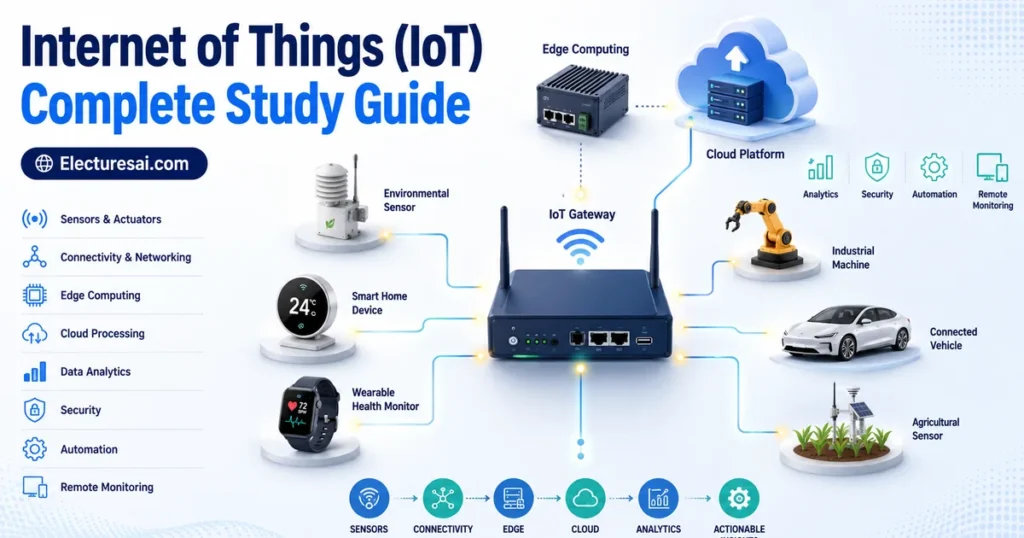
The Internet of Things, commonly known as IoT, is an important subject for students of Computer Science, Information Technology, Software Engineering, Artificial Intelligence, Electronics, and related degree programs. It explains how physical objects can collect data, communicate through networks, and perform useful actions with limited or no direct human involvement.
Students often understand individual IoT terms such as sensors, cloud platforms, wireless networks, and smart devices, but they struggle to connect these components into one complete system. A sensor alone is not an IoT solution. An IoT system also requires communication, data processing, security, storage, software, and a useful application.
Consider a smart irrigation system. A soil-moisture sensor measures the condition of the soil. The device sends this information through a network. Software analyzes the reading and decides whether water is required. An actuator then opens a valve, and the farmer may receive an update through a mobile application.
This guide explains the major concepts of the Internet of Things in simple academic language. It will help you prepare for semester exams, MCQs, short questions, diagrams, comparisons, assignments, and case-based questions.
Table of Contents
- What Is the Internet of Things?
- Key Components of IoT
- IoT Architecture and Layers
- IoT Communication Technologies
- Important IoT Protocols
- Edge, Fog, and Cloud Computing
- IoT Security and Privacy
- Applications of IoT
- Challenges of IoT
- Important Topics for Exam Preparation
- How to Study IoT Effectively
- Common Mistakes Students Make
- Expert Tips for Scoring High
- Practice MCQs
- Frequently Asked Questions
- Conclusion
What Is the Internet of Things?
The Internet of Things is a network of physical objects containing sensors, software, processing capability, and communication technologies that allow them to collect, exchange, and act upon data.
The physical objects connected through IoT are commonly called things, nodes, smart objects, or IoT devices.
Examples include:
- Smart watches
- Home-security cameras
- Industrial machines
- Connected vehicles
- Smart electricity meters
- Agricultural sensors
- Medical-monitoring devices
- Warehouse tracking systems
- Smart streetlights
Not every electronic device is automatically an IoT device. A normal temperature sensor may only display a local reading. It becomes part of an IoT system when its data is communicated, processed, stored, or used to trigger a service or action.
Why Is IoT Important?
IoT connects the physical and digital worlds. It allows organizations to observe real-world conditions continuously and respond more quickly.
Its benefits may include:
- Real-time monitoring
- Automation of repetitive work
- Reduced operational cost
- Improved resource efficiency
- Early detection of failures
- Better customer services
- Data-driven decision-making
- Remote control of equipment
However, IoT also introduces security, privacy, interoperability, power-management, and scalability challenges.
Key Components of the Internet of Things
Physical Things and Devices
A thing is the physical object being monitored or controlled. It may be a machine, vehicle, appliance, animal, building, medical device, or environmental location.
An IoT device commonly contains a processor or microcontroller, memory, communication interface, power source, and one or more sensors or actuators.
Sensors
A sensor detects or measures a physical condition and converts it into data that a system can process.
Common IoT sensors measure:
- Temperature
- Humidity
- Pressure
- Light
- Motion
- Distance
- Sound
- Location
- Air quality
- Soil moisture
- Heart rate
Sensor quality affects the reliability of the complete IoT system. Incorrect calibration, physical damage, or environmental interference can produce misleading data.
Actuators
An actuator performs a physical action in response to a command.
Examples include:
- Opening a valve
- Starting a motor
- Switching a light on or off
- Moving a robotic arm
- Adjusting a thermostat
- Locking a door
A sensor observes the environment, while an actuator changes the environment.
Embedded Processor
The processor performs local calculations, reads sensor values, controls actuators, and manages communication.
Small IoT devices commonly use microcontrollers because they consume less power and are suitable for focused tasks. More complex edge devices may use stronger processors capable of running operating systems and advanced analytics.
Connectivity
Connectivity allows devices to exchange data with gateways, applications, cloud services, or other devices.
The correct communication method depends on:
- Required range
- Data rate
- Power consumption
- Cost
- Network availability
- Environmental conditions
- Security requirements
IoT Gateway
An IoT gateway connects local devices with wider networks or cloud platforms.
A gateway may perform:
- Protocol translation
- Data aggregation
- Local filtering
- Temporary storage
- Device authentication
- Security enforcement
- Edge processing
For example, several low-power sensors may communicate with a gateway through Zigbee. The gateway may then send selected information to a cloud platform through Wi-Fi, Ethernet, or cellular connectivity.
IoT Platform
An IoT platform manages device connectivity, data collection, storage, rules, dashboards, alerts, and application integration.
It may also support:
- Device registration
- Remote configuration
- Firmware updates
- Access control
- Data visualization
- Application programming interfaces
User Interface
The user interface allows people to monitor data, receive alerts, configure devices, and send commands.
Interfaces may include web dashboards, mobile applications, control panels, voice interfaces, or automated reports.
IoT Architecture and Layers
IoT architecture describes how devices, communication networks, data-processing systems, and applications work together.
Three-Layer IoT Architecture
Perception Layer
The perception layer interacts with the physical environment. It contains sensors, actuators, RFID tags, cameras, and embedded devices.
Its main responsibilities are sensing, identification, measurement, and physical control.
Network Layer
The network layer transfers data between devices, gateways, servers, and applications.
It may use Wi-Fi, cellular networks, Bluetooth, Ethernet, Zigbee, LPWAN, or other communication technologies.
Application Layer
The application layer provides services to users and organizations.
Examples include smart-home control, health monitoring, industrial dashboards, traffic management, and agricultural automation.
Text-described three-layer diagram:
Perception Layer → Network Layer → Application Layer
Five-Layer IoT Architecture
Some courses use a five-layer model:
- Perception layer: Collects data and performs physical actions.
- Transport layer: Transfers data through communication networks.
- Processing layer: Stores, analyzes, and manages data.
- Application layer: Delivers domain-specific services.
- Business layer: Supports business rules, management, reporting, and decision-making.
Architecture terminology may vary among textbooks. In your exam, use the exact model taught by your lecturer.
IoT Communication Models
Device-to-device: Devices communicate directly with one another.
Device-to-cloud: A device connects directly to a cloud service.
Device-to-gateway: A device communicates through an intermediate gateway.
Back-end data sharing: Data from one IoT platform is shared with other approved systems or services.
IoT Communication Technologies
Wi-Fi
Wi-Fi provides relatively high data rates and direct internet connectivity. It is useful for cameras, home devices, and applications that require more bandwidth.
Its power consumption may be too high for small battery-operated sensors that must operate for months or years.
Bluetooth Low Energy
Bluetooth Low Energy, or BLE, supports short-range communication with low power consumption.
It is commonly used in wearable devices, health sensors, smart locks, and accessories that communicate with smartphones.
Zigbee
Zigbee is a low-power communication technology often used for sensor and home-automation networks.
It can support mesh networking, where devices help forward data through the network.
RFID
Radio-Frequency Identification uses tags and readers for identification and tracking.
RFID is widely used in inventory management, access cards, supply chains, and asset tracking.
NFC
Near-Field Communication works over a very short distance.
It is used in contactless payments, access control, ticketing, and device pairing.
Cellular Networks
Cellular connectivity supports devices spread across large geographical areas.
Technologies such as LTE-M and NB-IoT are designed for lower-power IoT applications, while conventional cellular connections may support higher-bandwidth devices.
LoRaWAN
LoRaWAN is a low-power wide-area networking technology designed for long-range communication with relatively low data rates.
It is suitable for environmental sensors, agriculture, utility metering, and remote monitoring where small amounts of data are transmitted occasionally.
Important IoT Communication Protocols
MQTT
MQTT is a lightweight messaging protocol based on the publish-subscribe model.
Devices publish messages to named topics. Other devices or applications subscribe to those topics. A message broker receives and distributes the messages.
Text-described MQTT flow:
Publisher → MQTT Broker → Subscriber
MQTT is suitable for unreliable or limited-bandwidth networks because its messages can have low overhead.
CoAP
The Constrained Application Protocol, or CoAP, is designed for constrained devices and low-power networks.
It uses a request-response style similar to web communication and commonly operates over UDP.
HTTP and REST
HTTP is widely used for communication between devices, web servers, applications, and cloud platforms.
It is familiar and widely supported but may require more bandwidth and processing than lightweight protocols such as MQTT or CoAP.
AMQP
The Advanced Message Queuing Protocol supports reliable message exchange and queuing.
It is frequently associated with enterprise messaging systems where delivery control and structured routing are important.
Edge, Fog, and Cloud Computing in IoT
Edge Computing
Edge computing processes data close to the device or data source.
For example, a factory camera may identify a defective product locally instead of transmitting every video frame to a distant data centre.
Benefits of edge computing include:
- Lower delay
- Reduced network traffic
- Faster local response
- Improved operation during network failure
- Better control over sensitive data
Fog Computing
Fog computing provides distributed processing between edge devices and the cloud.
A local gateway or regional server may aggregate information from several nearby devices before sending selected results to the cloud.
Cloud Computing
Cloud platforms provide scalable storage, processing, analytics, device management, and application services.
The cloud is useful for combining data from many locations, running long-term analysis, managing large device fleets, and supporting remote dashboards.
IoT Data Lifecycle
A simplified IoT data lifecycle is:
Sensing → Transmission → Processing → Storage → Analysis → Decision → Action
Good IoT design determines which data should be processed locally, which should be transmitted, how long it should be stored, and who may access it.
IoT Security and Privacy
IoT security is challenging because devices may be small, physically exposed, widely distributed, and expected to operate for many years.
Common IoT Security Risks
- Default passwords
- Weak authentication
- Unencrypted communication
- Outdated firmware
- Insecure mobile applications
- Exposed network services
- Poor device management
- Physical tampering
- Excessive data collection
- Insecure cloud interfaces
Device Authentication
Each device should have a reliable identity. The system should verify devices before accepting data or sending sensitive commands.
Using the same default password on thousands of devices creates a serious security risk.
Encryption
Encryption protects data while it is stored and while it moves through networks.
Encryption alone is not sufficient. Secure key generation, storage, rotation, and revocation are also required.
Secure Boot and Firmware Updates
Secure boot helps ensure that a device starts only trusted software.
Digitally signed firmware updates help prevent attackers from installing unauthorized code. Devices should support safe update procedures throughout their operational life.
Network Segmentation
IoT devices should not automatically receive unrestricted access to every organizational system.
Network segmentation limits communication and reduces the impact of a compromised device.
Privacy
IoT devices may collect location, health, activity, audio, video, and household information.
Privacy protection requires clear purpose, limited collection, controlled access, secure retention, and responsible deletion.
Applications of the Internet of Things
Smart Homes
Smart-home systems connect lights, locks, cameras, thermostats, alarms, and appliances. Users may monitor and control these devices remotely.
Healthcare
Wearable sensors and connected medical devices can monitor heart rate, glucose, movement, medication use, or other health indicators.
Healthcare IoT requires strong reliability, privacy, and safety controls.
Industrial IoT
Industrial IoT connects machines, production lines, sensors, and maintenance systems.
It supports predictive maintenance, equipment monitoring, quality control, energy management, and process automation.
Smart Agriculture
Agricultural IoT systems monitor soil moisture, temperature, weather, irrigation, livestock, and crop conditions.
They can help farmers use water, fertilizer, and energy more efficiently.
Smart Cities
Smart-city applications include traffic monitoring, smart parking, waste management, street lighting, environmental monitoring, and public-safety systems.
Logistics and Supply Chains
Connected sensors can track location, temperature, vibration, and condition during storage and transportation.
This is valuable for food, medicines, industrial products, and other sensitive goods.
Challenges of IoT
- Interoperability: Devices from different manufacturers may use incompatible formats and protocols.
- Scalability: Managing thousands or millions of devices requires efficient identification, monitoring, and updates.
- Power consumption: Battery-powered devices must operate efficiently.
- Connectivity: Remote or mobile devices may experience weak or interrupted networks.
- Latency: Safety-critical applications may require immediate responses.
- Security: Every connected device can increase the attack surface.
- Privacy: Continuous monitoring may collect sensitive personal information.
- Data management: Large device fleets can generate enormous amounts of data.
- Lifecycle support: Devices may remain deployed longer than their software support period.
- Cost: Hardware, connectivity, platforms, maintenance, and support all affect the project.
Important Topics for IoT Exam Preparation
- Definition and characteristics of IoT
- Sensors and actuators
- IoT devices and gateways
- Three-layer and five-layer IoT architectures
- Device-to-device and device-to-cloud models
- Wi-Fi, BLE, Zigbee, RFID, NFC, and cellular IoT
- LoRaWAN and low-power wide-area networks
- MQTT publish-subscribe model
- CoAP and HTTP
- Edge, fog, and cloud computing
- IoT data lifecycle
- Device management and firmware updates
- IoT security threats
- Authentication and encryption
- Network segmentation
- IoT privacy
- Industrial IoT
- Smart homes, healthcare, agriculture, and cities
- Interoperability and scalability
- Power and latency constraints
Step-by-Step: How to Study IoT Effectively
Step 1: Understand the Complete Data Flow
Memorize the basic sequence:
Sensor → Device → Network → Gateway or Cloud → Application → Decision → Actuator
Step 2: Learn the Purpose of Every Component
Do not memorize only names. Explain what the sensor, actuator, gateway, broker, platform, and application contribute to the system.
Step 3: Compare Architecture Layers
Create a table showing the function and examples of each layer in the three-layer and five-layer models.
Step 4: Compare Communication Technologies
Use range, power consumption, data rate, cost, and typical application as comparison headings.
Step 5: Draw Protocol Diagrams
Practice the MQTT publisher-broker-subscriber diagram and a simple CoAP request-response diagram.
Step 6: Study One Complete Case
Take a smart farm, hospital, home, or factory and identify its sensors, communication method, processing platform, application, actuator, and security requirements.
Step 7: Practise Scenario-Based Questions
Ask which technology is suitable for a low-power remote sensor, where urgent data should be processed, or which control prevents unauthorized firmware.
Step 8: Attempt Timed MCQs
Start with topic-wise questions and finish with a mixed quiz covering architecture, protocols, computing, security, and applications.
Common Mistakes Students Make
Calling Every Electronic Device an IoT Device
An IoT device normally collects, communicates, processes, or acts on data as part of a connected system.
Confusing Sensors and Actuators
A sensor measures a condition. An actuator performs a physical action.
Confusing MQTT With a Network Technology
MQTT is an application-layer messaging protocol. Wi-Fi, cellular networks, and Zigbee provide communication connectivity.
Assuming All Data Must Go to the Cloud
Edge processing may be faster, cheaper, more private, and more reliable for time-sensitive tasks.
Confusing Edge and Gateway
A gateway may perform edge computing, but its main role is often connecting, aggregating, and translating between devices and wider networks.
Ignoring Device Updates
IoT security must continue after deployment. Unsupported or unpatched devices may remain vulnerable for years.
Choosing Technology Without Considering Power
A communication technology suitable for a powered camera may be unsuitable for a battery-operated field sensor.
Ignoring Privacy
Continuous collection of location, health, audio, or activity data can create serious privacy concerns.
Expert Tips for Scoring High in IoT
- Start long answers with a clear IoT definition.
- Draw a labelled end-to-end IoT architecture.
- Give one practical example for every major concept.
- Compare protocols and communication technologies in tables.
- Explain why edge processing is useful.
- Mention both security and privacy in application questions.
- Connect sensors with appropriate actuators.
- Use range, power, bandwidth, and cost in technology comparisons.
- Explain challenges as well as benefits.
- Practise scenario-based MCQs before the exam.
Practice MCQs
MCQ 1
Which component measures a physical condition in an IoT system?
A. Sensor
B. Actuator
C. Dashboard
D. Router table
Correct Answer: A. Sensor
Explanation: A sensor detects conditions such as temperature, pressure, motion, or moisture. An actuator performs a physical action.
MCQ 2
What is the main function of an IoT gateway?
A. Connecting devices with wider networks and services
B. Replacing every sensor
C. Manufacturing physical products
D. Removing all communication protocols
Correct Answer: A. Connecting devices with wider networks and services
Explanation: A gateway may aggregate data, translate protocols, apply security, and connect local devices to cloud or enterprise systems.
MCQ 3
Which protocol uses a publisher, broker, and subscriber model?
A. MQTT
B. NFC
C. RFID
D. Ethernet cable
Correct Answer: A. MQTT
Explanation: MQTT publishers send messages to topics through a broker. Subscribers receive messages from the topics they follow.
MCQ 4
Why is edge computing useful in an IoT system?
A. It processes data close to the source
B. It removes the need for all sensors
C. It guarantees unlimited storage
D. It eliminates every security risk
Correct Answer: A. It processes data close to the source
Explanation: Edge computing can reduce latency, network traffic, and dependence on a remote cloud connection.
MCQ 5
Which practice creates a major IoT security risk?
A. Using the same default password on many devices
B. Digitally signing firmware updates
C. Segmenting the network
D. Encrypting sensitive communication
Correct Answer: A. Using the same default password on many devices
Explanation: Shared default credentials allow attackers to compromise many devices easily. Unique credentials and secure enrollment reduce this risk.
Frequently Asked Questions
What is the Internet of Things in simple words?
The Internet of Things connects physical objects with sensors, software, and communication networks. These objects can collect information, exchange it, and perform useful actions.
What are the main components of an IoT system?
The main components include devices, sensors, actuators, processors, communication networks, gateways, platforms, data storage, and user applications.
What is the difference between a sensor and an actuator?
A sensor detects or measures a physical condition. An actuator receives a command and performs an action that changes the physical environment.
What is the difference between IoT and embedded systems?
An embedded system performs a dedicated function inside a device. An IoT system commonly adds networking, remote data exchange, services, and device management to embedded technology.
Which protocol is commonly used in IoT?
MQTT is widely used because it is lightweight and supports publish-subscribe messaging. CoAP and HTTP are also used depending on device and application requirements.
What is the difference between edge and cloud computing?
Edge computing processes data near the device or data source. Cloud computing uses remote infrastructure for large-scale storage, management, and analytics.
Why is IoT security difficult?
IoT systems may contain many small, distributed, physically exposed devices with limited computing resources. Long device lifecycles and weak update procedures can increase the risk.
How should I prepare Internet of Things MCQs?
Revise components, architecture layers, communication technologies, protocols, edge computing, security, and applications. Practise scenario-based questions instead of memorizing definitions only.
Conclusion
The Internet of Things connects physical devices with sensing, communication, processing, and application services. A complete IoT solution may contain sensors, actuators, gateways, networks, edge systems, cloud platforms, and user interfaces.
The subject becomes easier when you follow the complete flow of information. A sensor collects data, a network transfers it, software analyzes it, and an actuator or user responds.
Prepare architecture diagrams, protocol comparisons, practical case studies, and security scenarios. Combine this theory with regular MCQ practice to improve your understanding and semester-exam performance.
Ready to Test Your Knowledge?
If you want to practice Internet of Things (IoT) MCQs with a timer, instant score, and answer explanations, continue your preparation on TestInFlow.
Practice Internet of Things MCQs on TestInFlow →
Want to Explore More Topics?
eLecturesAI covers university subjects with detailed lecture notes, MCQs, and study guides.