Introduction to Entomology: Complete Guide for Semester Exams
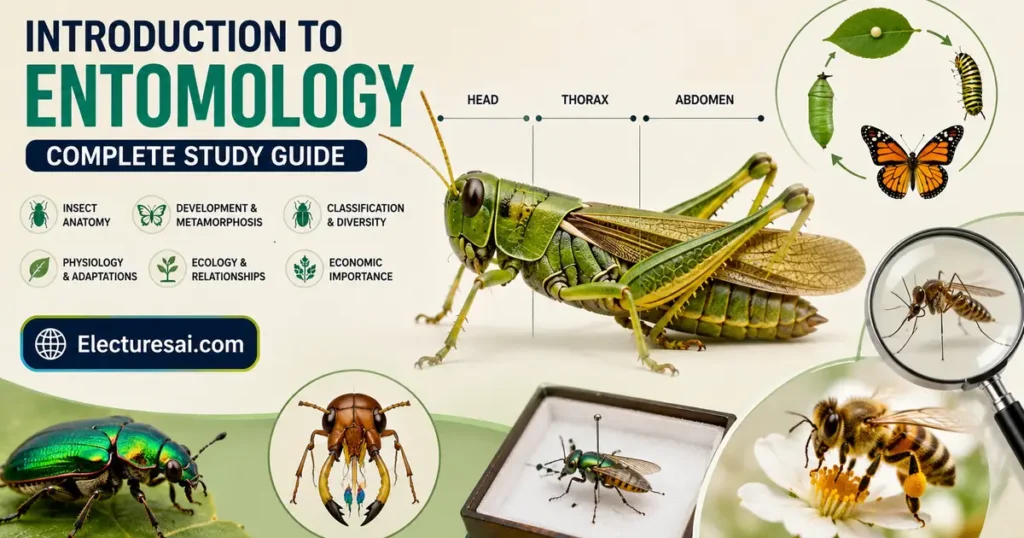
Introduction to Entomology is a foundational subject for students of Zoology, Biology, Agriculture, Environmental Science, Forestry, and related university programs. It explains the structure, development, classification, physiology, behavior, ecology, and economic importance of insects.
Students often recognize familiar insects such as butterflies, bees, mosquitoes, beetles, and grasshoppers but find it difficult to connect them with scientific concepts. Your examination may ask you to identify body regions, compare types of metamorphosis, recognize insect orders, explain mouthpart modifications, or discuss the beneficial and harmful roles of insects.
Insects are exceptionally diverse and occupy almost every terrestrial and freshwater habitat. They pollinate crops, decompose organic matter, support food webs, transmit diseases, damage stored products, and provide useful products such as honey, silk, and lac.
This guide explains the major concepts of Introduction to Entomology in clear academic language. It will help you prepare for MCQs, short questions, diagrams, practical identification, comparisons, assignments, and descriptive semester-exam answers.
Table of Contents
- What Is Entomology?
- General Characteristics of Insects
- External Anatomy of an Insect
- Insect Integument and Molting
- Types of Insect Mouthparts
- Major Internal Systems
- Growth and Metamorphosis
- Important Insect Orders
- Insect Ecology and Behavior
- Economic Importance of Insects
- Insect Collection and Preservation
- Introduction to Pest Management
- Important Topics for Exam Preparation
- How to Study Entomology Effectively
- Common Mistakes Students Make
- Expert Tips for Scoring High
- Practice MCQs
- Frequently Asked Questions
- Conclusion
What Is Entomology?
Entomology is the scientific study of insects, including their anatomy, physiology, development, classification, behavior, ecology, distribution, and relationships with humans and other organisms.
Entomology is a specialized branch of zoology. It has important applications in agriculture, medicine, veterinary science, forestry, environmental conservation, food storage, public health, and forensic investigation.
Major branches of entomology include:
- Agricultural entomology: Studies insects affecting crops and farm production.
- Medical entomology: Studies insects associated with human diseases.
- Veterinary entomology: Examines insects affecting domestic and wild animals.
- Forest entomology: Studies insects living in and affecting forests.
- Economic entomology: Examines useful insects and insects causing economic loss.
- Forensic entomology: Uses insect evidence in legal investigations.
- Systematic entomology: Focuses on insect identification, classification, and evolutionary relationships.
Why Are Insects So Successful?
Insects are successful because they possess several useful adaptations:
- A protective exoskeleton
- Small body size
- Ability to fly in many groups
- High reproductive capacity
- Short generation times
- Specialized mouthparts
- Metamorphosis that separates juvenile and adult lifestyles
- Effective sensory systems
- Ability to survive in diverse habitats
The combination of these features has allowed insects to exploit a remarkable variety of food sources and ecological niches.
General Characteristics of Insects
Insects belong to phylum Arthropoda, subphylum Hexapoda, and class Insecta.
The main characteristics of a typical adult insect are:
- The body is divided into head, thorax, and abdomen.
- Three pairs of jointed legs are attached to the thorax.
- One pair of antennae is present on the head.
- Compound eyes are commonly present.
- Zero, one, or two pairs of wings may occur in adults.
- The body is covered by a chitin-containing exoskeleton.
- Respiration generally occurs through a tracheal system.
- Circulation is open.
- Excretion commonly involves Malpighian tubules.
- Sexes are usually separate.
How Are Insects Different From Other Arthropods?
Spiders have two main body regions and four pairs of legs. Crustaceans commonly possess two pairs of antennae and many appendages. Centipedes and millipedes have elongated bodies with numerous segments and legs.
Insects are distinguished by three principal body regions and exactly three pairs of thoracic legs in the adult stage.
External Anatomy of an Insect
Head
The head is the main sensory and feeding region. It usually carries:
- One pair of antennae
- Compound eyes
- Simple eyes called ocelli in many species
- Modified mouthparts
Antennae may detect touch, smell, air movement, humidity, vibration, and chemical signals. Their shapes vary and may help in identification.
Thorax
The thorax is the locomotory region and consists of three segments:
- Prothorax
- Mesothorax
- Metathorax
Each thoracic segment carries one pair of legs. Wings, when present, are attached to the mesothorax and metathorax.
Text-described body diagram:
Head: antennae, eyes, mouthparts → Thorax: three pairs of legs and wings → Abdomen: digestive, excretory, reproductive, and respiratory structures
Insect Legs
A typical insect leg includes the coxa, trochanter, femur, tibia, tarsus, and pretarsus.
Legs may be modified for different functions:
- Cursorial: Running, as in cockroaches
- Saltatorial: Jumping, as in grasshoppers
- Raptorial: Capturing prey, as in mantises
- Fossorial: Digging, as in mole crickets
- Natatorial: Swimming, as in aquatic beetles
- Pollen-collecting: Modified for carrying pollen in worker honeybees
Wings
Most winged insects possess two pairs of wings, although modifications are common.
- Beetle forewings form hard protective covers called elytra.
- Butterfly and moth wings are covered with scales.
- True flies possess one functional pair of wings.
- The hindwings of flies are modified into balancing organs called halteres.
- Grasshopper forewings are relatively leathery, while the hindwings are broad and membranous.
Abdomen
The abdomen contains most of the digestive, reproductive, and excretory organs. Spiracles are often visible along its sides.
Abdominal appendages may be modified into cerci, ovipositors, stingers, or reproductive structures.
Insect Integument and Molting
The insect body is covered by an external skeleton called the exoskeleton. It provides support, protects internal tissues, reduces water loss, and offers attachment points for muscles.
The body covering includes:
- Epicuticle: A thin outer layer important in protection and reducing water loss.
- Procuticle: A thicker layer containing chitin and proteins.
- Epidermis: A living cellular layer that produces the cuticle.
Because the rigid exoskeleton cannot expand continuously, insects must shed it during growth.
Molting and Ecdysis
Molting is the process of producing and replacing the old cuticle. Ecdysis is the actual shedding of the old exoskeleton.
A simplified sequence is:
Separation of old cuticle → Formation of new cuticle → Digestion of selected old layers → Shedding of old cuticle → Expansion and hardening of new cuticle
The hormone ecdysone promotes molting. Juvenile hormone influences whether the next stage remains juvenile or develops toward the adult form.
Types of Insect Mouthparts
Insect mouthparts are modified according to feeding habits. Understanding these modifications is important for practical identification and examination questions.
Chewing Mouthparts
Chewing mouthparts possess strong mandibles that cut and crush solid food.
Examples include grasshoppers, cockroaches, and many beetles.
Piercing-Sucking Mouthparts
These mouthparts pierce plant or animal tissues and withdraw fluids.
Examples include mosquitoes, aphids, and true bugs.
Siphoning Mouthparts
Butterflies and many moths possess a long coiled proboscis used to suck nectar and other liquids.
Sponging Mouthparts
Houseflies use sponge-like terminal structures to absorb liquid or dissolved food.
Chewing-Lapping Mouthparts
Honeybees possess structures that allow them to manipulate materials and lap liquid food such as nectar.
Mouthpart type often indicates how an insect damages crops or transmits disease. Chewing insects remove plant tissue, while piercing-sucking insects may cause sap loss or transmit pathogens.
Major Internal Systems of Insects
Digestive System
The insect digestive tract is commonly divided into:
- Foregut: Receives, stores, and mechanically processes food.
- Midgut: Main region of digestion and nutrient absorption.
- Hindgut: Reabsorbs water and forms waste.
Respiratory System
Most insects breathe through a tracheal system.
Air enters through external openings called spiracles. It passes through larger tracheae and smaller tracheoles that carry gases directly toward body tissues.
Text-described respiratory flow:
Spiracle → Trachea → Tracheoles → Body cells
Circulatory System
Insects possess an open circulatory system. Their internal fluid, called hemolymph, circulates through the body cavity or hemocoel.
A dorsal vessel helps move hemolymph. Because oxygen is normally transported through the tracheal system, insect hemolymph generally does not serve as the principal oxygen carrier.
Excretory System
Malpighian tubules remove nitrogenous wastes from the hemolymph and release them into the digestive tract.
The hindgut reabsorbs water and salts, helping terrestrial insects conserve water.
Nervous and Sensory Systems
The insect nervous system includes a brain, a ventral nerve cord, and segmental ganglia.
Sensory structures detect:
- Light
- Sound
- Touch
- Odor
- Taste
- Temperature
- Humidity
- Body position
Reproductive System
Most insects reproduce sexually and have separate male and female individuals. Fertilization is usually internal.
Many insects lay eggs, although some species retain developing young for part or all of embryonic development.
Growth and Metamorphosis in Insects
Metamorphosis refers to the developmental changes that occur between the immature and adult stages.
Ametabolous Development
Ametabolous insects undergo little obvious metamorphosis.
The young resemble small adults but lack mature reproductive organs. Silverfish are a common example.
Life cycle: Egg → Young stage → Adult
Incomplete Metamorphosis
Incomplete or hemimetabolous metamorphosis includes egg, nymph, and adult stages.
Nymphs usually resemble small wingless adults and gradually develop adult structures through successive molts.
Examples include grasshoppers, cockroaches, dragonflies, and true bugs.
Life cycle: Egg → Nymph → Adult
Complete Metamorphosis
Complete or holometabolous metamorphosis includes egg, larva, pupa, and adult stages.
The larva and adult often differ greatly in appearance, habitat, and food requirements. The pupal stage is the major transformation stage.
Examples include beetles, butterflies, moths, flies, bees, wasps, and ants.
Life cycle: Egg → Larva → Pupa → Adult
Advantages of Complete Metamorphosis
Larvae and adults can use different foods and habitats. This reduces competition between young and mature members of the same species.
Important Insect Orders
Order Coleoptera
Coleoptera includes beetles. The forewings form protective elytra, while the hindwings are usually used for flight.
Order Lepidoptera
Lepidoptera includes butterflies and moths. Adults possess scale-covered wings, and larvae are commonly called caterpillars.
Order Diptera
Diptera includes true flies, mosquitoes, and houseflies. Adults possess one functional pair of wings and a pair of halteres.
Order Hymenoptera
Hymenoptera includes bees, ants, wasps, and sawflies. Many species are important pollinators, parasitoids, predators, or social insects.
Order Hemiptera
Hemiptera includes true bugs, aphids, cicadas, and related insects. They generally possess piercing-sucking mouthparts.
Order Orthoptera
Orthoptera includes grasshoppers, locusts, and crickets. Many possess enlarged hind legs for jumping and chewing mouthparts.
Order Odonata
Odonata includes dragonflies and damselflies. Both adults and aquatic immature stages are predatory.
Order Blattodea
Blattodea includes cockroaches and termites. Termites are social insects with specialized colony castes.
Order Mantodea
Mantodea includes mantises, which possess raptorial forelegs for capturing prey.
Order Siphonaptera
Siphonaptera includes fleas. They are wingless, laterally compressed insects adapted for jumping and blood feeding.
For exams, learn the common name, distinguishing feature, mouthpart type, metamorphosis, and one important example for each major order.
Insect Ecology and Behavior
Ecological Roles
Insects serve as pollinators, herbivores, predators, parasites, parasitoids, scavengers, and decomposers.
They are also important food sources for birds, fish, reptiles, amphibians, mammals, and other arthropods.
Communication
Insects communicate through chemical, visual, sound, vibration, and touch signals.
Pheromones are chemicals released by an individual that influence other members of the same species. They may attract mates, mark trails, signal danger, or organize colony behavior.
Camouflage and Mimicry
Camouflage helps an insect blend into its environment. Mimicry occurs when an insect resembles another organism or object and gains protection or another advantage.
Social Insects
Ants, termites, and some bees and wasps form organized colonies.
Advanced social organization may include:
- Cooperative care of young
- Overlapping generations
- Division into reproductive and non-reproductive castes
- Collective defense and food gathering
Economic Importance of Insects
Beneficial Insects
Useful roles of insects include:
- Pollination of crops and wild plants
- Production of honey and beeswax
- Production of silk
- Production of lac
- Biological control of pests
- Decomposition and nutrient cycling
- Scientific and medical research
- Food for other animals
Harmful Insects
Insects may cause economic or health-related damage by:
- Feeding on crops
- Damaging forests
- Destroying stored products
- Infesting homes and buildings
- Parasitizing humans or animals
- Transmitting pathogens
- Damaging clothing, wood, and paper
Insects as Disease Vectors
A vector carries a disease-causing organism from one host to another.
Examples include mosquitoes transmitting malaria parasites and dengue viruses, fleas transmitting plague bacteria, and certain flies transmitting pathogens mechanically or biologically.
Insect Collection and Preservation
Insect collections support identification, teaching, biodiversity studies, pest monitoring, and research.
Collection Methods
Common methods include:
- Aerial nets
- Sweep nets
- Light traps
- Pitfall traps
- Aspirators
- Hand collection
- Beating sheets
Preservation
Many hard-bodied adult insects are pinned and stored in protected collection boxes. Small specimens may be mounted on points or slides.
Soft-bodied insects, larvae, and many immature stages are commonly preserved in suitable alcohol-based solutions.
Specimen Labels
A scientifically useful specimen should have a label recording:
- Collection locality
- Date
- Collector’s name
- Habitat or host, when relevant
- Collection method, when useful
An unlabeled specimen has very limited scientific value because its origin and context are unknown.
Introduction to Insect Pest Management
A pest is an organism that causes unacceptable economic, health, environmental, or social damage.
Not every insect present in a crop requires control. Pest-management decisions should consider population size, crop stage, natural enemies, likely damage, and control cost.
Integrated Pest Management
Integrated Pest Management, or IPM, combines compatible methods to keep pest populations below damaging levels while reducing unnecessary risks.
IPM may include:
- Monitoring and correct identification
- Cultural control
- Mechanical and physical control
- Biological control
- Host-plant resistance
- Behavioral control
- Careful chemical control when necessary
Economic Threshold
The economic threshold is the pest population level at which control action should be started to prevent the population from reaching the economic injury level.
Applying pesticides without monitoring may waste money, harm natural enemies, leave residues, and increase resistance.
Important Topics for Introduction to Entomology Exam Preparation
- Definition and branches of entomology
- Reasons for insect diversity and success
- Characteristics of class Insecta
- Head, thorax, and abdomen
- Structure and modifications of insect legs
- Types and modifications of wings
- Insect integument and ecdysis
- Chewing, piercing-sucking, siphoning, sponging, and chewing-lapping mouthparts
- Digestive, respiratory, circulatory, excretory, and nervous systems
- Ametabolous, hemimetabolous, and holometabolous development
- Major insect orders and identifying features
- Insect communication and social behavior
- Pollination and biological control
- Insect pests and disease vectors
- Collection and preservation methods
- Specimen labeling
- Integrated Pest Management
- Economic threshold
Step-by-Step: How to Study Entomology Effectively
Step 1: Learn the Basic Insect Body Plan
Draw a simple insect and label the head, thorax, abdomen, antennae, eyes, legs, wings, and spiracles.
Step 2: Connect Structure With Function
Do not memorize structures separately. Connect enlarged hind legs with jumping, raptorial forelegs with prey capture, and piercing mouthparts with fluid feeding.
Step 3: Compare Metamorphosis Types
Create a table showing stages, immature form, presence or absence of a pupa, and examples.
Step 4: Build an Insect Order Chart
For each order, write its common name, wing feature, mouthpart type, metamorphosis, and one representative insect.
Step 5: Revise Internal Systems Through Flow Diagrams
Draw short flows for respiration, digestion, and excretion rather than learning long paragraphs only.
Step 6: Use Real Specimens or Clear Images
Observe antennae, legs, wings, mouthparts, and body shape. Identification becomes easier when theory is linked with visible characters.
Step 7: Separate Beneficial and Harmful Roles
Prepare two columns and include pollinators, decomposers, biological-control agents, crop pests, stored-product pests, and disease vectors.
Step 8: Attempt Timed MCQs
Begin with topic-based quizzes and finish with mixed questions covering anatomy, physiology, development, classification, and economic importance.
Common Mistakes Students Make
Calling Every Small Arthropod an Insect
Spiders, mites, centipedes, and millipedes are arthropods but are not insects. Adult insects possess three pairs of thoracic legs.
Confusing the Thorax and Abdomen
Legs and wings are attached to the thorax. Most digestive, reproductive, and excretory organs are located in the abdomen.
Confusing Spiracles With Tracheae
Spiracles are external openings. Tracheae are internal air tubes connected to those openings.
Calling Every Immature Insect a Larva
Holometabolous insects have larvae. Hemimetabolous insects have nymphs.
Confusing Molting With Metamorphosis
Molting is the shedding and replacement of the cuticle. Metamorphosis is the broader developmental change between life stages.
Assuming Every Insect Is Harmful
Many insects are essential pollinators, decomposers, predators, parasitoids, and food-web components.
Identifying Orders by Color Alone
Color can vary greatly within a species. Wing structure, mouthparts, antennae, legs, and metamorphosis are more reliable characters.
Forgetting Collection Labels
A specimen without locality, date, and collector information loses much of its scientific value.
Expert Tips for Scoring High in Entomology
- Begin long answers with a direct scientific definition.
- Draw clean, labeled diagrams of insect body regions.
- Write examples with every mouthpart and leg modification.
- Use comparison tables for metamorphosis types.
- Learn one identifying feature for each major order.
- Connect insect structure with feeding or movement.
- Explain both beneficial and harmful insect roles.
- Use correct terms such as larva, nymph, pupa, and adult.
- Mention monitoring and thresholds in pest-management answers.
- Review practical specimens before attempting identification questions.
Practice MCQs
MCQ 1
How many pairs of legs are present in a typical adult insect?
A. Two pairs
B. Three pairs
C. Four pairs
D. Five pairs
Correct Answer: B. Three pairs
Explanation: Adult insects possess three pairs of jointed legs, with one pair attached to each thoracic segment. Four pairs of legs are characteristic of arachnids such as spiders.
MCQ 2
Which structures carry air directly toward insect tissues?
A. Blood capillaries
B. Tracheae and tracheoles
C. Malpighian tubules
D. Nephridia
Correct Answer: B. Tracheae and tracheoles
Explanation: Air enters through spiracles and moves through tracheae and tracheoles. Malpighian tubules perform excretory and osmoregulatory functions.
MCQ 3
Which life cycle represents complete metamorphosis?
A. Egg → Nymph → Adult
B. Egg → Young stage → Adult
C. Egg → Larva → Pupa → Adult
D. Egg → Pupa → Nymph → Adult
Correct Answer: C. Egg → Larva → Pupa → Adult
Explanation: Complete metamorphosis includes distinct larval and pupal stages. Incomplete metamorphosis has egg, nymph, and adult stages without a pupa.
MCQ 4
Which insect order includes beetles?
A. Diptera
B. Coleoptera
C. Lepidoptera
D. Orthoptera
Correct Answer: B. Coleoptera
Explanation: Beetles belong to Coleoptera and typically possess hardened forewings called elytra. Diptera includes true flies, while Lepidoptera includes butterflies and moths.
MCQ 5
Which insect structure is primarily responsible for excretion?
A. Halteres
B. Malpighian tubules
C. Compound eyes
D. Ocelli
Correct Answer: B. Malpighian tubules
Explanation: Malpighian tubules remove wastes from the hemolymph and release them into the gut. Halteres are balancing organs in true flies.
Frequently Asked Questions
What is entomology in simple words?
Entomology is the scientific study of insects. It covers their body structure, life cycles, classification, behavior, ecology, and importance to humans and the environment.
What characteristics distinguish an insect from other arthropods?
A typical adult insect has a head, thorax, abdomen, one pair of antennae, and three pairs of legs. Wings may be absent or present, but the six-legged thoracic arrangement is the most important identifying feature.
What are the three main body regions of an insect?
The three regions are the head, thorax, and abdomen. The head carries sensory and feeding structures, the thorax carries legs and wings, and the abdomen contains many internal organs.
What is the difference between complete and incomplete metamorphosis?
Complete metamorphosis includes egg, larva, pupa, and adult stages. Incomplete metamorphosis includes egg, nymph, and adult stages and does not contain a pupal stage.
Which insect orders are most important for exams?
Coleoptera, Lepidoptera, Diptera, Hymenoptera, Hemiptera, Orthoptera, Odonata, Blattodea, and Siphonaptera are commonly examined. Learn their examples and identifying features rather than memorizing names only.
Why are insects economically important?
Insects pollinate crops, produce useful materials, recycle nutrients, and control other pests. Some also damage crops, destroy stored products, parasitize animals, and transmit diseases.
How are insects preserved for practical study?
Many hard-bodied adults are pinned or point-mounted. Soft-bodied specimens and immature stages are commonly preserved in suitable alcohol, and every specimen should carry complete collection data.
How should I prepare Introduction to Entomology MCQs?
Revise insect characteristics, anatomy, mouthparts, organ systems, metamorphosis, major orders, and economic importance. Practice questions by subtopic before attempting a full mixed quiz under timed conditions.
Conclusion
Introduction to Entomology provides the foundation for understanding insect structure, function, development, classification, ecology, and importance. Insects share a basic body plan but possess remarkable modifications that allow them to live in diverse environments.
The subject becomes easier when you connect visible structures with their functions. Mouthparts reveal feeding methods, legs reveal movement, wings support classification, and developmental stages explain the insect life cycle.
Prepare labeled diagrams, metamorphosis tables, order-identification charts, and practical examples. Combine these notes with regular MCQ practice to strengthen your understanding and semester-exam performance.
Ready to Test Your Knowledge?
Practice Introduction to Entomology MCQs with answers, explanations, and exam-focused questions on TestInFlow.
Practice Introduction to Entomology MCQs →
Want to Explore More Topics?
Explore more university lecture notes, study guides, and subject resources on eLecturesAI.