Animal Form and Function-I: Complete Guide for Semester Exams
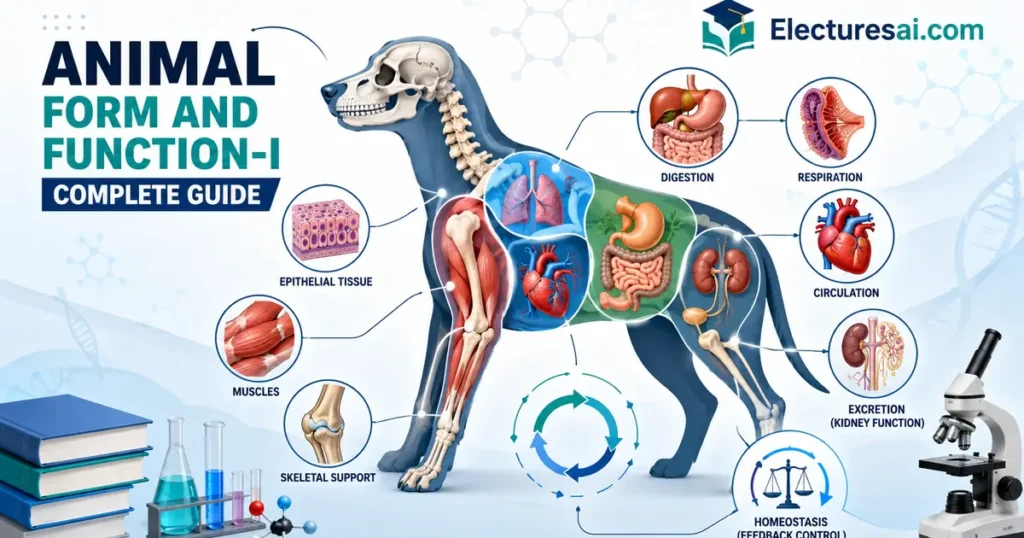
Animal Form and Function-I is an important subject for students of Zoology, Biology, Environmental Science, and related degree programs. It explains how the structures of animals allow them to perform essential life processes such as movement, feeding, respiration, circulation, excretion, and maintenance of a stable internal environment.
Students often find this subject challenging because it combines anatomy with physiology. You are not only expected to identify a tissue, organ, or body system. You must also explain how that structure works and why it is suitable for a particular function.
For example, the small intestine is not simply a long digestive tube. Its folds, villi, thin lining, blood vessels, and large surface area make it highly effective for nutrient absorption. In the same way, the thin and moist respiratory surface of an animal supports the rapid diffusion of gases.
This guide explains the major concepts of Animal Form and Function-I in simple academic language. It is designed to help you prepare for semester exams, MCQs, short questions, diagrams, comparisons, and descriptive answers.
Table of Contents
- What Is Animal Form and Function-I?
- Key Concepts in Animal Form and Function-I
- Important Topics for Exam Preparation
- How to Study Animal Form and Function-I Effectively
- Common Mistakes Students Make
- Expert Tips for Scoring High
- Practice MCQs
- Frequently Asked Questions
- Conclusion
What Is Animal Form and Function-I?
Animal Form and Function-I is the study of how animal body structures, tissues, organs, and organ systems are organized to perform essential physiological functions.
The word form refers to the shape, structure, and organization of an animal or one of its body parts. The word function refers to the job performed by that structure.
Form and function are closely connected. A structure usually possesses features that help it perform its role efficiently.
Consider a bird’s wing. Its lightweight bones, powerful muscles, feathers, and streamlined shape support flight. Similarly, the flattened shape of a red blood cell provides a large surface area for gas exchange and allows the cell to move through narrow blood vessels.
Why Is Animal Form and Function Important?
The subject helps students understand how animals survive in different environments. Desert animals conserve water, aquatic animals exchange gases with water, and active animals require efficient circulation and respiration.
Animal physiology is also important in:
- Veterinary science
- Medicine and healthcare
- Wildlife management
- Animal husbandry
- Fisheries
- Environmental biology
- Evolutionary biology
- Laboratory research
Understanding normal animal function also helps scientists recognize disease, injury, stress, and abnormal physiological conditions.
Key Concepts in Animal Form and Function-I
Relationship Between Form and Function
Animal structures are shaped by their functions and environments. A body feature that is useful in one environment may not be suitable in another.
Fish possess streamlined bodies and fins that reduce resistance and support movement through water. Earthworms use circular and longitudinal muscles against a fluid-filled body cavity. Arthropods use jointed appendages attached to a rigid exoskeleton.
When answering an exam question, do not describe only what a structure looks like. Explain how its design supports its function.
Levels of Structural Organization
Animal bodies are organized into several levels:
- Cells: The smallest living units of the body.
- Tissues: Groups of similar cells performing related functions.
- Organs: Structures composed of several tissue types.
- Organ systems: Groups of organs working together.
- Organism: The complete living animal.
For example, a muscle cell is part of muscle tissue. Muscle tissue contributes to an organ such as the stomach. The stomach works with the intestine, liver, pancreas, and other organs in the digestive system.
Text-described diagram:
Cell → Tissue → Organ → Organ System → Organism
Animal Tissues
Most animal bodies contain four major tissue types: epithelial, connective, muscle, and nervous tissue.
Epithelial Tissue
Epithelial tissue covers body surfaces, lines internal cavities, and forms many glands.
Its cells are closely packed with little material between them. Depending on location, epithelial tissue may provide protection, absorption, secretion, filtration, or sensory reception.
Common forms include:
- Squamous epithelium: Thin, flattened cells suitable for diffusion and filtration.
- Cuboidal epithelium: Cube-shaped cells involved in secretion and absorption.
- Columnar epithelium: Tall cells commonly associated with absorption and secretion.
- Ciliated epithelium: Contains cilia that move substances across the surface.
- Stratified epithelium: Contains several layers and provides protection.
The air sacs of lungs possess thin epithelium for rapid gas diffusion, while the outer skin contains multiple protective layers.
Connective Tissue
Connective tissue supports, binds, protects, stores, and transports materials.
Unlike epithelial tissue, connective tissue usually contains cells separated by an extracellular matrix. This matrix may be fluid, flexible, fibrous, or hard.
Examples include:
- Loose connective tissue
- Dense connective tissue
- Adipose tissue
- Cartilage
- Bone
- Blood
Blood is classified as connective tissue because its cells are suspended in a fluid matrix called plasma.
Muscle Tissue
Muscle tissue contains contractile proteins that produce force and movement.
There are three main types:
- Skeletal muscle: Usually voluntary and attached to the skeleton.
- Smooth muscle: Involuntary and present in organs such as the intestine and blood vessels.
- Cardiac muscle: Found only in the heart and adapted for continuous rhythmic contraction.
Skeletal muscles move bones, smooth muscles move materials through internal organs, and cardiac muscle pumps blood.
Nervous Tissue
Nervous tissue detects stimuli, processes information, and transmits electrical signals.
Neurons are specialized for communication. Supporting cells, commonly called glial cells, protect neurons and help maintain a suitable environment around them.
Nervous tissue allows different parts of the body to coordinate their activities rapidly.
Homeostasis
Homeostasis is the maintenance of relatively stable internal conditions despite changes inside or outside the body.
Animals regulate variables such as:
- Body temperature
- Blood glucose
- Water balance
- Salt concentration
- Blood pressure
- Oxygen and carbon dioxide levels
- Acid-base balance
A homeostatic control system commonly includes:
- Receptor: Detects a change.
- Control centre: Compares the condition with the desired range.
- Effector: Produces a response.
Text-described feedback diagram:
Change in condition → Receptor → Control centre → Effector → Condition returns toward normal
Negative Feedback
Negative feedback reduces the original change and moves a condition back toward its normal range.
If body temperature rises, sweating and increased blood flow near the skin help release heat. If body temperature falls, shivering helps produce heat.
Most homeostatic regulation depends on negative feedback.
Positive Feedback
Positive feedback strengthens the original change. It is less common and usually continues until a specific event is completed.
Examples include blood clotting and the increasing muscular contractions that occur during childbirth.
Integumentary System
The integument is the outer covering of an animal. It may include skin, scales, feathers, hair, shells, cuticles, or other surface structures.
Its functions may include:
- Protection from injury and pathogens
- Prevention of water loss
- Temperature regulation
- Sensory reception
- Camouflage
- Communication
- Vitamin production in some vertebrates
The nature of the body covering reflects the animal’s environment. Aquatic animals face different problems from terrestrial animals, particularly in water balance and physical support.
Support Systems in Animals
Animals require support to maintain body shape, protect organs, and provide surfaces against which muscles can act.
Hydrostatic Skeleton
A hydrostatic skeleton uses fluid enclosed within a body cavity. Muscles contract against the fluid to change body shape and produce movement.
Earthworms and many soft-bodied invertebrates use this type of support.
Exoskeleton
An exoskeleton is a hard external supporting structure.
Arthropods possess an exoskeleton containing chitin. It provides support, protection, attachment for muscles, and reduction of water loss.
Because the exoskeleton cannot grow continuously with the animal, arthropods must periodically shed it through molting.
Endoskeleton
An endoskeleton is located inside the body. It may be composed of cartilage, bone, or other supporting materials.
It grows with the animal and provides strong support without completely covering the outer body surface.
Movement and Muscle Action
Movement occurs when muscles generate force against a supporting structure.
Muscles can shorten through contraction, but they cannot actively push themselves back to their original length. For this reason, many muscles work in antagonistic pairs.
When one muscle contracts, the opposing muscle relaxes.
In a vertebrate arm, the biceps bends the elbow while the triceps extends it.
Tendons attach muscles to bones. Ligaments connect bones to other bones and help stabilize joints.
Nutrition and Feeding
Animals are heterotrophs. They obtain organic nutrients by consuming other organisms or organic material.
Different feeding methods include:
- Filter feeding
- Deposit feeding
- Fluid feeding
- Bulk feeding
- Predation
- Herbivory
- Parasitism
Food provides energy, structural materials, vitamins, minerals, and substances required for growth and repair.
Digestion
Digestion breaks large food molecules into smaller units that can be absorbed and used by cells.
Mechanical digestion physically breaks food into smaller pieces. Chemical digestion uses enzymes to break chemical bonds.
Intracellular and Extracellular Digestion
Intracellular digestion occurs inside cells, usually within food vacuoles.
Extracellular digestion occurs outside cells within a digestive cavity or digestive tract. The products are then absorbed.
Incomplete and Complete Digestive Systems
An incomplete digestive system has one opening that functions as both mouth and exit.
A complete digestive tract has separate mouth and anus openings. This arrangement allows food to move in one direction and supports specialization of different digestive regions.
Human Digestive Tract as an Example
Although Animal Form and Function compares many animal groups, the mammalian digestive system provides a useful model.
- Mouth: Ingestion, chewing, and beginning of carbohydrate digestion.
- Stomach: Temporary storage, mixing, acidic conditions, and protein digestion.
- Small intestine: Most chemical digestion and nutrient absorption.
- Large intestine: Water and electrolyte absorption.
- Liver: Produces bile and processes absorbed nutrients.
- Pancreas: Produces digestive enzymes and bicarbonate.
The small intestine contains folds and villi that increase its absorptive surface area.
Respiration and Gas Exchange
Respiration may refer to cellular energy release or the broader process of obtaining oxygen and removing carbon dioxide.
An effective respiratory surface is usually:
- Thin
- Moist
- Large in surface area
- Well ventilated
- Closely associated with transport fluids or tissues
Types of Respiratory Structures
Body surface: Small or thin animals may exchange gases directly across the body wall.
Gills: Aquatic respiratory structures with a large surface area.
Tracheal system: A network of air tubes that carries gases directly to tissues in insects.
Lungs: Internal respiratory organs used by many terrestrial animals.
Countercurrent Exchange
In fish gills, water and blood commonly move in opposite directions. This countercurrent arrangement maintains a diffusion gradient over a larger part of the respiratory surface.
Circulation
Larger animals require internal transport systems because diffusion alone is too slow over long distances.
A circulatory system distributes:
- Respiratory gases
- Nutrients
- Hormones
- Metabolic wastes
- Heat
- Immune cells
Open Circulatory System
In an open circulatory system, the circulating fluid is not always confined to blood vessels. It enters body spaces and directly bathes organs.
This system occurs in arthropods and most molluscs.
Closed Circulatory System
In a closed circulatory system, blood remains within vessels.
This arrangement allows greater control of pressure and distribution. Annelids, cephalopods, and vertebrates possess closed circulation.
Blood Vessels
- Arteries: Carry blood away from the heart.
- Veins: Return blood toward the heart.
- Capillaries: Thin vessels where exchange occurs.
The direction of flow defines arteries and veins, not the amount of oxygen in the blood.
Osmoregulation and Excretion
Osmoregulation is the control of water and dissolved-solute concentrations in body fluids.
Excretion is the removal of metabolic wastes produced by cells.
Major nitrogenous wastes include:
- Ammonia: Highly toxic and requires large amounts of water for removal.
- Urea: Less toxic and requires less water.
- Uric acid: Conserves water but requires more energy to produce.
Excretory Structures
Different animal groups possess different excretory systems:
- Contractile vacuoles in some unicellular organisms
- Flame cells in flatworms
- Nephridia in annelids
- Malpighian tubules in many insects
- Kidneys in vertebrates
Nephron
The nephron is the functional unit of the vertebrate kidney.
Its major processes include:
- Filtration
- Selective reabsorption
- Tubular secretion
- Excretion
Water balance is regulated partly through hormones. Antidiuretic hormone increases water reabsorption and helps produce more concentrated urine when the body needs to conserve water.
Important Topics for Animal Form and Function-I Exam Preparation
Give special attention to these high-value topics:
- Relationship between structure and function
- Levels of biological organization
- Epithelial, connective, muscular, and nervous tissues
- Negative and positive feedback
- Homeostatic control systems
- Functions of animal integument
- Hydrostatic skeleton, exoskeleton, and endoskeleton
- Antagonistic muscle action
- Tendons, ligaments, and joints
- Feeding mechanisms
- Mechanical and chemical digestion
- Incomplete and complete digestive tracts
- Functions of the stomach, liver, pancreas, and small intestine
- Characteristics of an efficient respiratory surface
- Gills, tracheae, lungs, and body-surface respiration
- Countercurrent exchange
- Open and closed circulation
- Arteries, veins, and capillaries
- Osmoregulation and excretion
- Ammonia, urea, and uric acid
- Excretory organs of major animal groups
- Structure and function of the nephron
Examiners may present a physiological situation rather than ask for a direct definition. For example, a question may describe sweating after an increase in body temperature and ask you to identify negative feedback.
Step-by-Step: How to Study Animal Form and Function-I Effectively
Step 1: Start With the Structure-Function Relationship
For every organ or tissue, ask two questions: what is its structure, and how does that structure support its job?
Step 2: Study One System at a Time
A useful sequence is:
- Tissues
- Homeostasis
- Integument and support
- Muscles and movement
- Nutrition and digestion
- Respiration
- Circulation
- Osmoregulation and excretion
Step 3: Make Comparison Tables
Prepare short comparisons for:
- Epithelial versus connective tissue
- Skeletal versus smooth versus cardiac muscle
- Negative versus positive feedback
- Exoskeleton versus endoskeleton
- Tendon versus ligament
- Mechanical versus chemical digestion
- Open versus closed circulation
- Ammonia versus urea versus uric acid
Step 4: Draw Process Diagrams
Practice diagrams of a feedback loop, antagonistic muscle action, digestive tract, respiratory surface, open and closed circulation, and nephron.
Step 5: Use Practical Examples
Connect each concept with a familiar animal. Use earthworms for hydrostatic support, insects for exoskeleton and tracheae, fish for gills, and mammals for kidneys and double circulation.
Step 6: Practice Questions After Every Unit
Complete topic-wise MCQs before moving to the next body system. This helps you identify misunderstandings early.
Step 7: Review Wrong Answers
Do not simply memorize the correct option. Write one sentence explaining the relevant physiological principle.
Step 8: Attempt a Timed Mixed Quiz
Before the semester exam, combine questions from all systems. Timed practice improves recall, concentration, and confidence.
Common Mistakes Students Make
Describing Structure Without Function
A complete answer should explain why the structure is useful. Do not only write that villi are present in the intestine; explain that they increase surface area for absorption.
Confusing Tendons and Ligaments
Tendons connect muscles to bones, while ligaments connect bones to other bones.
Calling All Feedback Positive
Most homeostatic control depends on negative feedback because it opposes the original change.
Confusing Breathing With Cellular Respiration
Breathing moves air into and out of respiratory organs. Cellular respiration releases usable energy from nutrients inside cells.
Defining Arteries as Oxygenated Vessels
Arteries carry blood away from the heart. Some arteries, such as pulmonary arteries, carry oxygen-poor blood.
Confusing Excretion With Egestion
Excretion removes metabolic wastes produced by cells. Egestion removes undigested food from the digestive tract.
Ignoring Comparative Physiology
Animal Form and Function is not limited to human systems. Include examples from invertebrates, fish, amphibians, reptiles, birds, and mammals when appropriate.
Expert Tips for Scoring High in Animal Form and Function-I
- Start long answers with a direct definition.
- Use headings for structure, function, mechanism, and example.
- Add labelled diagrams where relevant.
- Underline physiological terms such as homeostasis, diffusion, filtration, and reabsorption.
- Include one animal example in comparative questions.
- Explain cause-and-effect relationships clearly.
- Use tables for differences between similar concepts.
- Practice identifying tissues and organs from diagrams.
- Review incorrect MCQs and short questions regularly.
- Revise processes in sequence instead of memorizing isolated terms.
Practice MCQs
MCQ 1
Which animal tissue covers surfaces and lines internal cavities?
A. Connective tissue
B. Epithelial tissue
C. Muscle tissue
D. Nervous tissue
Correct Answer: B. Epithelial tissue
Explanation: Epithelial tissue forms coverings, linings, and many glands. Its functions include protection, absorption, secretion, and filtration.
MCQ 2
Which feedback mechanism normally returns an internal condition toward its set range?
A. Positive feedback
B. Negative feedback
C. Random feedback
D. Structural feedback
Correct Answer: B. Negative feedback
Explanation: Negative feedback opposes the original change. It is the main mechanism used to regulate temperature, glucose, water balance, and many other variables.
MCQ 3
Which structure connects a skeletal muscle to a bone?
A. Ligament
B. Tendon
C. Cartilage
D. Epithelium
Correct Answer: B. Tendon
Explanation: Tendons transmit muscle force to bones. Ligaments connect one bone to another at a joint.
MCQ 4
Which feature increases the absorptive surface of the small intestine?
A. Villi
B. Alveoli
C. Nephridia
D. Tendons
Correct Answer: A. Villi
Explanation: Villi and microvilli greatly increase the surface area available for nutrient absorption. The other structures perform different functions.
MCQ 5
What is the functional unit of the vertebrate kidney?
A. Alveolus
B. Nephron
C. Neuron
D. Sarcomere
Correct Answer: B. Nephron
Explanation: Nephrons filter blood, reabsorb useful substances, secrete selected materials, and contribute to urine formation.
Frequently Asked Questions
What is studied in Animal Form and Function-I?
The subject studies animal tissues, homeostasis, support, movement, nutrition, digestion, respiration, circulation, osmoregulation, and excretion. It focuses on how animal structures are adapted to perform specific functions.
Is Animal Form and Function-I the same as animal physiology?
It includes a large part of introductory animal physiology, but it also emphasizes anatomy and structural organization. The exact course content may vary among universities.
Which topics are most important for the semester exam?
Tissues, feedback mechanisms, skeletal systems, muscle action, digestion, respiratory surfaces, circulation, and excretion are commonly examined. Use your course outline and past papers to set the final priority.
What is the difference between anatomy and physiology?
Anatomy studies body structure, while physiology studies how the body and its parts function. Animal Form and Function connects both areas.
How can I remember the four animal tissue types?
Link each tissue with its main role: epithelium covers, connective tissue supports, muscle produces movement, and nervous tissue communicates.
Why is homeostasis important for animals?
Cells function properly only within suitable internal conditions. Homeostasis helps maintain temperature, water balance, pH, glucose, and other variables within workable ranges.
What is the difference between excretion and egestion?
Excretion removes metabolic wastes such as carbon dioxide and nitrogenous compounds. Egestion removes undigested material from the digestive tract.
How should I prepare Animal Form and Function-I MCQs?
Study each body system, make comparison tables, and practice questions immediately afterward. Finish your preparation with mixed timed quizzes and review every incorrect answer.
Conclusion
Animal Form and Function-I explains how animal structures support survival, movement, feeding, gas exchange, transport, and internal regulation.
The subject becomes easier when you study structure and function together. Do not memorize organs as isolated names. Understand how their shapes, tissues, surfaces, and connections allow them to perform their roles.
Use diagrams, comparison tables, practical examples, and regular MCQ practice. This approach will improve your understanding and help you write stronger semester-exam answers.
Ready to Test Your Knowledge?
If you want to practice Animal Form and Function-I MCQs with answers, explanations, and exam-focused questions, continue your preparation on TestInFlow.
Practice Animal Form and Function-I MCQs on TestInFlow →
Want to Explore More Topics?
ElecturesAI covers university subjects with detailed lecture notes, study guides, MCQs, and exam-preparation resources.