

Explore Electric Charge, Electric Force, and Coulomb’s Law in Applied Physics Lecture 2. Learn charge quantization, conservation of charge, and real-world applications in electronics, AI hardware, and sensors.
1. Introduction
Electricity is one of the most important pillars of modern technology. Every electronic device, computing system, and AI hardware platform operates due to the movement and interaction of electric charges. Understanding electric charge and electric force is the first step toward mastering electrostatics and electronics.
In this lecture, we study the nature of electric charge, how charges interact through electric force, and how these interactions are mathematically described using Coulomb’s Law.
2. Electric Charge
Electric charge is a fundamental property of matter that causes it to experience a force when placed in an electric or magnetic field.
There are two types of electric charges:
- Positive charge
- Negative charge
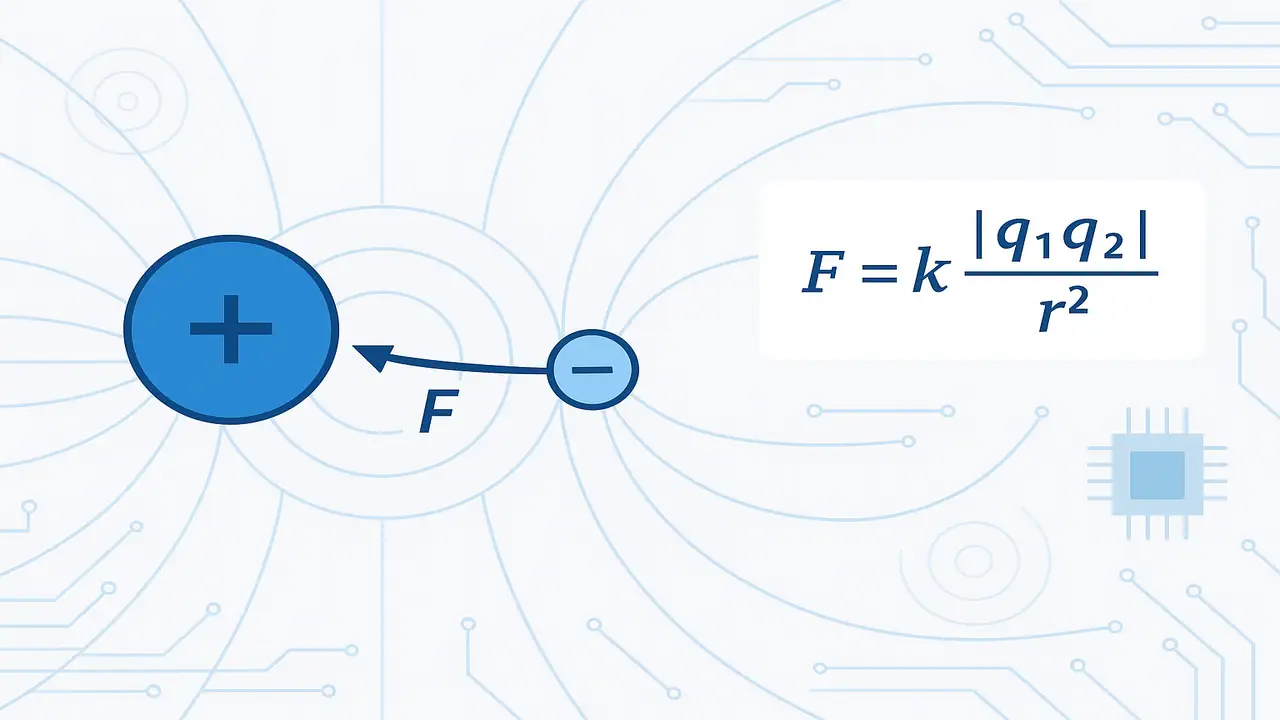
Like charges repel each other, while unlike charges attract each other.
2.1 Unit of Electric Charge
The SI unit of electric charge is the coulomb (C).
One coulomb represents a very large amount of charge, which is why electric charge is usually measured in smaller quantities at the atomic level.
2.2 Charge on an Electron
The smallest known unit of free charge is the charge on an electron:
This value plays a crucial role in electronics and semiconductor devices used in AI hardware.
3. Quantization of Charge
Electric charge is quantized, meaning it exists in discrete packets.
Where:
- = total charge
- = integer
- = charge of one electron
This means no object can have a charge smaller than the charge of a single electron.
Halliday, Resnick & Walker – Fundamentals of Physics
Real-World Importance
- Digital electronics rely on discrete charge movement
- Memory cells store information using quantized charge
- AI processors depend on controlled electron flow
4. Conservation of Electric Charge
The law of conservation of charge states:
Electric charge can neither be created nor destroyed; it can only be transferred from one body to another.
In an isolated system, the total charge remains constant.
Practical Examples
- Charging a capacitor
- Static electricity
- Battery operation
This law is essential for analyzing circuits and power systems.
Lecture 1 – Introduction to Applied Physics
5. Electric Force
Electric force is the force of attraction or repulsion between charged objects.
This force:
- Acts along the line joining the charges
- Depends on the magnitude of charges
- Depends on the distance between charges
Electric force is a non-contact force, meaning charges do not need to touch to interact.
6. Coulomb’s Law
Coulomb’s Law gives the mathematical expression for electric force between two point charges.
Where:
- = electric force
- = charges
- = distance between charges
Nature of Force
- Repulsive for like charges
- Attractive for unlike charges
7. Vector Nature of Electric Force
Electric force is a vector quantity, meaning it has both magnitude and direction.
When multiple charges are present, the principle of superposition is used:
The net force is the vector sum of all individual forces.
This principle is widely used in:
- Circuit analysis
- Field calculations
- Sensor modeling
8. Applications of Electric Force
8.1 Electronics and Computing
- Electron flow in conductors
- Transistor operation
- Integrated circuits
8.2 AI Sensors
- Capacitive touch sensors
- Proximity sensors
- MEMS devices
8.3 Data Storage Devices
- Charge-based memory (DRAM)
- Flash storage
Summary
In this lecture, we studied electric charge, its quantized nature, conservation of charge, and the electric force between charges. Coulomb’s Law provides a fundamental tool for analyzing interactions in electrostatic systems. These concepts form the foundation for understanding electric fields, circuits, sensors, and modern AI hardware.
Next Lecture 3 – Electric Field and Field Lines
People also ask:
Electric charge is a fundamental property of matter responsible for electric interactions.
Because charge exists in discrete units equal to the charge of an electron.
It describes the electric force between two point charges.
No, it acts even when charges are separated.
AI hardware relies on controlled charge movement in electronic components.