
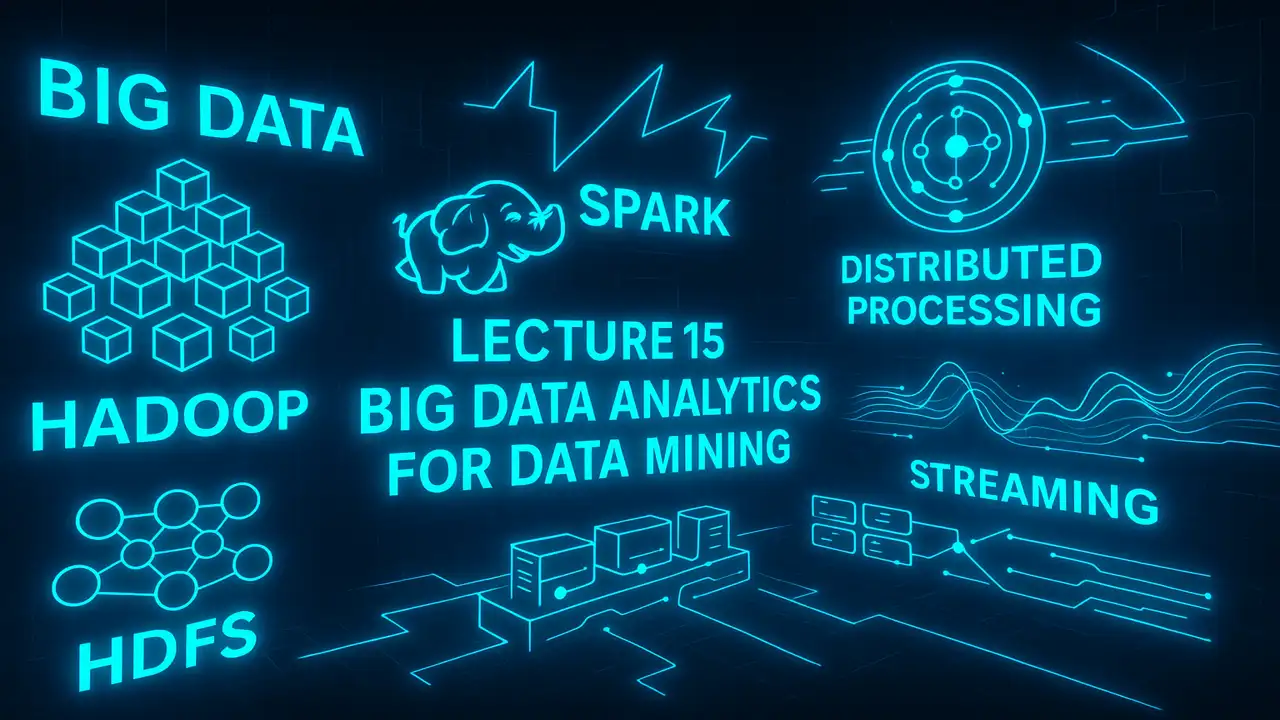
Lecture 15 explains Big Data Analytics for Data Mining, including Hadoop, Spark, HDFS, MapReduce, distributed storage, real-time processing, MLlib, large-scale clustering, classification, and industry case studies.
As organizations generate enormous volumes of data from sensors, mobile apps, IoT devices, social networks, transactions, and enterprise systems, traditional data mining methods become insufficient. Big Data technologies enable processing, storage, and mining of data that is too large, too fast, or too complex for a single machine.
This lecture builds a deep understanding of modern Big Data Analytics and how it empowers Data Mining in distributed environments.
Introduction to Big Data Analytics
What Is Big Data?
Big Data refers to datasets that are:
- Too large
- Too fast
- Too diverse
for traditional systems to handle.
The 5Vs of Big Data
| V | Description |
|---|---|
| Volume | Massive size (TBs, PBs) |
| Velocity | High-speed generation |
| Variety | Structured, semi-structured, unstructured |
| Veracity | Data quality issues |
| Value | Useful insights extracted |
Why Traditional Data Mining Fails at Big Data
Memory Limitations
Most ML algorithms assume all data fits in RAM but big datasets exceed memory.
Single Machine Bottlenecks
Single machines cannot:
- Scale horizontally
- Handle streaming data
- Process billions of records
Hence the need for distributed systems.
Big Data Architecture Overview
Big Data systems combine:
- Distributed file systems
- Distributed processing
- Data ingestion engines
- Machine learning pipelines
Distributed Storage
Data is stored across multiple nodes.
Examples:
- HDFS
- Amazon S3
- Google Cloud Storage
Distributed Computing
Computation is split across nodes.
Frameworks:
- Hadoop MapReduce
- Apache Spark
- Apache Flink
Batch vs Real-Time Analytics
Batch Processing
Handles large historical datasets.
Example: Hadoop MapReduce.
Real-Time Processing
Handles streaming data.
Example: Kafka + Spark Streaming.
Hadoop Ecosystem for Data Mining
Apache Hadoop revolutionized large-scale data processing.
HDFS (Hadoop Distributed File System)
Key idea: Split large files into blocks and store across cluster nodes.
Block Diagram:
File → Blocks → Distributed NodesNameNode & DataNode
- NameNode → Master, manages metadata
- DataNode → Stores actual blocks
MapReduce
A programming model with two phases:
Map Phase:
Processes input and produces key-value pairs.
Reduce Phase:
Aggregates values for each key.
Example (Word Count):
Map: (word, 1)
Reduce: sum counts
Hive & Pig
| Tool | Description |
|---|---|
| Hive | SQL-like queries on Hadoop |
| Pig | Dataflow scripts for ETL |
Apache Spark for Big Data Mining
Spark is the most widely used big data engine today.
Spark Architecture
Spark uses:
- Cluster Manager
- Executors
- Driver Program
Spark RDDs & DataFrames
RDD: Resilient Distributed Dataset
Low-level, fault-tolerant distributed collection.
DataFrames
Optimized, structured, SQL-compatible.
Spark SQL
Run SQL queries on distributed data.
Spark Streaming
Processes live data streams.
Sources:
- Kafka
- Flume
- TCP sockets
Spark MLlib
Spark’s machine learning library includes:
- KMeans
- Logistic Regression
- Decision Trees
- Random Forests
- Gradient Boosted Trees
- FP-Growth
Distributed Processing Models
In-Memory Computation
Spark keeps data in memory, making it much faster than Hadoop MapReduce.
DAG Execution Model
Spark builds a Directed Acyclic Graph (DAG) for optimized execution.
Cluster Managers
- YARN
- Mesos
- Kubernetes
Lecture 14 – Time Series Data Mining & Sequential Pattern Analysis
Data Mining on Hadoop
Distributed Classification
Algorithms implemented using MapReduce:
- Naive Bayes
- Decision Trees
Distributed Clustering
KMeans on Hadoop iterates using MapReduce jobs.
Large-Scale Association Rules
FP-Growth distributed implementations scan partitions independently.
Data Mining on Spark
MLlib Pipelines
Automated pipelines include:
- Data preprocessing
- Model training
- Evaluation
Logistic Regression Example
LogisticRegression()
  .setMaxIter(20)
  .fit(trainingData)
KMeans on Spark
KMeans().setK(3).fit(data)FP-Growth
FPGrowth(minSupport=0.2).fit(df)Big Data Storage Technologies
HDFS
Distributed block storage.
NoSQL Databases
Designed for unstructured data.
Examples:
- MongoDB
- Cassandra
- HBase
Columnar & Document Stores
Great for analytics.
Examples:
- Parquet
- ORC
Big Data Processing Tools
Kafka
Distributed event streaming.
Flink
Streaming-first processing engine.
Storm
Low-latency real-time processing.
Case Studies
Netflix
Uses Spark for:
- Recommendations
- Real-time personalization
- A/B testing
Uber
Uses Kafka + Spark for:
- Surge pricing
- Driver matching
- Route optimization
Amazon
Uses Hadoop + EMR for:
- Customer analytics
- Inventory prediction
- Fraud detection
Summary
Lecture 15 explored Big Data Analytics for Data Mining including Hadoop, Spark, distributed storage, real-time streaming, MLlib, distributed clustering/classification, and real-world industry use cases. Students gain the knowledge required to handle large-scale analytical systems and the transition from traditional data mining to modern distributed AI pipelines.
People also ask:
Hadoop is disk-based; Spark is in-memory and much faster.
Distributed storage of large datasets.
A programming model for parallel data processing.
Yes, using MLlib.
Yes, for datasets that exceed single-machine capabilities.