

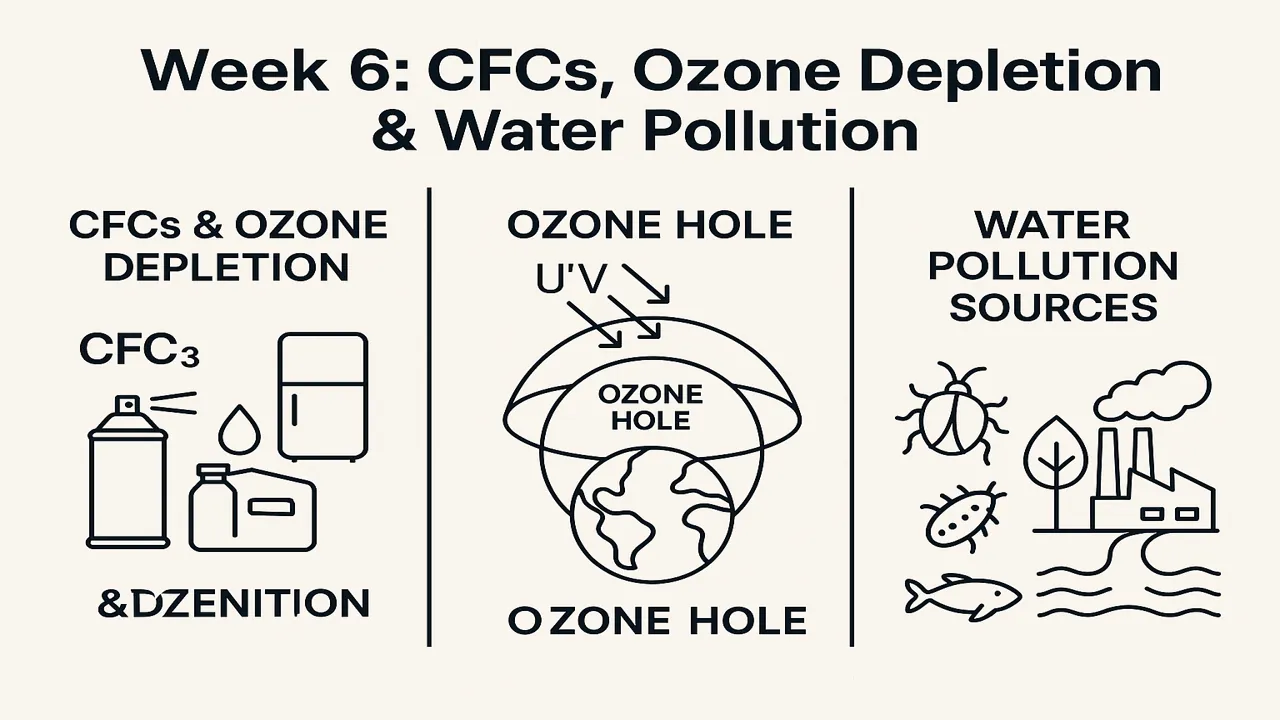
How chlorofluorocarbons (CFCs) damage the ozone layer and explore the causes, sources, and impacts of water pollution with Pakistan-specific examples and solutions.
Chlorofluorocarbons (CFCs)
Definition:
CFCs are synthetic compounds made of carbon, chlorine, and fluorine, used widely in refrigeration, air conditioning, aerosol sprays, and foam production.
Chemical Formula:
CFCl₃ (Trichlorofluoromethane) and CF₂Cl₂ (Dichlorodifluoromethane).
Properties
- Stable, non-flammable, non-toxic in lower atmosphere.
- Float up to stratosphere where UV radiation breaks them, releasing chlorine atoms.
Reaction:
CFCl₃ + UV → CFCl₂ + Cl
Cl + O₃ → ClO + O₂
ClO + O → Cl + O₂
→ One chlorine atom can destroy 100,000 ozone molecules!
Ozone Layer Depletion and Effects
The ozone layer (O₃) in the stratosphere absorbs harmful ultraviolet (UV-B) radiation.
CFCs thin this protective shield, creating the “Ozone Hole” (first detected over Antarctica).
Effects:
- Human Health: skin cancer, cataracts, weakened immune system.
- Ecosystems: reduced phytoplankton productivity → marine food chain disruption.
- Climate: increased UV affects crops like maize, rice, and soybeans.
Pakistan Context:
Though Pakistan produces few CFCs, imported old cooling systems still emit them.
→ Montreal Protocol (1987): global agreement to phase out ozone-depleting substances (ODS).
Pakistan banned CFCs in new refrigeration in 2010 and promotes hydrofluorocarbons (HFCs) and natural refrigerants (CO₂, ammonia) as substitutes.
Water Pollution Overview
Definition:
Degradation of water quality that makes it harmful for humans, animals, and ecosystems.
Main Categories:
- Point sources: identifiable discharge points (pipes, drains, factories).
- Non-point sources: diffuse runoff from farms, cities, mines.
Major Sources of Water Pollution
| Source | Pollutant Type | Example in Pakistan | Impact |
|---|---|---|---|
| Industrial Effluents | Heavy metals, dyes, acids | Tanneries in Kasur, textile units in Faisalabad | Toxicity, bioaccumulation |
| Agricultural Runoff | Fertilizers, pesticides | Punjab & Sindh canal zones | Eutrophication, groundwater pollution |
| Domestic Sewage | Organic waste, detergents | Karachi drains, Ravi River | Pathogens, oxygen depletion |
| Oil Spills | Hydrocarbons | Karachi coast (Keamari spill) | Marine death, reduced oxygen |
| Thermal Pollution | Heat discharge | Power plants | Lower dissolved oxygen |
| Plastic Waste | Non-biodegradable | Indus River & canals | Clogging, ingestion by fish |
Effects of Water Pollution
- Eutrophication: excess nutrients → algal blooms → oxygen depletion → fish kills.
- Disease spread: cholera, typhoid, dysentery from contaminated drinking water.
- Biodiversity loss: aquatic fauna decline.
- Economic loss: fisheries and tourism decline.
Water Pollution Control Measures
- Industrial: treatment plants (ETPs), recycling of process water.
- Agricultural: precision irrigation, organic farming, integrated pest management.
- Municipal: sewage treatment, proper sanitation infrastructure.
- Public awareness: “Save Water” campaigns, community-based river cleanups.
Pakistan Example:
Clean Green Pakistan Index (CGPI) encourages cities to monitor solid waste and wastewater management for sustainability ranking.
Summary
CFCs, though once considered “miracle chemicals,” are now banned for causing ozone depletion and increasing UV radiation. Meanwhile, water pollution from industry, agriculture, and urban waste threatens aquatic life and human health. Both issues highlight the need for sustainable production, waste treatment, and international cooperation.
The approach followed at E Lectures reflects both academic depth and easy-to-understand explanations.
People also ask:
HFCs, CO₂, and ammonia-based refrigerants are widely used eco-friendly alternatives.
By parameters like pH, BOD, COD, turbidity, and heavy metal content.
It causes oxygen depletion, killing fish and disrupting aquatic ecosystems.
Cholera, typhoid, and hepatitis A.
Avoid littering, use biodegradable detergents, and support recycling programs.


