Common Mistakes Students Make in MCQ Exams
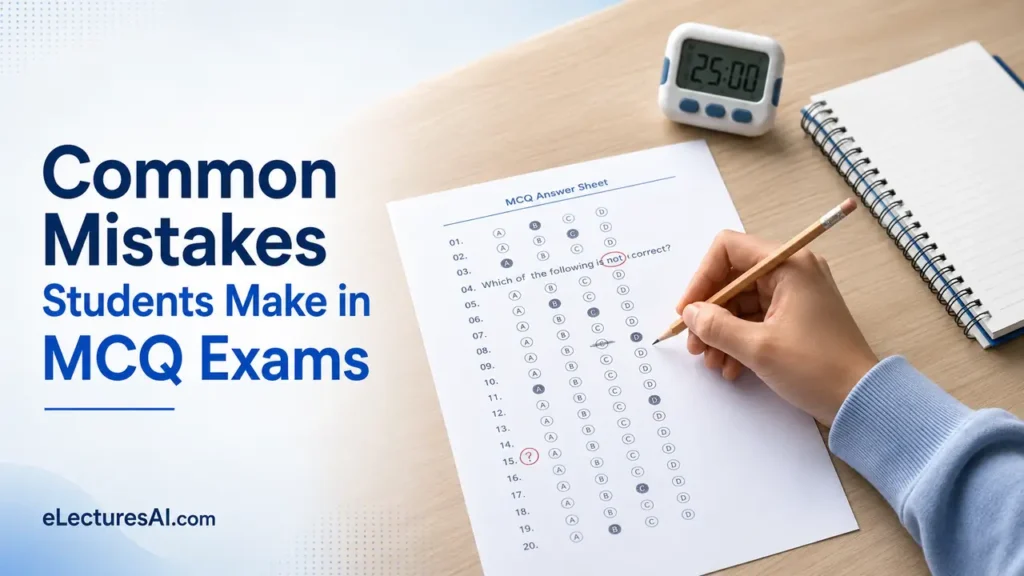
Multiple-choice question exams appear simple because the correct answer is already present among the available options. However, MCQ exams are not only tests of memory. They also test your concentration, subject understanding, time management, confidence, and ability to distinguish between similar answers.
Many students lose marks even after studying the syllabus properly. They may misread a question, ignore a negative word, spend too much time on one difficult item, or change a correct answer because of anxiety.
Understanding the common mistakes students make in MCQ exams can help you protect easy marks and improve your overall performance. This guide explains why these mistakes happen, how they affect your result, and what you can do to avoid them during your semester exam, job test, admission test, or competitive examination.
Table of Contents
- What Are MCQ Exam Mistakes?
- Why Students Make Mistakes in MCQ Exams
- Key Concepts for Solving MCQs
- Important Areas for MCQ Exam Preparation
- How to Study for MCQ Exams Effectively
- Common Mistakes Students Make
- Expert Tips for Scoring Higher
- Practice MCQs
- Frequently Asked Questions
- Conclusion
What Are MCQ Exam Mistakes?
MCQ exam mistakes are errors caused by weak subject knowledge, careless reading, poor decision-making, ineffective time management, or an unsuitable answering strategy.
Some mistakes happen because a student does not know the concept. Others happen even when the student knows the correct answer.
For example, a student may understand operating systems but choose the wrong option because the question asks for the statement that is “not correct.” The problem in this case is not subject knowledge. It is question interpretation.
MCQ mistakes can be divided into four main categories:
- Knowledge mistakes
- Reading mistakes
- Time-management mistakes
- Decision-making mistakes
Recognising which type of mistake you make most frequently is the first step towards improving your score.
Why Do Students Make Mistakes in MCQ Exams?
Students usually make mistakes for more than one reason.
Lack of Conceptual Understanding
Some students memorise definitions or previous answers without understanding the underlying concept. This works only when the same question appears with the same wording.
When the examiner changes the statement or gives a practical scenario, memorised answers may no longer help.
Exam Pressure
Anxiety can make a student rush, overthink simple questions, or forget information that was previously understood.
A student may also change a correct answer because the first option feels “too easy.”
Poor Practice Habits
Untimed practice does not fully prepare a student for a real examination. A learner may answer questions correctly at home but struggle when required to complete 50 questions within 45 minutes.
Failure to Review Mistakes
Some students complete many mock tests but look only at the final score. They do not study the questions they answered incorrectly.
As a result, the same mistake appears in every test.
Overconfidence
A familiar topic may cause a student to answer before reading the full question. The student assumes they already know what is being asked.
Overconfidence is particularly dangerous when the question contains words such as “except,” “incorrect,” “least,” or “most appropriate.”
Key Concepts in MCQ Exam Strategy
Question Interpretation
Question interpretation means identifying exactly what the examiner wants.
Before considering the options, find the main topic and the instruction word.
Important instruction words include:
- Correct
- Incorrect
- Best
- Most suitable
- Least likely
- Primary
- Except
- Not
- Always
- Never
A single instruction word can change the answer completely.
Distractors
A distractor is an incorrect option designed to appear reasonable.
Good distractors are often:
- Related to the topic
- Partially correct
- Correct in a different situation
- Based on a common misunderstanding
- Similar to the correct answer
You should not select an option simply because it looks familiar. Ask whether it answers the exact question.
Elimination
Elimination is the process of removing options that are clearly incorrect.
Suppose a question has four options. If you remove two incorrect options, you can focus on the remaining two. This makes your decision more manageable.
Elimination is especially useful when:
- You cannot recall the exact answer
- Two options are clearly unrelated
- One option contradicts a known fact
- One answer uses an incorrect unit or term
- One option does not fit grammatically
Time Allocation
Time allocation means deciding how much time to spend on each question and each section.
If you have 60 minutes for 50 questions, you cannot spend several minutes on every difficult question.
A better method is:
- Complete easy questions first.
- Mark difficult questions.
- Return to them after protecting the easier marks.
- Reserve time for final review.
Confidence Levels
You can classify questions according to confidence:
- High confidence: You know the answer and can explain it.
- Medium confidence: You can remove one or two options.
- Low confidence: You do not understand the question and cannot eliminate anything.
This method is particularly useful when negative marking applies.
Negative Marking
Negative marking means marks are deducted for incorrect answers.
Before attempting the paper, confirm:
- Marks awarded for a correct answer
- Marks deducted for an incorrect answer
- Whether unanswered questions carry a penalty
- Number of options in each question
Your guessing strategy should depend on these rules.
Important Areas for MCQ Exam Preparation
Subject Concepts
Understand important definitions, principles, formulas, processes, classifications, and examples.
Commonly Confused Terms
Examiners frequently create distractors using terms that students confuse.
Examples include:
- Compiler and interpreter
- RAM and ROM
- Accuracy and precision
- Authentication and authorization
- Primary and secondary memory
Keywords and Qualifiers
Practise identifying words that control the meaning of a question.
Calculation-Based Questions
For numerical MCQs, revise formulas, units, signs, and common calculation errors.
Scenario-Based Questions
Scenario questions test whether you can apply knowledge rather than repeat a definition.
Previous Mistakes
Your wrong answers provide a personalised revision list. They show where your understanding or exam technique is weak.
Step-by-Step: How to Study for MCQ Exams Effectively
Step 1: Start With the Official Syllabus
Do not begin by attempting random questions from unrelated topics.
Divide the syllabus into units and identify the topics with the highest importance.
Step 2: Build Basic Understanding
Read your lecture notes, textbook, or trusted study guide.
Make sure you understand the basic concept before attempting advanced MCQs.
Step 3: Practise Topic-Wise Questions
After studying one topic, attempt a focused set of questions.
For example, after studying database normalization, practise only normalization MCQs before moving to transactions or SQL.
Step 4: Review Every Answer
Do not review only the questions you answered incorrectly.
You may sometimes select the correct option for the wrong reason. Read the explanation and confirm that your reasoning was accurate.
Step 5: Maintain an Error Log
Create a simple record containing:
- Question topic
- Your answer
- Correct answer
- Reason for the mistake
- Concept to revise
Your error log may show patterns such as:
- Missing negative words
- Forgetting formulas
- Confusing similar terms
- Rushing calculations
- Changing correct answers
Step 6: Attempt Mixed Quizzes
Once you have prepared individual topics, attempt quizzes containing questions from several chapters.
Mixed practice trains you to identify the relevant concept without being told the chapter name.
Step 7: Practise With a Timer
Use timed practice after building your basic understanding.
Timed quizzes improve:
- Speed
- Concentration
- Decision-making
- Question selection
- Exam stamina
Step 8: Analyse Your Performance
After every mock test, record:
- Total score
- Accuracy percentage
- Time used
- Unanswered questions
- Weak topics
- Careless mistakes
Your objective should not be only to attempt more questions. It should be to reduce repeated mistakes.
Common Mistakes Students Make in MCQ Exams
1. Reading the Question Too Quickly
Students often recognise the topic and select an answer before reading the complete question.
The last few words may change the required response.
How to avoid it:
Read the complete statement before looking at the options. Identify the subject, instruction word, and any condition included in the question.
2. Missing Words Such as “Not” and “Except”
Negative words reverse the direction of a question.
A student may identify a correct statement when the examiner is asking for the incorrect statement.
How to avoid it:
Mentally underline words such as:
- Not
- Except
- Incorrect
- False
- Least likely
3. Selecting the First Familiar Option
A familiar word may attract your attention even when it does not answer the question.
How to avoid it:
Compare every option with the exact wording of the question. Familiarity is not proof of correctness.
4. Reading the Options Before Understanding the Question
Incorrect options can influence your thinking.
How to avoid it:
Try to predict the answer before reading the choices. Then select the option closest to your expected answer.
5. Spending Too Much Time on One Question
A difficult question may carry the same marks as an easy question.
How to avoid it:
Set a reasonable time limit. Mark the question and return later.
6. Changing Answers Without Evidence
Students sometimes change answers because of anxiety rather than new reasoning.
How to avoid it:
Change an answer only when you:
- Notice a reading mistake
- Remember a relevant fact
- Identify a calculation error
- Find clear evidence for another option
7. Guessing Blindly
Random guessing is risky, especially when negative marking applies.
How to avoid it:
Use elimination. Remove clearly incorrect options before making a decision.
8. Ignoring Negative Marking
Attempting every question without understanding the penalty can reduce your score.
How to avoid it:
Read the instructions and adjust your strategy according to the marking formula.
9. Treating “All of the Above” Carelessly
One correct statement is not enough to prove that “all of the above” is correct.
How to avoid it:
Check each listed option individually. Every relevant statement must be correct.
10. Misusing “None of the Above”
Students sometimes select “none of the above” when they do not recognise the answer.
How to avoid it:
Confirm that every other option is incorrect before selecting it.
11. Misaligning the Answer Sheet
In paper-based exams, skipping one row can shift several answers.
How to avoid it:
Check question numbers regularly and fill the answer sheet carefully.
12. Leaving Too Many Questions for the End
Postponing difficult questions is useful, but leaving a large number until the final minute creates panic.
How to avoid it:
Start the review phase while enough time remains.
13. Memorising Answers Without Concepts
Memorised option letters do not prepare you for reworded questions.
How to avoid it:
Learn why the correct answer is right and why the other options are wrong.
14. Practising Without Exam Conditions
Comfortable untimed practice may create false confidence.
How to avoid it:
Complete some mock tests with a timer, no notes, and no interruptions.
15. Ignoring Wrong Answers After Practice
A score tells you what happened. An explanation tells you why.
How to avoid it:
Review each mistake and revise the related concept.
Expert Tips for Scoring High in MCQ Exams
Use a Three-Round Attempt Method
Round 1: Answer easy questions.
Round 2: Attempt medium-difficulty questions using reasoning and elimination.
Round 3: Review difficult or uncertain questions.
Protect Easy Marks
Do not lose an easy question because you are still thinking about a difficult one.
Check Units and Signs
In numerical questions, confirm:
- Unit
- Positive or negative sign
- Decimal position
- Formula
- Required form of the answer
Compare Similar Options Carefully
When two options appear correct, look for:
- Greater completeness
- Better accuracy
- Correct conditions
- Appropriate scope
- Exact terminology
Read Absolute Words Carefully
Options containing “always,” “never,” “all,” or “only” should be examined carefully. They may be correct, but they make a broad claim that must be true in every relevant situation.
Stay Calm
A difficult question does not mean the entire paper is difficult. Mark it and continue.
Reserve Review Time
Final review should focus on:
- Negative-word questions
- Calculations
- Changed answers
- Unanswered questions
- Answer-sheet alignment
Practice MCQs
Q1. What should a student do first when a question contains the word “except”?
A. Select the first correct statement
B. Identify the option that does not belong
C. Skip the complete section
D. Choose the longest option
Correct Answer: B. Identify the option that does not belong
Explanation: The word “except” asks you to find the option that is different or excluded. Missing this word can make you choose the opposite of the required answer.
Q2. What is the best approach to a difficult question during a timed examination?
A. Spend unlimited time solving it
B. Leave the examination immediately
C. Mark it for review and continue
D. Choose option A without reading
Correct Answer: C. Mark it for review and continue
Explanation: Marking the question allows you to protect time for easier questions. You can return after completing the questions you can answer confidently.
Q3. When should you change an answer?
A. Whenever you feel nervous
B. When you have a clear reason or identify an error
C. Whenever another option is longer
D. During every review
Correct Answer: B. When you have a clear reason or identify an error
Explanation: Answer changes should be based on evidence, corrected reasoning, or a recognised mistake. Anxiety alone is not a reliable reason.
Q4. What is educated guessing?
A. Selecting an option randomly
B. Choosing the most familiar word
C. Eliminating unlikely options before answering
D. Leaving every uncertain question blank
Correct Answer: C. Eliminating unlikely options before answering
Explanation: Educated guessing uses partial knowledge and logical elimination. It is more reliable than selecting an answer randomly.
Q5. Which practice method best prepares a student for examination pressure?
A. Reading answers without attempting questions
B. Memorising option letters
C. Completing timed mock tests under exam-like conditions
D. Practising only one easy topic
Correct Answer: C. Completing timed mock tests under exam-like conditions
Explanation: Timed mock tests help improve speed, concentration, decision-making, and exam stamina.
Frequently Asked Questions
1. What is the most common mistake students make in MCQ exams?
Reading the question too quickly is one of the most common mistakes. Students often miss words such as “not,” “except,” or “most appropriate,” which changes the required answer.
2. Should I answer every question in an MCQ exam?
It depends on the marking policy. When no marks are deducted for incorrect answers, attempting every question is usually beneficial. With negative marking, use elimination and consider your confidence level.
3. How can I improve my MCQ accuracy?
Read questions carefully, identify instruction words, predict answers before reading options, and review every wrong answer. Regular timed practice also helps reduce careless mistakes.
4. Should I trust my first answer?
Your first answer may be correct, but it is not automatically correct. Keep it unless you discover a clear reading, factual, or calculation error.
5. How much time should I spend on one MCQ?
The available time depends on the number of questions and exam duration. Avoid spending several minutes on one question while easier questions remain unanswered.
6. What should I do when two options appear correct?
Compare both options with the exact wording of the question. Look for differences in completeness, accuracy, conditions, and scope.
7. How should I handle negative marking?
Read the penalty rules before starting. Attempt high-confidence questions first, then use elimination for medium-confidence questions and avoid completely blind guesses.
8. Are online mock tests useful?
Yes. Online mock tests improve speed, concentration, time management, and familiarity with exam conditions. Their greatest value comes from reviewing mistakes after completion.
Conclusion
Students do not lose marks in MCQ exams only because they lack knowledge. Careless reading, poor time management, blind guessing, anxiety, and ineffective practice can also lower a score.
The most effective approach is to combine subject understanding with a clear exam strategy. Read every question completely, identify important words, eliminate incorrect options, protect your time, and review your mistakes after every practice session.
Before your next exam, remember three important rules:
- Read the exact question.
- Protect the easy marks.
- Change an answer only for a clear reason.
Ready to Test Your Exam Strategy?
Practise timed MCQs, receive an instant score, and review answer explanations using the TestInFlow Smart MCQ Quiz Builder.
Want to Explore More Study Guides?
ELecturesAI provides university lecture notes, concept explanations, exam guides, and practical learning resources.