E-Commerce: Complete Guide for Semester Exams
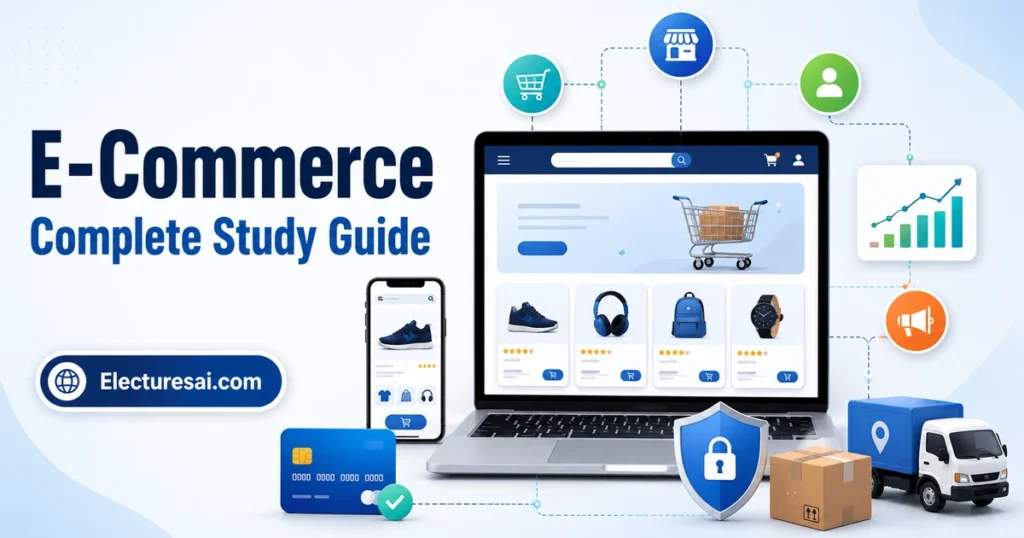
E-Commerce is an important subject for students of Business Administration, Computer Science, Information Technology, Digital Marketing, Software Engineering, and related degree programs. It explains how products, services, payments, information, and business transactions are managed through digital networks.
Students sometimes assume that E-Commerce simply means selling products through a website. In reality, it includes a complete business system involving product discovery, customer accounts, shopping carts, online payments, inventory, security, order processing, delivery, returns, customer support, and performance analysis.
Consider a customer buying a mobile phone online. The visible activity may take only a few minutes, but several systems work behind the screen. The website checks inventory, calculates the total price, verifies payment, creates an order, informs the warehouse, updates stock, generates tracking information, and sends a confirmation to the customer.
This guide explains the major concepts of E-Commerce in simple academic language. It will help you prepare for semester exams, assignments, MCQs, short questions, case studies, comparisons, and descriptive answers.
Table of Contents
- What Is E-Commerce?
- Key Concepts in E-Commerce
- Major E-Commerce Business Models
- How an E-Commerce Transaction Works
- Payments and E-Commerce Security
- Marketing, Fulfillment, and Logistics
- Important Topics for Exam Preparation
- How to Study E-Commerce Effectively
- Common Mistakes Students Make
- Expert Tips for Scoring High
- Practice MCQs
- Frequently Asked Questions
- Conclusion
What Is E-Commerce?
E-Commerce, or electronic commerce, is the buying, selling, exchanging, and servicing of products, services, and information through electronic networks, especially the internet.
An E-Commerce transaction may involve physical products, digital products, subscriptions, professional services, online bookings, financial services, or business-to-business supplies.
Examples include:
- Buying clothes from an online store
- Ordering food through a mobile application
- Paying for a video-streaming subscription
- Booking an airline ticket online
- Purchasing software through a digital marketplace
- A manufacturer ordering raw materials through a supplier portal
- A freelancer offering services through an online platform
E-Commerce and E-Business
E-Commerce mainly focuses on electronic buying and selling activities.
E-Business is a broader term. It includes E-Commerce as well as other digitally supported business processes such as supply-chain coordination, customer relationship management, employee portals, electronic procurement, internal communication, and online collaboration.
A company may use digital systems for accounting, human resources, inventory, and supplier management even when a particular activity does not involve an online sale. These activities are part of E-Business.
Why Is E-Commerce Important?
E-Commerce allows businesses to reach customers beyond their physical location. A small seller can serve customers in other cities or countries without opening a traditional store in each region.
It also provides:
- Twenty-four-hour access
- Wider market reach
- Faster product comparison
- Automated transaction processing
- Personalized recommendations
- Measurable customer activity
- Lower dependence on physical retail space
- Convenient digital payments
However, E-Commerce also creates challenges involving cybersecurity, privacy, fraud, delivery, customer trust, platform reliability, and legal compliance.
Key Concepts in E-Commerce
E-Commerce Storefront
The storefront is the customer-facing part of an E-Commerce system. It includes product pages, categories, search, filters, prices, reviews, images, and account features.
A good storefront should be easy to navigate, quick to load, mobile-friendly, and clear about product details, delivery, returns, and payment options.
Product Catalogue
A product catalogue stores and displays information about available products or services.
Typical catalogue data includes:
- Product title
- Description
- Price
- Images
- Brand
- Category
- Stock status
- Size or colour variants
- Technical specifications
- Customer ratings
Accurate catalogue information improves customer confidence and reduces returns caused by incorrect expectations.
Shopping Cart
A shopping cart temporarily stores the items a customer intends to purchase.
It may calculate:
- Item quantity
- Subtotal
- Discounts
- Taxes
- Delivery charges
- Final payable amount
A persistent cart may retain selected products even when the customer leaves and returns later.
Checkout
Checkout is the stage where the customer confirms order details and provides delivery and payment information.
A complicated checkout process can increase cart abandonment. Businesses commonly reduce unnecessary form fields, explain delivery costs early, and provide several trusted payment options.
Inventory Management
Inventory management tracks how many units are available, reserved, sold, returned, or damaged.
If inventory data is inaccurate, a customer may pay for an unavailable product. This can damage trust and increase cancellations.
In an integrated system, stock may update automatically when an order is confirmed, cancelled, returned, or restocked.
Order Management System
An order management system tracks an order from placement to completion.
Common order states include:
- Pending
- Payment confirmed
- Processing
- Packed
- Shipped
- Delivered
- Cancelled
- Returned
- Refunded
The system connects customer service, payment processing, inventory, warehouse operations, and delivery services.
Customer Relationship Management
Customer Relationship Management, commonly called CRM, stores and organizes customer interactions.
It may contain:
- Contact details
- Purchase history
- Support requests
- Preferences
- Marketing responses
- Loyalty activity
Businesses use this information to improve service, personalize communication, and retain customers.
Enterprise Resource Planning
Enterprise Resource Planning, or ERP, connects major business functions such as finance, procurement, inventory, sales, manufacturing, and human resources.
When an E-Commerce platform is integrated with ERP, confirmed orders can automatically update accounting, inventory, and procurement records.
Mobile Commerce
Mobile commerce, also called M-Commerce, refers to commercial transactions completed through smartphones and tablets.
Mobile applications, responsive websites, digital wallets, location services, and push notifications are important parts of M-Commerce.
A mobile experience should use readable text, simple navigation, fast pages, and short checkout forms.
Social Commerce
Social commerce involves product discovery, promotion, communication, and purchasing through social-media platforms.
Customers may discover a product through a post, video, review, livestream, or influencer recommendation and then complete the purchase through an integrated shop or linked website.
Marketplace and Direct-to-Consumer Store
An online marketplace connects multiple sellers with buyers. The platform may manage search, payments, reviews, and dispute processes.
A direct-to-consumer store is operated by one brand or seller. It provides greater control over pricing, branding, customer experience, and customer data.
Marketplaces may offer immediate access to a large audience, but sellers usually face platform fees, competition, and limited control.
Pure-Play and Omnichannel Businesses
A pure-play E-Commerce business operates mainly or entirely online.
An omnichannel business connects online and offline customer experiences. A customer may research online, collect from a store, return through another channel, or receive consistent support across web, mobile, and physical locations.
Major E-Commerce Business Models
Business-to-Consumer
Business-to-Consumer, or B2C, occurs when a business sells directly to individual customers.
Examples include online clothing stores, food-delivery applications, streaming subscriptions, and electronics retailers.
Business-to-Business
Business-to-Business, or B2B, occurs when one business sells products or services to another business.
B2B transactions may involve:
- Bulk purchasing
- Negotiated prices
- Purchase orders
- Long-term contracts
- Credit arrangements
- Complex approval processes
Consumer-to-Consumer
Consumer-to-Consumer, or C2C, allows individuals to sell to other individuals through a platform.
Used-product marketplaces, classified platforms, and auction websites are common examples.
Consumer-to-Business
Consumer-to-Business, or C2B, occurs when an individual provides value to a business.
Examples include freelancers offering services, photographers licensing images, influencers promoting products, and individuals submitting price proposals.
Business-to-Government
Business-to-Government, or B2G, involves businesses supplying goods or services to government organizations through electronic procurement systems.
Subscription Model
In a subscription model, customers pay regularly for continued access to a product or service.
Examples include software subscriptions, educational platforms, entertainment services, and recurring product deliveries.
Marketplace Model
A marketplace earns revenue by connecting buyers and sellers. It may charge:
- Commission per sale
- Listing fees
- Subscription fees
- Advertising charges
- Payment-processing fees
Dropshipping Model
In dropshipping, the seller accepts the customer’s order but does not normally hold the product in its own warehouse. A supplier ships the product directly to the customer.
This model reduces inventory investment, but the seller may have less control over stock, packaging, quality, and delivery speed.
How an E-Commerce Transaction Works
A typical transaction follows this sequence:
- The customer discovers a product.
- The customer reviews information and availability.
- The product is added to the shopping cart.
- The customer begins checkout.
- Delivery and contact details are entered.
- The system calculates discounts, taxes, and shipping.
- The customer selects a payment method.
- The payment request is authorized.
- The order is recorded and confirmed.
- Inventory is updated or reserved.
- The warehouse prepares the order.
- The delivery partner transports the package.
- The customer receives the order.
- Support, return, or refund processes may follow.
Text-described transaction diagram:
Product discovery → Cart → Checkout → Payment → Order confirmation → Fulfillment → Delivery → After-sales service
Payment Authorization and Settlement
Authorization checks whether a payment method can approve the requested amount.
Settlement is the later movement of approved funds through the payment system to the merchant’s account.
An approved authorization does not always mean the funds have already reached the seller.
Payment Gateway
A payment gateway securely transmits payment information between the customer-facing store and the payment-processing network.
It may support:
- Card payments
- Bank transfers
- Digital wallets
- Mobile payments
- Alternative payment methods
Digital Wallet
A digital wallet stores payment credentials or tokens and allows customers to complete purchases without entering full payment details for every transaction.
Convenience, authentication, and security controls influence customer trust in digital-wallet payments.
Payments and E-Commerce Security
Transport Encryption
Secure E-Commerce websites use encrypted communication to protect data moving between the customer’s browser and the website.
Transport Layer Security helps reduce the risk of payment details, passwords, and personal information being read during transmission.
Authentication
Authentication verifies the identity of a user.
Common methods include:
- Passwords
- One-time codes
- Authentication applications
- Biometric verification
- Multi-factor authentication
Multi-factor authentication requires evidence from more than one category, such as a password and a one-time code.
Authorization
Authorization determines what an authenticated user is allowed to access or perform.
A customer may view personal orders, while a warehouse employee may update fulfillment status. Neither user should automatically receive full administrative access.
Tokenization
Tokenization replaces sensitive payment information with a non-sensitive token.
The token can be used in the approved payment environment without repeatedly exposing the original account details.
Common E-Commerce Threats
E-Commerce systems may face:
- Account takeover
- Phishing
- Payment fraud
- Fake stores
- Malicious software
- Data breaches
- Credential stuffing
- Web-application attacks
- Refund abuse
- Denial-of-service attacks
Fraud Prevention
Fraud controls may examine:
- Transaction amount
- Location
- Device information
- Previous order history
- Unusual login activity
- Repeated failed payments
- Billing and delivery mismatches
Fraud prevention should balance protection with customer convenience. Excessive blocking may reject genuine customers.
Privacy
E-Commerce businesses collect personal information such as names, addresses, contact details, order history, and payment-related data.
Organizations should collect only necessary information, explain its use, secure it, control access, and follow applicable privacy requirements.
E-Commerce Marketing, Fulfillment, and Logistics
Search Engine Optimization
Search Engine Optimization helps product and category pages become more understandable and discoverable through search engines.
Important elements include:
- Clear product titles
- Useful descriptions
- Logical categories
- Fast page loading
- Mobile usability
- Descriptive URLs
- Helpful internal links
- Original product information
Paid Advertising
Businesses may use search, display, social, video, and marketplace advertising to attract customers.
Advertising performance should be measured against revenue, margin, and customer-acquisition cost rather than clicks alone.
Email Marketing
Email may be used for:
- Welcome messages
- Product announcements
- Cart reminders
- Order updates
- Loyalty offers
- Re-engagement campaigns
Communication should be relevant, permission-based, and easy to unsubscribe from.
Conversion Rate
Conversion rate is the percentage of visitors who complete a desired action, such as placing an order.
A low conversion rate may result from poor product information, high delivery costs, weak trust signals, technical errors, or a complicated checkout process.
Cart Abandonment
Cart abandonment occurs when a customer adds products to a cart but does not complete the purchase.
Possible causes include:
- Unexpected charges
- Forced account creation
- Slow pages
- Limited payment options
- Delivery delays
- Security concerns
- Complex forms
Customer Acquisition Cost
Customer Acquisition Cost, or CAC, estimates the cost of gaining a new customer.
Marketing spending should be compared with customer value and profit, not only the number of new accounts.
Average Order Value
Average Order Value, or AOV, measures the average value of completed orders.
Businesses may improve AOV through bundles, complementary-product suggestions, quantity offers, or free-shipping thresholds. These techniques should remain useful and transparent to customers.
Order Fulfillment
Order fulfillment includes receiving, processing, picking, packing, shipping, and delivering an order.
Fast checkout cannot compensate for poor fulfillment. An incorrect, damaged, or late order can destroy customer trust.
Last-Mile Delivery
Last-mile delivery is the final stage in which the order travels from a local distribution point to the customer.
This stage is often costly and operationally difficult because deliveries are spread across many individual addresses.
Reverse Logistics
Reverse logistics manages products moving from the customer back to the seller or supply chain.
It includes:
- Returns
- Exchanges
- Repairs
- Recycling
- Refund processing
- Restocking
- Disposal
A clear return policy can improve customer confidence, although returns also create cost and inventory challenges.
Important Topics for E-Commerce Exam Preparation
Give special attention to these topics:
- Definition and scope of E-Commerce
- Difference between E-Commerce and E-Business
- B2B, B2C, C2C, C2B, and B2G models
- Subscription, marketplace, and dropshipping models
- Pure-play and omnichannel businesses
- Mobile commerce and social commerce
- Product catalogue and shopping cart
- Checkout and order management
- Inventory, CRM, and ERP integration
- Payment gateways and digital wallets
- Authorization and settlement
- Encryption, authentication, and authorization
- Tokenization and fraud prevention
- Customer privacy
- SEO, advertising, and email marketing
- Conversion rate and cart abandonment
- Customer Acquisition Cost
- Average Order Value
- Order fulfillment
- Last-mile delivery
- Reverse logistics
- Advantages and limitations of E-Commerce
- Legal, ethical, and consumer-protection issues
Examiners may provide a business scenario and ask you to identify the correct model. For example, an individual selling a used laptop to another individual through a platform represents C2C commerce.
Step-by-Step: How to Study E-Commerce Effectively
Step 1: Learn the Core Definition
Understand that E-Commerce includes the complete electronic transaction process, not only the website where products are displayed.
Step 2: Master the Business Models
Prepare a table showing the seller, buyer, and one example for B2B, B2C, C2C, C2B, and B2G.
Step 3: Draw the Transaction Flow
Write the complete sequence from product discovery to payment, fulfillment, delivery, and after-sales service.
Step 4: Compare Important Concepts
Prepare comparisons for:
- E-Commerce versus E-Business
- Marketplace versus direct store
- Pure-play versus omnichannel
- Authorization versus settlement
- Authentication versus authorization
- Forward logistics versus reverse logistics
- B2B versus B2C
Step 5: Connect Technology With Business Purpose
Do not memorize a payment gateway as an isolated term. Explain that it securely transfers payment information during checkout.
Step 6: Study One Real Store
Observe how a familiar online store organizes categories, search, cart, checkout, payment, delivery, reviews, and returns. Connect each visible feature with the concepts in your course.
Step 7: Practise Case-Based Questions
For each scenario, identify the business model, payment method, security risk, marketing metric, or logistics process being described.
Step 8: Attempt Timed MCQs
Practise topic-wise questions first. Near the exam, attempt a mixed quiz covering business models, systems, payments, security, marketing, and logistics.
Common Mistakes Students Make
Defining E-Commerce as a Website Only
An E-Commerce system also includes payments, inventory, customer management, fulfillment, delivery, and support.
Confusing E-Commerce With E-Business
E-Commerce focuses on electronic commercial transactions. E-Business includes wider digital business processes.
Confusing B2B and B2C
B2B involves one business selling to another business. B2C involves a business selling to an individual consumer.
Assuming Payment Authorization Means Final Settlement
Authorization approves the transaction request. Settlement transfers the approved funds through the payment system.
Confusing Authentication and Authorization
Authentication verifies identity. Authorization determines permitted actions.
Focusing Only on Website Design
A visually attractive website may still fail because of inaccurate inventory, poor delivery, weak security, or difficult returns.
Treating Every Visitor as a Conversion
A visit is not automatically a sale. Conversion occurs when the user completes the defined target action.
Ignoring After-Sales Service
Returns, refunds, support, reviews, and repeat purchases are important parts of the customer experience.
Expert Tips for Scoring High in E-Commerce
- Start every descriptive answer with a direct definition.
- Add one practical example for each business model.
- Draw a transaction-flow diagram where appropriate.
- Use tables for comparison questions.
- Explain both business and technical aspects.
- Connect security controls with the risks they reduce.
- Include advantages and limitations in long answers.
- Use metrics such as conversion rate, CAC, and AOV correctly.
- Mention delivery and returns in customer-experience questions.
- Practise scenario-based MCQs before the exam.
Practice MCQs
MCQ 1
Which E-Commerce model involves a business selling directly to an individual customer?
A. B2B
B. B2C
C. C2C
D. C2B
Correct Answer: B. B2C
Explanation: Business-to-Consumer commerce occurs when a business sells products or services to individual buyers. B2B transactions take place between businesses.
MCQ 2
What is the primary purpose of a shopping cart?
A. To temporarily store products selected for purchase
B. To deliver products to customers
C. To authenticate warehouse employees
D. To manufacture products
Correct Answer: A. To temporarily store products selected for purchase
Explanation: A shopping cart holds selected items and calculates quantities and totals before checkout. Delivery and manufacturing occur in later or separate processes.
MCQ 3
Which system securely transmits payment information during an online transaction?
A. Payment gateway
B. Search engine crawler
C. Warehouse shelf
D. Product review
Correct Answer: A. Payment gateway
Explanation: A payment gateway connects the online store with payment-processing services. It helps transfer payment data securely.
MCQ 4
Which metric measures the percentage of visitors who complete a desired action?
A. Conversion rate
B. Delivery distance
C. Inventory age
D. Password length
Correct Answer: A. Conversion rate
Explanation: Conversion rate measures how many visitors complete an action such as a purchase. The remaining options measure unrelated operational or security details.
MCQ 5
What does reverse logistics primarily manage?
A. Products moving back from customers
B. New customers visiting a website
C. Product advertisements
D. Password creation
Correct Answer: A. Products moving back from customers
Explanation: Reverse logistics handles returns, exchanges, repairs, recycling, and restocking. Normal delivery from seller to customer is part of forward logistics.
Frequently Asked Questions
What is E-Commerce in simple words?
E-Commerce is the buying and selling of products, services, or information through electronic networks. It includes online stores, payments, order processing, delivery, and customer support.
What is the difference between E-Commerce and E-Business?
E-Commerce focuses mainly on electronic commercial transactions. E-Business also includes internal digital processes such as procurement, accounting, customer management, and supply-chain coordination.
What are the main types of E-Commerce?
The main models are B2B, B2C, C2C, C2B, and B2G. Each model is identified by the relationship between the seller and buyer.
What is a payment gateway?
A payment gateway securely transfers payment information between an online store and the payment-processing system. It supports authorization and transaction communication.
Why do customers abandon shopping carts?
Common reasons include unexpected charges, difficult checkout forms, slow pages, limited payment methods, security concerns, and unsuitable delivery options.
What is the difference between authentication and authorization?
Authentication verifies the identity of a user. Authorization decides which resources and actions that verified user may access.
Why is logistics important in E-Commerce?
Logistics determines whether orders are picked, packed, shipped, delivered, and returned efficiently. Poor delivery can damage customer trust even when the website and payment process work well.
How should I prepare E-Commerce MCQs?
Revise business models, transaction steps, payment systems, security, marketing metrics, and logistics. Practise scenario-based questions and review every incorrect answer.
Conclusion
E-Commerce is a complete digital business system rather than only an online product page. It connects customers, sellers, technology, payments, marketing, inventory, fulfillment, logistics, and customer service.
The subject becomes easier when you follow the complete customer journey. Begin with product discovery, continue through cart, checkout, payment, and fulfillment, and finish with delivery, support, and returns.
Prepare comparison tables, transaction diagrams, practical examples, and case-based answers. Combine these notes with regular MCQ practice to strengthen your understanding and semester-exam performance.
Ready to Test Your Knowledge?
If you want to practice E-Commerce MCQs with a timer, instant score, and answer explanations, continue your preparation on TestInFlow.
Practice E-Commerce MCQs on TestInFlow →
Want to Explore More Topics?
eLecturesAI covers university subjects with detailed lecture notes, study guides, MCQs, and exam-preparation resources.