How to Prepare for IELTS in 7 Days: A Complete Study Plan for Beginners
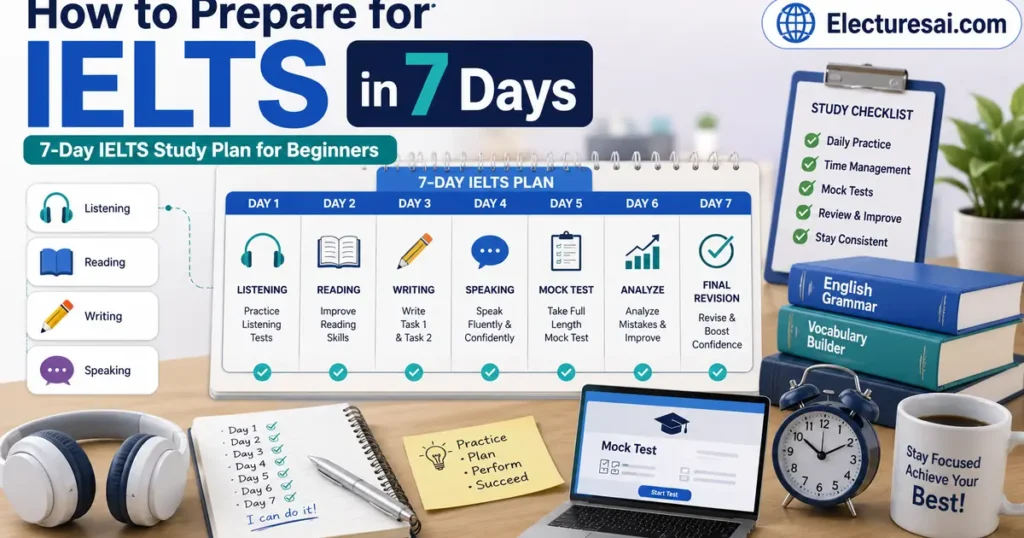
Preparing for IELTS in only 7 days can feel stressful, especially if you are a beginner. You may be worried about vocabulary, grammar, speaking confidence, writing structure, time management, and the test format. The good news is that one focused week can still help you improve your exam strategy, understand the test sections, avoid common mistakes, and enter the test with a clear plan.
IELTS tests your English ability in four skills: Listening, Reading, Writing, and Speaking. A 7-day plan cannot magically replace months of language learning, but it can help you prepare smartly. The goal is not to study everything. The goal is to study the right things in the right order.
This guide is designed for beginners who need a practical one-week IELTS preparation schedule. It explains what to do each day, how to divide your time, how to practise each section, and how to use mock tests effectively. It also includes common mistakes, expert tips, FAQs, and sample MCQs to help you revise quickly.
Table of Contents
- What Is IELTS?
- Key Concepts Beginners Must Know
- 7-Day IELTS Study Plan for Beginners
- IELTS Listening Preparation
- IELTS Reading Preparation
- IELTS Writing Preparation
- IELTS Speaking Preparation
- Mock Tests and Time Management
- Important Topics for IELTS Preparation
- How to Study IELTS Effectively in 7 Days
- Common Mistakes Students Make
- Expert Tips for Scoring Higher
- Practice MCQs
- Frequently Asked Questions
- Conclusion
What Is IELTS?
IELTS, or the International English Language Testing System, is an English proficiency test used for study, work, and migration purposes. It assesses how well a candidate can understand and use English in listening, reading, writing, and speaking situations.
There are two common IELTS test types:
- IELTS Academic: Usually taken by students applying for universities or professional registration.
- IELTS General Training: Usually taken for migration, work, or general training purposes.
Both tests assess the same four skills, but the Reading and Writing sections are different in Academic and General Training. Listening and Speaking are usually the same for both test types.
Can You Prepare for IELTS in 7 Days?
Yes, you can prepare in 7 days if your aim is to understand the test format, practise high-value question types, improve your time management, and fix common mistakes. However, if your English level is very weak, one week may not be enough to reach a very high band score.
A realistic 7-day IELTS plan should focus on:
- Understanding the test format
- Learning question types
- Practising under time pressure
- Improving writing structure
- Building speaking confidence
- Reviewing mistakes daily
- Taking at least one full mock test
Key Concepts Beginners Must Know
IELTS Is a Skills Test, Not a Memory Test
Many beginners try to memorize essays, answers, and vocabulary lists. This is not the best approach. IELTS tests how you use English in real tasks. You need to understand questions, manage time, organize ideas, and communicate clearly.
Every Section Needs a Different Strategy
Listening requires concentration and prediction. Reading requires scanning, skimming, and locating answers quickly. Writing requires structure and task response. Speaking requires fluency, pronunciation, and confidence.
Time Management Is Essential
Many candidates know the answers but lose marks because they run out of time. In a 7-day plan, you must practise with timers from the beginning.
Accuracy Matters More Than Fancy English
Beginners often try to use difficult vocabulary and long sentences. Simple, accurate, natural English is better than complex but incorrect English.
Mistake Review Is More Important Than Repetition
Doing many practice tests without checking mistakes is not effective. After each practice session, write down what went wrong and how to fix it.
7-Day IELTS Study Plan for Beginners
Day 1: Understand the IELTS Format and Take a Diagnostic Test
Start by learning the structure of the test. Understand the four sections, number of tasks, time limits, and common question types. Do not begin with random practice. First, know what the test expects.
Tasks for Day 1:
- Read the format of Listening, Reading, Writing, and Speaking.
- Take a short diagnostic test for Listening and Reading.
- Write one short essay or Task 1 response.
- Record yourself speaking for 2 minutes on a simple topic.
- Identify your weakest section.
Goal: Understand your starting level and create a personal priority list.
Day 2: Focus on IELTS Listening
Listening is often easier to improve quickly because the question types are predictable. Beginners should practise listening for keywords, synonyms, spelling, numbers, and speaker attitude.
Tasks for Day 2:
- Practise one full Listening test.
- Review wrong answers carefully.
- Write difficult words and spellings in a notebook.
- Practise numbers, dates, names, addresses, and maps.
- Listen again without looking at the transcript.
Goal: Improve concentration and answer prediction.
Day 3: Focus on IELTS Reading
Reading is difficult for beginners because of time pressure. You do not need to read every sentence slowly. You need to locate information efficiently.
Tasks for Day 3:
- Practise skimming for the main idea.
- Practise scanning for names, numbers, dates, and keywords.
- Attempt one Reading passage under a timer.
- Review True/False/Not Given or Yes/No/Not Given questions.
- Learn how synonyms appear in questions and passages.
Goal: Build speed and avoid over-reading.
Day 4: Focus on IELTS Writing Task 1
Writing Task 1 depends on your test type. Academic candidates usually describe charts, graphs, maps, diagrams, or processes. General Training candidates usually write a letter.
Tasks for Day 4:
- Learn the structure of Task 1.
- Write one Task 1 response under time pressure.
- Check whether you answered the task fully.
- Improve paragraphing and linking words.
- Review common vocabulary for comparison, increase, decrease, request, apology, and explanation.
Goal: Learn a safe structure and avoid informal or incomplete responses.
Day 5: Focus on IELTS Writing Task 2
Writing Task 2 is important because it requires clear arguments, examples, paragraph organization, and grammar control. Beginners should focus on structure first.
Tasks for Day 5:
- Learn common essay types: opinion, discussion, advantages/disadvantages, problem/solution.
- Write one full essay under a timer.
- Use a simple structure: introduction, body paragraph 1, body paragraph 2, conclusion.
- Check whether each paragraph has one clear main idea.
- Rewrite weak sentences after reviewing your essay.
Goal: Build a reliable essay structure.
Day 6: Focus on IELTS Speaking
Speaking improves with practice and confidence. You do not need perfect English. You need to answer naturally, extend your responses, and avoid long silent pauses.
Tasks for Day 6:
- Practise Part 1 personal questions.
- Prepare 5 common Part 2 cue-card topics.
- Record yourself speaking for 2 minutes.
- Practise giving reasons, examples, and short stories.
- Review pronunciation, fluency, and grammar mistakes.
Goal: Speak clearly and extend answers naturally.
Day 7: Full Mock Test and Final Revision
The final day should not be used for learning everything again. It should be used for exam simulation and revision of weak areas.
Tasks for Day 7:
- Take a full Listening test.
- Take a timed Reading test.
- Write one Task 1 and one Task 2 response.
- Do one complete Speaking simulation.
- Review your mistake notebook.
- Prepare exam-day documents and timing.
Goal: Build confidence and reduce exam anxiety.
IELTS Listening Preparation
Understand the Question Before the Audio Starts
Use the preparation time to read questions carefully. Underline keywords and predict the type of answer required. The answer may be a name, number, date, place, noun, adjective, or short phrase.
Listen for Synonyms
The audio may not repeat the exact words in the question. For example, the question may say “cost”, but the speaker may say “price” or “fee”. Beginners should train themselves to listen for meaning, not only matching words.
Check Spelling and Plurals
Spelling mistakes can cost marks in Listening. Pay attention to plural nouns, names, street addresses, and numbers.
Do Not Panic If You Miss One Answer
If you miss an answer, move on quickly. Waiting too long for one missed answer can make you miss the next three.
IELTS Reading Preparation
Skimming
Skimming means reading quickly to understand the main idea. You do not need every detail at first. Read titles, headings, first sentences, and repeated ideas.
Scanning
Scanning means looking quickly for specific information such as a name, number, year, place, or keyword.
Handle True, False, Not Given Carefully
True means the passage agrees with the statement. False means the passage contradicts it. Not Given means the information is not stated clearly in the passage.
Do Not Use Outside Knowledge
IELTS Reading answers must come from the passage. Even if you know something is true in real life, do not use outside knowledge.
IELTS Writing Preparation
Writing Task 1 Strategy
For Academic Task 1, describe the main features, comparisons, trends, or stages. Do not explain causes unless the task asks for them.
For General Training Task 1, focus on the purpose of the letter, correct tone, clear points, and natural language.
Writing Task 2 Strategy
Task 2 requires a clear answer to the question. Your essay should have a direct introduction, focused body paragraphs, relevant examples, and a short conclusion.
Simple Essay Structure
Use this beginner-friendly structure:
- Introduction: Paraphrase the topic and give your position.
- Body Paragraph 1: First main idea with explanation and example.
- Body Paragraph 2: Second main idea with explanation and example.
- Conclusion: Summarize your answer clearly.
Avoid Memorized Essays
Memorized essays often sound unnatural and may not answer the exact question. Learn flexible structures instead of fixed essays.
IELTS Speaking Preparation
Part 1: Short Personal Questions
Give direct answers with one or two extra details. Do not answer with only one word.
Example: “Do you like reading?”
Better answer: “Yes, I enjoy reading short articles and novels because they help me learn new vocabulary and relax after studying.”
Part 2: Cue Card
Use the 1-minute preparation time to write quick notes. Do not write full sentences. Prepare a beginning, two details, and a closing sentence.
Part 3: Discussion Questions
Part 3 requires longer and more general answers. Use reasons, comparisons, examples, and opinions.
Fluency Over Perfection
Small grammar mistakes are normal. Avoid long silence. Speak clearly, continue your answer, and correct yourself naturally when needed.
Mock Tests and Time Management
A mock test helps you understand your real exam readiness. In a 7-day IELTS plan, you should take at least one full mock test on Day 7 and shorter timed practices earlier in the week.
How to Review a Mock Test
- List wrong Listening answers by type.
- Check whether Reading errors came from vocabulary, time, or misunderstanding.
- Review Writing for structure, task response, grammar, and vocabulary.
- Record Speaking and note fluency, pronunciation, and hesitation.
Create a Mistake Notebook
Your mistake notebook should include wrong answers, weak vocabulary, grammar errors, spelling mistakes, and repeated problems. Review it every night during your 7-day preparation.
Important Topics for IELTS Preparation
- IELTS test format
- Difference between Academic and General Training
- Listening question types
- Reading skimming and scanning
- True/False/Not Given questions
- Writing Task 1 structure
- Writing Task 2 essay types
- Speaking Part 1, Part 2, and Part 3
- Vocabulary building
- Grammar accuracy
- Paraphrasing
- Time management
- Mock test review
- Common spelling mistakes
- Exam-day strategy
Step-by-Step: How to Study IELTS Effectively in 7 Days
Step 1: Find Your Weakest Skill
Take a short diagnostic test. Do not guess your weakness. Check your actual performance.
Step 2: Study One Main Skill Per Day
Do not try to do everything every day. Focus deeply on one skill while keeping short revision for the others.
Step 3: Use Timers
Practise with real time limits. IELTS is not only about English knowledge; it is also about speed and accuracy.
Step 4: Review Mistakes Daily
Spend at least 30 minutes reviewing mistakes every day. This is where real improvement happens.
Step 5: Speak Out Loud Every Day
Even 15 minutes of daily speaking can improve confidence. Record yourself and listen again.
Step 6: Write at Least Three Full Responses
During the week, write at least one Task 1 response and two Task 2 essays. Review structure and grammar carefully.
Step 7: Take a Full Mock Test
Use the final day for a full test simulation. Do not stay awake all night before the exam.
Common Mistakes Students Make
Trying to Memorize Everything
Memorized answers may not fit the question. Learn flexible structures and practise using them naturally.
Ignoring the Test Format
Some beginners practise English generally but do not study IELTS question types. This wastes time during a short preparation period.
Using Difficult Vocabulary Incorrectly
Simple and accurate vocabulary is better than advanced words used wrongly.
Not Practising Under Time Pressure
Without timed practice, you may perform well at home but struggle in the real test.
Skipping Speaking Practice
Many students focus on Reading and Writing only. Speaking needs daily practice because confidence improves through repetition.
Writing Without Planning
A short plan before writing can improve structure and reduce repetition.
Not Reviewing Mistakes
Doing practice tests without reviewing mistakes gives limited improvement.
Studying Too Much on the Final Night
Exhaustion can reduce concentration. Final revision should be light and organized.
Expert Tips for Scoring Higher in IELTS
- Learn the test format before practising.
- Use a mistake notebook for all four skills.
- Practise Listening with headphones and no pauses.
- Read questions before searching the Reading passage.
- Use simple paragraph structures in Writing.
- Answer the exact essay question, not a similar topic.
- Record your Speaking answers daily.
- Use natural examples from daily life.
- Do at least one full mock test before exam day.
- Sleep properly before the real test.
Practice MCQs
MCQ 1
Which four skills are tested in IELTS?
A. Grammar, Translation, Writing, Speaking
B. Listening, Reading, Writing, Speaking
C. Vocabulary, Essay, Interview, Dictation
D. Reading, Grammar, Literature, Speaking
Correct Answer: B. Listening, Reading, Writing, Speaking
Explanation: IELTS assesses four language skills: Listening, Reading, Writing, and Speaking. Grammar and vocabulary are important, but they are assessed through these four skills.
MCQ 2
What should beginners do on the first day of IELTS preparation?
A. Memorize 20 essays
B. Understand the test format and take a diagnostic test
C. Study only grammar rules
D. Skip Listening and Speaking
Correct Answer: B. Understand the test format and take a diagnostic test
Explanation: Beginners should first understand the test structure and identify weak areas. This helps them use the remaining days more effectively.
MCQ 3
Which technique helps you find specific information quickly in IELTS Reading?
A. Scanning
B. Memorizing
C. Guessing only
D. Translating every word
Correct Answer: A. Scanning
Explanation: Scanning means looking quickly for specific details such as names, numbers, dates, and keywords. It saves time during Reading practice.
MCQ 4
What is the best approach for IELTS Speaking practice?
A. Only read model answers silently
B. Record yourself and practise speaking aloud
C. Avoid mistakes by not speaking
D. Memorize long speeches for every topic
Correct Answer: B. Record yourself and practise speaking aloud
Explanation: Speaking improves when you practise aloud and review your fluency, pronunciation, and grammar. Silent reading does not build speaking confidence.
MCQ 5
Why is a full mock test important before IELTS?
A. It replaces all preparation
B. It helps test timing, stamina, and weak areas
C. It guarantees a perfect band score
D. It removes the need for Writing practice
Correct Answer: B. It helps test timing, stamina, and weak areas
Explanation: A mock test shows how you perform under exam-like conditions. It helps you identify timing problems and sections that need final revision.
Frequently Asked Questions
Can I prepare for IELTS in 7 days as a beginner?
Yes, you can prepare for the IELTS format, question types, strategies, and time management in 7 days. However, your final band score depends on your current English level. A one-week plan works best when you already have basic English and need focused exam preparation.
How many hours should I study IELTS per day for 7 days?
A beginner should study around 4 to 6 focused hours per day if the exam is very close. Divide the time between one main skill, short revision of other skills, vocabulary, and mistake review. Avoid studying continuously without breaks.
Which IELTS section should I study first?
Start by understanding the full test format and taking a diagnostic test. After that, focus first on your weakest section. Many beginners start with Listening and Reading because these sections are easier to practise with immediate answer checking.
Can I improve IELTS Writing in one week?
You can improve your Writing structure, task response, paragraphing, and common grammar mistakes in one week. Major language improvement takes longer, but better planning and clearer structure can still improve your performance.
How can I practise IELTS Speaking alone?
Use common IELTS questions, speak aloud, record your answers, and listen again. Focus on fluency, pronunciation, grammar, and answer length. Try to add reasons and examples instead of giving very short answers.
Should I memorize IELTS essays?
No, memorizing essays is risky because the real question may be different. Learn essay structures, useful phrases, and common topic vocabulary instead. Your answer should directly respond to the question given in the test.
How many mock tests should I take in 7 days?
Take one short diagnostic test on Day 1 and at least one full mock test on Day 7. You can also practise shorter timed sections during the week. Always review your mistakes after each test.
What should I do one day before IELTS?
Review your mistake notebook, revise key strategies, prepare your documents, and sleep properly. Do not try to learn everything at the last minute. A calm and focused mind is more useful than late-night cramming.
Conclusion
Preparing for IELTS in 7 days is challenging, but it is possible to make meaningful progress with a focused plan. Beginners should not waste time on random practice. They should understand the test format, focus on one skill per day, practise under time limits, and review mistakes carefully.
The best 7-day IELTS plan includes Listening, Reading, Writing Task 1, Writing Task 2, Speaking, mock testing, and final revision. Your aim should be to improve strategy, confidence, accuracy, and time management.
Use this plan as a practical checklist. Study consistently, speak aloud every day, write under time pressure, and review your mistakes. With smart preparation, you can enter the IELTS test with better control and confidence.
Ready to Test Your Knowledge?
If you want to practice IELTS preparation MCQs with a timer, instant score, and answer explanations, continue your preparation on TestInFlow.
Practice IELTS Preparation MCQs on TestInFlow →
Want to Explore More Topics?
eLecturesAI covers university subjects, English proficiency guides, lecture notes, MCQs, and study resources.