

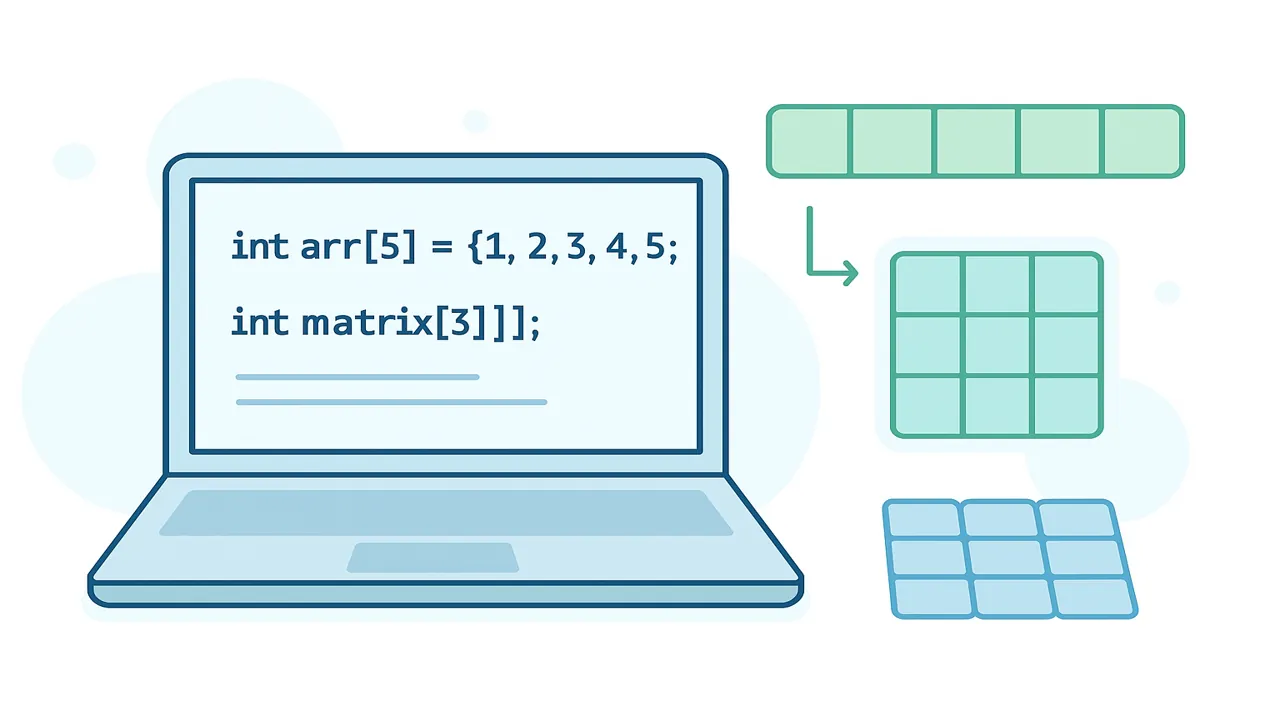
Learn arrays in C from zero, declare, initialize, index, compute sizes, and map 1D/2D addresses in row/column-major with worked examples.
What is an array?
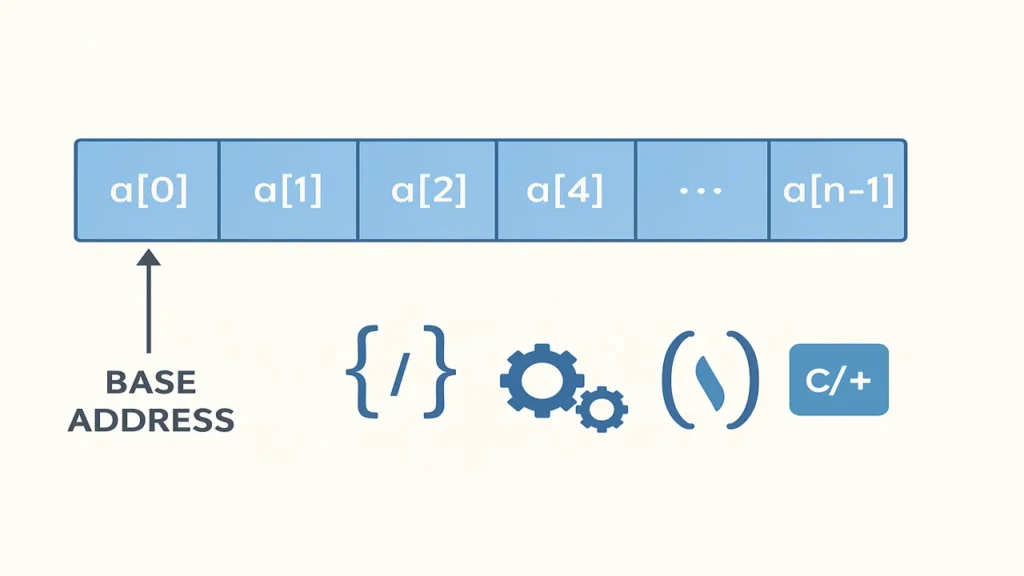
An array is a data structure that stores a collection of elements of the same type in contiguous memory, accessed by an index. In C, indexing starts at 0.
Declaring arrays in C
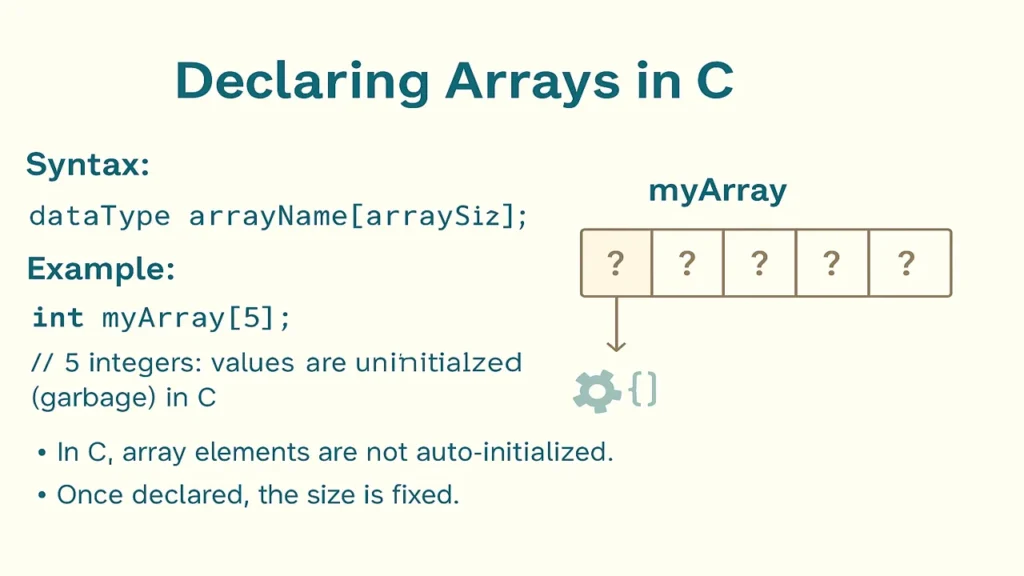
Syntax: dataType arrayName[arraySize];
Example:
int myArray[5]; // 5 integers; values are uninitialized (garbage) in CNotes:
- In C, array elements are not auto-initialized.
- Once declared, the size is fixed.
Initializing arrays & updating elements
You can initialize with a brace list:
int nums[5] = {1, 2, 3, 4, 5};
int nums2[] = {1, 2, 3, 4, 5}; // size inferred as 5
Update by index:
nums[2] = -1; // third element becomes -1
nums[4] = 0;  // fifth element becomes 0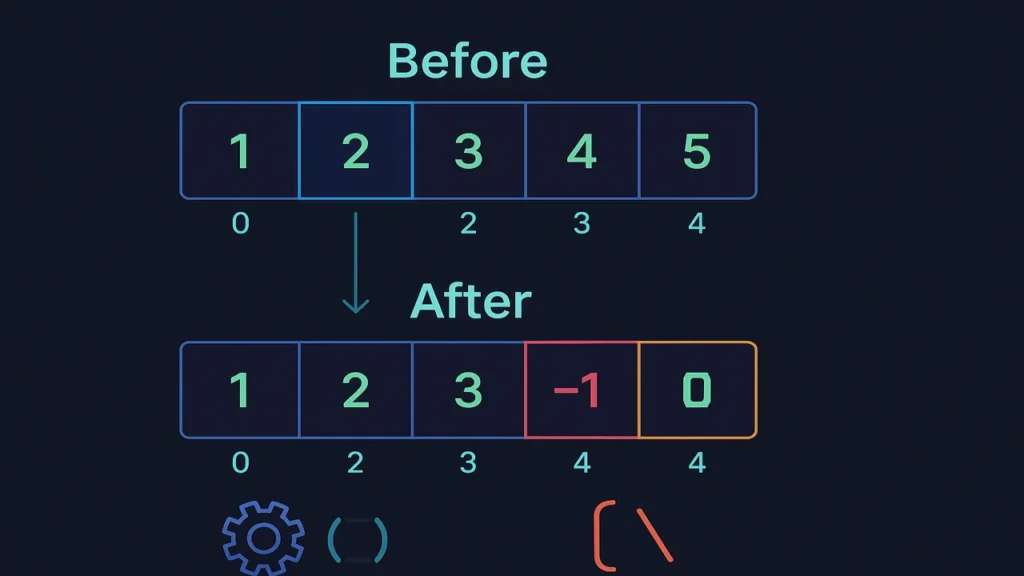
Analysis of Algorithms – Example of Summing Natural Numbers
Key characteristics of arrays
- Homogeneous type: all elements share one type.
- Contiguous memory: enables predictable addressing.
- Fixed size (C/C++/Java) vs dynamic in some languages.
- Indexed access: constant-time lookups by index.
Advantages
- Efficient storage & retrieval due to contiguity.
- Random access:
a[k]is O(1). - Easy to sort/search with classic algorithms.
- Versatile base for stacks, queues, etc.
- Simple mental model for beginners.
Disadvantages
- Fixed size; resizing needs reallocation/copy.
- Insert/Delete costly (shifts).
- Homogeneous only (no mixed types).
- Some ops slower than hash tables/trees.
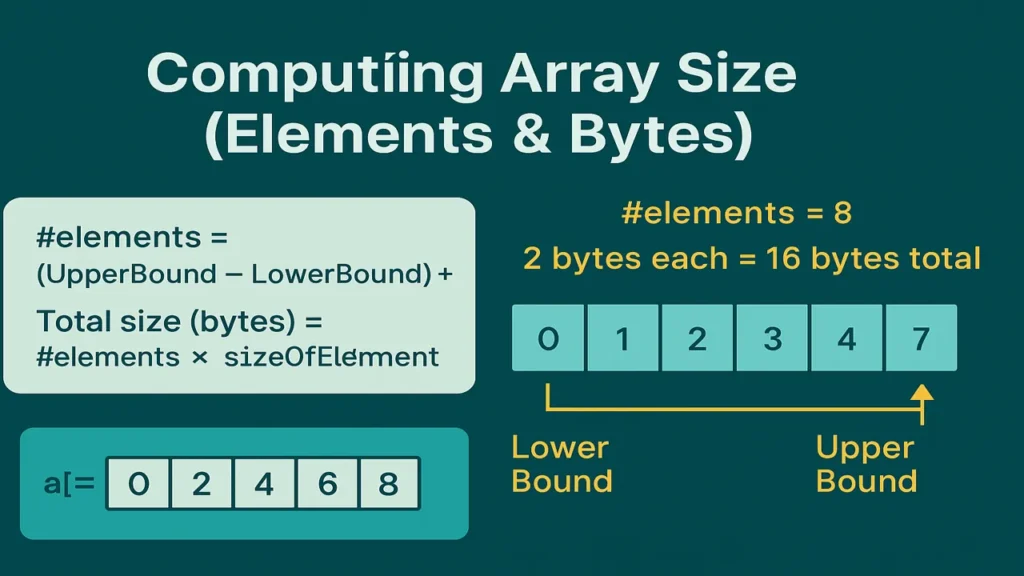
Computing array size (elements & bytes)
- #elements =
(UpperBound – LowerBound) + 1 - Total size (bytes) =
#elements × sizeOfElement
1D arrays: address formula + example
Let B = base address (start of the array), W = size of each element in bytes, k = index, L = lower bound (in C usually 0).
Address of a[k]:
a[k] = B + W * (k - L)If L = 0, then a[k] = B + W * k.
Practice: 1D questions
Q1. Base B=250, each element W=3 bytes. Address of 5th element of a[10]?
- Indexing from 0 → 5th element is
k=4. - Address =
250 + 3 * 4 = 262.
Q2. A[-6…6], W=4 bytes, base B=3500. Address of A[0]?
L=-6,k=0→k - L = 6.- Address =
3500 + 4 * 6 = 3524.
2D arrays: concept & use
A 2D array is an array of arrays, modeled as a matrix of rows and columns useful for tables and grid-like data.
Declaring/initializing 2D arrays
int disp[2][4] = {
  {10, 11, 12, 13},
  {14, 15, 16, 17}
};
// or (flattened initializer)
int disp2[2][4] = {10,11,12,13, 14,15,16,17};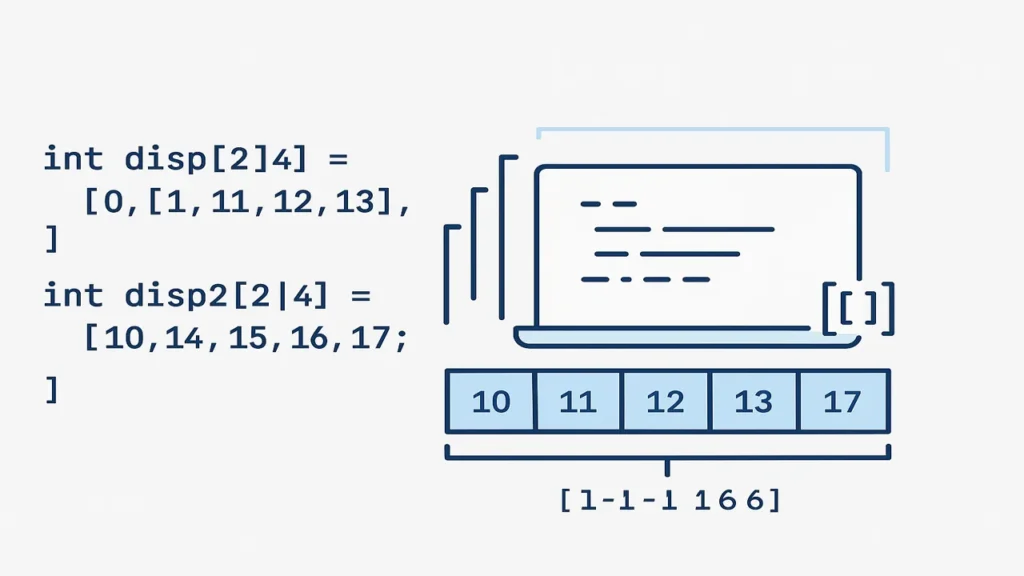
2D arrays in memory (overview)
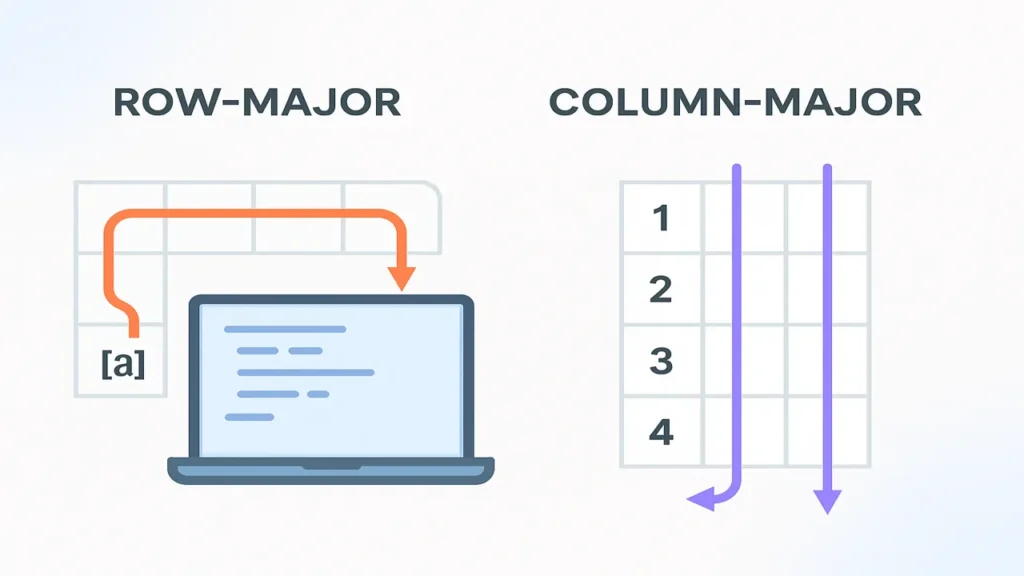
Multidimensional arrays are stored linearly in RAM. The order defines which elements are contiguous.
Row-major: rows are stored one after another (C uses row-major).
Column-major: columns are stored one after another.
Row-major vs column-major (intuition)
- Row-major: “finish the row, then move to next row.”
- Column-major: “finish the column, then move to next column.”
Row-major address formula (with meaning)
For a[i][j] with row bounds L1…U1, col bounds L2…U2:
Address = B + W * [ (U2 - L2 + 1) * (i - L1) + (j - L2) ]Meaning:
(U2 - L2 + 1)= #columns(i - L1)= rows before row i(j - L2)= offset inside row i
Column-major address formula (with meaning)
Address = B + W * [ (U1 - L1 + 1) * (j - L2) + (i - L1) ]Meaning:
(U1 - L1 + 1)= #rows(j - L2)= columns before column j(i - L1)= offset inside column j
Practice: 2D question (worked)
Given: VAL[1…15][1…10], W=4 bytes, B=1500. Find address of VAL[12][9]
Row-major (C style):
#cols = 10
i - L1 = 12 - 1 = 11
j - L2 = 9  - 1 = 8
Address = 1500 + 4 * (10*11 + 8)
        = 1500 + 4 * (110 + 8)
        = 1500 + 4 * 118
        = 1500 + 472
        = 1972
Column-major:
#rows = 15
j - L2 = 8
i - L1 = 11
Address = 1500 + 4 * (15*8 + 11)
        = 1500 + 4 * (120 + 11)
        = 1500 + 4 * 131
        = 1500 + 524
        = 2024
People also ask:
Yes. The first element is a[0].
No. Track the length separately or compute with sizeof(a) / sizeof(a[0]) only in the same scope where a is a raw array (not a pointer).
Not directly. Use dynamic allocation (malloc/realloc) or higher-level containers if you need resizing.