
Classes and Objects
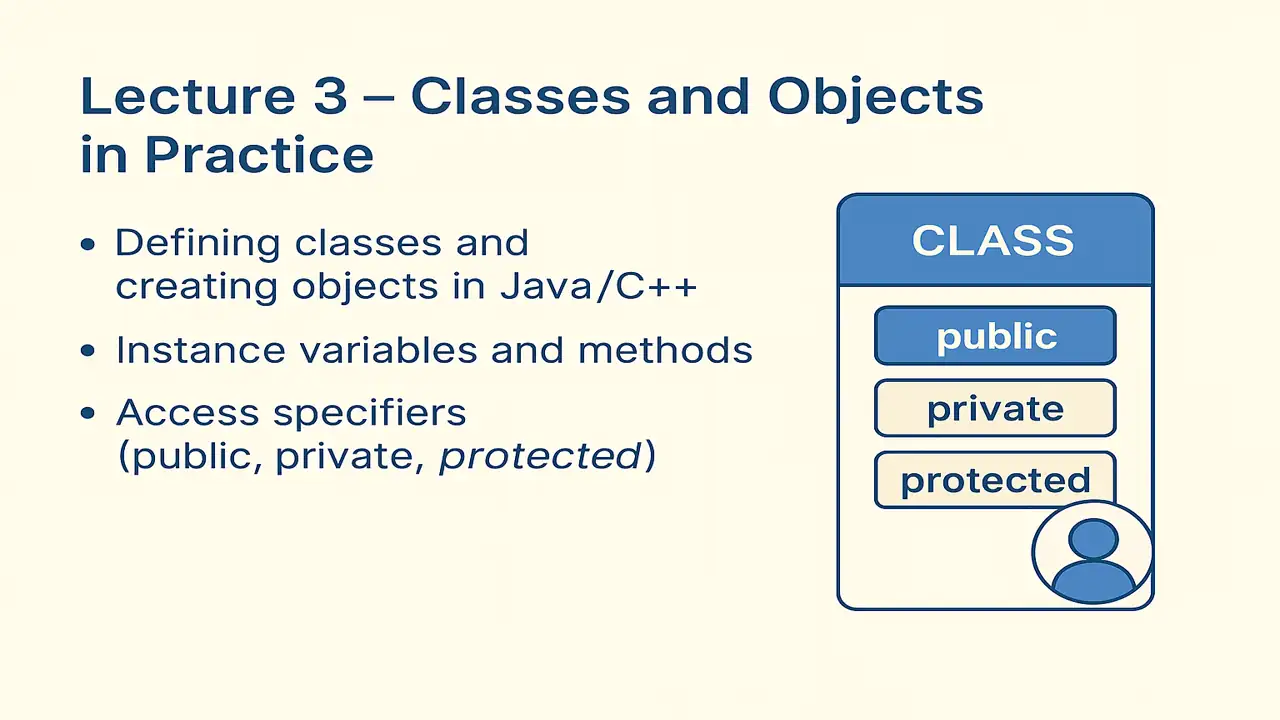
Learn how to define and use classes and objects in Java and C++. Understand instance variables, methods, and access specifiers public, private, and protected to write structured, secure, and reusable code in this hands-on lecture.
Defining Classes and Creating Objects in Java & C++
In Object-Oriented Programming, a class acts as a template and an object is a real-world instance of that class.
A class contains two main things:
- Attributes (Data members / instance variables)
- Methods (Functions / behaviors)
Example (C++):
#include <iostream>
using namespace std;

class Student {
public:
    string name;
    int rollNo;

    void introduce() {
        cout << "Hi, I'm " << name << ", Roll No: " << rollNo << endl;
    }
};

int main() {
    Student s1; // Object creation
    s1.name = "Ali";
    s1.rollNo = 101;
    s1.introduce();

    Student s2;
    s2.name = "Sara";
    s2.rollNo = 102;
    s2.introduce();
}
Explanation:
class Studentdefines what every student has (name,rollNo) and does (introduce()).s1ands2are two independent objects of the same class.
Example (Java):
class Student {
    String name;
    int rollNo;

    void introduce() {
        System.out.println("Hi, I'm " + name + ", Roll No: " + rollNo);
    }
}

public class Main {
    public static void main(String[] args) {
        Student s1 = new Student();
        s1.name = "Ali";
        s1.rollNo = 101;
        s1.introduce();

        Student s2 = new Student();
        s2.name = "Sara";
        s2.rollNo = 102;
        s2.introduce();
    }
}
Here too, each object (s1, s2) stores its own data and performs its own actions.
Lecture 2 – Core Concepts of Object-Oriented Programming
Instance Variables and Methods
Instance Variables
These are the attributes that belong to each object separately. Each object has its own copy of these variables.
Example:
Student s1, s2;
s1.name = "Ali";
s2.name = "Sara";
Even though both are from the same class, s1 and s2 hold different data.
Instance Methods
These are the behaviors or actions performed by objects. They often use instance variables to perform operations.
Example:
void introduce() {
    cout << "Hi, I'm " << name;
}
Each object runs this method using its own data.
Access Specifiers (public, private, protected)
Access specifiers control who can access what inside a class.
| Access Specifier | Access Level | Description |
|---|---|---|
public | Everyone | Accessible anywhere |
private | Class only | Hidden from outside |
protected | Class + Derived classes | Used in inheritance |
C++ Example:
#include <iostream>
using namespace std;

class BankAccount {
private:
    double balance; // Private: cannot be accessed directly

public:
    void setBalance(double amount) {
        if (amount >= 0)
            balance = amount;
        else
            cout << "Invalid amount!" << endl;
    }

    double getBalance() {
        return balance;
    }
};

int main() {
    BankAccount acc;
    acc.setBalance(5000);
    cout << "Your balance is: " << acc.getBalance();
}
This ensures data safety no one can directly modify balance.
Java Example:
class BankAccount {
    private double balance;

    void setBalance(double amount) {
        if (amount >= 0)
            balance = amount;
        else
            System.out.println("Invalid amount!");
    }

    double getBalance() {
        return balance;
    }
}

public class Main {
    public static void main(String[] args) {
        BankAccount acc = new BankAccount();
        acc.setBalance(5000);
        System.out.println("Your balance is: " + acc.getBalance());
    }
}
Access specifiers allow you to hide implementation details while exposing only necessary methods.
Why Access Specifiers Matter
They help:
- Prevent unauthorized data modification
- Support Encapsulation
- Improve security and code readability
- Allow controlled interaction between objects
Example:
- A
Userclass might exposegetName()but hidepassword.
Summary of Lecture 3
| Concept | Description | Example |
|---|---|---|
| Class | Blueprint or structure | class Student {} |
| Object | Instance of a class | Student s1 = new Student(); |
| Instance Variables | Each object’s own data | s1.name, s2.name |
| Instance Methods | Object behaviors | introduce() |
| Access Specifiers | Visibility control | public, private, protected |
Positive Thought for Students
“Don’t just learn to code learn to think in objects. Once you can visualize code as living things that act, react, and interact programming becomes creativity, not complexity.”