
Understanding the Köppen Global Climate Classification System | Week 3 – ElecturesAI
Discover how scientists classify the world’s climates through the Köppen Global Climate System. Learn how temperature, rainfall, and vegetation define Earth’s diverse regions in Week 3 of ElecturesAI’s Climate Change course.
Introduction Why Classifying Climate Matters
To understand the climate system, we must first learn how to organize it.
Every region on Earth experiences unique patterns of temperature and rainfall. From the humid Amazon forests to the frozen Arctic tundra, these differences define ecosystems, agriculture, and even human lifestyles.
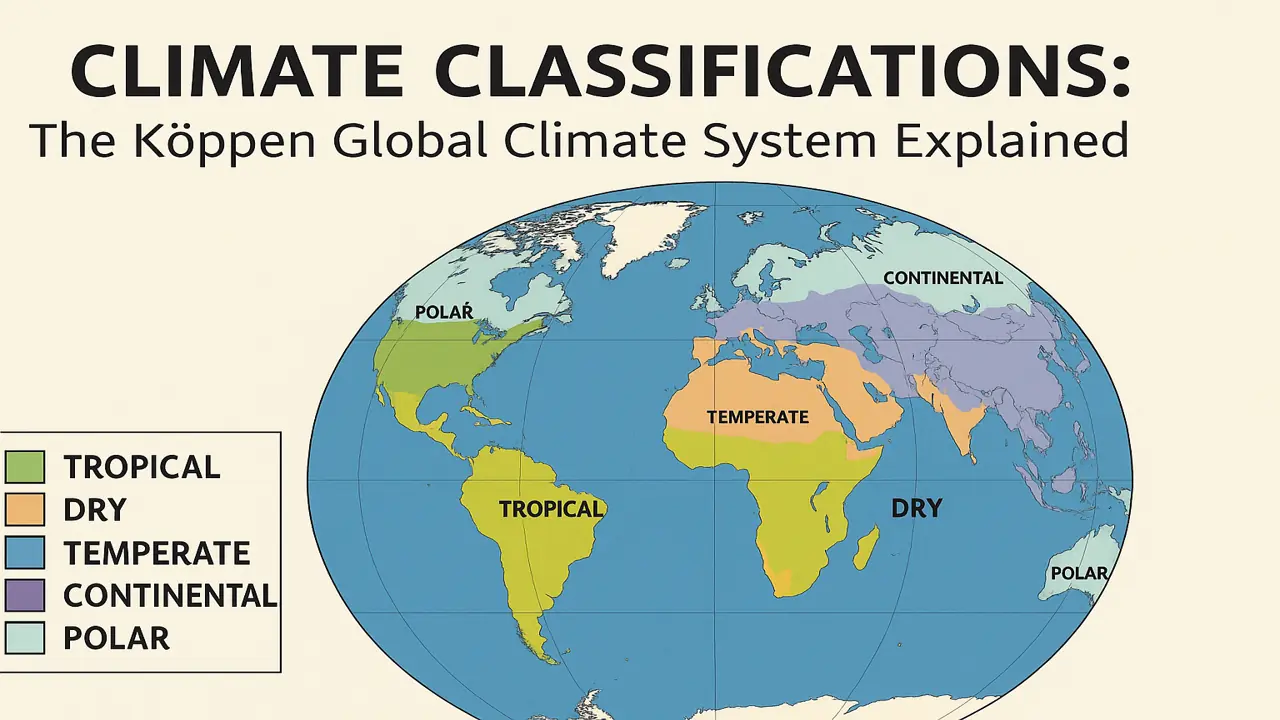
Scientists use a system called the Köppen Climate Classification one of the most widely used methods to categorize the world’s climates into logical, data-driven groups.
For More. Week 1 – Defining Climate and the Climate System
The Origin of the Köppen Climate Classification
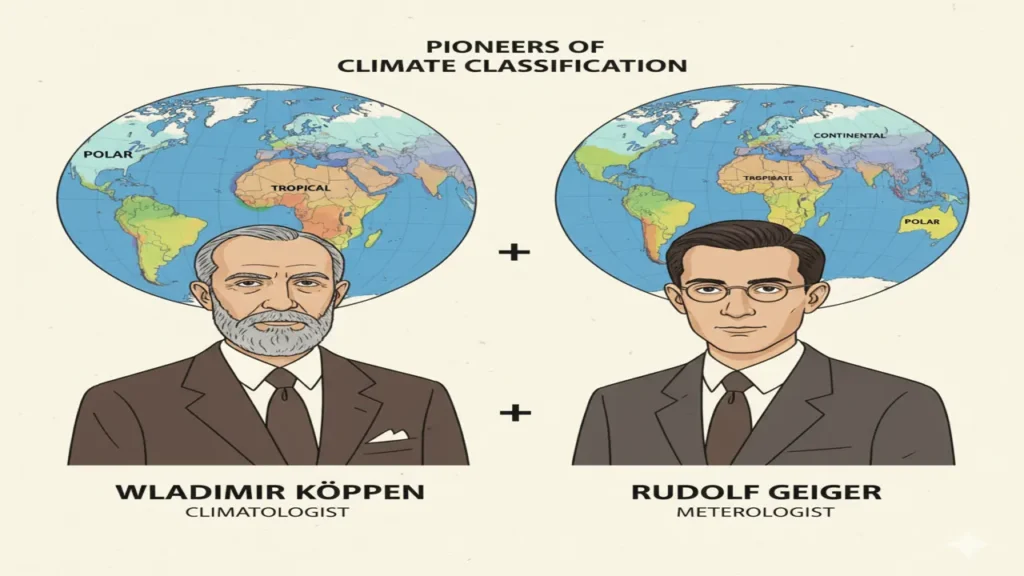
The system was developed by Wladimir Köppen, a German climatologist, in the early 1900s.
He noticed that plant life closely followed patterns of temperature and rainfall, meaning that vegetation could reveal a region’s climate type.
Köppen’s goal was simple yet brilliant to classify the planet’s climates based on observable, measurable data rather than vague descriptions.
Over time, the system was refined by scientists like Rudolf Geiger, becoming what we now call the Köppen–Geiger Climate Classification.
For More. Week 2 – Electromagnetic Radiation and the Global Energy Budget
The Five Major Climate Zones
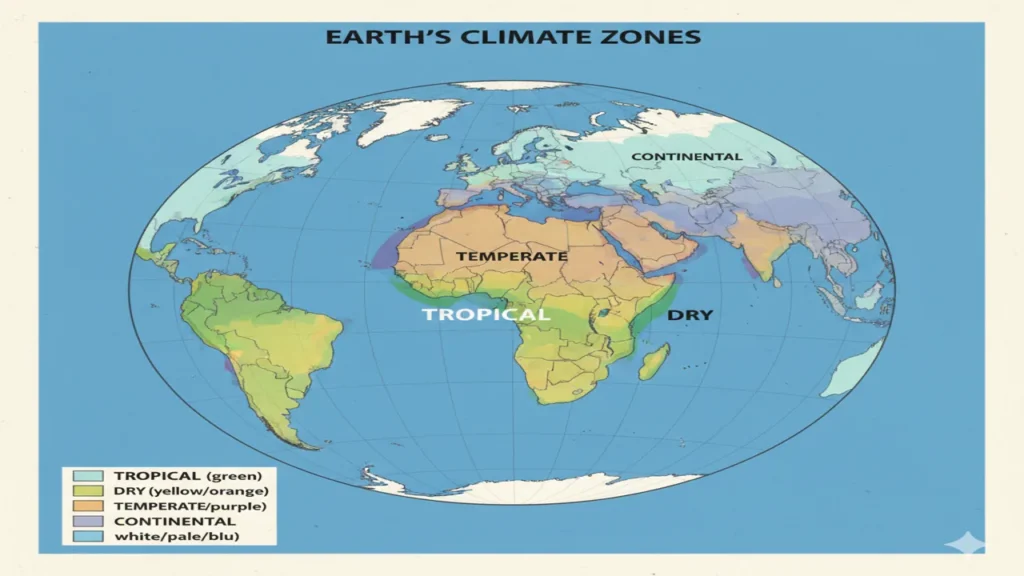
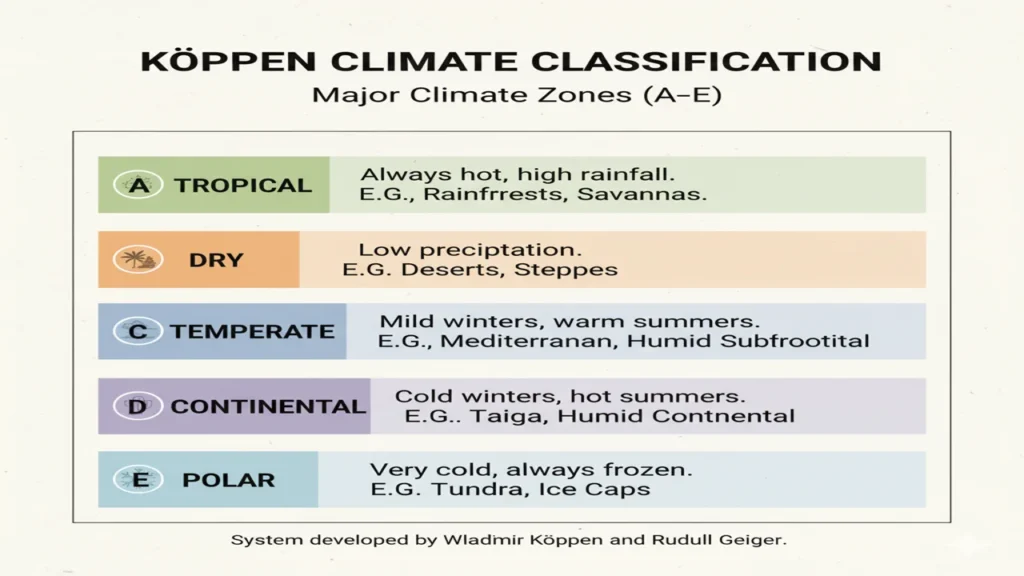
Köppen’s system divides the Earth into five primary zones, each represented by a letter and defined by average temperature and precipitation.
| Zone | Name | Main Characteristics | Examples |
|---|---|---|---|
| A | Tropical | Hot and humid all year; abundant rainfall. | Amazon Basin, Indonesia, Central Africa |
| B | Dry (Arid & Semi-arid) | Very low rainfall; desert or steppe environments. | Sahara Desert, Arabian Peninsula |
| C | Temperate (Mild Mid-latitude) | Warm summers, mild winters, moderate rainfall. | Mediterranean, SE China, Southern US |
| D | Continental | Cold winters, warm summers, distinct seasons. | Russia, Canada, Northern Europe |
| E | Polar | Very cold year-round, little precipitation. | Antarctica, Greenland, Arctic tundra |
Subdivisions and Detailed Variations
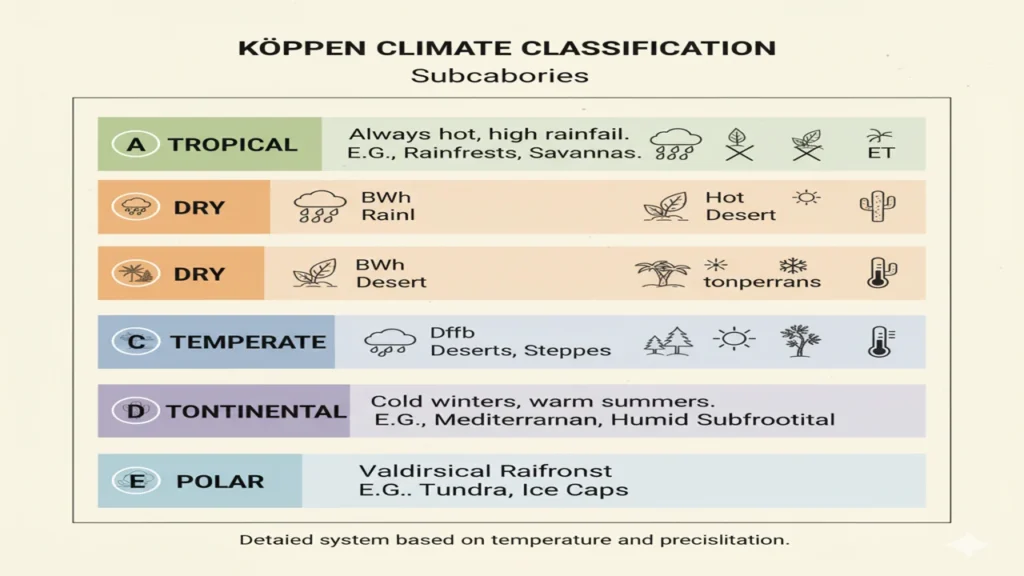
Each major zone is further divided using additional letters:
- Af / Am / Aw – Different tropical climates (rainforest, monsoon, savanna).
- Bw / Bs – Dry desert and semi-desert.
- Cf / Cw / Cs – Temperate wet, dry winter, and dry summer (Mediterranean).
- Df / Dw / Ds – Continental with variations in moisture and temperature.
- ET / EF – Tundra and frost climates.
These small distinctions matter: the difference between a humid subtropical and a Mediterranean climate can determine what crops grow, what energy sources thrive, and how people live.
Why Climate Classification Is Important
Understanding climate zones helps scientists and policymakers:
- Predict agricultural suitability for crops.
- Model climate change impacts on temperature and rainfall.
- Design infrastructure adapted to local conditions.
- Study biodiversity and ecosystems across regions.
It’s also essential for climate research, allowing data from different countries to be compared consistently using a shared framework.

Connection to the Climate System
The Köppen classification doesn’t just describe climate it reflects how the climate system behaves.
Temperature, rainfall, and vegetation patterns arise from interactions between atmosphere, hydrosphere, biosphere, and lithosphere (from Week 1).
By categorizing climates, we better understand how energy and moisture circulate through Earth’s system.
Summary
The Köppen Global Climate System remains one of the most powerful tools for understanding Earth’s environmental diversity.
It simplifies complex data into a clear, structured model that helps us visualize how our planet’s climate system connects from tropical jungles to icy poles.