

Database Systems
Learn the fundamentals of Database Systems explore what databases are, how DBMS works, and their key components including hardware, software, data, and users. Understand relational models, data integrity, and the vital role of databases in modern organizations for secure and efficient data management.
What is a Database?
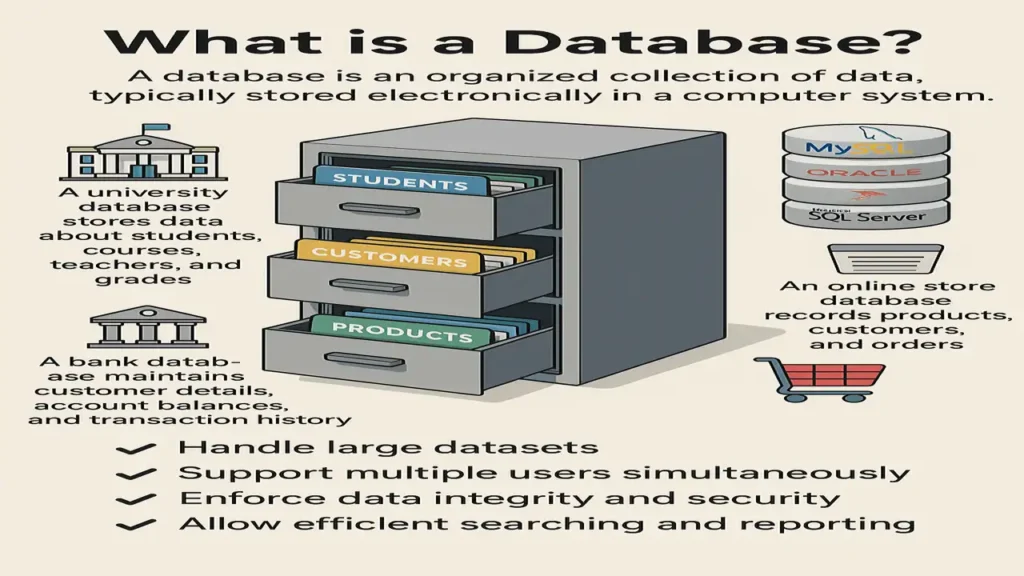
A database is an organized collection of structured information, or data, typically stored electronically in a computer system. The database is designed to hold large amounts of information that can be easily accessed, managed, and updated.
In the simplest terms, a database is like a digital filing cabinet, where each drawer (table) stores data related to a specific topic or entity. For instance:
- A university database stores data about students, courses, teachers, and grades.
- A bank database maintains customer details, account balances, and transaction history.
- An online store database records products, customers, and orders.
A database is managed by a Database Management System (DBMS) a specialized software used to store, retrieve, and manipulate data. Examples of DBMS include MySQL, Oracle, Microsoft SQL Server, and PostgreSQL.
Unlike simple files such as Excel sheets or Word documents, a database can:
- Handle large datasets.
- Support multiple users simultaneously.
- Enforce data integrity and security.
- Allow efficient searching and reporting.
Lecture 1 – Introduction to Programming Paradigms
Difference Between Data, Information, and Knowledge
It’s important to understand the difference between data, information, and knowledge, as they represent three stages of understanding.
| Concept | Description | Example |
|---|---|---|
| Data | Raw facts or figures without context. | 1200, “Ali”, “CS101” |
| Information | Data processed and organized to add meaning. | “Ali is enrolled in course CS101.” |
| Knowledge | Applying information for understanding or decision-making. | “Students enrolled in CS101 usually need access to the lab database.” |
Let’s look at a simple scenario:
Imagine a database storing sales records.
- Data: Numbers like 25, 40, 75 (just sales figures).
- Information: “Sales increased by 50% in the last quarter.”
- Knowledge: “High sales in December occur due to holiday promotions, so increase stock next December.”
Thus, data is the raw input, information is the processed output, and knowledge is the insight or wisdom derived from it.
Components of a Database System
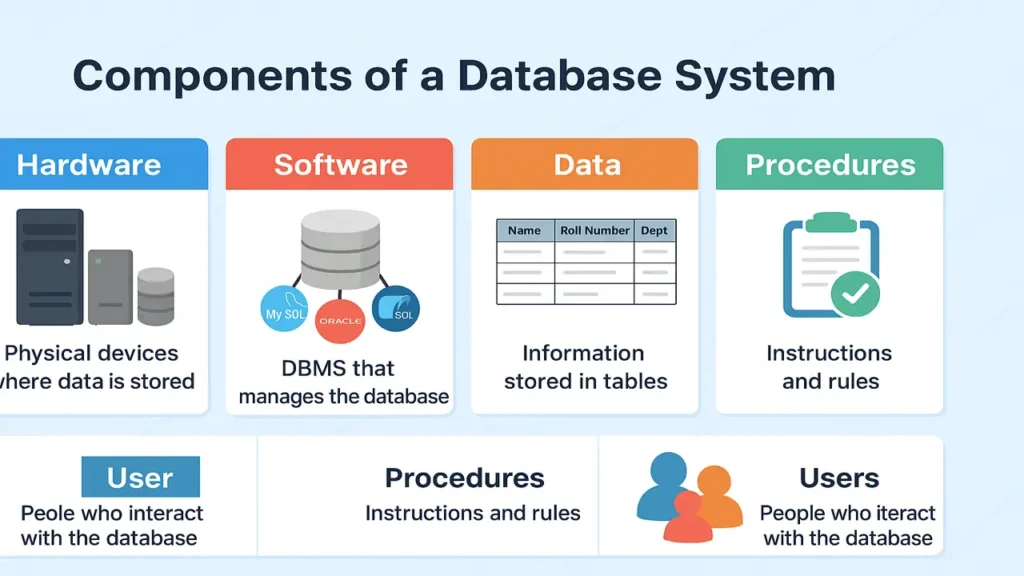
A database system is more than just the data. It includes hardware, software, people, and procedures that work together to collect, store, and process information.
a. Hardware
This includes the physical devices on which data is stored servers, storage drives, and client computers that run DBMS software.
b. Software
The main software component is the DBMS, which controls how data is stored, retrieved, and updated. Examples include:
- MySQL for web applications.
- Oracle for large enterprise systems.
- SQLite for mobile apps.
c. Data
The actual information stored in tables. For example, in a university system, one table may store student details (name, roll number, department), while another stores course details.
d. Procedures
The guidelines and instructions that define how data is entered, maintained, and backed up. For instance, a rule may state that every new student record must have a unique ID.
e. Users
Different types of users interact with a database:
- Database Administrator (DBA): Manages and maintains the database.
- Application Programmers: Develop programs that interact with the database.
- End Users: Use applications to retrieve or input data (e.g., a student checking grades).
Database Architecture
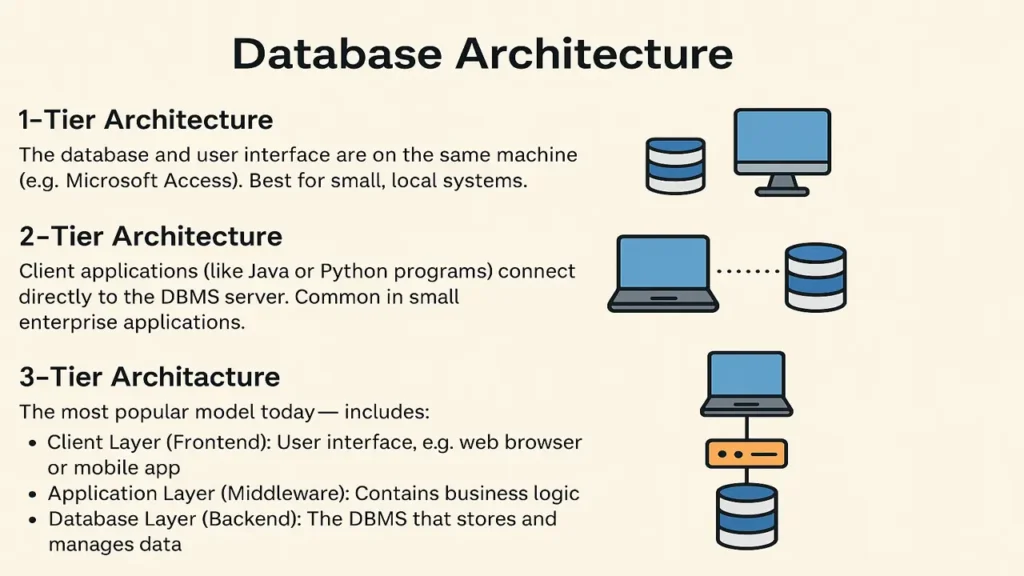
Database systems can be structured in different architectural models, depending on how users access data.
1-Tier Architecture:
The database and user interface are on the same machine (e.g., Microsoft Access). Best for small, local systems.
2-Tier Architecture:
Client applications (like Java or Python programs) connect directly to the DBMS server. Common in small enterprise applications.
3-Tier Architecture:
The most popular model today includes:
- Client Layer (Frontend): User interface, e.g., web browser or mobile app.
- Application Layer (Middleware): Contains business logic.
- Database Layer (Backend): The DBMS that stores and manages data.
Most web systems (e.g., Amazon, YouTube, or banking apps) follow the 3-tier architecture for scalability, security, and speed.
Role of DBMS in Modern Organizations
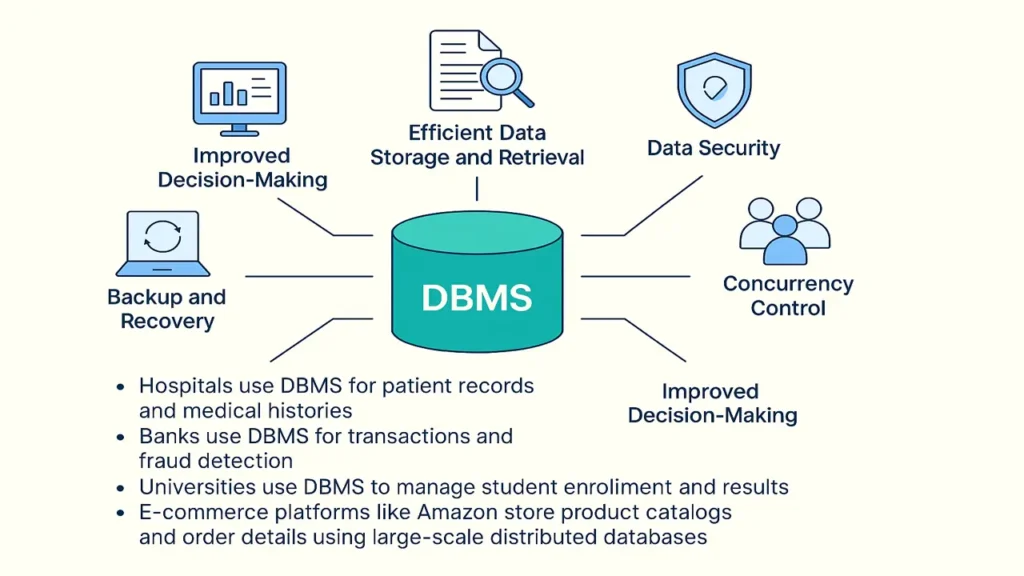
A Database Management System (DBMS) plays a central role in nearly every modern organization because data is the backbone of decision-making.
Key Roles and Benefits:
- Efficient Data Storage and Retrieval:
DBMS allows structured data storage and fast searching using SQL. - Data Integrity:
Ensures accuracy and consistency through rules (constraints, keys, etc.). - Data Security:
Restricts unauthorized access through passwords, user roles, and permissions. - Concurrency Control:
Allows multiple users to work on the same data without conflicts. - Backup and Recovery:
Protects data from hardware failure or human error. - Improved Decision-Making:
Reports and analytics help managers make informed decisions.
Examples:
- Hospitals use DBMS for patient records and medical histories.
- Banks use DBMS for transactions and fraud detection.
- Universities use DBMS to manage student enrollment and results.
- E-commerce platforms like Amazon store product catalogs and order details using large-scale distributed databases.
Summary
- A database stores structured data in an organized and accessible form.
- Data becomes information when processed, and knowledge when applied.
- The database system consists of hardware, software, data, users, and procedures.
- A DBMS enables efficient, secure, and reliable management of data forming the foundation of all modern digital systems.