Information Assurance: Complete Guide for Semester Exams
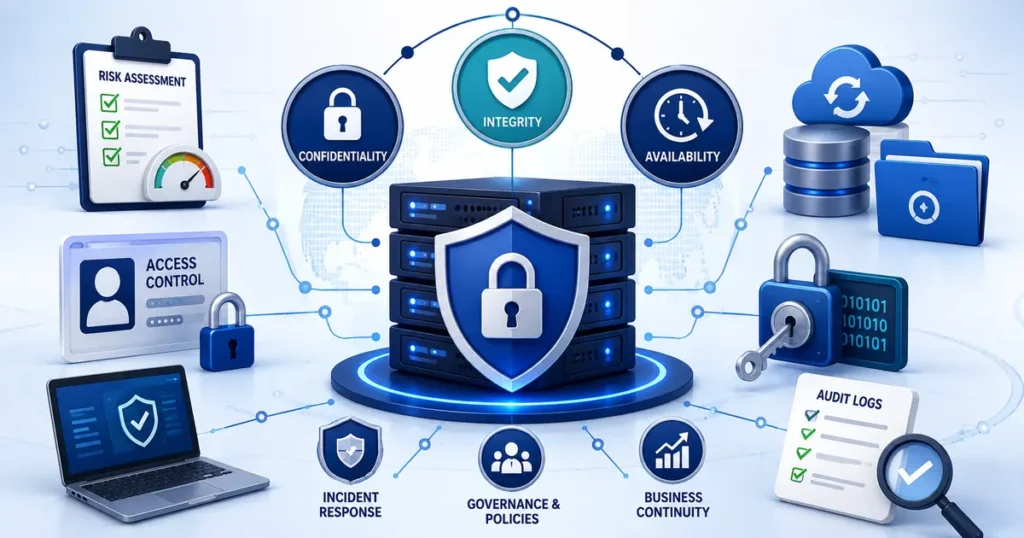
Information Assurance is an important subject for students of Cybersecurity, Computer Science, Information Technology, Software Engineering, Business Information Systems, and related degree programs. It explains how organizations protect information and ensure that it remains accurate, available, confidential, authentic, and trustworthy.
Students often confuse Information Assurance with basic computer security. Security is certainly part of the subject, but Information Assurance is broader. It includes risk management, policies, people, technology, legal responsibilities, business continuity, incident response, auditing, and long-term protection of information.
Consider a university examination system. It must prevent unauthorized students from changing marks, protect private student records, remain available during result announcements, keep accurate logs, and recover after a system failure. Protecting only the password page would not be enough. The complete information process must be protected.
This guide explains the major concepts of Information Assurance in simple academic language. It is designed to help you prepare for semester exams, MCQs, short questions, comparisons, case studies, and descriptive answers.
Table of Contents
- What Is Information Assurance?
- Key Principles of Information Assurance
- Information Risk Management
- Security Controls and Access Management
- Cryptography and Data Protection
- Governance, Policies, and Compliance
- Incident Response and Business Continuity
- Security Assessment and Auditing
- Important Topics for Exam Preparation
- How to Study Information Assurance Effectively
- Common Mistakes Students Make
- Expert Tips for Scoring High
- Practice MCQs
- Frequently Asked Questions
- Conclusion
What Is Information Assurance?
Information Assurance is the practice of managing risks to information and information systems so that data remains confidential, accurate, available, authentic, and reliable throughout its lifecycle.
The subject focuses on more than preventing attacks. It also ensures that information can support business operations, legal obligations, decision-making, customer trust, and recovery after disruption.
Information may exist in many forms:
- Digital files
- Databases
- Email messages
- Cloud records
- Printed documents
- Voice communication
- Backup media
- Mobile devices
- Network traffic
- Business reports
All of these forms may require protection.
Information Assurance and Information Security
Information security mainly focuses on protecting information against unauthorized access, alteration, disclosure, and destruction.
Information Assurance includes security but also covers reliability, continuity, governance, accountability, risk acceptance, recovery, and confidence in information systems.
A useful way to remember the difference is:
Information security protects information. Information Assurance ensures that information can be trusted and used when required.
Why Is Information Assurance Important?
Organizations depend on information for almost every operation. A hospital needs accurate patient records. A bank needs reliable transaction data. A university needs secure examination results. An online store needs available customer and payment systems.
Weak Information Assurance may lead to:
- Data breaches
- Financial loss
- Incorrect decisions
- Service interruption
- Privacy violations
- Loss of customer confidence
- Legal or contractual problems
- Damage to organizational reputation
Key Principles of Information Assurance
Confidentiality
Confidentiality ensures that information is accessible only to authorized people, systems, or processes.
Common confidentiality controls include:
- Access permissions
- Encryption
- Strong authentication
- Data classification
- Secure communication
- Physical protection
For example, student examination records should be visible only to authorized staff and the relevant student.
Integrity
Integrity ensures that information remains accurate, complete, and protected against unauthorized or accidental modification.
Integrity may be supported through:
- Hashing
- Digital signatures
- Database constraints
- Version control
- Audit logs
- Change approval
- Backup verification
If a financial record changes without authorization, its integrity has been violated even when nobody else has seen the data.
Availability
Availability ensures that authorized users can access information and services when required.
Availability controls include:
- Redundant systems
- Backups
- Reliable power
- Capacity planning
- System monitoring
- Disaster recovery
- Protection against service disruption
A system can be confidential and accurate but still fail the organization if it is unavailable during an important operation.
The CIA Triad
Confidentiality, Integrity, and Availability form the CIA triad.
Text-described diagram:
Confidentiality + Integrity + Availability → Trusted and usable information
The three goals must be balanced. Extremely strict access rules may improve confidentiality but reduce availability. Easy access may improve convenience but increase security risk.
Authenticity
Authenticity confirms that a user, message, device, or data source is genuine.
Authentication controls may include passwords, security tokens, certificates, one-time codes, or biometric checks.
An authentic message comes from the claimed source. Authenticity is especially important in electronic communication and financial transactions.
Accountability
Accountability means that actions can be traced to the responsible user, process, or system.
Unique accounts, audit logs, time records, and activity monitoring support accountability.
Shared administrator accounts weaken accountability because several people may use the same identity.
Non-Repudiation
Non-repudiation provides evidence that a particular action or communication occurred and helps prevent a participant from denying it later.
Digital signatures, trusted timestamps, transaction records, and controlled audit logs may support non-repudiation.
Privacy
Privacy concerns the proper collection, use, storage, sharing, and disposal of personal information.
An organization should collect only necessary data, explain why it is needed, protect it, limit access, and retain it only for an appropriate period.
Information Risk Management
Risk management is one of the central activities of Information Assurance.
Organizations cannot remove every possible risk. Instead, they identify important information assets, examine threats and vulnerabilities, estimate possible loss, and select suitable controls.
Asset
An asset is anything valuable that requires protection.
Examples include:
- Customer databases
- Employee records
- Business applications
- Network equipment
- Reputation
- Intellectual property
- Cloud accounts
- Physical facilities
Threat
A threat is a potential cause of harm.
Threats may include attackers, malicious software, dishonest employees, fire, flood, hardware failure, human error, or service-provider failure.
Vulnerability
A vulnerability is a weakness that a threat may exploit.
Examples include:
- Weak passwords
- Unpatched software
- Incorrect permissions
- Missing backups
- Poor staff training
- Unsecured physical access
- Misconfigured cloud storage
Risk
Risk is the possibility that a threat will exploit a vulnerability and cause harm to an asset.
A common conceptual approach is:
Risk depends on likelihood and impact.
A highly likely event with severe consequences usually receives greater priority than an unlikely event with minor consequences.
Risk Assessment
A risk assessment commonly includes:
- Identify information assets.
- Identify threats.
- Identify vulnerabilities.
- Estimate likelihood.
- Estimate impact.
- Determine risk level.
- Recommend treatment.
- Review the remaining risk.
Risk Treatment Options
Organizations may respond to risk in several ways:
- Avoid: Stop the activity that creates the risk.
- Reduce: Apply controls to lower likelihood or impact.
- Transfer: Share financial or operational impact through contracts or insurance.
- Accept: Formally accept the remaining risk when it is within tolerance.
Residual Risk
Residual risk is the risk that remains after security controls are applied.
No control normally removes all risk. Management must decide whether the residual risk is acceptable.
Security Controls and Access Management
Administrative Controls
Administrative controls are policies, procedures, responsibilities, training activities, and management processes.
Examples include:
- Security policies
- Employee screening
- Awareness training
- Risk assessments
- Change-management procedures
- Incident-response plans
Technical Controls
Technical controls use hardware or software to protect information.
Examples include:
- Firewalls
- Encryption
- Access-control systems
- Antimalware protection
- Logging tools
- Network segmentation
- Backup software
Physical Controls
Physical controls protect buildings, equipment, media, and people.
Examples include locks, guards, access cards, surveillance cameras, secure server rooms, fire suppression, and environmental monitoring.
Preventive, Detective, and Corrective Controls
Preventive controls attempt to stop an incident before it occurs. Examples include access restrictions and security training.
Detective controls identify events that have occurred or are occurring. Examples include audit logs, alarms, and monitoring systems.
Corrective controls reduce damage or restore normal operations. Examples include recovery procedures, malware removal, and restoring from backup.
Identification, Authentication, Authorization, and Accounting
Access control is commonly described through four related steps:
- Identification: The user claims an identity.
- Authentication: The system verifies that identity.
- Authorization: The system decides what the user may do.
- Accounting: The system records relevant activities.
Least Privilege
The principle of least privilege gives users and systems only the access required for their tasks.
A staff member who only prepares reports should not automatically receive permission to delete the complete database.
Need to Know
Need to know limits access to information required for a particular responsibility.
A user may have a high organizational position but still not require access to every confidential record.
Separation of Duties
Separation of duties divides sensitive activities among different people.
For example, one employee may create a payment request while another approves it. This reduces fraud, error, and misuse.
Multi-Factor Authentication
Multi-factor authentication uses evidence from more than one category:
- Something the user knows
- Something the user has
- Something the user is
Using a password and a one-time code is stronger than using two passwords because the factors come from different categories.
Cryptography and Data Protection
Encryption
Encryption transforms readable information into an unreadable form that requires an appropriate key to recover.
Encryption may protect:
- Data at rest
- Data in transit
- Backup media
- Mobile devices
- Cloud storage
- Network communication
Symmetric Encryption
Symmetric encryption uses the same secret key for encryption and decryption.
It is generally efficient for protecting large amounts of data, but the key must be shared securely.
Asymmetric Encryption
Asymmetric encryption uses a mathematically related public key and private key.
The public key may be shared, while the private key must remain protected.
Asymmetric methods support secure key exchange, digital signatures, and identity verification.
Hashing
A cryptographic hash function produces a fixed-length digest from input data.
Hashing is commonly used to verify integrity. A changed file normally produces a different hash value.
Hashing is not the same as encryption because a hash is not intended to be reversed to recover the original data.
Digital Signatures
A digital signature supports integrity, authenticity, and non-repudiation.
The signer uses a private key to create the signature, and the recipient uses the corresponding public key to verify it.
Key Management
Strong cryptography can fail when keys are poorly managed.
Key management includes:
- Key generation
- Secure storage
- Distribution
- Rotation
- Revocation
- Backup
- Destruction
Governance, Policies, and Compliance
Information Security Governance
Governance ensures that information protection supports organizational goals and receives appropriate leadership, funding, responsibility, and oversight.
Senior management remains responsible for major risk decisions even when technical tasks are assigned to security teams.
Security Policy
A security policy states the organization’s expectations and direction for protecting information.
Supporting documents may include standards, procedures, guidelines, and baselines.
- Policy: States what must be achieved.
- Standard: Defines mandatory requirements.
- Procedure: Explains how to perform a task.
- Guideline: Provides recommended practice.
Data Classification
Data classification groups information according to sensitivity and business value.
Common levels may include public, internal, confidential, and highly restricted information.
The classification should influence access, encryption, storage, sharing, retention, and disposal.
Information Lifecycle
Information should be protected throughout its lifecycle:
Creation → Storage → Use → Sharing → Retention → Disposal
Secure disposal is important because old storage media and unnecessary records can still expose sensitive information.
Security Awareness
Employees influence Information Assurance every day.
Awareness programs may cover phishing, passwords, confidential documents, reporting incidents, secure remote work, social engineering, and responsible device use.
Training should be practical and repeated rather than treated as a one-time activity.
Third-Party Risk
Organizations often share data or systems with suppliers, cloud providers, consultants, and business partners.
Third-party assurance may require contracts, security requirements, access restrictions, monitoring, audit rights, incident-notification rules, and service-continuity planning.
Incident Response and Business Continuity
Incident Response
Incident response is the organized process used to handle security incidents.
A common lifecycle includes:
- Preparation
- Detection and analysis
- Containment
- Eradication
- Recovery
- Post-incident review
Containment limits the spread of an incident. Eradication removes the cause. Recovery returns systems to normal operation.
Business Continuity
Business continuity focuses on keeping critical operations functioning during and after disruption.
It may include alternative facilities, manual procedures, backup communication, replacement staff, supplier alternatives, and emergency decision-making.
Disaster Recovery
Disaster recovery focuses mainly on restoring technology, systems, applications, and data after a major disruption.
Business continuity is broader than disaster recovery because business operations may continue through temporary methods before full technical recovery.
Recovery Time Objective
Recovery Time Objective, or RTO, describes the target time within which a service should be restored after disruption.
Recovery Point Objective
Recovery Point Objective, or RPO, describes the maximum acceptable amount of data loss measured in time.
If the RPO is four hours, backup and replication arrangements should normally limit data loss to approximately that period.
Backups
Backups support availability and recovery, but they must be protected, monitored, and tested.
A backup is useful only when the organization can restore it successfully within the required time.
Security Assessment and Auditing
Security Audit
A security audit compares actual practices and controls with policies, requirements, or expected standards.
Auditors may examine documents, configurations, records, physical controls, interviews, and evidence of control operation.
Vulnerability Assessment
A vulnerability assessment identifies and prioritizes weaknesses in systems, applications, networks, or processes.
Its purpose is to help the organization understand where improvement is required.
Penetration Testing
Penetration testing uses authorized and controlled attempts to determine whether selected weaknesses can be exploited.
A vulnerability assessment identifies possible weaknesses, while penetration testing provides deeper evidence about selected attack paths.
Security Monitoring
Monitoring helps identify unusual activity, policy violations, failures, and possible attacks.
Useful evidence may include:
- Authentication logs
- Network activity
- System events
- Application errors
- Administrative changes
- Data-access records
Secure Development
Information Assurance should be considered throughout software development.
Important activities include secure requirements, design review, controlled coding practices, testing, change management, access control, logging, and maintenance.
Security added only after development may be expensive and incomplete.
Important Topics for Information Assurance Exam Preparation
- Definition and scope of Information Assurance
- Information security versus Information Assurance
- CIA triad
- Authenticity, accountability, privacy, and non-repudiation
- Assets, threats, vulnerabilities, likelihood, and impact
- Risk assessment and treatment
- Residual risk
- Administrative, technical, and physical controls
- Preventive, detective, and corrective controls
- Identification, authentication, authorization, and accounting
- Least privilege and need to know
- Separation of duties
- Multi-factor authentication
- Symmetric and asymmetric encryption
- Hashing and digital signatures
- Data classification and information lifecycle
- Security policies, standards, procedures, and guidelines
- Incident-response phases
- Business continuity and disaster recovery
- RTO and RPO
- Security audits and monitoring
- Vulnerability assessment and penetration testing
- Third-party risk
- Security awareness
Step-by-Step: How to Study Information Assurance Effectively
Step 1: Begin With the CIA Triad
Connect confidentiality, integrity, and availability with one real example each.
Step 2: Learn Risk Terms as a Chain
Use this sequence:
Asset → Threat → Vulnerability → Impact → Risk → Control → Residual risk
Step 3: Create Control Tables
Classify controls by administrative, technical, physical, preventive, detective, and corrective categories.
Step 4: Compare Similar Terms
Prepare short comparisons for:
- Authentication versus authorization
- Confidentiality versus privacy
- Hashing versus encryption
- Business continuity versus disaster recovery
- RTO versus RPO
- Vulnerability assessment versus penetration testing
- Policy versus procedure
Step 5: Use Case Studies
Take a hospital, bank, university, or online store and identify its assets, risks, controls, and recovery requirements.
Step 6: Practice Process Questions
Learn the correct order of risk assessment, incident response, data lifecycle, and continuity planning.
Step 7: Review Incorrect Answers
For every wrong MCQ, write the concept you confused and one example that explains the correct answer.
Step 8: Attempt a Timed Mixed Quiz
Before your exam, combine governance, technical controls, risk, continuity, and cryptography in one timed practice session.
Common Mistakes Students Make
Thinking Information Assurance Means Antivirus Only
The subject includes governance, people, risk, continuity, privacy, and accountability in addition to technical security.
Confusing Threat and Vulnerability
A threat can cause harm. A vulnerability is a weakness that may allow the harm to occur.
Confusing Authentication and Authorization
Authentication verifies identity. Authorization determines permitted actions.
Assuming Encryption Guarantees Integrity
Encryption mainly protects confidentiality. Integrity requires suitable mechanisms such as hashing, message authentication, or digital signatures.
Confusing Backup With Business Continuity
Backups are one recovery control. Business continuity includes people, facilities, communication, suppliers, and alternative operations.
Ignoring Residual Risk
Controls reduce risk but do not normally remove it completely.
Treating Policies and Procedures as the Same
A policy gives direction and requirements. A procedure explains the steps used to perform a task.
Assuming Compliance Automatically Means Security
Compliance may confirm selected requirements, but organizations must still understand their actual threats, systems, and business risks.
Expert Tips for Scoring High in Information Assurance
- Begin long answers with a direct definition.
- Use the CIA triad in practical examples.
- Write risk terms in their correct relationship.
- Classify every control by type and purpose.
- Explain the business reason behind each security control.
- Use tables for similar concepts.
- Include people, process, and technology in descriptive answers.
- Draw simple lifecycle and feedback diagrams.
- Use realistic examples from banks, hospitals, and universities.
- Practice scenario-based MCQs before your semester exam.
Practice MCQs
MCQ 1
Which Information Assurance principle ensures that authorized users can access information when required?
A. Confidentiality
B. Availability
C. Non-repudiation
D. Privacy
Correct Answer: B. Availability
Explanation: Availability ensures that systems and information remain accessible to authorized users. Confidentiality controls who may view the information.
MCQ 2
Which term describes a weakness that may be exploited by a threat?
A. Asset
B. Vulnerability
C. Policy
D. Audit
Correct Answer: B. Vulnerability
Explanation: A vulnerability is a weakness in a system, process, or control. A threat is a potential cause of harm that may exploit the weakness.
MCQ 3
Which principle gives a user only the access required for assigned duties?
A. Least privilege
B. Maximum access
C. Open authorization
D. Shared responsibility
Correct Answer: A. Least privilege
Explanation: Least privilege reduces risk by limiting unnecessary access. It applies to users, applications, services, and administrators.
MCQ 4
Which technique is primarily used to verify whether data has changed?
A. Hashing
B. Compression
C. Formatting
D. Routing
Correct Answer: A. Hashing
Explanation: Hashing produces a digest that changes when the input changes. Encryption is mainly used to protect confidentiality.
MCQ 5
Which value describes the maximum acceptable data loss measured in time?
A. RTO
B. RPO
C. CIA
D. MFA
Correct Answer: B. RPO
Explanation: Recovery Point Objective describes how much recent data an organization can afford to lose. Recovery Time Objective describes how quickly a service should be restored.
Frequently Asked Questions
What is Information Assurance in simple words?
Information Assurance is the process of making sure information remains protected, accurate, available, and trustworthy. It combines security controls, risk management, policies, people, and recovery planning.
Is Information Assurance the same as cybersecurity?
No. Cybersecurity mainly focuses on protecting digital systems from threats. Information Assurance is broader and also includes governance, continuity, reliability, privacy, accountability, and confidence in information.
What are the main principles of Information Assurance?
The core principles are confidentiality, integrity, and availability. Authenticity, accountability, non-repudiation, and privacy are also commonly included.
Why is risk management important in Information Assurance?
Organizations have limited resources and cannot eliminate every risk. Risk management helps them identify important assets, estimate possible harm, and select suitable controls.
What is the difference between authentication and authorization?
Authentication verifies who the user is. Authorization determines which systems, information, and actions that verified user may access.
What is the difference between RTO and RPO?
RTO describes the target time for restoring a service. RPO describes the maximum acceptable amount of recent data loss measured in time.
What is the difference between business continuity and disaster recovery?
Business continuity keeps critical operations functioning during disruption. Disaster recovery focuses mainly on restoring technology, applications, and data.
How should I prepare Information Assurance MCQs?
Revise definitions, comparisons, control types, risk-management steps, cryptography, continuity, and incident response. Practice scenario-based questions and study the explanation for every wrong answer.
Conclusion
Information Assurance ensures that information remains confidential, accurate, available, authentic, and dependable. It connects technical security with risk management, governance, people, policies, continuity, and accountability.
The subject becomes easier when you study it as a complete system. Begin with information assets, identify threats and vulnerabilities, assess risk, select controls, monitor results, and prepare for incidents and recovery.
Use comparison tables, real-world scenarios, control classifications, and regular MCQ practice. This approach will strengthen your understanding and improve your semester-exam performance.
Ready to Test Your Knowledge?
If you want to practice Information Assurance MCQs with a timer, instant score, and answer explanations, continue your preparation on TestInFlow.
Practice Information Assurance MCQs on TestInFlow →
Want to Explore More Topics?
eLecturesAI covers university subjects with detailed lecture notes, study guides, MCQs, and exam-preparation resources.