


CPU fetch–decode execute cycle, caches and memory hierarchy, virtual memory, the OS’s role, and how systems communicate over networks.
Instruction Execution: Fetch → Decode → Execute
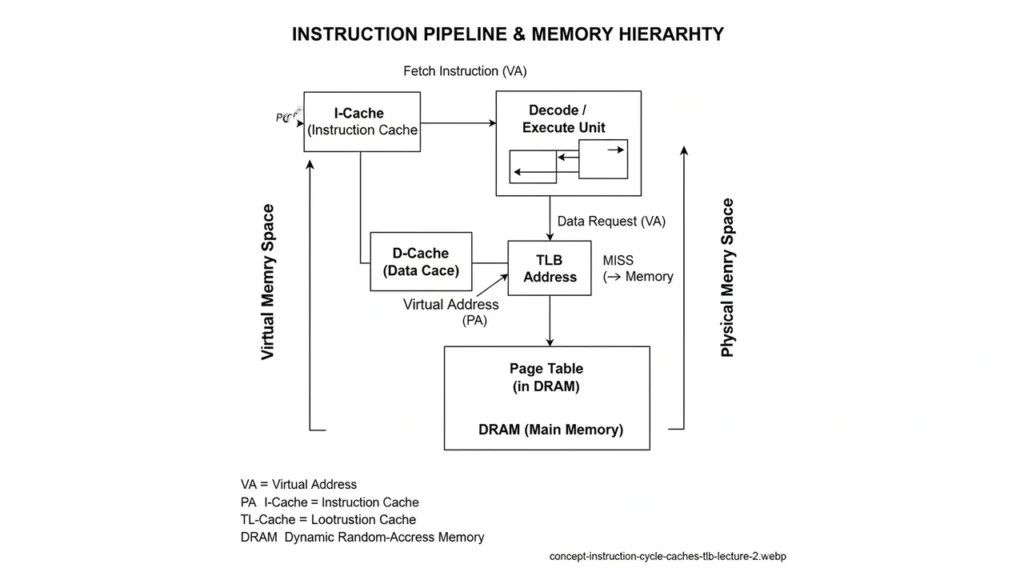
- Fetch: The Program Counter (PC) holds the address of the next instruction. The CPU requests that instruction from L1 I-cache/memory.
- Decode: The control unit translates the instruction into internal control signals (or micro-ops).
- Execute: The ALU, load/store unit, or branch unit performs the operation, possibly reading/writing registers or memory.
- Write-back & PC update: Results go to registers/memory; the PC advances or is changed by a branch/jump.
Modern CPUs overlap these stages with pipelining and may issue multiple instructions per cycle (superscalar, out-of-order).
Why Caches Matter ?
DRAM is far slower than the CPU. Caches keep recently or nearby data close to the core.
- Locality
- Temporal: recently used data likely used again.
- Spatial: nearby addresses likely accessed next.
- Cache anatomy
- Line (block): e.g., 64 bytes fetched on a miss.
- Mapping: direct-mapped, N-way set-associative, or fully associative.
- Replacement: LRU/PLRU/random.
- Write policy: write-back vs write-through; write-allocate vs no-write-allocate.
- Miss types: compulsory (cold), capacity, conflict.
Example: a loop that scans an array linearly benefits from spatial locality; a stride of 64B matches typical line size, while large strides cause more misses.
The Memory & Storage Hierarchy (conceptual latencies)
Registers (≈1 cycle) → L1 (≈4 cycles) → L2 (≈12 cycles) → L3 (≈30–50 cycles) → DRAM (≈100–200 ns) → NVMe SSD (≈100 µs) → HDD (ms) → Network/Cloud (ms–100s ms).
Hierarchy trades speed vs capacity vs cost; software and the OS try to keep working sets near the top.
Lecture 1: Introduction to Computer Systems & Compilation System (Bits, Bytes, and Integers)
Virtual Memory in One Page
- Pages/Frames: virtual address space is split into pages (e.g., 4 KiB), mapped to physical frames.
- Page Table: per-process mapping maintained by the OS; enables isolation and shared pages (e.g., shared libraries).
- TLB: a small cache of recent page translations. A TLB miss forces a page-table walk.
- Page Faults: on missing pages, the OS loads data from disk (slow); on protection faults, the OS may kill the process.
OS Responsibilities You Touch in Assembly
- Process & Thread Scheduling (time slices, priorities).
- System Calls (trap/
int/syscallinstructions): file I/O, memory management (mmap,brk), networking, timers. - Interrupts & Exceptions: device signals and error conditions; the OS dispatches handlers.
- DMA: devices transfer data to memory with minimal CPU intervention.
- Filesystems: logical file view over blocks on storage.
Devices, I/O & Networks
- Device controller ↔ driver: registers (often memory-mapped I/O), queues, interrupts.
- Networking path: user process → socket API → kernel networking stack (TCP/IP) → NIC → wire → remote host.
- Latency vs throughput: small messages pay handshake/RTT costs; large transfers saturate bandwidth.
Mini-Lab
# 1) Observe CPU + caches
lscpu | egrep 'Model name|cache'
# Linux: cat /proc/cpuinfo | less  (for more detail)

# 2) Measure memory locality (Python quick test)
python3 - << 'PY'
import numpy as np, time
N=64*1024*1024//8; a=np.zeros(N,dtype=np.int64)
for s in [1,8,64,512,4096]:
    t=time.time()
    x=0
    for i in range(0,N,s): x+=a[i]
    print(f"stride={s:4d} time={time.time()-t:.3f}s")
PY

# 3) Basic network path
ping -c 3 8.8.8.8
traceroute google.com  # Windows: tracert google.com
Quick Check (with answers)
- What architectural principle makes caches effective? Temporal and spatial locality.
- What does the TLB cache? Virtual→physical address translations.
- Which policy delays writes to DRAM until eviction? Write-back.
- What causes a page fault? Access to a virtual page not currently in physical memory.
- Where do system calls execute? In kernel mode via a trap/syscall mechanism.
The approach followed at E Lectures reflects both academic depth and easy-to-understand explanations.
People also ask:
Common policies include LRU, pseudo-LRU, or random; the choice balances hardware cost and hit rate.
A cache miss fetches from the next lower level (often DRAM) and is fast relative to disk; a page fault requires OS intervention and may load from storage, which is much slower.
Not typically; it affects byte ordering in memory and data interchange. We’ll cover details in the ISA/endian lecture.
Linear scans exploit spatial locality, keeping misses low; scattered access defeats the cache’s prefetching and mapping.
Direct Memory Access lets devices move data to RAM without tying up the CPU, improving throughput and reducing latency.


