

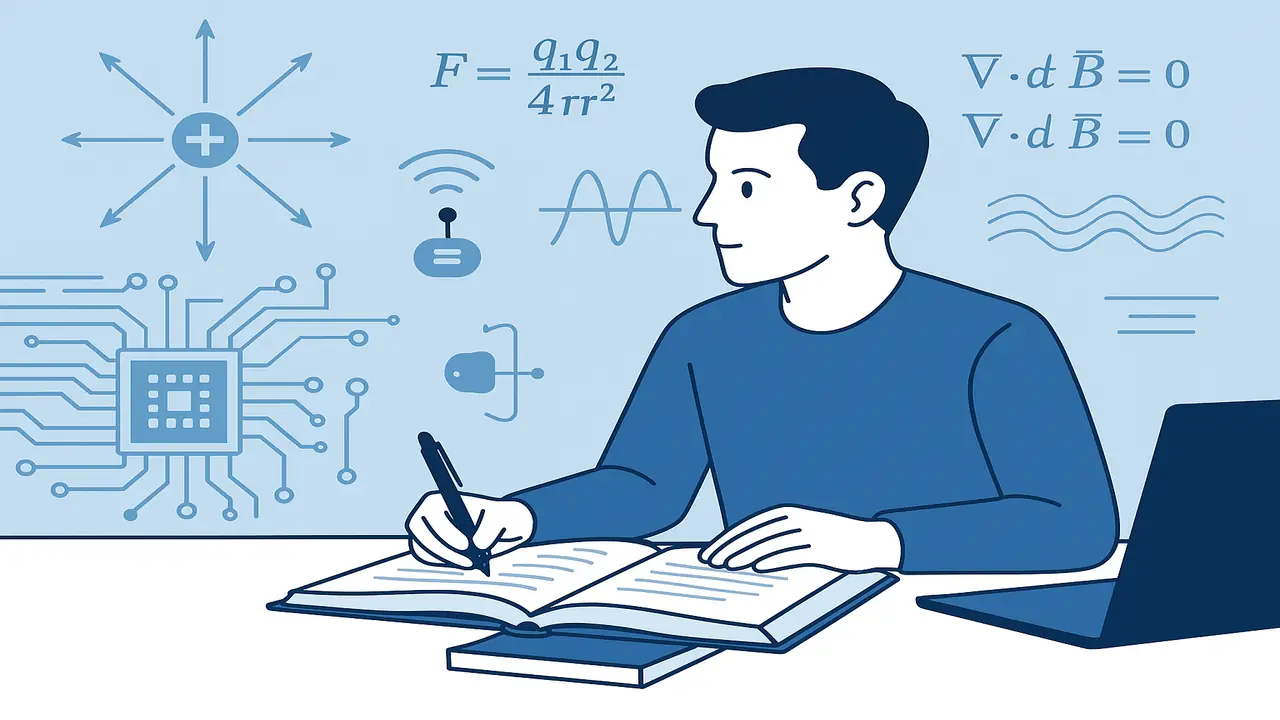
Understand the role of physics in electronics, computing, sensors, and modern AI systems with real-world examples and clear concepts.
1. Introduction
Applied Physics is not just a theoretical subject; it is the foundation of modern technology. From smartphones and computers to artificial intelligence systems, robotics, and smart sensors, all advanced technologies rely on the principles of physics.
For students of Artificial Intelligence, understanding Applied Physics is essential because AI systems do not exist in isolation. They operate on hardware, interact with the physical world, and depend on electrical, magnetic, and optical phenomena to sense, compute, and communicate.
This lecture introduces the scope, importance, and real-world relevance of Applied Physics, preparing students for advanced topics such as electricity, magnetism, electromagnetism, and optics.
2. What Is Applied Physics?
Applied Physics is a branch of physics that focuses on the practical application of physical laws to solve real-world problems.
Unlike pure physics, which aims to discover new laws of nature, applied physics uses existing principles to design and improve:
- Electronic devices
- Communication systems
- Sensors and actuators
- Computing hardware
- Medical and industrial instruments
In simple words:
Applied Physics bridges the gap between theory and technology.
3. Why Applied Physics Is Important for AI Students
Artificial Intelligence students often focus on algorithms, data, and software. However, AI systems ultimately depend on physical components.
3.1 Physics Behind AI Hardware
AI models run on:
- CPUs
- GPUs
- TPUs
- Embedded systems
All these devices rely on:
- Electric current
- Semiconductor physics
- Heat dissipation
- Electromagnetic fields
Without physics, AI hardware cannot function efficiently.
3.2 Physics in Sensors and Data Collection
AI systems depend on data collected from sensors such as:
- Cameras (optics and light waves)
- Microphones (sound waves)
- Temperature sensors (thermal physics)
- Magnetic sensors (Hall effect)
Understanding physics helps AI engineers:
- Improve accuracy
- Reduce noise
- Optimize sensor performance
3.3 Physics in Robotics and Automation
Robots use:
- Motors (magnetic fields)
- Power systems (electric circuits)
- Vision systems (optics and polarization)
Applied Physics provides the foundation for:
- Motion control
- Energy efficiency
- Precision engineering
4. Scope of Applied Physics in This Course
This course focuses on three major areas:
4.1 Electricity and Electrostatics
- Electric charge and force
- Electric fields and potential
- Applications in electronics
4.2 Magnetism and Electromagnetism
- Magnetic fields
- Electromagnetic induction
- Maxwell’s equations
4.3 Optics and Wave Phenomena
- Reflection and refraction
- Interference and diffraction
- Polarization
Each topic is taught with:
- Conceptual understanding
- Numerical problem solving
- Real-world applications
Physics for Computer Science Students – Springer
5. Relationship Between Physics and Engineering
Engineering is essentially applied physics.
| Physics Concept | Engineering Application |
|---|---|
| Electric fields | Circuit design |
| Magnetic fields | Motors and generators |
| Electromagnetic waves | Wireless communication |
| Optics | Cameras, fiber optics |
| Waves | Signal processing |
AI engineers must understand these links to build efficient systems.
6. Units and Physical Quantities (Quick Review)
Before moving into advanced topics, students must be comfortable with basic quantities.
6.1 Fundamental Quantities
- Length (meter, m)
- Mass (kilogram, kg)
- Time (second, s)
- Electric current (ampere, A)
6.2 Derived Quantities
- Force (newton, N)
- Energy (joule, J)
- Power (watt, W)
- Electric charge (coulomb, C)
Understanding units is crucial for:
- Correct calculations
- Circuit analysis
- System modeling
7. Importance of Mathematical Tools in Physics
Applied Physics uses mathematics as its language.
Key tools include:
- Algebra
- Trigonometry
- Basic calculus
- Vector analysis
In AI, the same mathematical tools are used in:
- Machine learning models
- Optimization algorithms
- Signal processing
This shows a strong connection between physics and AI mathematics.
8. Real-World Examples Connecting Physics and AI
Example 1: Camera Vision Systems
- Light reflection and refraction
- Lens design (optics)
- Image sensors (photoelectric effect)
Used in:
- Facial recognition
- Autonomous vehicles
Example 2: Data Centers and Power Efficiency
- Electric current and resistance
- Heat generation
- Energy loss
Physics helps in:
- Reducing power consumption
- Improving cooling systems
Example 3: Wireless Communication
- Electromagnetic waves
- Antennas
- Signal propagation
Essential for:
- IoT
- Smart cities
- AI-driven networks
9. Problem-Solving Approach in Applied Physics
This course follows a step-by-step framework for problem solving:
- Understand the physical situation
- Identify relevant laws
- Write equations
- Substitute known values
- Solve systematically
- Interpret the result
This approach improves:
- Analytical thinking
- Logical reasoning
- Engineering judgment
Summary
Applied Physics is the backbone of modern engineering and Artificial Intelligence systems. This lecture introduced the scope, importance, and relevance of physics in AI, electronics, sensors, robotics, and communication technologies. Students learned why physics is essential for understanding hardware, improving system efficiency, and solving real-world problems. This foundation prepares students for advanced topics in electricity, magnetism, and optics covered in upcoming lectures.
Next Lecture 2: Electric Charge and Force
People also ask:
AI systems rely on physical hardware, sensors, and communication systems, all governed by physics laws.
No. When taught conceptually with real-world examples, it becomes intuitive and practical.
Yes. Problem solving is a core component of Applied Physics.
Electricity, magnetism, and electromagnetism form the foundation of electronic devices.
Yes. It helps optimize power, performance, sensing, and system reliability.
