
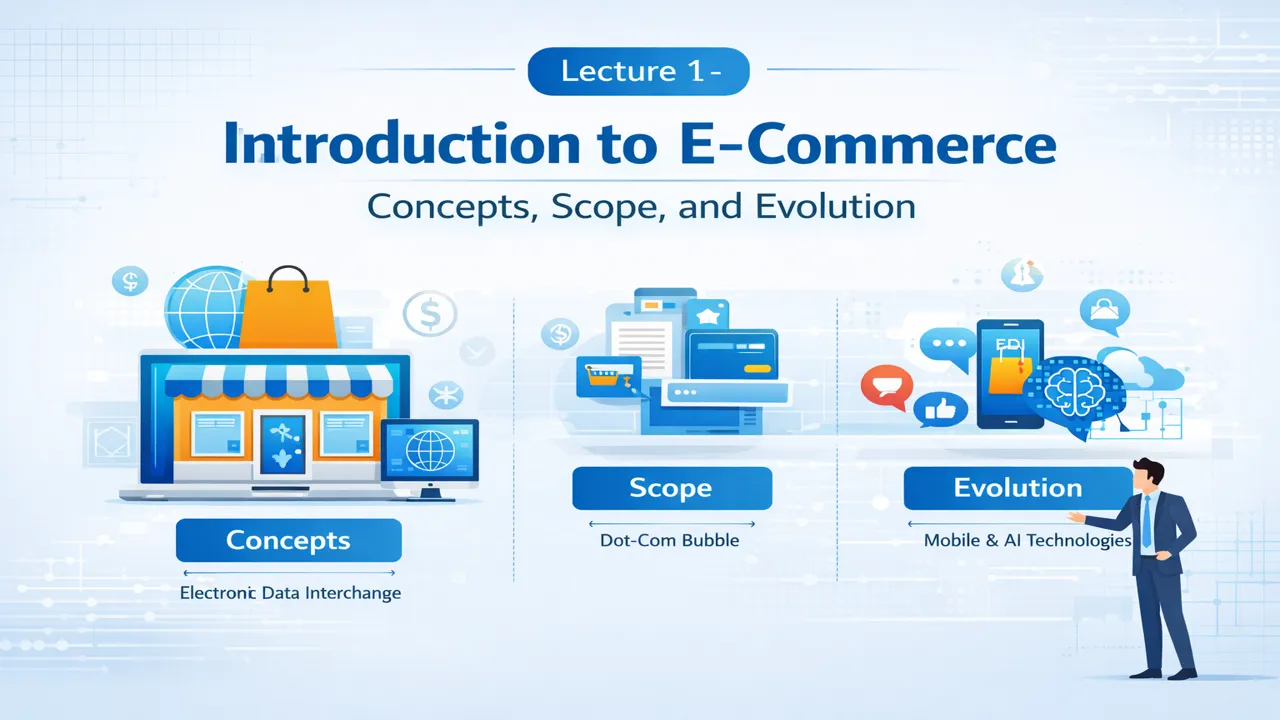
Learn the fundamentals of electronic commerce (e-commerce), including its concepts, types (B2B, B2C, C2C, C2B), scope, benefits, challenges, and historical evolution. A complete beginner-friendly guide for BS-level students.
Introduction to E-Commerce
Electronic Commerce, commonly known as E-Commerce, refers to the buying and selling of goods and services using the internet and digital technologies. Over the past two decades, e-commerce has transformed the global economy by enabling businesses and consumers to conduct transactions anytime and anywhere.
This lecture provides a comprehensive introduction to e-commerce concepts, scope, types, features, advantages, limitations, and its historical evolution, forming the foundation for advanced topics in digital business.
What is Electronic Commerce?
Electronic Commerce (E-Commerce) is the process of conducting commercial transactions electronically over computer networks, primarily the internet.
It includes:
- Online buying and selling of products
- Digital payments
- Online banking
- Electronic data interchange (EDI)
- Online marketing and advertising
- Supply chain coordination
In simple terms, whenever you purchase a product from Amazon, pay through a digital wallet, or book a flight ticket online, you are participating in e-commerce.
Key Features of E-Commerce
E-commerce has several distinguishing characteristics:
1) Ubiquity (Anytime, Anywhere Availability)
Meaning:
E-commerce is accessible 24/7 from almost any location with internet access (home, office, mobile phone, another city/country).
Why it matters:
- Convenience for customers: People can shop after office hours, on weekends, or while traveling.
- More sales opportunities for businesses: A physical shop might operate 10–12 hours/day, but e-commerce can generate orders all day and night.
- Reduced dependency on location: Customers don’t need to travel to a market or mall.
Example:
A student in Karachi can order a laptop at 2:00 AM from an online store and receive it later no store visit required.
Business impact:
- Expands customer base without opening multiple branches.
- Supports “always-on” marketing (ads + website keep selling even while staff is offline).
2) Global Reach (Access to International Markets)
Meaning:
E-commerce connects sellers and buyers across national and international boundaries. A business is not limited to its city or country.
Why it matters:
- Wider market size: A niche product with few local buyers can have thousands globally.
- Export opportunities: Small businesses can sell internationally without physical stores abroad.
- Cross-border competition: Customers can compare products worldwide, increasing competition and pushing quality improvement.
Example:
A Pakistani leather brand can sell wallets to customers in the UAE, UK, or USA through a website + international shipping.
Business impact:
- Requires knowledge of international shipping, customs, taxes, exchange rates, and sometimes localization (language/currency).
3) Universal Standards (Common Internet Standards)
Meaning:
E-commerce runs on widely accepted standards such as HTTP/HTTPS, HTML, TCP/IP, SSL/TLS, QR standards, payment protocols, etc. Because most systems follow the same standards, they can communicate smoothly.
Why it matters:
- Lower costs: Businesses don’t need unique systems for each customer.
- Compatibility: Websites work on different devices and browsers; payment systems integrate with many stores.
- Reduced complexity: Standard methods for checkout, payment gateway integration, tracking, and emails simplify operations.
Example:
A payment gateway can integrate with many different e-commerce sites because they follow standard APIs and web protocols.
Business impact:
- Easier integration with third-party services like logistics companies, CRM, email marketing tools, and analytics.
4) Interactivity (Two-Way Communication)
Meaning:
Unlike traditional media (TV, newspaper), e-commerce allows two-way communication between businesses and customers in real time.
How it happens:
- Live chat and chatbots
- Customer reviews and ratings
- Social media comments and DMs
- Email and SMS updates
- Personalized offers based on user actions
Why it matters:
- Better customer service: Quick answers reduce cart abandonment.
- Trust building: Reviews, Q&A, and responsive communication increase credibility.
- Feedback loop: Businesses can learn what customers want and improve products.
Example:
A customer asks on live chat: “Is this shirt original and what’s the return policy?” The reply helps them decide immediately.
Business impact:
- Improves conversion rate (more visitors become buyers).
- Helps handle complaints faster, protecting brand reputation.
5) Information Density (Rich, Real-Time Information)
Meaning:
E-commerce provides high-quality and large amounts of information quickly and cheaply product details, pricing, comparisons, availability, shipping status, reviews, and more.
Why it matters for customers:
- Can compare products, prices, brands, and reviews before buying.
- Can see specifications (size, material, warranty, delivery time) instantly.
Why it matters for businesses:
- Real-time stock updates and pricing.
- Sales reports, customer behavior tracking, demand forecasting.
- Better decisions based on data instead of guesswork.
Example:
A website shows: “Only 3 items left” + “Delivery by Wednesday” + “4.6 rating from 2,300 reviews.”
Business impact:
- Enables data-driven strategies: which products sell, which ads work, which pages cause users to leave.
6) Personalization (Customized Experience)
Meaning:
E-commerce platforms tailor content and offers to each user using data analytics, cookies, browsing history, purchase history, and AI recommender systems.
How personalization appears:
- “Recommended for you”
- “Customers also bought”
- Personalized discounts (new user coupon, loyalty discount)
- Showing relevant products based on search behavior
- Customized email campaigns
Why it matters:
- Higher sales: Relevant recommendations increase average order value.
- Better user experience: Customers find what they need faster.
- Customer retention: Personalized experiences encourage repeat purchases.
Example:
If you search for “running shoes,” the site later shows sportswear, socks, and fitness accessories.
Business impact & caution:
- Big advantage in marketing efficiency.
- Must follow privacy rules and ethical data use (don’t misuse customer data).
Quick Summary
- Ubiquity: Shop anytime, anywhere.
- Global Reach: Sell and buy across borders.
- Universal Standards: Common technologies reduce cost/complexity.
- Interactivity: Two-way communication builds trust and improves service.
- Information Density: More accurate, real-time data for better decisions.
- Personalization: Customized experiences increase conversions and loyalty.
Types of E-Commerce
Understanding the different e-commerce business models is essential because each model operates differently in terms of:
- Target customers
- Revenue structure
- Transaction size
- Marketing strategy
- Legal and operational requirements
Each model defines who is selling to whom in an online transaction
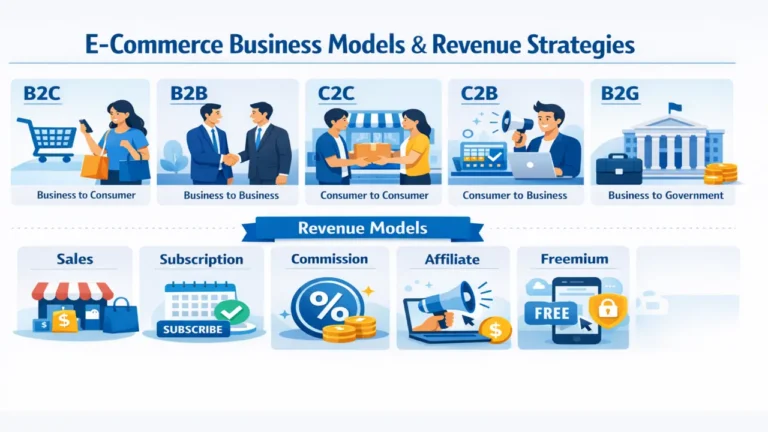
1. Business-to-Consumer (B2C)
Definition
Business-to-Consumer (B2C) e-commerce refers to online transactions where a business sells products or services directly to individual consumers.
It is the most common and widely recognized type of e-commerce.
How It Works
- A company lists products on its website or marketplace.
- Customers browse, add items to cart, and complete payment online.
- The product is shipped to the consumer’s address.
Examples
- Amazon
- Daraz
- Walmart online store
- Netflix (subscription service)
Key Characteristics
- Large number of customers
- Smaller transaction values (usually retail)
- Focus on marketing, branding, and customer experience
- Fast delivery and return policies
Advantages
- Direct customer relationship
- High scalability
- Brand visibility
Challenges
- High competition
- Customer acquisition cost
- Logistics and return management
2. Business-to-Business (B2B)
Definition
Business-to-Business (B2B) e-commerce involves transactions between two businesses rather than between a business and individual consumers.
How It Works
- A manufacturer sells raw materials to a wholesaler.
- A wholesaler sells products to retailers.
- Transactions are often bulk-based and contract-driven.
Examples
- Alibaba wholesale platform
- SAP Ariba
- Amazon Business
Key Characteristics
- Larger order volumes
- Long-term contracts
- Negotiated pricing
- Formal payment terms
Advantages
- Higher revenue per transaction
- Stable long-term relationships
- Predictable demand
Challenges
- Complex negotiation processes
- Credit risk management
- Integration with enterprise systems
Example Scenario
A clothing retailer orders 1,000 shirts from a textile manufacturer via an online B2B portal.
3. Consumer-to-Consumer (C2C)
Definition
Consumer-to-Consumer (C2C) e-commerce allows individuals to sell goods or services directly to other individuals using an online platform.
How It Works
- The platform acts as a marketplace.
- Individuals list products.
- Buyers purchase directly from sellers.
- The platform may charge commission.
Examples
- eBay
- OLX
- Facebook Marketplace
Key Characteristics
- Peer-to-peer transactions
- Used or second-hand goods common
- Platform provides listing and payment support
Advantages
- Low entry barriers
- Easy monetization of unused goods
- Wide audience reach
Challenges
- Trust issues
- Fraud risks
- Quality inconsistency
Example Scenario
A student sells a used laptop to another student through an online marketplace.
4. Consumer-to-Business (C2B)
Definition
Consumer-to-Business (C2B) e-commerce occurs when individuals offer products or services to businesses.
This model reverses the traditional business-consumer relationship.
How It Works
- Individuals create value.
- Businesses purchase services or content.
- Often project-based or contract-based.
Examples
- Freelancers on Upwork or Fiverr
- Influencers promoting brands
- Photographers selling images to companies
Key Characteristics
- Skill-based economy
- Digital services dominant
- Flexible pricing
Advantages
- Income opportunities for individuals
- Access to global clients
- Flexible work structure
Challenges
- Income instability
- High competition
- Platform commission fees
Example Scenario
A graphic designer creates a company logo for a startup through an online freelance platform.
5. Business-to-Government (B2G)
Definition
Business-to-Government (B2G) e-commerce involves transactions between private companies and government agencies through digital procurement systems.
How It Works
- Government publishes tenders online.
- Companies submit bids electronically.
- Contracts are awarded digitally.
Examples
- E-procurement portals
- Government tender websites
- Online tax filing systems
Key Characteristics
- Formal bidding processes
- Regulatory compliance required
- Large contract values
Advantages
- Stable revenue opportunities
- Long-term contracts
- Transparency in procurement
Challenges
- Complex documentation
- Strict legal regulations
- Competitive bidding
Example Scenario
An IT company supplies software to a government department through an online bidding portal.
Comparative Overview
| Model | Seller | Buyer | Example | Transaction Nature |
|---|---|---|---|---|
| B2C | Business | Consumer | Amazon | Retail |
| B2B | Business | Business | Alibaba | Bulk/Wholesale |
| C2C | Consumer | Consumer | OLX | Peer-to-peer |
| C2B | Consumer | Business | Upwork | Service-based |
| B2G | Business | Government | E-procurement | Contract-based |
Key Differences Between Models
Flexibility: C2B offers flexible income opportunities.
Transaction size: B2B and B2G usually involve large-scale contracts.
Customer relationship: B2C focuses on marketing and experience.
Trust mechanisms: C2C depends heavily on reviews and ratings.
Revenue stability: B2B and B2G offer long-term stability.
Scope of Electronic Commerce
The scope of e-commerce extends beyond online retailing. It includes:
- Online banking and financial services
- Digital marketing and advertising
- E-procurement systems
- Online education platforms
- Mobile commerce (m-commerce)
- Social commerce
- Cloud-based business solutions
Today, nearly every industry healthcare, education, retail, manufacturing, entertainment uses e-commerce technologies.
Evolution of E-Commerce
The evolution of e-commerce reflects the advancement of digital technology, communication systems, and consumer behavior. From simple electronic document exchange to AI-powered personalized shopping, e-commerce has undergone several transformational phases.
Phase 1: Electronic Data Interchange (EDI) – 1960s to 1980s
Overview
The foundation of e-commerce began with Electronic Data Interchange (EDI) in the 1960s. During this period, businesses started using computer systems to exchange business documents electronically instead of using paper-based methods.
What Was EDI?
EDI allowed companies to transmit:
- Purchase orders
- Invoices
- Shipping notices
- Bills of lading
- Financial documents
These documents were transferred between computer systems using standardized formats.
Key Characteristics
- Used private networks (not the public internet)
- Limited to large corporations
- Expensive and complex systems
- Required dedicated infrastructure
Importance
- Reduced paperwork
- Improved transaction speed
- Lowered administrative costs
- Minimized human errors
Example
Large retailers like Walmart used EDI to communicate electronically with suppliers for inventory management.
Limitations
- High setup cost
- Limited accessibility
- No consumer involvement
- Restricted to business-to-business transactions
This phase laid the technical foundation for modern e-commerce.
Phase 2: Emergence of the Internet – 1990s
Overview
The 1990s marked a major breakthrough with the development of the World Wide Web (WWW) and commercial internet access.
The introduction of web browsers (like Netscape) made online systems user-friendly and accessible to the general public.
Major Developments
- 1991: Internet opened for commercial use
- 1994: Amazon founded
- 1995: eBay launched
- Development of secure payment protocols (SSL)
Key Innovations
- Online shopping websites
- Email communication
- Digital payment systems
- Online advertising
Impact
For the first time:
- Consumers could buy products online
- Small businesses could create websites
- Global markets became accessible
Example
Amazon initially started as an online bookstore but soon expanded into multiple product categories.
Significance
This phase shifted e-commerce from B2B only (EDI era) to B2C models, allowing direct interaction between businesses and consumers.
Phase 3: Dot-Com Boom and Crash – Late 1990s to Early 2000s
Overview
The rapid popularity of the internet led to the Dot-Com Boom, where thousands of internet-based startups were launched.
Investors heavily funded online businesses, expecting massive profits.
Characteristics of the Boom
- Rapid website creation
- Venture capital investments
- High stock market valuations
- Aggressive online expansion
However, many companies lacked:
- Sustainable business models
- Profit strategies
- Proper revenue planning
Dot-Com Crash (2000-2001)
The stock market collapsed when many online companies failed to generate profits.
Effects
- Many startups shut down
- Investors lost billions
- Market confidence declined
Positive Outcome
Despite the crash:
- Strong companies survived (Amazon, eBay)
- Infrastructure improved
- Lessons learned about sustainable business models
This phase taught businesses the importance of profitability, customer retention, and strategic planning.
Phase 4: Web 2.0 and Social Media Era – 2005 to 2015
Overview
This period is known as the Web 2.0 era, characterized by interactive, user-generated, and socially connected platforms.
Unlike early websites (static pages), Web 2.0 enabled:
- User interaction
- Content sharing
- Social networking
- Real-time communication
Key Developments
- Facebook (2004), YouTube (2005), Twitter (2006)
- Online reviews and ratings
- Marketplace platforms (Alibaba, Etsy)
- Cloud computing services
Impact on E-Commerce
- Rise of social commerce
- Online advertising through social media
- Customer reviews influencing buying decisions
- Two-way communication between brands and customers
Example
Customers could read product reviews before purchasing, increasing transparency and trust.
Business Transformation
- Shift from product-centered marketing to customer-centered marketing
- Use of digital marketing tools (SEO, SEM, email campaigns)
- Growth of online marketplaces
This phase strengthened personalization and customer engagement.
Phase 5: Mobile & AI-Driven Commerce – 2015 to Present
Overview
The most recent phase is driven by smartphones, artificial intelligence (AI), big data, and cloud computing.
Mobile devices became the primary method for online shopping.
Key Technologies
- Mobile apps
- Digital wallets (Apple Pay, Google Pay)
- AI recommendation systems
- Chatbots
- Blockchain technology
- Cloud-based infrastructure
Characteristics
- Mobile-first design
- Personalized recommendations
- Data-driven marketing
- Same-day delivery models
- Integration of online and offline retail (Omnichannel commerce)
AI and Data Role
Platforms analyze:
- Browsing history
- Purchase behavior
- Search patterns
To offer:
- Personalized product suggestions
- Targeted advertisements
- Dynamic pricing
Example
Amazon’s recommendation engine suggests products based on past purchases.
Emerging Trends
- Voice commerce (Alexa, Google Assistant)
- Augmented Reality (AR) for virtual product trials
- Subscription-based services
- Cryptocurrency payments
Impact
- Increased customer convenience
- Higher conversion rates
- Global digital economy expansion
Summary of Evolution
| Phase | Time Period | Key Feature | Major Contribution |
|---|---|---|---|
| Phase 1 | 1960s–1980s | EDI | Digital document exchange |
| Phase 2 | 1990s | Internet & WWW | Birth of online shopping |
| Phase 3 | 1998–2001 | Dot-Com Boom | Rapid expansion & crash |
| Phase 4 | 2005–2015 | Web 2.0 & Social Media | Interactive & social commerce |
| Phase 5 | 2015–Present | Mobile & AI | Smart, personalized commerce |
Advantages of E-Commerce
- Lower operational costs
- Wider market reach
- 24/7 availability
- Faster transactions
- Better customer data analysis
- Reduced physical infrastructure
Limitations of E-Commerce
- Security risks and cyber threats
- Privacy concerns
- Lack of physical product inspection
- Technical issues and downtime
- Dependence on internet connectivity
Importance of E-Commerce in the Modern Economy
E-commerce plays a crucial role in:
- Economic growth
- Employment generation
- Global trade expansion
- Digital transformation of businesses
- Innovation in financial technologies
The COVID-19 pandemic further accelerated digital transformation, making e-commerce an essential component of modern business strategy.
Conclusion
Electronic Commerce has revolutionized the way businesses operate and consumers interact with markets. From simple online transactions to AI-driven personalized shopping experiences, e-commerce continues to evolve rapidly.
Understanding its concepts, scope, types, and evolution provides a strong foundation for advanced topics such as digital marketing, cybersecurity, analytics, and e-commerce strategy.
This lecture sets the groundwork for developing deeper analytical and practical skills in the field of digital business.
Multiple Choice Questions (MCQs)
1. E-Commerce refers to:
A) Traditional retail selling
B) Buying and selling through the internet
C) Telephone marketing
D) Physical trade only
Answer: B
2. The foundation of E-Commerce began with:
A) Social Media
B) EDI
C) Smartphones
D) Blockchain
Answer: B
3. EDI stands for:
A) Electronic Data Integration
B) Electronic Data Interchange
C) Electronic Digital Interface
D) Electronic Distribution Index
Answer: B
4. Which decade introduced commercial internet use?
A) 1970s
B) 1980s
C) 1990s
D) 2000s
Answer: C
5. Amazon was founded in:
A) 1990
B) 1994
C) 1998
D) 2001
Answer: B
6. The Dot-Com crash occurred around:
A) 1995
B) 2000–2001
C) 2005
D) 2010
Answer: B
7. Ubiquity in E-Commerce means:
A) High cost
B) Limited access
C) Available everywhere and anytime
D) Only mobile access
Answer: C
8. Global Reach allows businesses to:
A) Sell locally only
B) Sell internationally
C) Sell offline
D) Sell only to government
Answer: B
9. Web 2.0 is associated with:
A) Static websites
B) Interactive platforms
C) EDI systems
D) Fax machines
Answer: B
10. Which is an example of B2C?
A) Alibaba wholesale
B) Amazon
C) Government tender portal
D) Freelancer website
Answer: B
11. Information Density refers to:
A) Less data availability
B) Real-time and rich information
C) No pricing information
D) Limited product details
Answer: B
12. Which technology drives modern E-Commerce?
A) AI
B) Telegraph
C) Typewriter
D) Fax
Answer: A
13. C2C model example:
A) OLX
B) Amazon Business
C) SAP
D) WTO
Answer: A
14. B2B transactions usually involve:
A) Small retail purchases
B) Bulk transactions
C) Government payments
D) Freelancers
Answer: B
15. Personalization uses:
A) Paper records
B) AI & Data analytics
C) Manual marketing
D) Offline stores
Answer: B
Short Questions Answers
1. Define E-Commerce and explain its importance in modern business.
Answer:
E-Commerce (Electronic Commerce) refers to the buying and selling of goods and services through electronic networks, mainly the internet. It includes online transactions, digital payments, online marketing, and electronic data exchange between businesses and consumers.
E-Commerce is important in modern business because it enables companies to operate 24/7, reach global markets, reduce operational costs, and improve customer convenience. It also supports digital payments, faster transactions, and data-driven decision-making. In today’s digital economy, e-commerce enhances competitiveness and business growth.
2. Explain the concept of Ubiquity with examples.
Answer:
Ubiquity in e-commerce means that online services are available everywhere and at any time. Customers can access online stores 24/7 using computers, smartphones, or tablets from any location with internet access.
For example, a customer can order groceries at midnight through an online app or book airline tickets while traveling. Unlike physical stores that operate during fixed hours, e-commerce platforms provide continuous access, increasing convenience and sales opportunities for businesses.
3. Discuss the role of EDI in the evolution of E-Commerce.
Answer:
Electronic Data Interchange (EDI) was the foundation of modern e-commerce. Developed in the 1960s, EDI allowed businesses to exchange documents such as purchase orders and invoices electronically instead of using paper.
It improved transaction speed, reduced errors, and lowered administrative costs. Although it was limited to large corporations and private networks, EDI introduced the concept of digital business transactions, paving the way for internet-based e-commerce systems.
4. Differentiate between B2C and B2B models.
Answer:
B2C (Business-to-Consumer) refers to transactions where businesses sell directly to individual consumers. Examples include Amazon and Daraz. Transactions are usually smaller in value and focus on customer experience and marketing.
B2B (Business-to-Business) involves transactions between companies, such as manufacturers selling to retailers. These transactions are usually bulk-based, involve negotiated pricing, and focus on long-term relationships. B2B transactions generally have higher value compared to B2C.
5. Explain the Dot-Com Boom and its consequences.
Answer:
The Dot-Com Boom occurred in the late 1990s when many internet-based companies were launched and heavily funded by investors. Stock prices of online businesses increased rapidly due to high expectations.
However, many companies lacked sustainable business models and failed to generate profits. Around 2000–2001, the market crashed, leading to the closure of many startups. Despite losses, strong companies like Amazon survived and the crash taught businesses the importance of profitability and strategic planning.
6. Describe the key features of Web 2.0.
Answer:
Web 2.0 refers to the second generation of internet development focused on user interaction and participation. Unlike static websites, Web 2.0 allows users to create and share content.
Key features include:
- Social media platforms
- User-generated content
- Online reviews and ratings
- Interactive communication
- Cloud-based services
Web 2.0 improved customer engagement and enabled social commerce growth.
7. What is Information Density? Why is it important?
Answer:
Information Density refers to the large amount of accurate, real-time information available online at low cost. In e-commerce, customers can access product details, prices, reviews, and delivery information instantly.
It is important because it improves transparency, reduces information asymmetry, and helps customers make better purchasing decisions. For businesses, it enables data-driven decision-making and performance analysis.
8. Explain Personalization in E-Commerce.
Answer:
Personalization in e-commerce means customizing the shopping experience based on user data such as browsing history, purchase behavior, and preferences.
For example, online platforms recommend products based on previous searches or purchases. AI and data analytics help businesses offer personalized discounts and advertisements. Personalization increases customer satisfaction, improves conversion rates, and enhances customer loyalty.
9. Discuss the scope of E-Commerce in different industries.
Answer:
The scope of e-commerce extends across multiple industries including retail, banking, education, healthcare, manufacturing, and entertainment.
Examples include:
- Online retail stores
- Online banking and digital payments
- E-learning platforms
- Telemedicine services
- Online ticket booking
E-commerce supports global trade, reduces costs, and enables digital transformation across sectors.
10. Write short notes on Mobile Commerce.
Answer:
Mobile Commerce (M-Commerce) refers to e-commerce transactions conducted through mobile devices such as smartphones and tablets.
It includes:
- Mobile shopping apps
- Digital wallets (Apple Pay, Google Pay)
- Mobile banking
- QR code payments
M-commerce provides convenience, faster transactions, and location-based services. With the rise of smartphones, mobile commerce has become a major driver of modern e-commerce growth.
Long Questions Answers
1. Explain in detail the Evolution of E-Commerce from EDI to AI-driven commerce.
Answer:
The evolution of e-commerce reflects the development of digital technologies and global communication systems. It can be divided into five major phases.
Phase 1: Electronic Data Interchange (1960s–1980s)
E-commerce began with Electronic Data Interchange (EDI), which allowed businesses to exchange documents such as purchase orders and invoices electronically. It reduced paperwork, improved speed, and minimized errors. However, it was limited to large corporations using private networks.
Phase 2: Internet Era (1990s)
The commercialization of the internet and the development of the World Wide Web transformed e-commerce. Online businesses like Amazon (1994) and eBay (1995) emerged. Secure payment systems such as SSL enabled safe online transactions. This phase expanded e-commerce from B2B to B2C.
Phase 3: Dot-Com Boom and Crash (2000–2001)
During the late 1990s, many internet startups received heavy investments. However, many lacked sustainable business models, leading to the Dot-Com crash. Despite failures, strong companies survived and improved digital infrastructure.
Phase 4: Web 2.0 and Social Media (2005–2015)
Interactive websites, social media platforms, and user-generated content changed customer engagement. Online reviews, ratings, and digital marketing became important. Businesses shifted toward customer-focused strategies.
Phase 5: Mobile and AI-Driven Commerce (2015–Present)
Smartphones, AI recommendation systems, digital wallets, and cloud computing define modern e-commerce. Personalization, chatbots, and data analytics improve customer experience. Today, e-commerce is global, intelligent, and highly integrated with daily life.
Thus, e-commerce evolved from simple electronic document exchange to intelligent, AI-driven global digital marketplaces.
2. Discuss the Key Features of E-Commerce and their impact on business growth.
Answer:
E-commerce has several distinguishing features that significantly contribute to business growth.
1. Ubiquity
E-commerce is available anytime and anywhere. Customers can shop 24/7, increasing sales opportunities and customer convenience.
2. Global Reach
Businesses can access international markets beyond geographical boundaries. This expands customer base and revenue potential.
3. Universal Standards
The internet operates on standardized technologies, reducing communication costs and system compatibility issues.
4. Interactivity
Two-way communication through chatbots, reviews, and emails builds trust and improves customer satisfaction.
5. Information Density
Customers have access to detailed product information and reviews, helping them make informed decisions. Businesses use real-time data for better planning.
6. Personalization
AI-driven recommendations and targeted marketing increase conversion rates and customer loyalty.
Overall, these features reduce operational costs, increase market access, improve efficiency, and enhance customer experience, leading to sustainable business growth.
3. Explain different Types of E-Commerce with examples and compare them.
Answer:
E-commerce is categorized based on the parties involved in transactions.
1. Business-to-Consumer (B2C)
Businesses sell directly to consumers. Example: Amazon.
Transactions are retail-based and focus on customer experience.
2. Business-to-Business (B2B)
Businesses sell to other businesses. Example: Alibaba wholesale.
Transactions involve bulk orders and long-term contracts.
3. Consumer-to-Consumer (C2C)
Consumers sell to other consumers. Example: OLX or eBay.
The platform acts as a mediator.
4. Consumer-to-Business (C2B)
Individuals offer services to businesses. Example: Freelancers on Upwork.
This model is common in the digital services economy.
5. Business-to-Government (B2G)
Businesses provide goods or services to government agencies via e-procurement systems.
Comparison
- B2C focuses on individual customers.
- B2B involves larger transactions and professional relationships.
- C2C enables peer-to-peer selling.
- C2B allows individuals to earn from businesses.
- B2G involves formal contracts and regulations.
Each model serves different market needs and requires different strategies.
Next Lecture- Lecture 2 – E-Commerce Business Models and Revenue Strategies