

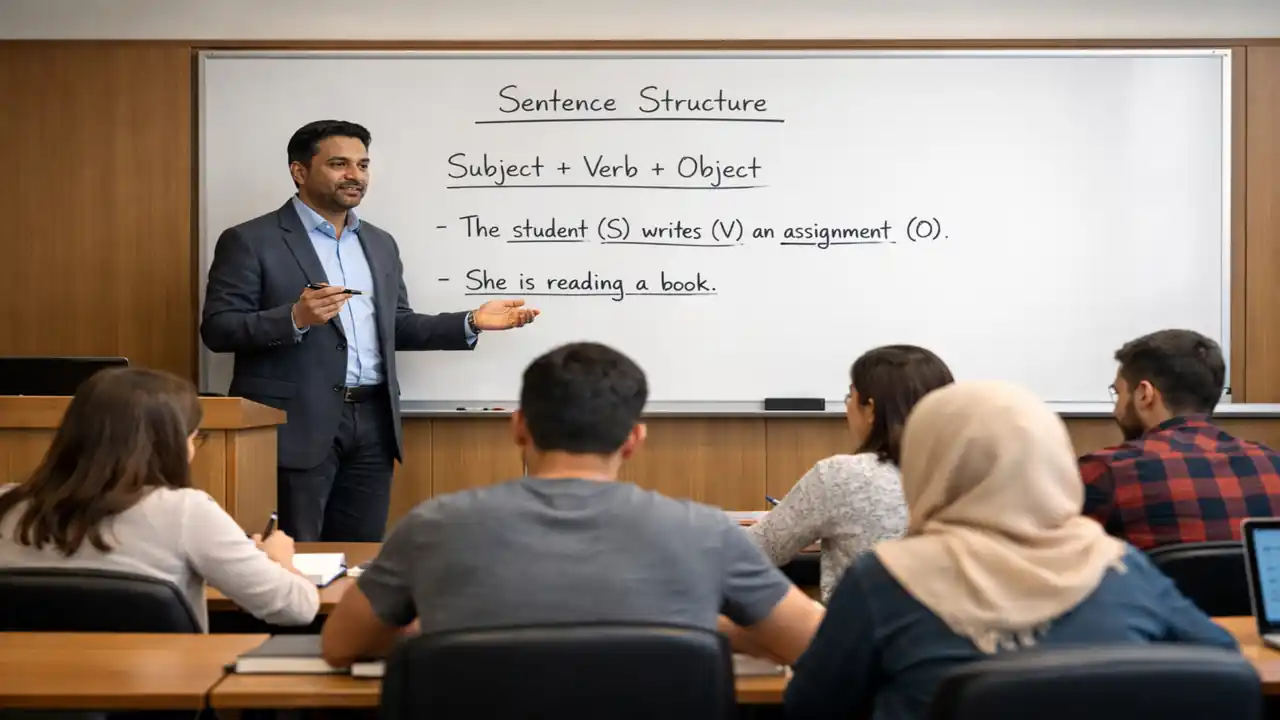
This lecture introduces Functional English for BS students, focusing on sentence structure, common sentence errors, and the foundations of clear academic and professional communication.
1. Introduction
English plays a central role in higher education, professional life, and global communication. For students enrolled in Bachelor of Science programs, English is not merely a subject to pass but a working tool used across all disciplines. Whether students are writing assignments, preparing lab reports, giving presentations, or sitting for examinations, English becomes the medium through which their knowledge is evaluated.
Functional English is designed to help students use English effectively, not just learn rules in isolation. This course emphasizes clarity, correctness, and confidence in communication. The first step toward mastering English is understanding how sentences work, because every form of communication begins with a sentence.
This lecture introduces students to Functional English and builds the foundation of sentence structure while giving an overview of common sentence errors.
2. What Is Functional English?
Functional English refers to the practical use of English language in real-life situations. Unlike literary studies, which focus on poetry, novels, and drama, Functional English concentrates on how English is used in:
- Academic writing
- Professional communication
- Oral presentations
- Daily interaction
The goal is not to make students poets or novelists, but to help them become effective communicators.
Key Features of Functional English
- Practical and usage-based
- Focus on clarity and accuracy
- Emphasis on real-world communication
- Skill-oriented rather than theory-heavy
3. Importance of Functional English for BS Students
Many students possess strong subject knowledge but struggle to express their ideas clearly in English. This gap often leads to:
- Loss of marks in exams
- Poor performance in presentations
- Lack of confidence in speaking
- Weak written assignments
Functional English helps students:
- Communicate ideas logically
- Write grammatically correct sentences
- Speak confidently in academic settings
- Improve overall academic performance
English proficiency directly impacts a student’s success at university and beyond.
4. Language Skills Covered in Functional English
Functional English develops all four major language skills:
- Listening – understanding spoken English
- Speaking – expressing ideas clearly
- Reading – comprehending written material
- Writing – producing accurate and organized text
This lecture primarily focuses on writing, specifically on the sentence, which is the basic unit of language.
5. What Is a Sentence?
A sentence is a group of words that expresses a complete thought.
For a group of words to be a sentence, it must have:
- A subject
- A verb
- A complete meaning
Example
The student writes an assignment.
This is a complete sentence because:
- The student is the subject
- Writes is the verb
- The idea is complete
6. Diagram Explained in Text: Basic Sentence Structure
A basic English sentence follows this structure:
Subject → Verb → Object
Example Breakdown:
- Subject: The teacher
- Verb: explains
- Object: grammar
The teacher explains grammar.
If any of these elements are missing, the sentence becomes unclear or incorrect.
7. Subject and Verb: The Core of a Sentence
Subject
The subject tells us who or what the sentence is about.
Examples:
- The teacher
- Students
- English
Verb
The verb tells us what the subject does or is.
Examples:
- teaches
- study
- is
Example Sentences
Students study English.
English is important.
8. Types of Sentences (Introduction)
1. Declarative Sentence
States a fact.
English is a global language.
2. Interrogative Sentence
Asks a question.
Why is English important?
3. Imperative Sentence
Gives a command or request.
Improve your writing skills.
4. Exclamatory Sentence
Shows strong emotion.
What a great presentation!
Understanding sentence types helps students vary their writing style.
9. Common Sentence Errors (Overview)
Students frequently make sentence-level mistakes that affect clarity and correctness. These errors will be discussed in detail in later lectures, but an overview is essential.
1. Sentence Fragments
A fragment is an incomplete sentence.
❌ Because I was tired.
✔ I was tired.
The fragment lacks a complete idea.
2. Run-On Sentences
A run-on sentence joins two sentences without proper punctuation.
❌ English is important it is used worldwide.
✔ English is important. It is used worldwide.
3. Subject-Verb Agreement Errors
The subject and verb must agree in number.
❌ He go to university daily.
✔ He goes to university daily.
10. Real-World Importance of Correct Sentences
Academic Context
The experiment produced accurate results.
A clear sentence ensures that examiners understand the student’s answer.
Professional Context
The manager approved the proposal.
Correct sentence structure creates a professional impression.
Daily Life Context
I am preparing for my final exams.
Even informal communication relies on correct sentence formation.
11. Step-by-Step Framework to Write a Correct Sentence
Students can follow this simple framework:
Step 1: Identify the subject
Ask: Who or what is performing the action?
Step 2: Choose the correct verb
Make sure the verb matches the subject and tense.
Step 3: Add necessary details
Include objects or complements if required.
Step 4: Check for completeness
Ensure the sentence expresses a complete thought.
12. Common Student Problems with Sentences
Students often:
- Translate directly from Urdu or regional languages
- Overuse simple sentences
- Ignore grammar rules
- Avoid complex ideas due to fear of mistakes
This course gradually helps students overcome these problems through practice and feedback.
People also ask:
No. It focuses on using English effectively in real situations.
Because all writing and speaking depend on correct sentences.
Yes. Consistent practice and guidance make improvement possible.
Yes. Clear English improves performance across all disciplines.
Yes. Even small errors can change meaning and reduce marks.