

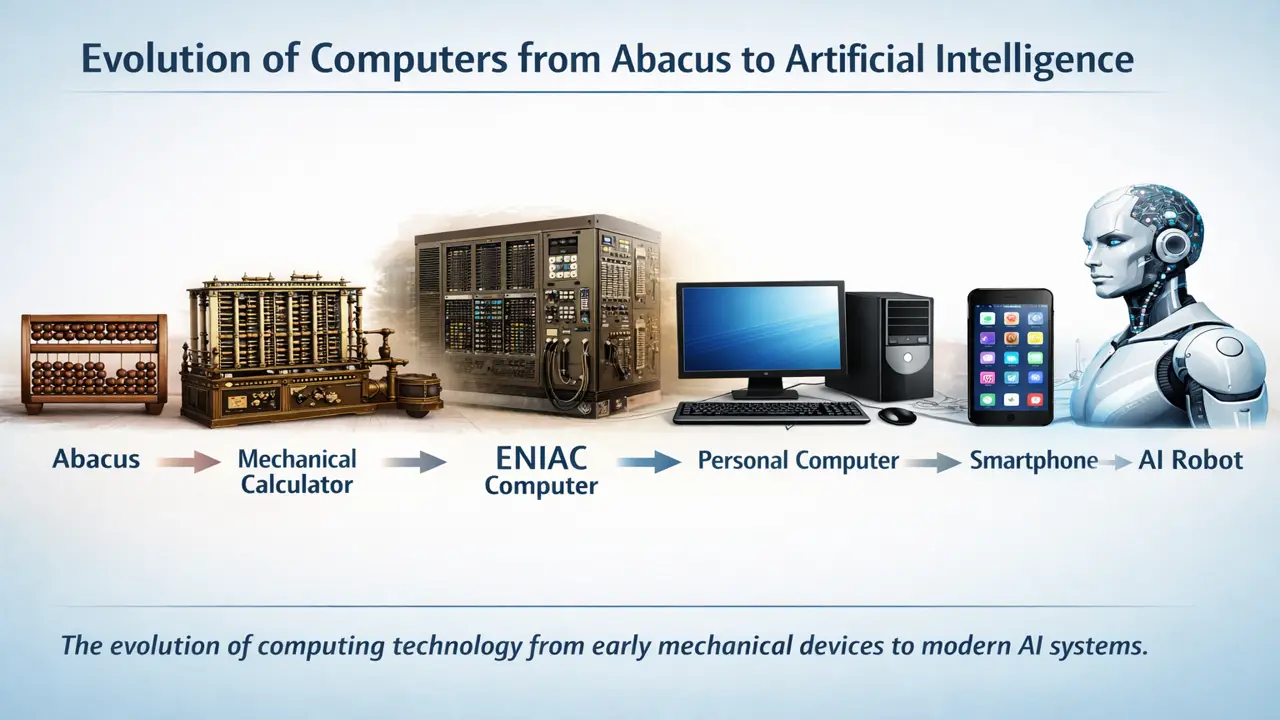
Learn the Introduction to ICT and History of Computers in simple language. Understand the four stages of computer history, evolution of computers, and generations explained for beginners.
1. Course Overview & Expectations
Welcome to Introduction to Information and Communication Technologies (ICT).
This course is designed especially for students who do not have a computer background. The aim is to build strong foundational knowledge so that every student feels confident using and understanding computer systems.
What You Will Learn in This Course
By the end of this course, you will:
- Understand basic concepts of computing
- Recognize hardware and software components
- Perform number system conversions
- Understand how networks and the internet work
- Use common computer applications effectively
What Is Expected From You?
- Attend lectures regularly
- Participate in discussions and activities
- Complete quizzes and assignments
- Engage in practical demonstrations
- Ask questions without hesitation
This course does not assume any prior knowledge. We will start from the very basics.
2. Definition of ICT (Information and Communication Technology)
What Does ICT Mean?
ICT (Information and Communication Technology) refers to all technologies used to handle telecommunications, broadcast media, intelligent building management systems, audiovisual processing, transmission systems, and network-based control and monitoring functions.
In simple words:
ICT includes all digital technologies that help us create, store, process, and communicate information.
Breaking Down the Term
- Information → Data that is processed and meaningful (text, images, videos, numbers)
- Communication → Sharing information between people or devices
- Technology → Tools and systems used to perform tasks
Examples of ICT in Daily Life
- Smartphones
- Computers and laptops
- Internet and Wi-Fi
- Email and social media
- Online banking
- Video conferencing (Zoom, Google Meet)
- E-learning platforms
ICT is not just computers it includes the entire digital communication ecosystem.
3. Why ICT Is Important
ICT plays a major role in:
Education
- Online classes
- Digital libraries
- Learning management systems
Business
- Online transactions
- E-commerce
- Data management systems
Healthcare
- Electronic medical records
- Telemedicine
Government
- E-governance
- Digital identity systems
Personal Life
- Social networking
- Online shopping
- Digital entertainment
ICT has transformed how society works.
4. Four Stages of Computer History
The development of computers did not happen overnight. It evolved over centuries. We can divide computer history into four major stages.
Stage 1: Pre-Mechanical Age (Before 1450)
This was the earliest stage of computing.
Key Characteristics:
- Manual calculation tools
- No electricity
- Human-operated devices
Important Developments:
- Abacus (around 3000 BC) – Used for counting and basic arithmetic
- Early numbering systems (Roman numerals, Hindu-Arabic system)
The Abacus is considered one of the earliest computing devices.
Stage 2: Mechanical Age (1450–1840)
Machines were introduced to assist calculations.
Key Inventions:
- Pascaline (1642) – Invented by Blaise Pascal
- Stepped Reckoner (1672) – Invented by Leibniz
- Analytical Engine (1837) – Designed by Charles Babbage
Charles Babbage is known as the “Father of the Computer.”
Ada Lovelace, who worked on the Analytical Engine, is considered the first computer programmer.
These machines used gears and mechanical parts.
Stage 3: Electromechanical Age (1840–1940)
Electricity began to play a role.
Major Developments:
- Telegraph (communication breakthrough)
- Telephone (Alexander Graham Bell)
- Punch card systems (Herman Hollerith)
- Early tabulating machines
Punch cards were used to store and process information.
Stage 4: Electronic Age (1940–Present)
This is the modern computing era.
Key Innovations:
- Vacuum tubes (First generation computers)
- Transistors
- Integrated Circuits
- Microprocessors
This stage led to the development of:
- Personal computers
- Laptops
- Smartphones
- Supercomputers
- Artificial Intelligence systems
5. Evolution from Mechanical to Modern Computers
Let us understand how computers evolved step by step.
First Generation (1940–1956)
- Used vacuum tubes
- Very large in size
- Consumed high electricity
- Example: ENIAC
Second Generation (1956–1963)
- Used transistors
- Smaller and faster
- More reliable
Third Generation (1964–1971)
- Used integrated circuits
- Reduced size further
- Improved speed and efficiency
Fourth Generation (1971–Present)
- Use microprocessors
- Personal computers introduced
- Internet development
- Mobile devices
Fifth Generation (Present & Future)
- Artificial Intelligence
- Machine Learning
- Robotics
- Quantum Computing
Computers have become:
- Smaller
- Faster
- Cheaper
- More powerful
6. Key Differences: Early vs Modern Computers
| Feature | Early Computers | Modern Computers |
|---|---|---|
| Size | Room-sized | Hand-held |
| Speed | Slow | Extremely fast |
| Storage | Very limited | Massive storage |
| Cost | Very expensive | Affordable |
| Accessibility | Limited | Worldwide access |
Summary
This lecture introduced students to the basic concept of Information and Communication Technology (ICT) and explained how technology is used to create, store, process, and share information. Students learned about the four main stages in the history of computers, starting from early manual tools like the abacus to modern digital computers and artificial intelligence systems. The session also discussed how computers evolved over time, becoming smaller, faster, and more powerful. This lecture provides a foundation for understanding how modern computing technology developed and why it is important in today’s world.