
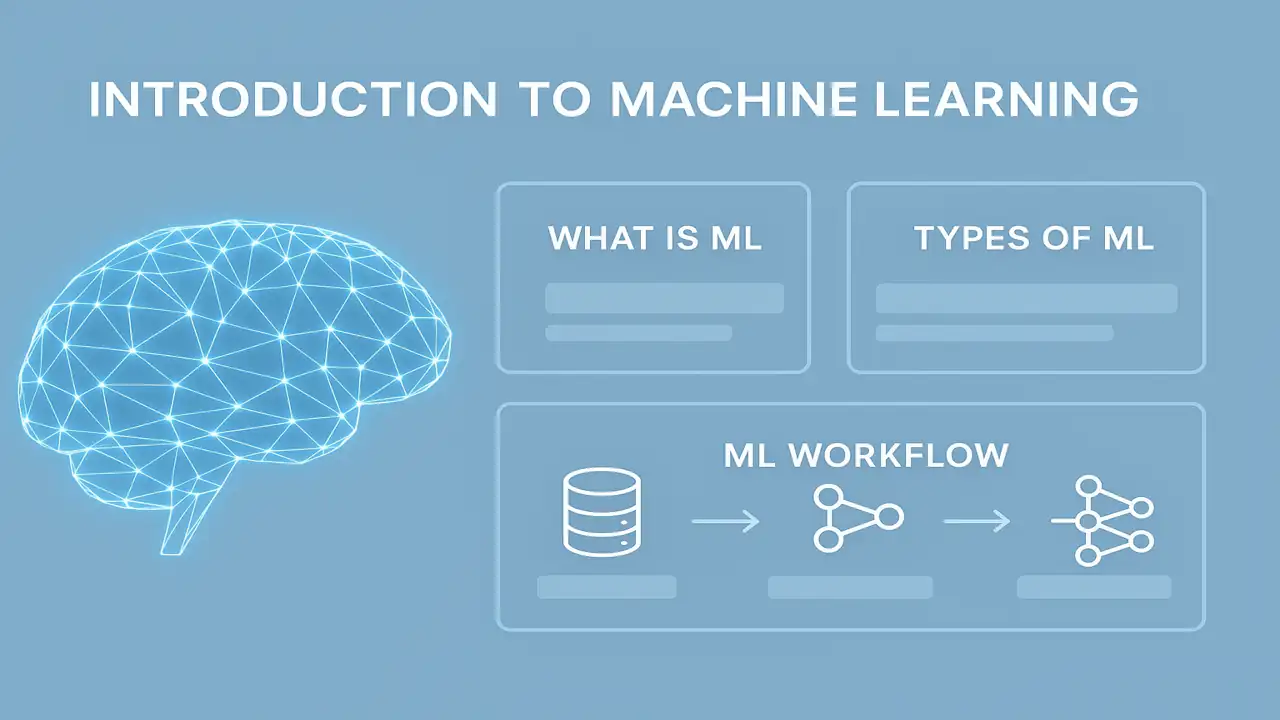
Machine Learning (ML) has become one of the most transformative technologies of the modern world. From medical diagnosis and fraud detection to self-driving cars and large language models (LLMs), ML powers systems that learn from data and improve over time. This lecture provides a comprehensive, zero-to-advanced introduction to ML, its types, and practical applications designed for students who want a strong foundation before moving into advanced algorithms.
What is Machine Learning?
Machine Learning is a subfield of Artificial Intelligence (AI) that enables computers to learn patterns from data and make decisions or predictions without being explicitly programmed for each task.
Formal Definition
Machine Learning is the study of algorithms that automatically improve through experience (data).
Intuitive Explanation
Traditional programming requires a programmer to write all rules manually.
Machine Learning discovers those rules on its own by studying examples.
Traditional Programming:
Rules + Input → Output
Machine Learning:
Input + Output → Learns the Rules
This makes ML ideal for problems where rules are too complex to define manually, such as face recognition, sentiment analysis, medical prediction, and recommendation systems.
Machine Learning vs Artificial Intelligence vs Deep Learning
These three terms are often confused, but each has a specific meaning:
Artificial Intelligence (AI)
AI is the broad field of creating intelligent machines that can think, reason, and act like humans. ML is a subset of AI.
Machine Learning (ML)
ML focuses on systems that learn from data and improve automatically.
Deep Learning (DL)
Deep Learning is a specialized branch of ML that uses artificial neural networks with multiple layers. Deep Learning handles complex, high-dimensional data such as images, audio, text, and video.
Hierarchy:
AI → ML → Deep Learning
Why Machine Learning Matters Today
Machine Learning is essential because modern systems generate massive volumes of data far beyond what humans can process manually. ML transforms this raw data into:
- Predictions
- Classifications
- Recommendations
- Insights
- Automation
This makes ML a core part of industries such as healthcare, robotics, security, finance, retail, and autonomous systems.
If you are new to AI, read our foundational guide on
Basics of Artificial Intelligence
to understand how ML fits into the broader field.
Types of Machine Learning
Machine Learning is generally divided into three main categories: Supervised, Unsupervised, and Reinforcement Learning. Each category serves a different purpose and solves different types of problems.
1. Supervised Learning
Supervised Learning trains a model using labeled data meaning each training example includes both input features and a known output.
Applications
- Email spam detection (spam / not spam)
- Disease prediction (cancer / no cancer)
- Credit risk scoring
- Price forecasting
- Image classification
Two Types of Supervised Learning
- Classification → Predict categories
(e.g., whether a tumor is benign or malignant) - Regression → Predict continuous numeric values
(e.g., predicting house prices)
2. Unsupervised Learning
Unsupervised Learning trains models using unlabeled data, meaning no predefined outputs exist. The goal is to discover hidden patterns and structure.
scikit-learn official documentation https://scikit-learn.org/
Applications
- Customer segmentation
- Grouping similar documents
- Anomaly detection
- Pattern discovery in datasets
- Recommendation systems
Common Algorithms
- K-Means Clustering
- Hierarchical Clustering
- PCA (Principal Component Analysis)
- Autoencoders
3. Reinforcement Learning
Reinforcement Learning (RL) is based on the concept of learning through interaction. An agent interacts with an environment, takes actions, receives rewards or penalties, and learns an optimal strategy.
Applications
- Self-driving cars
- Robotics navigation
- Game-playing AI (Chess, Go, Atari)
- Industrial automation
- Recommendation tuning
Core Concepts
- Agent learner
- Environment world around it
- Action step taken by agent
- Reward feedback
- Policy strategy
Real-World Applications of Machine Learning
Machine Learning is deeply embedded in almost every digital system today. Here are some major domains where ML plays a critical role:
1. Healthcare
- Early cancer detection
- Disease classification
- Drug discovery
- MRI scan analysis
- Patient risk prediction
ML models outperform doctors in many narrow diagnostic tasks due to their ability to detect subtle patterns.
2. Finance
- Fraud detection
- Stock movement prediction
- Credit scoring algorithms
- Loan risk analysis
- Algorithmic trading
Banks rely heavily on ML for decision-making and customer risk management.
3. Robotics and Automation
- Robotic vision
- Path planning
- Object recognition
- Autonomous warehouse robots
Reinforcement learning powers real-time movement optimization.
4. Large Language Models (LLMs) and NLP
Technologies like ChatGPT and Gemini are built on deep learning transformers.
Applications:
- Text generation
- Translation
- Summarization
- Chat interfaces
- Code generation
LLMs represent the frontier of modern ML.
5. Transportation
- Self-driving cars
- Traffic flow prediction
- Route optimization
- Real-time lane detection
ML enables safety-critical automation across transportation systems.
Practical Example Predicting House Prices
Let’s consider a classic supervised learning problem.
Objective:
Predict the price of a house using its features.
Input Features (X):
- Area (sq. ft)
- Number of bedrooms
- Location zip code
- Age of the house
- Distance to city center
Output (Y):
- House price (in USD)
How the Model Learns
- The model studies hundreds or thousands of past real estate records.
- It identifies mathematical correlations:
- Larger houses → higher prices
- Better locations → significantly higher prices
- More rooms → moderate increase in price
- After training, the model can estimate the price of any new house.
This demonstrates how ML converts past data into actionable predictions.
Summary
Machine Learning is the backbone of modern intelligent systems. Understanding its fundamentals including its categories, workflow, and real-world impact creates a strong foundation for more advanced topics such as decision trees, neural networks, support vector machines, clustering algorithms, and reinforcement learning strategies.
This lecture sets the stage for exploring deeper mathematical principles and practical implementations throughout the course.
People also ask:
The main goal of Machine Learning is to enable computers to learn patterns from data and make accurate predictions or decisions without being explicitly programmed for every task.
Artificial Intelligence is a broad concept of creating intelligent systems, while Machine Learning is a subset of AI focused on learning from data. Deep Learning is a specialized branch of ML using neural networks.
The three major types are:
- Supervised Learning (uses labeled data)
- Unsupervised Learning (discovers patterns in unlabeled data)
- Reinforcement Learning (learns through reward-based interactions)
Machine Learning is used in healthcare (disease prediction), finance (fraud detection), transportation (self-driving cars), e-commerce (recommendation systems), and Large Language Models like ChatGPT and Gemini.
A common example is predicting house prices using features like area, rooms, and location. The model studies past sales data, learns price patterns, and predicts the price of a new house.