


Software is the invisible engine of the modern world powering phones, cars, and entire industries. This Week 1 guide introduces the nature of software, the origins of Software Engineering, and why structured development replaced chaotic coding. You will find clear definitions, historical context, and the essential roles of software engineers.
Introduction
Software is everywhere in your smartphone, car, ATM, and even medical equipment. But have you ever wondered how these complex systems are built without falling apart? That’s where Software Engineering comes in.
Software Engineering is the systematic approach to designing, developing, testing, and maintaining software applications. Unlike simple programming, it applies engineering principles to ensure software is reliable, efficient, and scalable.
Nature of Software
Software isn’t like physical products. You can’t touch or see its components yet it runs the digital world.
Software is:
- Intangible: It exists as code and logic, not as a physical object.
- Engineered, not manufactured: Software development depends on design, logic, and human creativity rather than mechanical production.
- Subject to change: Software constantly evolves through updates, bug fixes, and upgrades.
Example: Think about your mobile apps they’re updated regularly to fix bugs or add new features. That’s part of the software evolution process.
Why Software Engineering Is Needed
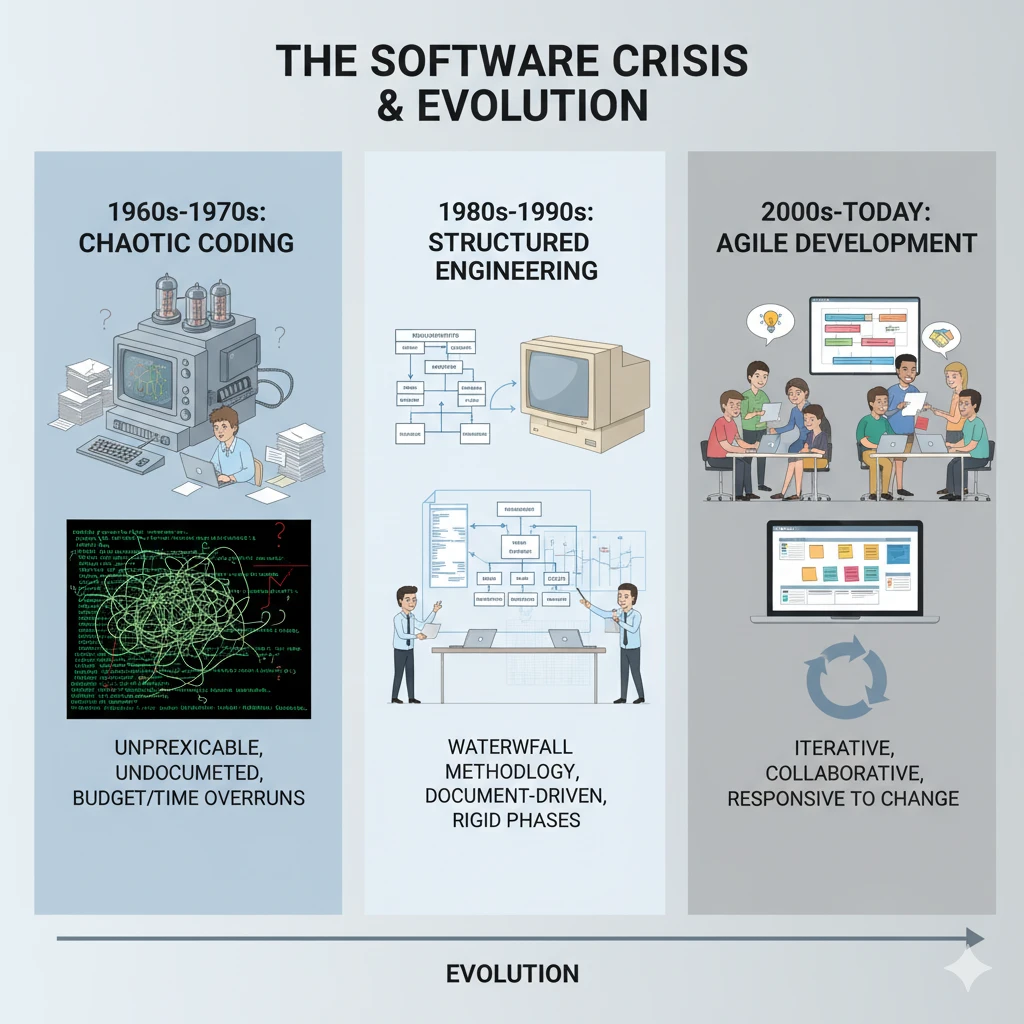
Before the 1970s, software was developed with little planning. As systems grew complex, developers faced what became known as the “Software Crisis.”
This crisis occurred because:
- Projects exceeded budgets and deadlines
- Programs were difficult to maintain or extend
- Systems often failed to meet user needs
To overcome this, the discipline of Software Engineering emerged combining programming with management, design, testing, and documentation.
What Software Engineers Do
Software Engineers don’t just write code they solve problems, model systems, and ensure product quality.
Their main roles include:
- Analyzing requirements to understand what users need
- Designing architectures for scalable and maintainable systems
- Developing and testing software using best practices
- Maintaining and evolving software post-release
They combine creativity and logic to bring digital products to life from mobile apps to enterprise systems.
Key Characteristics of Good Software
A well-engineered software system is:
- Maintainable – easy to modify when requirements change.
- Reliable – performs correctly under all conditions.
- Efficient – optimized for performance and memory use.
- Usable – easy for users to understand and operate.
- Secure – resistant to unauthorized access or failures.
The approach followed at E Lectures reflects both academic depth and easy-to-understand explanations.
Summary
This lecture laid the foundation of Software Engineering its definition, importance, and how it transformed from chaotic coding to a structured engineering discipline.
Next, we’ll dive into the Software Process Models that guide every successful project.
People also ask:
Software Engineering is the disciplined way of building reliable and efficient software using structured methods and tools.
Programming focuses on writing code, while Software Engineering covers the entire lifecycle from planning and design to testing and maintenance.
Every sector depends on software. Engineering principles ensure that software systems are scalable, secure, and sustainable over time.
Winston W. Royce is often credited for introducing structured development models, including the early concept of the waterfall model.
- Software Engineering by Ian Sommerville (10th Edition)
- Software Engineering: A Practitioner’s Approach by Pressman & Maxim (8th Edition)