
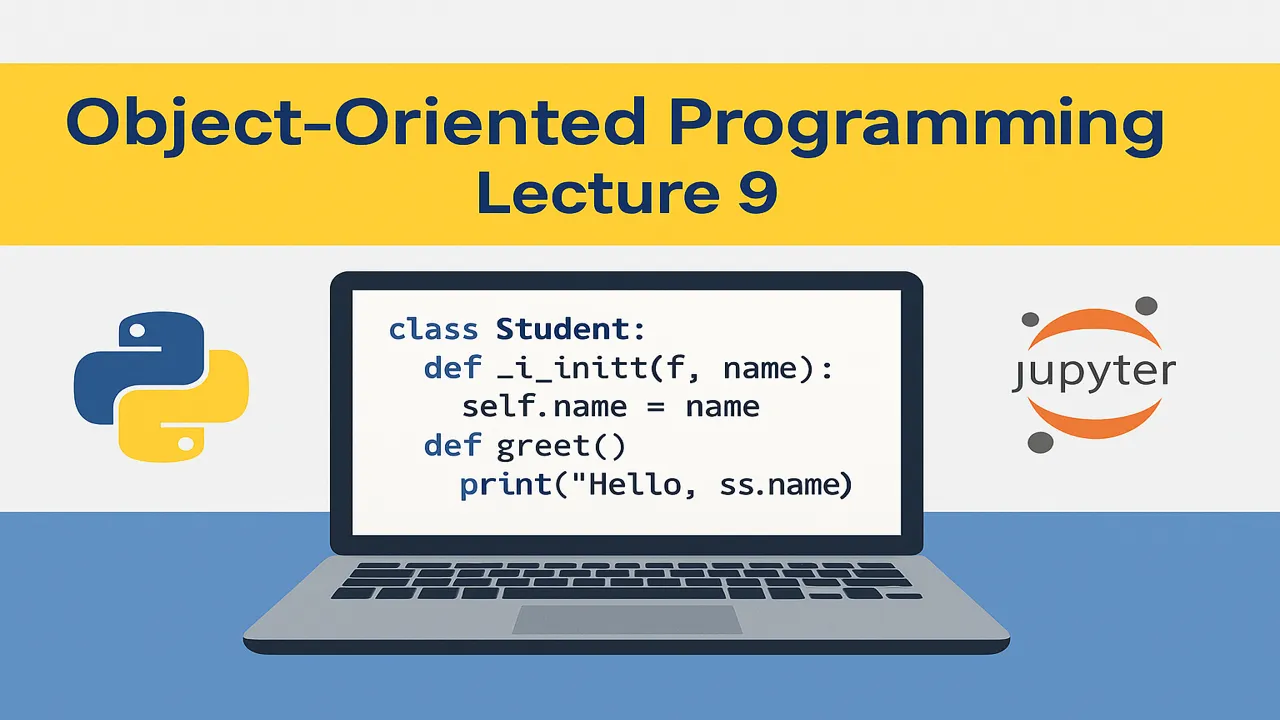
Learn Object-Oriented Programming in Python with Lecture 9. Understand classes, objects, constructors, methods, inheritance, and real-world examples. Beginner-friendly and Data Science focused.
What You Will Learn
After completing this lecture, you will be able to:
- Understand Object-Oriented Programming (OOP) concepts
- Create classes and objects
- Use constructors (
__init__) - Define methods
- Understand attributes
- Apply inheritance
- Relate OOP to real-world & Data Science problems
- Solve MCQs and practice questions
1) What is Object-Oriented Programming (OOP)?
OOP is a programming style based on real-world objects.
Real-world examples:
- Student
- Car
- Bank Account
- Laptop
Each object has:
- Properties (data)
- Actions (functions)
Python supports OOP to make code:
Organized
Reusable
Easy to manage
Scalable for large projects
2) Class – Blueprint of an Object
A class is like a blueprint.
Example:
class Student:
    pass
This defines a class named Student.
3) Object – Instance of a Class
An object is created from a class.
Example:
class Student:
    pass

s1 = Student()
print(s1)
4) Class with Attributes
class Student:
    name = "Tahir"
    age = 21

s1 = Student()
print(s1.name)
print(s1.age)
Lecture 8 – Modules and Packages in Python
5) Constructor (__init__ method)
The constructor runs automatically when an object is created.
Example:
class Student:
    def __init__(self, name, age):
        self.name = name
        self.age = age

s1 = Student("Tahir", 21)
s2 = Student("Sara", 20)

print(s1.name, s1.age)
print(s2.name, s2.age)
6) Methods (Functions inside a Class)
class Student:
    def __init__(self, name, marks):
        self.name = name
        self.marks = marks

    def display(self):
        print("Name:", self.name)
        print("Marks:", self.marks)

s = Student("Tahir", 95)
s.display()
7) Real-Life Example – Bank Account
class BankAccount:
    def __init__(self, owner, balance):
        self.owner = owner
        self.balance = balance

    def deposit(self, amount):
        self.balance += amount

    def withdraw(self, amount):
        self.balance -= amount

    def show_balance(self):
        print("Balance:", self.balance)

acc = BankAccount("Tahir", 5000)
acc.deposit(2000)
acc.withdraw(1000)
acc.show_balance()
The Python Tutorial- Documentation Classes
8) Inheritance (VERY IMPORTANT)
Inheritance allows a class to reuse another class.
Parent Class:
class Person:
    def __init__(self, name):
        self.name = name

    def greet(self):
        print("Hello", self.name)
Child Class:
class Student(Person):
    def __init__(self, name, roll_no):
        super().__init__(name)
        self.roll_no = roll_no

s = Student("Tahir", 101)
s.greet()
print(s.roll_no)
9) Data Science Example Using OOP
Dataset Object
class Dataset:
    def __init__(self, values):
        self.values = values

    def mean(self):
        return sum(self.values) / len(self.values)

    def maximum(self):
        return max(self.values)

data = Dataset([10, 20, 30, 40])
print("Mean:", data.mean())
print("Max:", data.maximum())
10) Another Example – Employee System
class Employee:
    def __init__(self, name, salary):
        self.name = name
        self.salary = salary

    def annual_salary(self):
        return self.salary * 12

e = Employee("Sara", 50000)
print(e.annual_salary())
Quiz – Test Your Understanding
Instruction: First read the question and choose your answer. Then scroll down to see the correct answer
What is a class?
a) Object
b) Blueprint
c) Function
d) Variable
Answer: b) Blueprint
Which method runs automatically?
a) main
b) start
c) init
d) __init__
Answer: d) __init__
Inheritance is used to:
a) Delete code
b) Repeat code
c) Reuse code
d) Hide data
Answer: c) Reuse code
What does self represent?
a) Class
b) Method
c) Current object
d) Variable
Answer: c) Current object
Practice Questions
Instruction for students: Read the question, open your Jupyter Notebook, and try to solve it yourself. After that, come back and check the answer.
class Car:
    def __init__(self, brand, year):
        self.brand = brand
self.year = yeardef display(self):
print(self.brand, self.year)class ElectricCar(Car):
passclass Model:
def accuracy(self, correct, total):
return correct / total