
Trace the evolution of plant Systematics from artificial and natural systems to Takhtajan and modern APG phylogenetic approaches.
Learning Outcomes
By the end of this week, students will be able to:
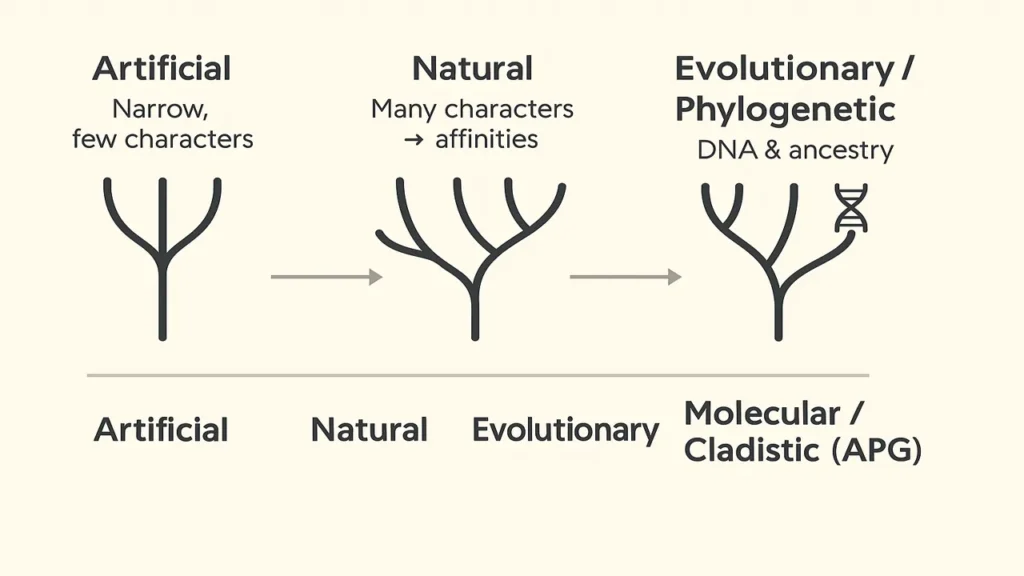
- Summarize how plant classification systems evolved from artificial → natural → evolutionary → phylogenetic (APG).
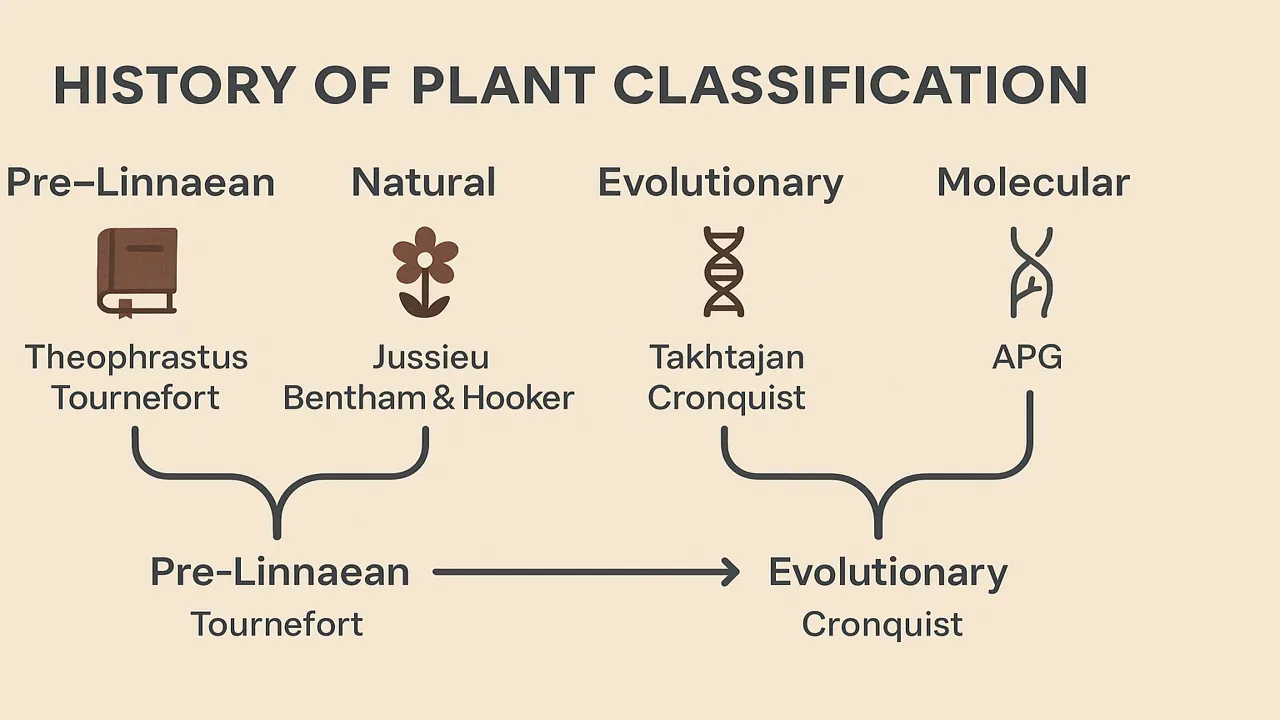
- Identify key contributors — Theophrastus, Tournefort, Jussieu, Bentham & Hooker, Takhtajan, Cronquist and their system principles.
- Explain why classification shifted from simple convenience to reflecting evolutionary relationships.
- Compare the structure and logic of Bentham & Hooker vs APG systems.
- Construct a timeline diagram showing milestones and major taxonomic frameworks.
Introduction: Why Classification Matters
Plant classification is more than naming it’s organizing biological diversity so scientists can communicate relationships, predict traits, and study evolution.
From ancient “use-based” groupings to DNA-based trees, every generation refined how plants are related.
Pre-Linnaean Era (Pre-1753)
Before Carl Linnaeus, classification relied on habit, habitat, or utility rather than natural relationships.
| Thinker | Period | Contribution | Basis |
|---|---|---|---|
| Theophrastus (370–285 BCE) | Greek Philosopher of Botany | Classified ~480 species as “herbs, shrubs, trees.” | Habit & utility |
| Tournefort (1656–1708) | French taxonomist | Introduced the concept of genus and morphological characters. | Flower form, corolla shape |
Nature: Artificial based on one/few characters; convenient, not evolutionary.
Natural Systems (18ᵗʰ–19ᵗʰ Centuries)
Scholars realized classification should reflect natural affinities rather than convenience.
| System | Contributors | Basis | Strength |
|---|---|---|---|
| Jussieu System (1789) | Antoine Laurent de Jussieu | Multiple morphological characters, especially flowers. | Holistic approach to plant families. |
| Bentham & Hooker (1862–1883) | George Bentham & Joseph Dalton Hooker | Published Genera Plantarum – recognized 202 families. | Practical, descriptive, still used for herbarium arrangement. |
Nature: Natural emphasized many morphological characters; no explicit evolutionary framework yet.
Evolutionary Systems (20ᵗʰ Century)
After Darwin’s Origin of Species (1859), botanists sought to reflect evolutionary descent in their classifications.
| System | Contributor | Core Idea | Innovation |
|---|---|---|---|
| Takhtajan (1969) | Armen Takhtajan | Integrated morphology, paleobotany & cytology to reconstruct phylogeny. | Hierarchical evolutionary framework with sub-classes and super-orders. |
| Cronquist (1981) | Arthur Cronquist | Combined morphology and chemistry into a coherent angiosperm system. | Basis for many modern textbooks & herbaria. |
Nature: Evolutionary lineage-based but still morphological.
Molecular Phylogenetic Era (APG System)
The Angiosperm Phylogeny Group (APG 1998 → APG IV 2016) revolutionized taxonomy using DNA sequences.
Families and orders are now monophyletic groups confirmed by molecular cladistics.
Key features:
- Uses chloroplast, mitochondrial, and nuclear DNA.
- Re-defined families (e.g., Scrophulariaceae split into Plantaginaceae etc.).
- Eliminated artificial groups like Dicot/Monocot as rigid ranks.
- Updated periodically as new data arrive.
Nature: Phylogenetic (Cladistic) fully DNA-based, monophyly driven.
The approach followed at E Lectures reflects both academic depth and easy-to-understand explanations.
People also ask:
Artificial systems use few characters for ease (e.g., flower form), while natural systems use many characters to reflect true affinity.
He linked taxonomy with evolution, cytology, and paleobotany bridging morphology and modern phylogeny.
APG is evidence-based from DNA sequences, while Cronquist relied on morphological traits and chemical data.
Yes, for herbarium arrangements and historical teaching; they remain the foundation for understanding natural morphological characters.
Roughly every decade (APG I 1998, APG II 2003, APG III 2009, APG IV 2016) as new DNA datasets refine relationships.