Why is Brassicaceae also called Cruciferae?
Week 7 – Diagnostic Families I: Brassicaceae & Fabaceae Key Characters & Economic Value
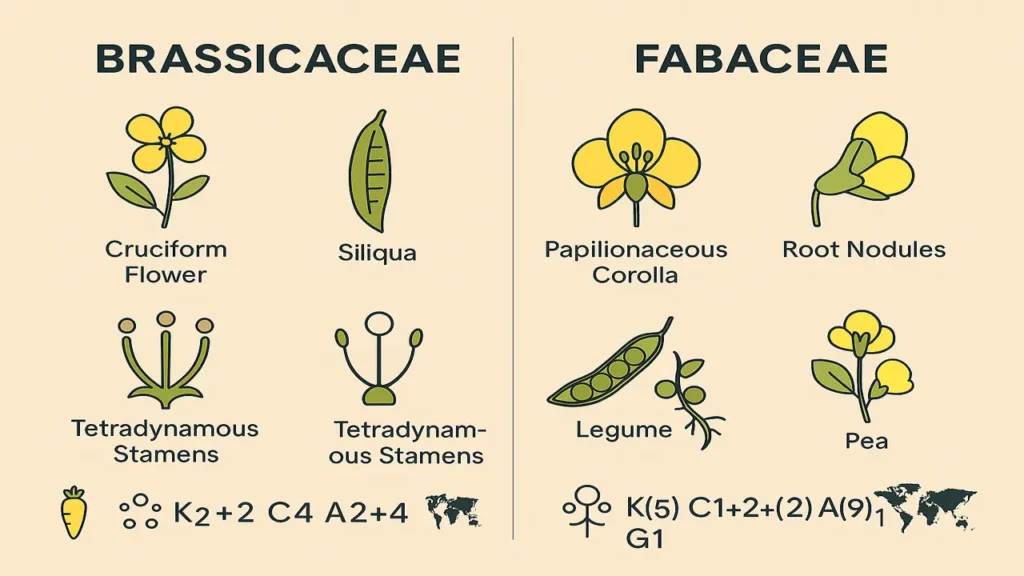
Brassicaceae and Fabaceae family morphology diagnostic characters, economic importance, floral diagrams, and dichotomous key lab practice.
Learning Outcomes
By the end of this week, students will be able to:
- Recognize diagnostic morphological and floral characters of Brassicaceae and Fabaceae.
- Interpret family-level features using dichotomous keys.
- Prepare and label floral diagrams for mustard and legume flowers.
- Evaluate the economic significance and global distribution of both families.
- Summarize key traits for field identification in “Family Fact Cards.”
Brassicaceae (Cruciferae)
Key Characteristics:
- Habit: Mostly annual or biennial herbs.
- Leaves: Alternate, simple, exstipulate; often form rosettes.
- Inflorescence: Raceme or corymb.
- Flower: Actinomorphic, bisexual, complete.
- Calyx: 4 sepals (2 outer + 2 inner).
- Corolla: 4 petals arranged in a cross (cruciform).
- Androecium: Tetradynamous (4 long + 2 short stamens).
- Gynoecium: Bicarpellary, syncarpous; ovary superior, placentation parietal.
- Fruit: Siliqua or silicule.
Floral Formula:⚥ K2+2 C4 A2+4 G(2)
Examples: Brassica campestris (mustard), Raphanus sativus (radish).
Economic Importance: Vegetables (cabbage, cauliflower), oilseeds (mustard), condiments (radish), and ornamental (Alyssum).
Distribution: Cosmopolitan, most diverse in temperate regions.
Fabaceae (Leguminosae)
Key Characteristics:
- Habit: Herbs, shrubs, or trees; root nodules with nitrogen-fixing bacteria.
- Leaves: Alternate, pinnate compound, stipulate.
- Inflorescence: Raceme, head, or solitary axillary.
- Flower: Zygomorphic, bisexual, papilionaceous corolla (standard, wings, keel).
- Calyx: 5 sepals, united.
- Corolla: 5 petals vexillary aestivation.
- Androecium: Diadelphous (9 fused + 1 free).
- Gynoecium: Monocarpellary; ovary superior, marginal placentation.
- Fruit: Legume or pod.
- Seed: Non-endospermic, rich in protein.
Floral Formula:⚥ K(5) C1+2+(2) A(9)+1 G1
Examples: Pisum sativum (pea), Cajanus cajan (pigeon pea), Trifolium (clover).
Economic Importance: Pulses, fodder, timber, green manure, gum, and medicinal plants.
Distribution: Widespread in tropical and subtropical regions.
Week 6 – Morphology II: Inflorescence, Flower, Placentation & Fruit
Economic Snapshot
| Family | Major Products | Economic Uses |
|---|---|---|
| Brassicaceae | Mustard, Cabbage, Cauliflower | Oil, Vegetables, Spices |
| Fabaceae | Pea, Beans, Clover, Acacia | Food, Fodder, Timber, Soil Enrichment |
The approach followed at E Lectures reflects both academic depth and easy-to-understand explanations.
People also ask:
Because its petals form a cross-shaped (cruciform) arrangement, hence “Cruciferae” meaning “cross-bearing.
Fabaceae” is the modern name under APG; “Leguminosae” was its older name based on characteristic fruit type the legume.
It helps distinguish members easily by their 6 stamens (4 long, 2 short), a diagnostic feature.
A unique petal arrangement with a large standard (vexillum), two wings, and two fused keel petals typical of peas and beans.
Through root nodules housing Rhizobium bacteria that fix atmospheric nitrogen.