
Morphology focus: inflorescence, flower structure, placentation & fruit types floral formulae, lab dissections, and a Week 1–6 quiz recap.
Learning Outcomes
By the end of this week, students will be able to:
- Classify types of inflorescence based on arrangement and development.
- Identify the floral parts (calyx, corolla, androecium, gynoecium) and their modifications.
- Describe major placentation types in ovaries and their evolutionary significance.
- Differentiate types of fruits and seeds based on origin and morphology.
- Construct and interpret floral formulae and diagrams from live specimens.
- Apply morphological terminology in the Quiz 1 (Weeks 1–6) assessment.
Inflorescence The Flowering Unit
An inflorescence is the arrangement of flowers on a stem. It helps in pollination efficiency and aesthetic diversity.
Major Categories
| Type | Key Characteristic | Example |
|---|---|---|
| Racemose | Indeterminate growth; youngest flower at tip | Mustard, Gulmohar |
| Cymose | Determinate growth; oldest flower at tip | Jasmine, Ixora |
| Specialized | Modified for protection or showy display | Spadix (Arum), Capitulum (Sunflower), Cyathium (Euphorbia) |
Racemose Subtypes
- Simple raceme – elongated axis (Radish)
- Spike – sessile flowers (Achyranthes)
- Catkin – pendulous, unisexual (Mulberry)
- Umbel – equal pedicels from one point (Onion)
- Corymb – lower pedicels longer (Candytuft)
Flower Morphology
A flower is a modified shoot bearing reproductive organs.
Four Floral Whorls
| Whorl | Description | Example Function |
|---|---|---|
| Calyx (Sepals) | Green, protective | Encloses bud |
| Corolla (Petals) | Colored, attractive | Pollinator lure |
| Androecium (Stamens) | Male organs | Pollen production |
| Gynoecium (Carpels) | Female organs | Ovule protection |
Floral Symmetry
- Actinomorphic – Radially symmetrical (Hibiscus)
- Zygomorphic – Bilaterally symmetrical (Pea)
Week 5 – Morphology I: Root, Stem & Leaf Forms & Adaptations
Floral Formula (Example: Hibiscus)
⚥ K(5) C5 A∞ G(5)
(Perfect flower, fused sepals, 5 petals, many stamens, 5 fused carpels)
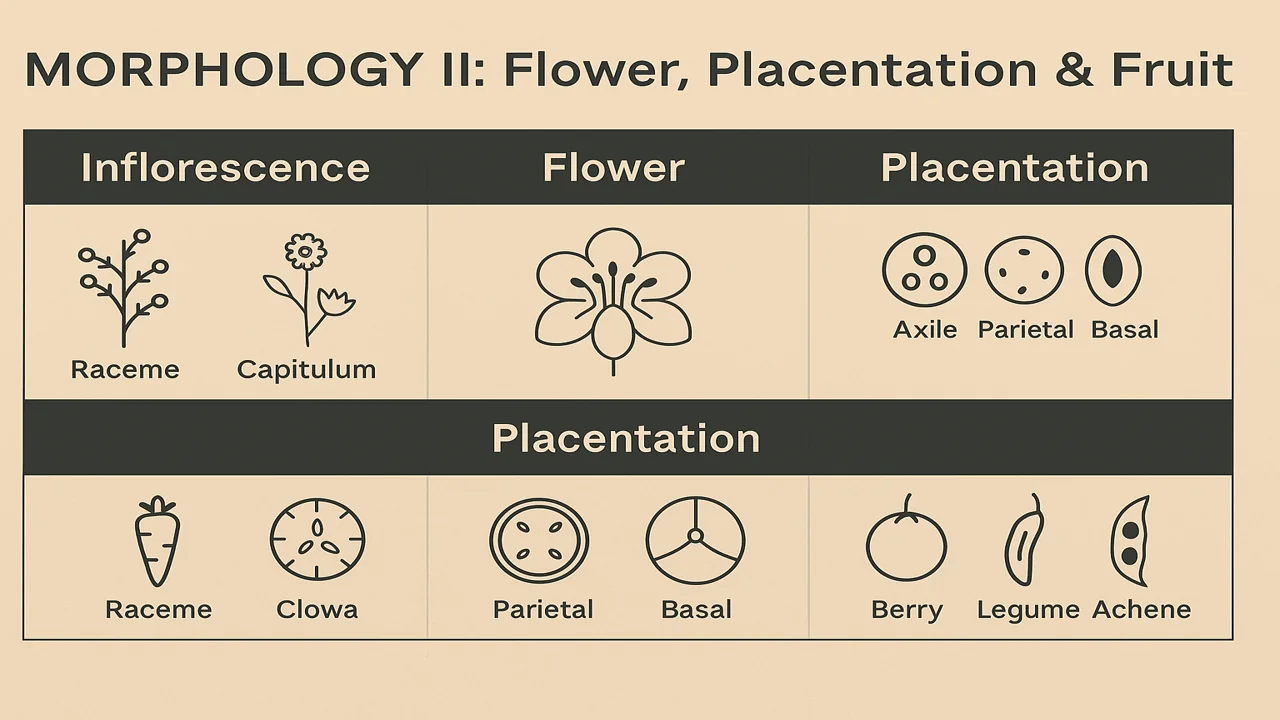
Placentation Ovule Arrangement in the Ovary
| Type | Description | Example |
|---|---|---|
| Marginal | Along ventral suture of ovary | Pea |
| Axile | Central axis divides locules | Tomato, Lemon |
| Parietal | On ovary walls | Mustard |
| Basal | Single ovule at base | Sunflower |
| Free Central | Ovules on free central column | Dianthus |
Placentation patterns reflect evolutionary divergence and fertilization strategy.
Fruit The Mature Ovary
A fruit develops from the ovary after fertilization (true fruit) or with accessory parts (false fruit, e.g., Apple).
Classification
| Type | Origin | Examples |
|---|---|---|
| Simple | One flower, one ovary | Mango, Tomato |
| Aggregate | One flower, many carpels | Strawberry |
| Multiple/Composite | Inflorescence → fruit | Pineapple, Fig |
| Dry dehiscent | Splits to release seeds | Pea, Cotton |
| Dry indehiscent | Does not split | Maize, Sunflower |
| Fleshy | Juicy pericarp | Orange, Apple |
Seed types:
- Monocot one cotyledon (Maize)
- Dicot two cotyledons (Bean)
The approach followed at E Lectures reflects both academic depth and easy-to-understand explanations.
People also ask:
Racemose inflorescences grow indefinitely with younger flowers at the top, while cymose inflorescences end in a flower and show older flowers at the top.
Observe cross-section of the ovary; note ovule attachment points central (axile), walls (parietal), or base (basal).
A fruit derived from ovary plus other floral parts (e.g., apple from thalamus).
Memorize symbols: ⚥ (bisexual), K (calyx), C (corolla), A (androecium), G (gynoecium); note bracketed parts for fusion.
Their structure determines dispersal mechanism, classification clues, and economic uses.