
Root, stem, and leaf morphology their forms, modifications, venation, phyllotaxy, and adaptive significance with comparative lab sections.
Learning Outcomes
By the end of this week, students will be able to:
- Identify the basic organs root, stem, and leaf and their characteristic forms.
- Differentiate major modifications and explain their adaptive value.
- Describe leaf venation and phyllotaxy patterns with examples.
- Interpret anatomical hand sections of dicot and monocot stems & leaves.
- Prepare labeled drawings illustrating internal and external morphological traits.
Root Form & Modifications
Types of Root Systems
| Type | Origin | Examples | Remarks |
|---|---|---|---|
| Taproot | From radicle (primary root persistent) | Mustard, Carrot | Typical of dicots |
| Fibrous | From stem base (radicle dies) | Wheat, Maize | Typical of monocots |
| Adventitious | From parts other than radicle | Grass, Ivy | Common in climbers |
Root Modifications and Functions
| Function | Modification | Example |
|---|---|---|
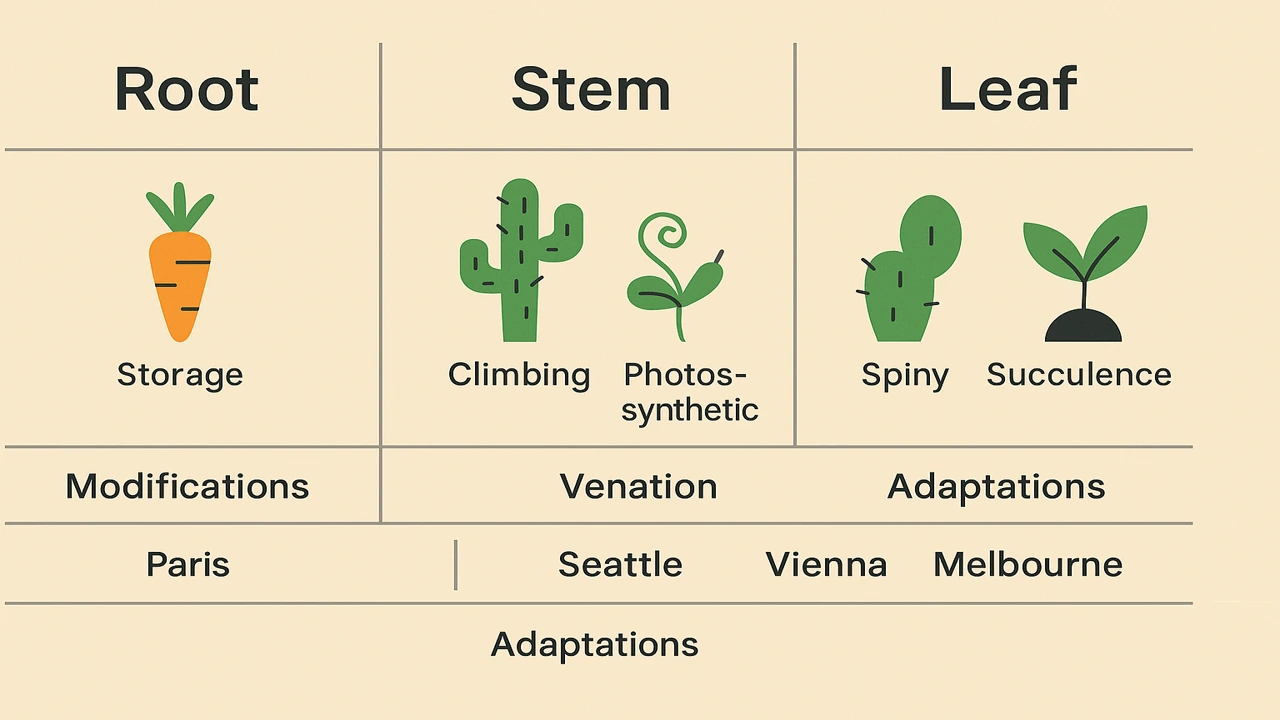
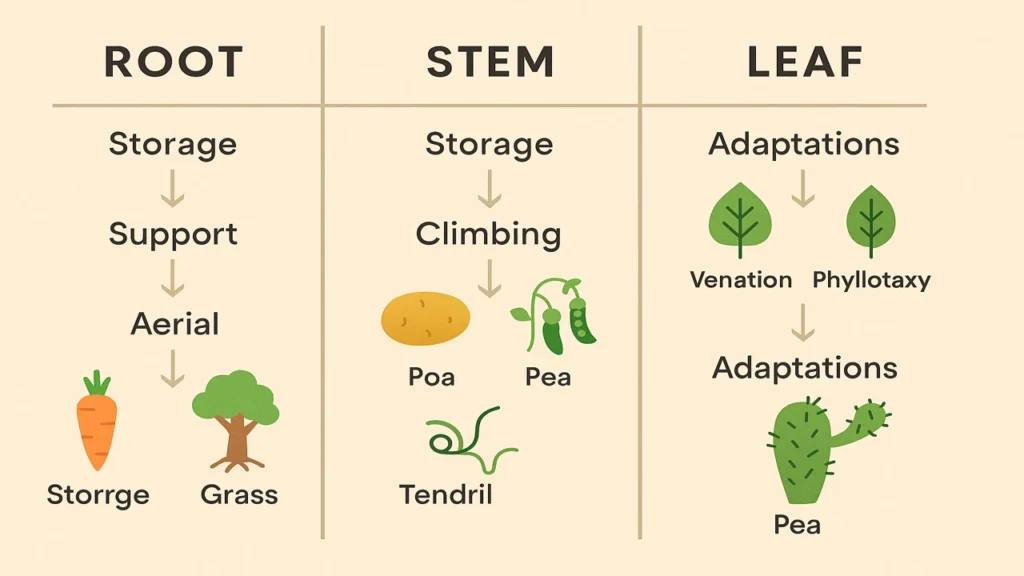
| Storage | Conical, Napiform, Fusiform | Carrot, Turnip, Radish |
| Support | Prop roots, Buttress roots | Banyan, Bombax |
| Climbing | Clinging roots | Betel, Pothos |
| Respiration | Pneumatophores | Avicennia |
| Assimilation | Photosynthetic roots | Tinospora |
| Parasitic suction | Haustorial roots | Cuscuta |
Stem Structure & Modifications
Basic Functions
- Support & conduction of water/food
- Storage and propagation
- Photosynthesis and climbing adaptations
Stem Modifications
| Type | Function | Examples |
|---|---|---|
| Underground | Storage & perennation | Rhizome (Ginger), Tuber (Potato), Bulb (Onion) |
| Sub-aerial | Vegetative propagation | Runner (Strawberry), Stolon (Mint) |
| Aerial | Support/Protection/Photosynthesis | Tendrils (Pea), Thorns (Bougainvillea), Phylloclades (Opuntia) |
Week 4 – Nomenclature & ICN in Plant Systematics (Vienna Code Lineage)
Leaf Form, Venation & Phyllotaxy
Parts of a Typical Leaf
- Lamina broad flat portion
- Petiole stalk connecting to stem
- Stipules leaf-base appendages
Venation Types
| Type | Description | Example |
|---|---|---|
| Reticulate | Net-like veins | Peepal (dicot) |
| Parallel | Veins run parallel | Maize (monocot) |
Phyllotaxy (Arrangement of Leaves)
| Type | Description | Example |
|---|---|---|
| Alternate | One leaf per node | Sunflower |
| Opposite | Two leaves per node | Guava |
| Whorled | More than two per node | Alstonia |
Leaf Adaptations
- Tendrils for climbing (Pea)
- Spines for protection (Cactus)
- Succulent leaves for water storage (Aloe vera)
- Insectivorous nutrition adaptation (Nepenthes, Drosera)
The approach followed at E Lectures reflects both academic depth and easy-to-understand explanations.
People also ask:
To adapt to environmental needs like storage, climbing, support, or defense—morphological changes ensure survival and reproduction.
In dicots, vascular bundles form a ring and show secondary growth; in monocots, bundles are scattered and closed.
A stem tuber it has nodes, buds (“eyes”), and can sprout, proving its stem origin.
They reduce surface area or become spines (e.g., Cactus) to minimize water loss.
In plants like Tinospora, roots become green and photosynthetic to compensate for reduced foliage.