
How plant names are formed under the International Code of Nomenclature (Vienna Code) binomial system, types, priority, authorship, and valid publication rules.
Learning Outcomes
By the end of this lecture, students will be able to:
- Explain the purpose and principles of botanical nomenclature within the ICN.
- Define and apply key concepts binomial system, type method, priority, authorship, ranks, and valid publication.
- Interpret a scientific name’s citation and the meaning of its author abbreviations.
- Recognize the hierarchy of taxonomic ranks and their naming conventions.
- Draft a mock diagnosis and etymology for a “new species” using ICN style.
- Detect and correct invalid names in a set of specimen descriptions.
What Is Botanical Nomenclature?
Botanical nomenclature is the set of rules and recommendations governing how plants are scientifically named and cited.
It is formalized in the International Code of Nomenclature for algae, fungi and plants (ICN), previously known as the International Code of Botanical Nomenclature (ICBN).
The Code ensures that:
- Each plant has one accepted, unique name globally.
- Names are stable and traceable through type specimens and publication records.
- Changes follow transparent rules, not personal preference.
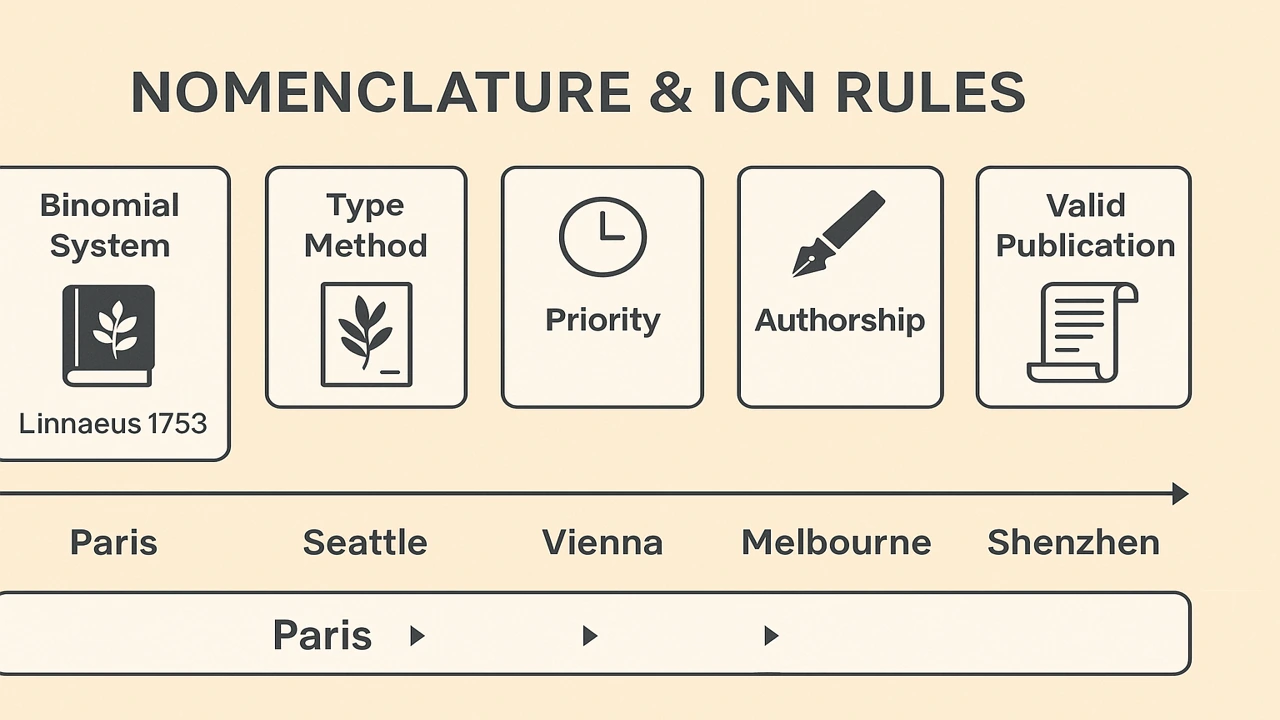
Evolution of the ICN (Vienna Lineage)
The ICN has been refined at international botanical congresses since 1905.
Each major revision is named after the city where it was adopted (Paris, Stockholm, Seattle, Tokyo, Vienna, Melbourne, Shenzhen).
| Edition (Congress) | Year | Key Change |
|---|---|---|
| Paris Code | 1954 | Introduced modern principles of priority and type method clarification. |
| Seattle Code | 1969 | Formalized rules for hybrids and conservation of names. |
| Vienna Code | 2005 | Digital publication standards; refined authorship and type citation. |
| Melbourne Code | 2011 | Allowed electronic publication and English diagnoses. |
| Shenzhen Code | 2017 | Introduced DOI citations and further clarified rank formats. |
The Vienna Code (2005) remains a milestone for its precision in types, priority rules, and authorship clarity.
Core Principles of ICN
Binomial System (Linnaeus 1753)
Every species has a two-part Latin name:
- Genus (capitalized, italicized)
- Specific epithet (lowercase, italicized)
Example: Rosa indica L. (where “L.” = Linnaeus)
Type Method
Each name is tied to a type specimen that anchors its application.
Types may be holotype, lectotype, neotype, syntype etc.
Priority Principle
The earliest validly published name (after 1 May 1753 for vascular plants) is the correct one, unless a later name is conserved for stability.
Week 3 – Classification Systems of Plant Systematics: From Pre-Linnaean to Takhtajan and APG
Authorship and Citation
Author abbreviations follow the species name: Solanum tuberosum L. (= Linnaeus).
If a species is transferred to another genus, the original author appears in parentheses: Brassica oleracea (L.) Mill.
Ranks
Hierarchical levels recognized by ICN:
Kingdom → Division → Class → Order → Family → Genus → Species → Subspecies/Variety/Form.
Suffix rules for key ranks:
- Family:
-aceae(e.g., Rosaceae) - Order:
-ales(e.g., Rosales) - Class:
-opsidaor-phyceae(for algae)
Valid Publication
For a name to be validly published, it must:
- Be effectively published (in a recognized medium).
- Be accompanied by a diagnosis (description) in Latin (or English post-2012).
- Indicate a type specimen.
- Follow ICN format rules.
Reading a Protologue
A protologue is the original description and publication where a name first appears.
It includes:
- Diagnostic features
- Habitat and location
- Collector details and type designation
- Author’s notes and illustrations
Being able to read a protologue helps verify the validity and priority of names in taxonomic research.
The approach followed at E Lectures reflects both academic depth and easy-to-understand explanations.
People also ask:
ICBN was the older name; ICN now covers plants, algae, and fungi under a single code since Melbourne 2011.
Latin is a dead language stable, universal, and unchanging, avoiding regional bias or translation errors.
If it lacks a type, description, or proper publication format it violates ICN Articles 32–45.
It standardized electronic and printed formats, clarified type citations and authorship, and is a key reference for modern taxonomists.
Use the IPNI database (International Plant Names Index) for standard author abbreviations (e.g., L. = Linnaeus, Mill. = Miller).