
Plant Systematics with clear definitions, scope, character types (morphology, anatomy, palynology, molecular) and how systematics drives conservation & agriculture.
Learning Outcomes (LOs)
By the end of this lecture, students will be able to:
- Define plant systematics and distinguish it from taxonomy and nomenclature.
- Explain the scope of systematics: documenting diversity, inferring relationships, and stabilizing names via ICN.
- Describe and compare the four major character sets used in systematics: morphology, anatomy, palynology, molecular.
- Discuss applications of systematics in biodiversity, conservation planning, agriculture, forestry, and medicine.
- Operate microscopes safely and record basic observations of local flora (lab refresher).
- Critically connect systematics to society by citing five current real-world examples from news/agri/medicine.
What Is Plant Systematics?
Plant systematics is the science of understanding plant diversity and evolutionary relationships. It integrates three pillars:
- Identification recognizing and verifying plants
- Classification grouping plants into a hierarchy that reflects relationships
- Nomenclature assigning stable, universal names under the International Code of Nomenclature (ICN)
Why It Matters
Accurate names and relationships power everything from threat assessments and habitat restoration to crop breeding, pharmacognosy, and biosecurity. In short: no correct name, no correct science.
Scope of Plant Systematics
- Documenting diversity: floras, monographs, species checklists, and barcoding datasets.
- Inferring relationships: morphological matrices and phylogenomic analyses to build trees.
- Stabilizing names: applying ICN rules (type method, priority, valid publication).
- Enabling application: field keys, identification guides, and databases for policy and industry.
The Evidence Toolkit: Characters Used in Systematics
| Character type | What we examine | What it’s good for | Typical tools |
|---|---|---|---|
| Morphological | Root/stem/leaf form; inflorescence; flower; fruit | Field diagnosis; building keys | Hand lens, dissection kit |
| Anatomical | Tissues: epidermis, xylem, phloem; stomata; trichomes | Microscopic confirmation; adaptations | Compound microscope, stains |
| Palynological | Pollen size, wall pattern (exine), aperture type | Reproductive evolution; family signals | Acetolysis prep, LM/SEM images |
| Molecular | DNA regions (e.g., rbcL, matK, ITS) | Deep/cryptic relationships; dating clades | PCR, sequencing, phylogenetics |
Best practice: combine independent character sets. Congruence across lines of evidence → stronger hypotheses.
ICN at a Glance
- Binomial format: Genus species + author citation
- Type method: a name is anchored to a type specimen
- Priority: earliest validly published name is correct
- Valid publication requires description/diagnosis and a designated type
Real-World Impact: Biodiversity, Conservation & Agriculture
- Biodiversity baselines: species lists and endemism patterns guide protected-area design.
- Threat categories: precise identities feed into IUCN assessments and red lists.
- Crop improvement: wild relatives identified through systematics supply drought/pest-resistance genes.
- Invasive species & biosecurity: fast, correct identification prevents costly spread.
- Medicine & quality control: verified plant sources reduce adulteration in herbal products.
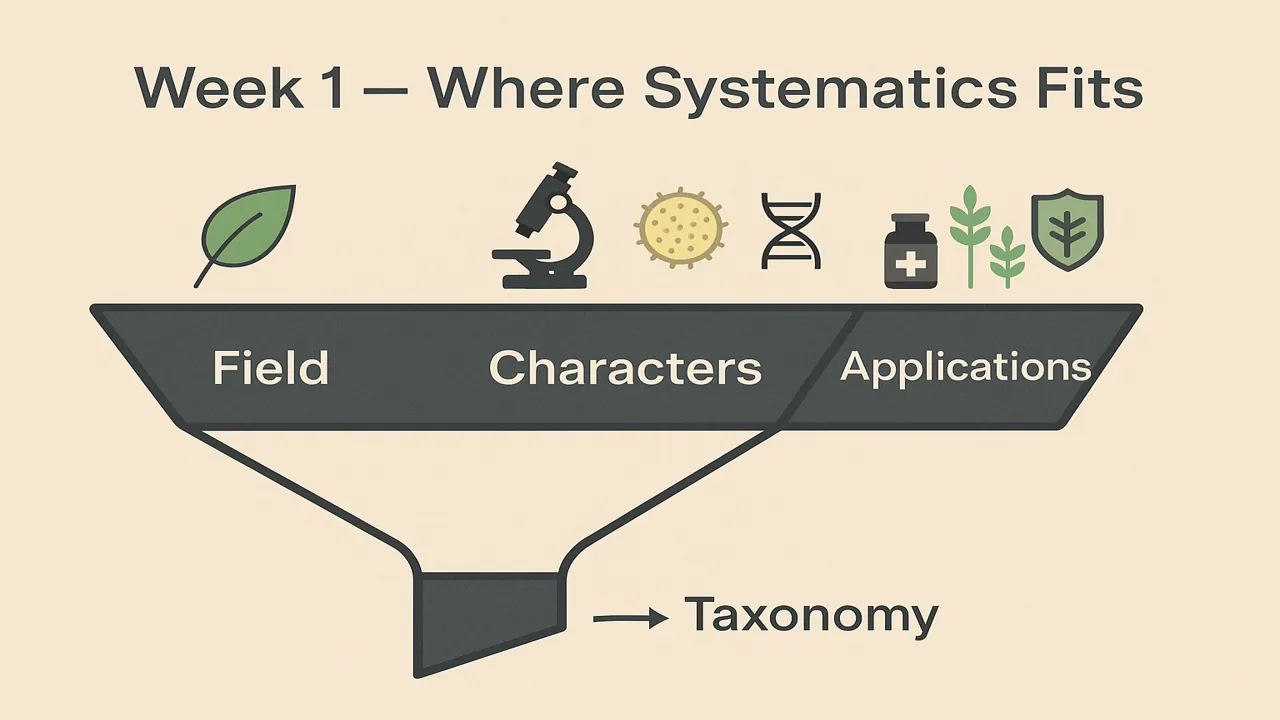
Where Systematics Fits
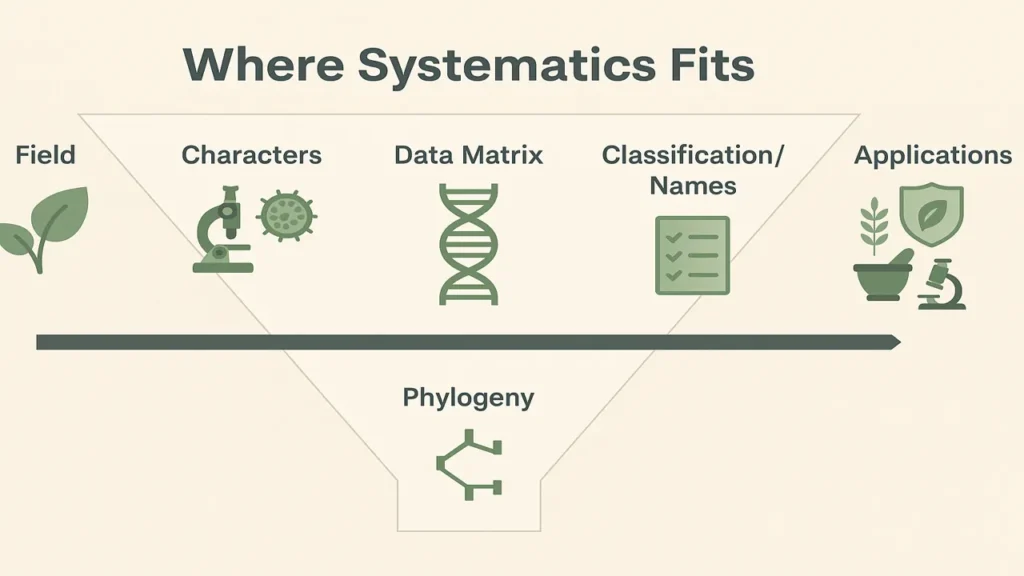
The approach followed at E Lectures reflects both academic depth and easy-to-understand explanations.
People also ask:
Taxonomy (description, naming, classification) is a subset of systematics. Systematics additionally tests evolutionary relationships using multiple evidence lines.
Latin names are universal and regulated by ICN; common names vary by region and can map to many different species.
Both are powerful together. Integrative datasets (morphology + molecules + anatomy + palynology) produce the most stable classifications.
Chloroplast rbcL and matK, nuclear ITS are common starting points; many studies now use phylogenomics (hundreds/thousands of loci).
It clarifies what species exist, where they occur, and how they’re related—inputs essential for red-listing, restoration, and corridor design.
10× hand lens, pocket field key, simple dissecting kit, and a phone/camera for geo-tagged photos.